

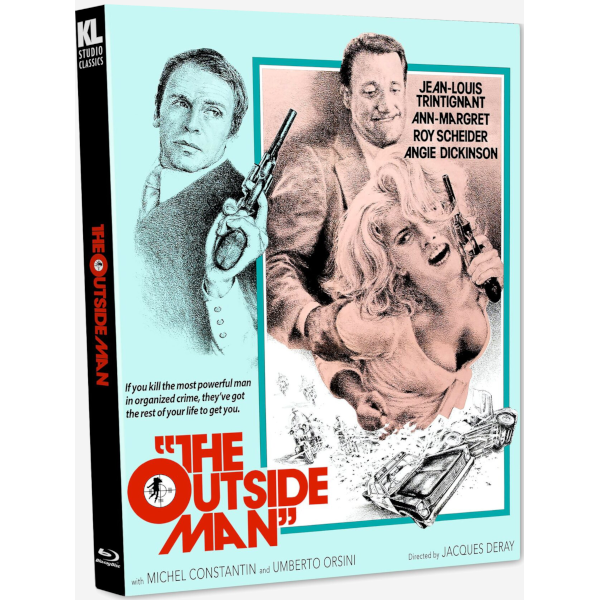

The French give out a yearly award called the Jacques Deray Prize, for the best French crime thriller of the year. Not rated as on the same level as Jean-Pierre Melville or Jacques Becker, the Lyon-borne Jacques Deray nevertheless scored consistently with continental action films, often starring Alain Delon or Jean-Paul Belmondo. His sexy murder thriller La piscine with Delon and Romy Schneider was rediscovered a few years back, but his best-known film here remains the retro gangster tale Borsalino. The success of Borsalino surely led United Artists to extend an offer for Deray to come to America, with 1972’s The Outside Man.

The film’s English-language title is unmemorable, and the alternate French title Un homme est mort sounds too generic. The Italian title Funerale a Los Angeles is at least descriptive. Credited to the veterans Jean-Claude Carriére and Ian McLellan Hunter, the screenplay plays with the standard gangland betrayal template, as does John Boorman’s Point Blank but without the psychedelic trimmings. Filmed in a plain-wrap style that emphasizes real locations, Outside Man shows two killers blasting their way across The City of The Angels, from the Sunset Strip to Culver City to Venice Beach. It’s a travelogue snapshot of L.A., taken by a Frenchman dazzled by the chrome on the cars, the plastic advertising and the never-ending freeways. Deray captures the look of our motels and supermarkets — and several iconic places that have since been torn down.
The casting choices are all over the map.
The French production was after international marquee appeal. Some of its casting is spot-on perfect, but a few choices seem counterproductive. Jean-Louis Trintignant turns in one of his near-deadpan, mostly non-verbal performances. He reportedly did not speak English, and learned his lines phonetically. Also from France comes the crime film veteran Michel Constantin. Mostly unknown here, Constantin could pass for Gene Barry’s evil brother. Italian Umberto Orsini is only okay as a treacherous mobster; he generates little interest. The capable Ann-Margret, Roy Scheider and Angie Dickinson lead the American contingent. Michel Legrand’s jazzy main theme would be at home in a blaxsploitation saga.
Like a lot of things in the show, the film’s opening scenes are explained only after the fact. A U.S. mobster in need of a killer turns to a French associate, the way old-time gangsters hired ‘out of town’ hit men to maintain plausible deniability. Newly arrived from Paris, Lucien Bellon (Trintignant) checks into the Beverly Wilshire Hotel and proceeds to ‘Crest Hill Drive’ in Beverly Hills. There he guns down top L.A. mobster Victor Kovacs (Ted de Corsia of The Naked City and The Killing). Victor’s wife Jackie and son Alex (Angie Dickinson & Umberto Orsini) give a false description of the hit man to LAPD detective Anderson (Felice Orlandi of Bullitt). The Kovacs heirs have plenty to hide. Almost immediately, Lucien Bellon realizes that his own murder is part of the plan as well. A Detroit hit man named Lenny (Roy Scheider) misses his first shot, but stays close on Bellon’s trail.

The truth is that Bellon took the job to clear up a ‘pay or die’ gambling debt to his Parisian bookie Antoine (Michel Constantin) — a friend who nevertheless can’t let him off the hook. Lucien may be an amateur, but he strategizes like a pro. He repeatedly evades the persistent Lenny, outrunning both the law and the mob.
Lucien Bellon kidnaps single mother Mrs. Barnes (Georgia Engel of The Mary Tyler Moore Show) and spends a few hours hiding in her apartment with her son Eric (young Jackie Earle Haley of Breaking Away and Watchmen). Bellon makes contact with topless waitress Nancy Robson (Ann-Margret), who helps him get a passport. Fed up with her situation — Alex and Jackie Kovacs took away her nightclub — Nancy sticks with Lucien and drops hints that she’d like to return with him to France. But he remains aloof to her attempts to get romantic.
Lucien decides that he can’t run back to Paris, because the mob can track him down wherever he goes. ‘Plan B’ is to stay in L.A. and go on the offensive. Nancy is horrified when the ‘crazy frog’ purposely lets Jackie and Lenny know his whereabouts. Lucky for Lucien, his bookie Antoine is not part of the double-cross. Furious at Alex Kovacs’ betrayal, Antoine and an associate arrive from France just as Detective Anderson realize that Jackie and Alex were not bystanders in the assassination. The final showdown plays out at Victor Kovacs’ funeral service.

The ruins of P.O.P. amusement pier; the ‘canals’ of Venice; the Collonade from Touch of Evil.
It’s always fun seeing how foreign directors embrace the ‘light and space’ of Los Angeles. After Paris or London, our megalopolis must seem a sprawling ‘nowheresville’ drowned in advertising, TV and smog. Notable contemporaries that took the plunge (and Hollywood $$) were Jacques Demy and Michelangelo Antonioni. The POV of a foreigner is always welcome. Jean-Louis Trintignant cruises through a Los Angeles turned into a shooting gallery, while we enjoy a Time Machine trip back to the year 1972.
Unlike some L.A. based pictures, the cars on view reflect what people would drive. Bellon rents a Lincoln, but one of his stolen vehicles is an unexciting 1971 Buick Skylark. Nancy’s ride is a beat-up classic pink Thunderbird. Bellon is almost trapped on the crumbling ruins of the Pacific Ocean Park amusement pier, which in just a couple of years will be erased from Venice Beach. Police cars vault the Venice Canal bridges and Roy Scheider spins out on a Wilshire Blvd. freeway offramp.
But most of the locations are L.A.-generic, like the faceless motel — back in the day, a lot of down-market student apartments looked like those motels. Ann-Margret’s obligingly sweet topless waitress Nancy keeps a rendezvous with Bellon in an incredibly scuzzy topless bar. Sorry kids, we don’t see Nancy at work, even in this ‘continental’ cut. When they need to escape, a nude dancer shows them the rear exit, and accompanies them all the way to the sidewalk.

LAX; Tower Records; downtown bridge; The Sunset Strip after dark.
The odd encounters continue. Lucien Bellon and little Eric pass the time by watching TV’s Star Trek together. They get along fine until Bellon catches Eric listening in on a telephone conversation. Bellon then meets a motorcycle gang in the parking lot of the long-gone Tower Records. Lenny’s second ambush attempt is fumbled when Lucien picks up a Hollywood hitchhiker who tries to convert him to Jesus.
With the aid of their henchman Miller (Alex Rocco of The Godfather), Jackie and Alex have initiated a palace coup. The noir element intrudes when we realize that the city and the Kovacs mob ‘have business together.’ Speaking for his LAPD superiors at Parker Center, Felice Orlandi’s Detective Anderson is mainly trying to put the lid back on this murder mess. But the running gun battles in the streets are impossible to keep quiet.
The Outside Man doesn’t oversell its cultural comments, but its ‘outsider’ POV makes fairly ordinary details seem funny. Lucien Bellon never smiles, so the friendly grin he fakes for a passport photo gets an unexpected laugh. A tall policeman / bodyguard takes little Eric to school, accidentally recreating a visual from George Lucas’s THX 1138. In a downtown bus station, the Frenchman uses a coin-fed public electric shaver, a revoltingly unsanitary device guaranteed to spread 20 kinds of diseases.

Meanwhile, the dogged Detective Anderson totes Mrs. Barnes from one homicide scene to the next, hoping she’ll recognize one of the dead bodies. Media reporters rush to obtain juicy news bites about rapes or tortures. Gloria Engel underplays beautifully. The joke is that the dead bodies really don’t bother Mrs. barnes — she begins to enjoy the attention of the TV cameras.
Hit Man Lenny is supplied with an unlikely-looking yet authentic rifle, with a barrel that flares like a funnel. Lucien Bellon escapes three times. Lenny should let someone less clumsy do the killing part of his job — he’s a great tracker but a lousy trigger man.
The storytelling style follows a ‘show, then tell’ strategy. The screenplay explains Lucien’s actions only after the fact, making us guess at what’s going on in any given scene. We eventually learn Lucien’s whole story, when he opens up to Nancy. Jacques Deray’s direction is always visually interesting, and writer Jean-Claude Carriere pulls some clever switcheroos with genre expectations. The dueling hit men business is excellent — Lucien going after Lenny is a bit like Oswald realizing he’s been double-crossed, and getting Jack Ruby first.

The show is unlike a couple of earlier Italian crime tales that were set in America but mostly filmed in Rome. Big chunks of Machine Gun McCain and They Came to Rob Las Vegas use actor doubles on California locations, and mocked up faux-California scenes back in Italy. The Outside Man appears to have been completely filmed locally. For this viewer, it’s like a trip back to my UCLA college days.
After making so many smart genre moves Outside Man goes more than a little haywire in the last reel. The mob funeral wants to be outrageous but feels like a mistake. It is not open-casket, but something surreal: the mobster’s corpse has been posed like a wax figure, sitting up and holding a cigar. The aged Ted de Corsia does a great job, sitting perfectly still in waxy makeup. Was the garish display meant as a parody of California weirdness, as in Tony Richardson’s The Loved One? If so, it’s a miscalculation that throws the fairly realistic tone off-kilter.
Jean-Louis Trintignant excels by projecting a cagey intelligence. Lucien Bellon obviously isn’t just an ordinary guy, and his actions would suggest that he already knows Los Angeles like a native. Yet we wonder if director Deray should have given him a few Fish-Out-of-Water moments.
Did Roy Scheider accept this generic bad guy part before it became clear that The French Connection would boost his star profile? It’s likely that he just wanted to work opposite Trintignant and Ann-Margret. When Lenny ambushes Nancy in her apartment, his manhandling of Ann-Margret looks pretty rough.

Ann-Margret is just delightful — her concern gives us a reason to care for Lucien Bellon, even though he doesn’t return her amorous overtures. Nancy isn’t seen at work in the topless bar, but the script gives her several sharp, frank lines of dialogue. It’s one of the better movies she made around this time, topped only by her great comeback in Carnal Knowledge.
Left somewhat adrift is Angie Dickinson, who occupies her scenes as if waiting to be directed by somebody. Her duplicitous gangland widow is little more than a walk-on. Perhaps the part was cut down? The interesting Felice Orlandi could have made a far better Alex — he looks much more like a hood than does Umberto Orsini, whose English lines appear to be dubbed.
The pleasant newcomer is Georgia Engel, who makes adds a light amusement to her charming sidebar scenes. She’s not as ditzy as her Georgette for Mary Tyler Moore’s TV shows, but the character is in the same vein. Engel should have already been recognized for her fine debut in Milo’s Forman’s Taking Off.
The film’s bit parts are stacked with interesting names. John Hillerman is a department store floorwalker and Ben Piazza (from The Hanging Tree) is a hotel clerk. Director Deray taps some actors fresh from The Godfather; in addition to Alex Rocco, we get a thin Talia Shire as a wisecracking funeral home attendant. Finally, Playboy Playmate of the Year Connie Kreski is a friendly downtown streetwalker, complete with bright hot pants. Her performance is just fine, playing off the controlled deadpan of Jean-Louis Trintignant.


Georgia, not Gloria, Engel.
Thanks, Glenn, I’ve waiting for a comprehensive review/analysis of The Outside Man. This movie (& La Piscine & Point Blank) are right up my street. Of course, the other foreign director with a POV was John Boorman. Cheers!
I really enjoyed this disc. Thanks for the review.