
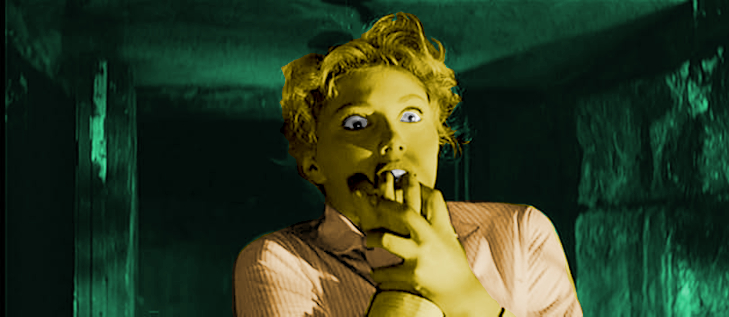
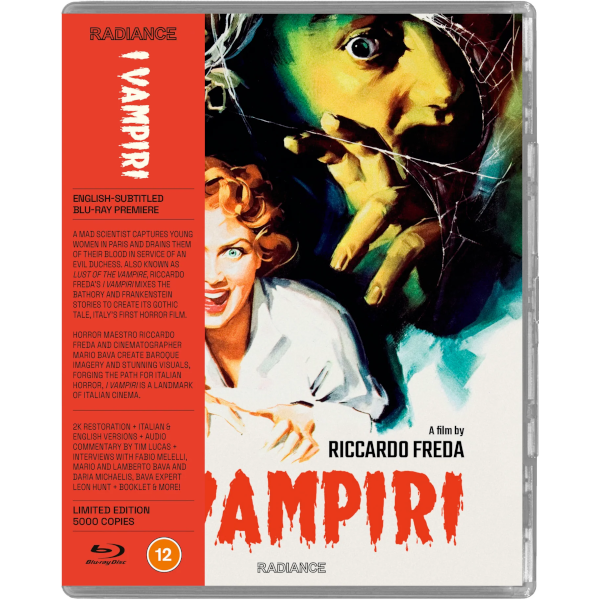

The 1950s horror boom ignited in England, with a daring Technicolor shocker that broke all the rules. Hair-splitting film historians will stipulate that the actual first Eurohorror of the decade came a month earlier, with an Italian picture. Riccardo Freda’s I Vampiri had a rocky start, for sure. Five years passed before it was released for English-speaking territories, revised with new scenes for the adults-only market. Its genre significance wasn’t acknowledged until much later than that.
More famous for what it represents than its actual merits, I Vampiri once existed only as a collection of confusing production stills and posters. A July 2001 Image DVD release satisfied the curiosity of new fans of Eurohorror than were keen to learn more about directors Riccardo Freda and Mario Bava. This new remaster by RAI TV and presented by the U.K. company Radiance gives us the original Italian-language Titanus release, plus encodings of two English language versions, revised for grindhouse distribution.
It’s a vampire movie, but with no vampires…
Good research has cleared up some of the questions behind I Vampiri — was it really a flop at the box office? Did it have any influence? The film itself doesn’t yield many clues. Tim Lucas’s new audio commentary tells the tale, explaining why the show doesn’t quite hang together.
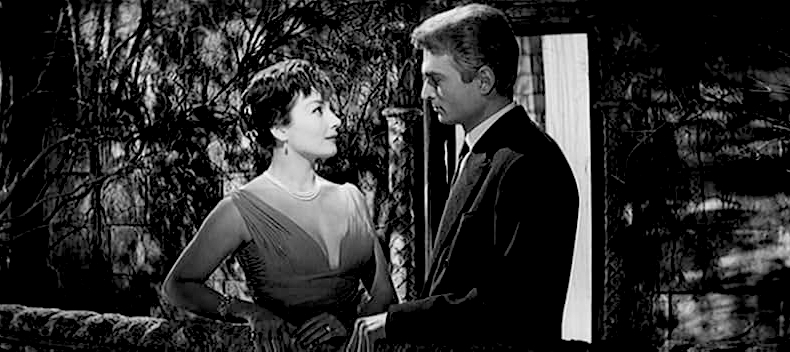
A string of murders of young women terrorizes Paris. Hoping to uncover the killer, the ambitious reporter Pierre Lantin (Dario Michaelis) irritates the Inspector Chantal (Carlo D’Angelo) by nosing about in police business. Pierre is pursued romantically by Giselle (Gianna Maria Canale), the wealthy niece of the elderly, reclusive Margherita Du Grand, a Duchess. Giselle is gorgeous but Pierre resents her attention: long ago, his father suffered a broken heart at the hands of the cruel Duchess, and Pierre doesn’t want to be hurt the same way.
Pierre thinks he has a good lead on the killer when he connects the drug addict Joseph Signoret (Paul Müller) to one of the missing girls. Warned off by Inspector Chantal and told by his editor to drop the story, Pierre instead narrows his sights on a small group of female students that fit the victims’ profile. But one of them, Laurette Robert (Wanda Guida of The Revolt of the Slaves) is kidnapped before he can interview her.
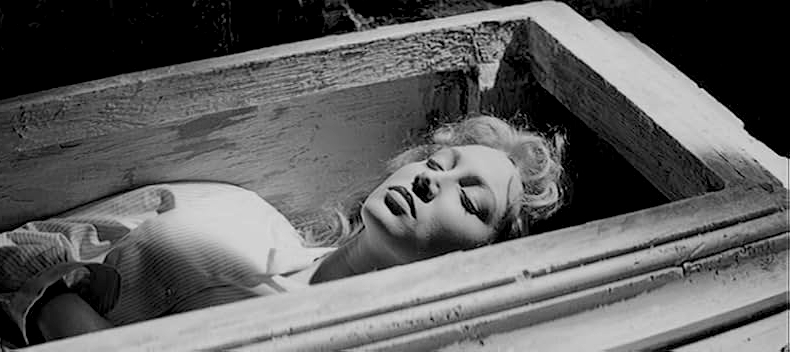
It turns out that the situation is more horrible than anyone thought possible — the ancient Castle Du Grand holds more secrets. Scientist Professor Du Grande (Antoine Balpêtré) fakes his own death, and seems capable of reviving a man from the dead. He commits atrocious crimes to maintain the beauty of a relative, a proud aristocrat.
We’re told that the original story writer Piero Regnoli had been a film critic for a Vatican publication, and that he dashed off his first plot outline in just a day or so. The final film is split between a crime investigation with Gothic trimmings, and a medical horror thriller. The ‘vampires’ are a word coined to sell newspapers.
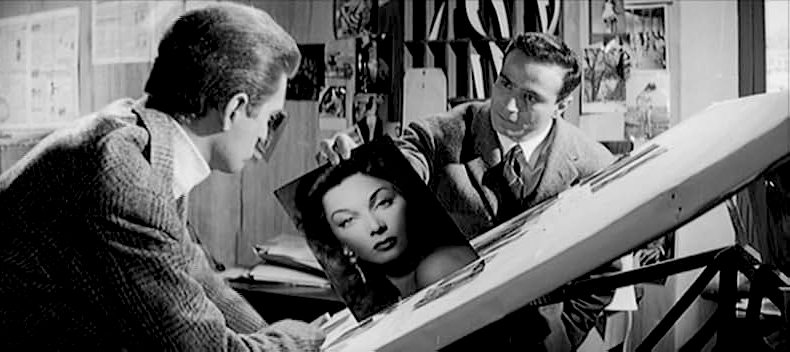
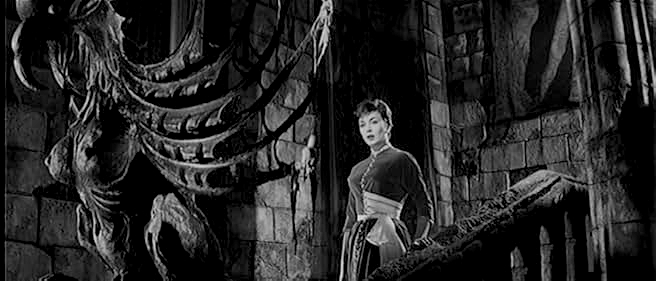
The central idea in I Vampiri is the notion of a beautiful woman who retains her beauty by stealing it from younger females, through some terrible magic. That’s basically the Countess Báthory legend, souped-up with modern medical ideas. In 1957 the notion of mixing a detective story with Gothic horror was not at all bad, but the unspooling of the mystery here is not particularly exciting. The film’s poster promises Gothic thrills and maybe a fiendish monster. I Vampiri has an impressive castle settingthat looks Gothic, but for most of its running time we’re investigating apartment blocks and following a reporter through newsrooms.
The movie wasn’t a hit in Italy, but that can’t be blamed on the lack of an established horror genre. As finished, I Vampiri doesn’t seem to know what kind of story it is telling. It never seems fully committed to horror thrills. Of the story’s four or five killings only two are shown on-screen. The female victims are kidnapped by a burly henchman and given injections of sedatives, but none of the vampiric (or in this case, medico-vampiric) attacks on them are shown.
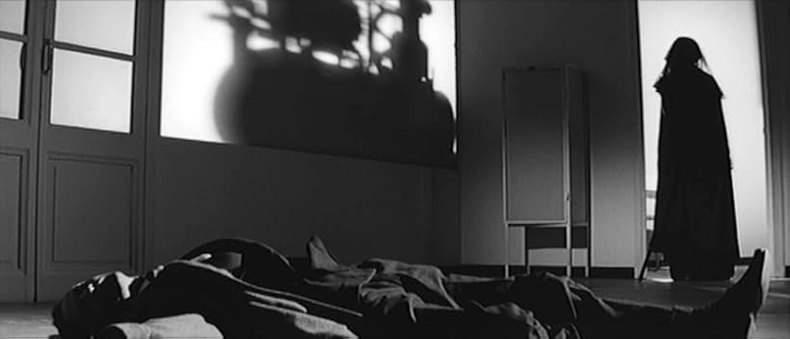
Was Italian censorship responsible for the lack of harder horror content? Even Bela Lugosi had been allowed to close in on his prey before a discreet fadeout. The only hint of what exactly is happening to these women is in dialogue references to needle marks found on their corpses. The ‘vampire’ figure’s only aggressive act is to shoot a male victim with a gun, because he breaks into her rooms to declare his love to her. Under these circumstances it’s unlikely that even Italian audiences would be aware of a vibrant new genre a’borning.
What is now obvious is that the first wave of Eurohorror that followed was more like I Vampiri than The Curse of Frankenstein. Between 1959 and 1962 there appeared thrillers about twisted medical experiments, and young women kidnapped and murdered to restore another woman’s youth, or to repair her face or body — in Italy, France, Spain, and Germany.
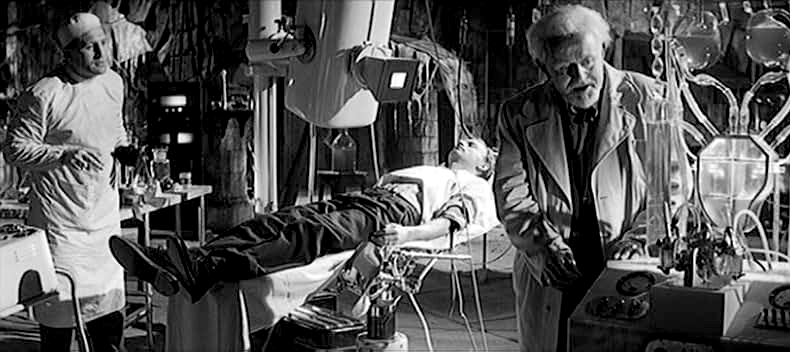
Despite its CinemaScope camerawork and some elaborate sets and art direction for the core scenes in Le Château Du Grand, the original Italian version meanders around its subject matter. Much of the dialogue is bald character exposition, with people explaining their backgrounds, and often the exact psychology behind their actions. The reporter Pierre has an assistant, that with no warning suddenly decides that he needs to make a daring romantic play for the icy Giselle Du Grand. She responds by explaining, in full, her personal vendetta against Pierre. The drug addict Joseph Signoret is apparently killed in one scene. He is simply seen lying around Professor Du Grand’s mad lab — until we suddenly see scars on his neck indicating Frankenstein-like experiments.
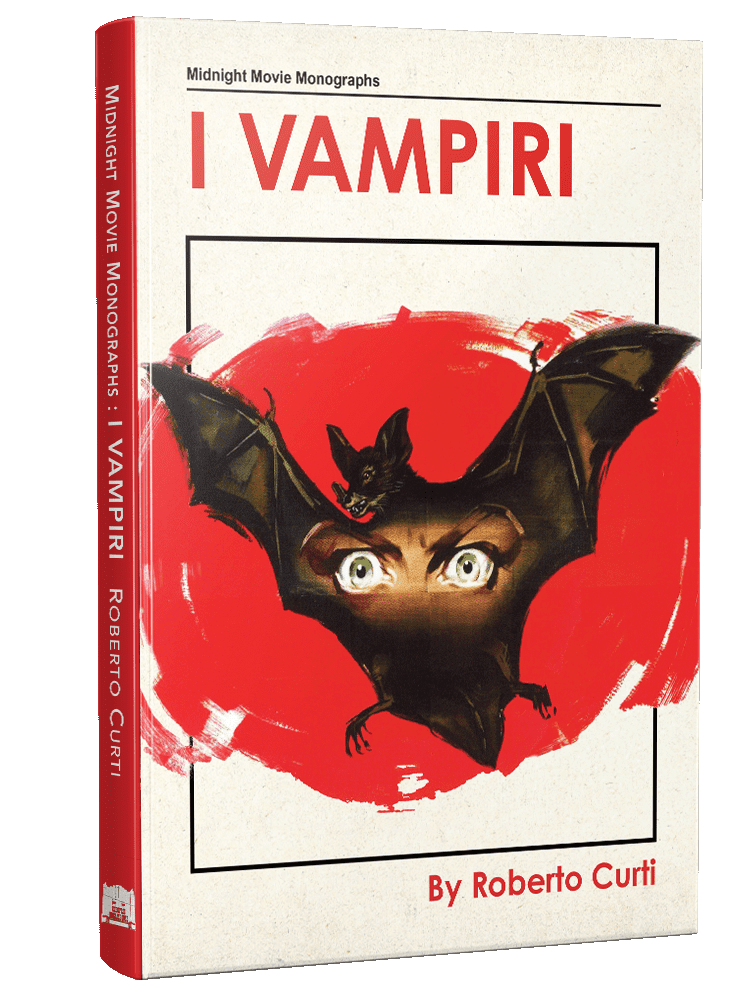
Tim Lucas and Roberto Curti explain that when Riccardo Freda left the film unfinished, the producers handed the job to rescuing it to the Director of Photography Mario Bava. It became Bava’s directing debut. Freda seems to have filmed most of the scenes with his movie star wife Gianna Maria Canale, and that Bava improvised new material to depict Pierre Lantin’s clashes with Inspector Chantal. People talk a story, very little of which is shown. The show mostly marks time until Pierre is ordered to report on a social event at Castle Du Grand. Seemingly essential scenes are ellipsed. After the secret of Giselle Du Grand is revealed, we don’t even see what happens to her. It’s assumed that Pierre and the kidnapped heroine will now become a romantic item. The male leads share a smug conversation before heading out for a cup of coffee.
Bava must really have been in a time squeeze, unable to fully iron out wrinkles in the story or finesse production details. We’re surprised when the daytime ‘Paris’ exteriors are much less attractive than the handsome interiors in the Castle and elsewhere. The anamorphic lens often behaves well, but numerous shots exhibit the ‘CinemaScope Mumps.’
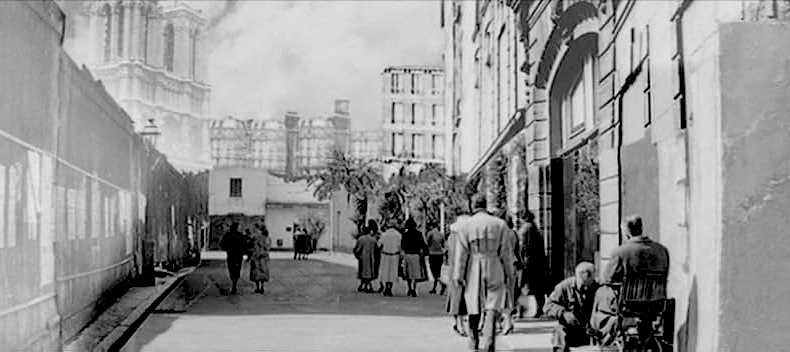
Bava’s camera tricks to fake a French location shoot are pretty awful, even if they draw critical praise in the disc’s extras. He appears to use photo cutouts, blown up and mounted in front of his lens, to add Paris scenery to his street exteriors. Neither the perspectives nor the contrast are a good match, and we can see errant reflections in the glass holding the cut-outs. The final composites are pretty dire, nothing like the often undetectable illusions in Bava’s later films. In the film’s very first shot, the Eiffel Tower is convincingly relocated … to a vast featureless landscape.
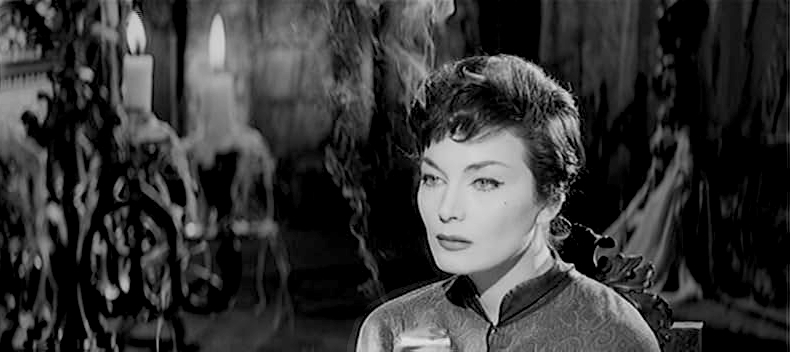
The fantastic centerpiece of the film are the age transformations of Giselle Du Grand. When the beautiful woman becomes emotional, she turns into a haggard crone before our very eyes. The change happens without a cut — Ms. Canale’s perfect skin suddenly grows lined and strained, and even her teeth look rotted, shattered. In his extra featurette, critic Fabio Melelli lauds this effect as something invented by Mario Bava, but it is now well known as a B&W camera trick with filters and colored makeup, first seen in silent movies. It was used to show the miraculous cure of lepers in the silent Ben-Hur; its most notable appearance was in the 1932 classic Dr. Jekyll and Mr. Hyde photographed by camerman Karl Struss. When MGM remade Jekyll it bought and suppressed the Oscar-winning 1932 version … another reason why Bava’s trick may have seemed brand-new in 1957.
Seen today, the transformation scenes are repeated at least once too often. Since we have little emotional attachment to Giselle or Pierre, the dramatic impact is muted. The illusion at least connects with the victim Laurette — although the Professor’s process isn’t really explained, we can see Laurette turning older while Giselle gets younger. Bava would of course repeat the gimmick much more successfully, with Barbara Steele’s witch in Black Sunday.
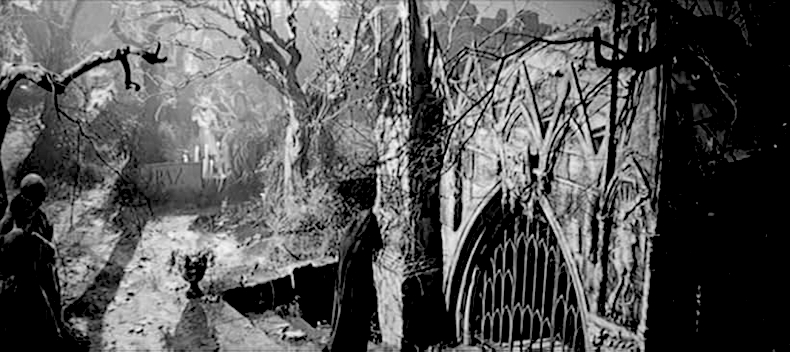
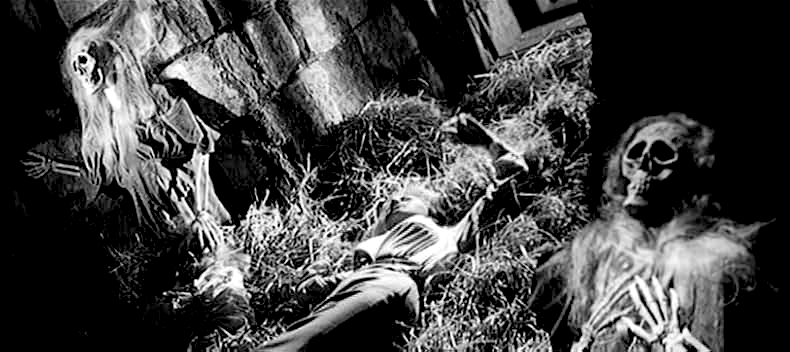
The lighting cinematography in I Vampiri is excellent, always atmospheric and beautifully lit: the Du Grand castle, the crypt, Professor Du Grand’s mad lab and various police offices. Gianna Maria Canale is made to look particularly cold and forbidding, despite being drop-dead gorgeous. That leaves Wandisa Guida’s Laurette as the liveliest person on screen, trying to escape from her castle chamber with its noose, and finding an arrangement of unexplained corpses in the dungeon next door. It’s interesting that the key Italian poster art features a stunning Guida close-up, instead of a portrait of the name star Gianna Maria Canale.
I Vampiri displays several elements of the coming wave of Eurohorrors mixing Gothic and modern themes: bizarre experiments on beautiful girls to benefit a hidden woman’s beauty; a doglike servant who procures victims via chloroform attacks. Fans of Bava and Riccardo Freda will eat it up, especially in this excellent remaster. Although no classic or even consistently logical, the show is indeed historically important to the genre. In 1957, we can really see the Horror film taking a major leap forward, in this picture, Hammer’s Frankenstein thriller, and Jacques Tourneur’s superb Night of the Demon.
The Roman film industry seems to have been a place where everybody knew everybody. When Tim Lucas suggests that Mario Bava stepped in to help out on many films for which he did not take credit, we believe him. Bava and Freda were close collaborators, and Freda worked several times more with producers Luigi Carpentieri and Ermanno Donati, most notably on the top Italo horror pictures The Horrible Dr. Hichcock and The Ghost with Barbara Steele. It’s great to have the IMDB to help make these connections, even if the experts tell us that their credits are riddled with errors. The IMDB lists actor Carlo D’Angelo as also having played in Howard Hawks’ classic costume epic Land of the Pharaohs — as Joan Collin’s bodyguard Nabuna. The uncredited actor playing Nabuna is a genuine muscleman with (to me) an entirely different face.
1 comment