


By 1935 the ‘glorious’ film factory Metro-Goldwyn-Mayer had already done its part to neutralize numerous great talents. The Marx Brothers’ anarchy had been greatly tamed. Buster Keaton’s stellar career had been scuttled several years before. MGM’s horror talent Tod Browning had crashed and burned with the shocking Freaks, made in a pre-Code year when even Paramount was toying with extreme and transgressive horror content. The bluenoses over at the Production Code office made horror films difficult to produce, as the entire genre was deemed too sexual, too morbid and inherently blasphemous. Tod Browning’s penultimate horror picture Mark of the Vampire got a pass by explaining that its undead horrors were an elaborate ruse, a joke. Adding to this was pressure from the English market — where horror films were routinely heavility edited or rejected outright.
According to biographer David J. Skal, Tod Browning picked Abraham Merritt’s novel Burn Witch Burn! for his next project, only to see it completely transformed. The original story was about witchcraft — Mrs. Manderlip transfers people’s souls into little wooden dolls. Skal says that a voodoo element was developed and then dropped, and with it all black characterizations. One of the writers contributing revisions was none other than the great Erich von Stroheim, although Skal says his work wasn’t used; Steve Haberman and Constantine Nasr report that von Stroheim was the one to switch the shrinking business from witchcraft horror to mad-doctor science fiction.

As finished, The Devil-Doll is five stories glued together, reprising ideas from earlier Tod Browning successes. The story’s main focus ought to be the humans shrunk to a fraction of their size and used as miniature assassins. Despite some precisely executed special effects, the killing dolls are barely explained, leaving only hints of deeper, more perverse ideas. As expected from MGM, the macabre elements are buried under a sentimental tale about a guilty father.
After serving 17 years on Devil’s Island, convicted embezzler/murderer Paul Lavond (Lionel Barrymore) escapes, determined to wreak vengeance on his three ex-partners, the Paris bankers that set him up as a fall guy. During his flight he comes across something entirely fantastic: his escape partner Marcel (Henry B. Walthal) dies, but his wife Malita (Raffaela Ottiano) shows Lavond the secret of Marcel’s life’s work, the ability to miniaturize living things, even people. Reduced to ten inches, the handicapped maid Lachna (Grace Ford) has lost her memory and lies still until ‘animated’ by Malita or Paul’s telepathic will. Malita wants to carry out Marcel’s plan to shrink all of humanity, to save it from overpopulation and starvation. * Paul instead has other plans for the zombie-like puppet people.
In Paris, Paul disguises himself in drag as the aged doll maker Madame Manderlip and from her toy shop dispatches miniature homunculi to attack the men who lied to send him to prison. Paul looks up his impoverished mother (Lucy Beaumont) but hides behind the Madame Manderlip disguise to talk to his daughter Lorraine (Maureen O’Sullivan). She’s slaving at a menial job, and curses what her criminal father has done to his family. Besides exacting his revenge, Paul must figure a way to clear his name so that Lorraine can receive her rightful inheritance — and do it all in secret.

Although handsomely directed and graced with (for 1936) elaborate special effects, The Devil-Doll is a stack of disparate, undigested ideas barely assembled in narrative form. Most fans see that Lionel Barrymore is recreating Lon Chaney’s great old-lady drag act from Browning’s The Unholy Three (either version). Chaney brought genuine menace to the role, whereas Barrymore is merely cute. Instead of using a midget to rob rich people of their jewelry, Mrs. Manderlip uses miniaturized burglar-dolls.
Paul Lamond’s family problem is a softened & sanitized echo of Browning’s penchant for stories of cruel irony between estranged fathers and daughters, as in the truly perverse silent West of Zanzibar. The sentimental aspect of The Devil-Doll is actually very thin and one-sided. Paul’s paternalistic ‘sacrifice’ keeps Lorraine entirely uninformed, like another puppet.
Was Irving Thalberg already ailing during pre-production? The writers’ committee approach to story problems leaves a narrative with preposterous events and characters that don’t connect. A five-minute ‘escape from Devil’s Island’ story segues into nonsensical scenes in a South American jungle, where the wild-eyed, Elsa Lanchester-wigged Malita is running a super-science lab in a primitive backwater shack, on that chance that her husband Marcel might someday escape and show up. Who needs Marcel, when Malita has perfected the shrink-ola process all on her own?
Marcel’s crackpot idea is to save the world but Paul Lavond only wants revenge, the melodramatic Tod Browning kind of revenge that requires an insane, more-trouble-than-it’s-worth scheme. Thus we have the establishment of a Paris toy shop as a front for a sci-fi lab, and Paul doing a highly theatrical & fruity old lady act to get close to his prey. Meanwhile, the sweet daughter Lorraine toils in a sweatshop laundry like Emil Zola’s Gervaise. Paul keeps her in the dark, but tells the truth to his still-alive mother.

Talk about characters not connecting: Lorraine and her boyfriend Toto (not the dog, but Frank Lawton of A Night to Remember) have no connection to the mad lab, the doll people or Malita, and vice-versa. Malita stays squirreled away in the shop, when she controls fantastic futuristic science that could make her the richest person on Earth. We’re not clear on the exact identity of the dolls. When the maid Lachna was shrunken, how did Marcel and Malita fix her physical deformity? If Lachna becomes the miniature female Apache dancer, does the uncredited dancer Jean Alden take her place only in the dancing sequence? The doll assassin disguised as a Christmas tree ornament is actually the banker Radin (Arthur Hohl), captured and paralyzed by Lavond. When ‘performing’ as an Apache dancer, he is identified as dancer Paul Foltz, uncredited.
The most exciting material is of course the stealth prowlings of the so-called Devil-Dolls. A tiny man and woman wield tiny stilettos dipped in a potent paralyzing drug. They creep on their missions like miniature Feuillade Vampires, tiptoeing into the houses of bankers Coulvet (Robert Grieg) and Matin (Pedro de Cordoba). Paul Lavond directs them by hypnotic remote control, standing below windows as once did Lugosi’s Dracula.

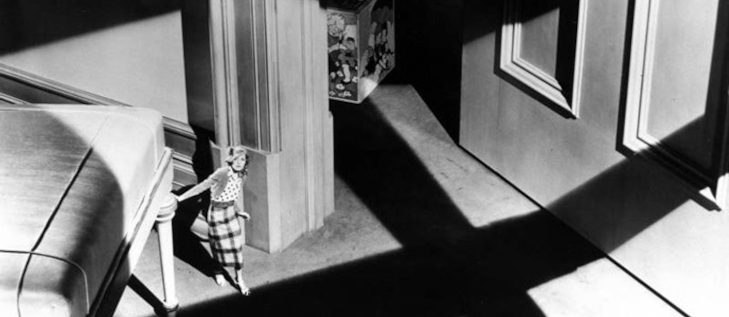
The effects themselves benefit from the ‘get it right’ luxury of MGM’s optical department. Most shots insert the tiny Alden and Foltz into live-action backgrounds via full traveling mattes. They are excellent yet of course imperfect, with little outlines left around the figures. The same thing persists twenty years later in the celebrated The Incredible Shrinking Man. But many of the effects are accomplished by building extremely convincing giant sets. If anything these are under-used. The angles are more interesting than those concocted for the Technicolor doll-people movie Dr. Cyclops.
Some of the optical composites are truly brilliant. The female Apache is part of a traveling matte as she climbs out of a child’s baby bed, and her shadow is thrown across an opposite wall. But most of the shot is a live-action oversized set . . . it’s the child who is matted in, behind the slatted side of the crib. Every shot is its own special problem to overcome.
Old-school matte shots were mostly static — locked down and still. Building the giant sets should allow free camera movement, but Tod Browning wasn’t much into dollies or cranes, and only goes in for a restrained pan or tilt here and there. Oddly enough, we think the most effective use of the oversized-set illusion is still the hilarious Laurel & Hardy comedy short subject Brats.
It’s a living Barbie doll … and not anatomically simplified.
Whether through censorship or simple avoidance of its own subject, Devil-Doll prevents us from identifying with its ten-inch puppet people. They aren’t really given personalities. We’re told that their ‘minds are left blank’ by the shrinking process, but that they can be ‘animated’ by mental concentration. Few details about this are given. The concept is undeniably erotic, when Marcel, Malita and Paul gaze down upon the beautiful Lachna, lying on the tabletop like a porcelain figurine. The screenwriters may have tried to ignore the dolls’ humanity, but we’re very concerned for them. Do they have thoughts? Are they prisoners in bodies they can’t move, until commanded by Paul Lavond’s brainwaves?

These concerns are emphasized when the Apache dancer falls from a table and injures her leg. Although still and silent, she sheds copious tears, indicating that she feels everything. It’s like the horror stories we’ve heard about patients supposedly anesthesized for medical surgery, but actually only immobilized, with all sensation left intact. Even in the absurd, disorganized logic of this movie, we worry for these oppressed little homunculi.
In trying to appease the Production Code, MGM’s ‘moral’ story resolution is anything but. (spoilers) Malita and the innocent puppet people perish in a fire, an injustice that the guilty Lavond never has to confront. Events are concocted so he doesn’t have to actually kill anyone. Paralyzing the bankers is justified because ‘he did it for his daughter and mother.’ Kidnapping and shrinking the doll-people is apparently A-OK as well. The script instead pussyfoots around the notion of Paul Lavond’s imminent suicide, another Code No-No. If the censors gave Lavond’s crimes a pass on the basis that he merely paralyzed his victims instead of killing them, then The Devil-Doll is the 1936 precursor to the morally reprehensible Terminator 2, in which Arnold Schwarzenegger doesn’t kill policemen, but merely blows their kneecaps off. How humane. The hypocrisy of censorship hasn’t changed.
Let’s see, all these crimes and outrages to the natural order . . . are just fine, because the object is to restore the love between a father and his daughter. She’s never told the truth about anything, of course. We demand a remake in which the unjustly tormented ‘devil dolls’ murder the entire full-sized cast, and live happily ever after.
Besides The Incredible Shrinking Man and Dr. Cyclops, Hollywood of the past toyed with ‘tiny people’ in Attack of the Puppet People, which sounds like a Devil-Doll remake but is not. We never caught the 1957 French comedy Un amor de poche, in which a three-inch Geneviève Page plays Jean Marais’ ‘lover in a pocket.’
Friend and multiple Oscar winner Randall William Cook’s Project One student film at UCLA directly revisited the idea of Devil-Doll. Animated in stop-motion, three doll-sized caricatures of film department professors strangle a film student with his own Super-8 movie. The victim’s fatal crime: his student film had ‘no redeeming social content whatsoever.’ Randall eventually got to play with ‘small figures / enlarged sets’ for his clever effects in 1987’s The Gate … which may have helped him win his career-topping stint on three mega-movies filmed in New Zealand.


3 comments