

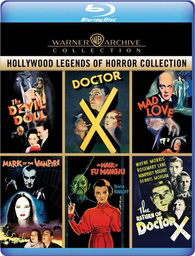
 Need help with your Halloween hangover? Here’s a cure for what ails you, a compilation of some of the finest horror films produced between 1932 and 1939. Warner Archive has repurposed six of their previous standalone releases on an invaluable new Blu ray set, Hollywood Legends of Horror Collection.
Though rife with vivid scenes of torture, implied bestiality and not-so subtle hints of necrophilia, horror films of the 30s were among the most beautifully designed and photographed movies in history. While the success of outré shockers like Erle C. Kenton’s Island of Lost Souls and Edgar Ulmer’s The Black Cat led to ever-more outrageous fare, some in the industry began to question their own motives; in Karl Freund’s The Mummy, Zita Johann asks a lovestruck David Manners point blank; “Do you have to open graves to find girls to fall in love with?”
In 1915 the Supreme Court decided that free speech did not extend to motion pictures leaving studios vulnerable to Will Hays who began his long-festering clean-up campaign in earnest, by the end of the 30s, films in general, and horror movies in particular, had been neutered. But thanks to decades-long revivals, TV’s Shock Theater, and supernatural restoration efforts, the artists and their work are avenged; Karl Freund, revolutionary cinematographer, Tod Browning, the carny hustler who brought the sideshow to the cinema, Charles Brabin, prolific silent era filmmaker, Vincent Sherman, gadabout Hollywood vet, and Michael Curtiz, the immigrant who began his noteworthy American career with Doctor X, the apogee of pulp horror.

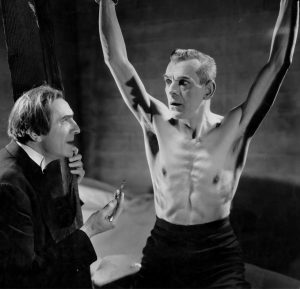
Adapted from the 1931 play that starred Howard Lang as the ambiguous protagonist, Doctor X was one of the last examples of the two-strip Technicolor process, and the first horror film to be shot in color. That color scheme, a queasy mix of poisonous pink and neon green, radiates throughout the film and defines the depraved psychology at the heart of the story, a tale of disfigurement, sexual frustration, and cannibalism (plus a unique form of plastic surgery). This is horror straight from the id.
Lionel Atwill plays the fastidious Doctor X whose well-publicized surgical experiments link him to a murderous hobgoblin described by the tabloids as the Moon Killer, a leering ghoul with talons and pointy ears who, it is implied, also eats his victims. Lee Tracy represents the humorous side of cannibalism and Fay Wray is her typically adorable self who screams at the drop of a hat. There are a lot of hats dropped during this 70 minute classic. The full rundown on the original disc is here.
What is more shocking to modern audiences in Charles Rabin’s The Mask of Fu Manchu—the exotic torture machines commandeered by the title villain or the jaw-dropping racism that forms the very essence of Boris Karloff’s portrayal. Even more perverse than his methods is the appearance of Myrna Loy as his slinky offspring (when the film was re-released in 1972, the Japanese American Citizens League complained she was portrayed as a sadistic sex fiend, no doubt Loy would have embraced the remark—Ornella Muti certainly studied Loy’s sly performance for her devastating turn in Flash Gordon). Fu is on the hunt for the sword and mask of Genghis Khan and he’ll use any device in his rec room (crocodile pit, steel spikes, deafening bells) to get his way. The full rundown on the original disc is here.

Mark of the Vampire is a film sorely in need of a trouble-making director, but Tod Browning is, for the most part, minding his manners (though the original script did come under fire, supposedly for allusions to incest and suicide). A remake of London after Midnight, Bela Lugosi and Carroll Borland make bloodsucking a family affair—Bela is Count Mora, a dead ringer for Dracula, and she is Luna who can be seen silently skulking about their castle when she’s not floating near the ceiling on bat wings. Lionel Barrymore presides over this horror mystery which is neither horrible or mysterious but it does have a luxurious sheen thanks to the great cinematographer James Wong Howe. The winking finale might qualify as the first meta-joke in fright films, and could have influenced the most famous moment in the original stage production of Arsenic and Old Lace: “They said I looked like Boris Karloff,” an applause-worthy line uttered by Boris himself. The full rundown on the original disc is here.
Browning’s next film was something of a remake too; the Lionel Barrymore drag show of 1936’s The Devil-Doll recalls Lon Chaney’s old lady disguise in Browning’s The Unholy Three. Based on Abraham Merritt’s Burn Witch Burn!, a murder mystery sparked by an omniscient witch who relies on homunculi to execute her orders. In the script by Guy Endore and Erich von Stroheim, Lionel Barrymore plays Paul Lavond, a prison escapee who lands in the lab of an unusually mad doctor named Marcel (Henry B. Walthall) who’s reducing animals to toy size. Why? Because food portions go a long way with three-inch tall horses. Voilà, no more food shortages. Barrymore sees a more personal use for Marcel’s screwy science project—revenge on those who betrayed him, and so dons grandmotherly duds as his disguise (as one does). Maureen O’Sullivan plays Barrymore’s purer than pure daughter and Rafaela Ottiano makes for a splendid weirdo as Marcel’s bug-eyed bride Malita. Who’s crazier, Lavond, Marcel, or Malita? Who knows? The full rundown on the original disc is here.

1935 was a high water mark for 30s horror; James Whale’s satirical romance The Bride of Frankenstein was released on April 22 and Karl Freund’s hallucinatory Mad Love debuted on July 12. An adaptation of Maurice Renard’s novel The Hands of Orlac, this was Freund’s final film as a director and he, in the most unsentimental fashion, returned to his work with Fritz Lang for inspiration (Freund photographed Metropolis). He also borrowed Lang’s greatest leading man; Peter Lorre. The actor plays a chrome-domed maniac named Gogol whose obsession with Frances Drake, an actress in soft-core Grand Guignol theater, sends him over the brink. The eternally high-strung Colin Clive plays her sweetheart, the pianist who loses his hands in a train accident—enter Gogol with a cure that’s more like a curse.
MGM got warnings even before the film was shot with elements of the script being “too brutal or too shocking.” But the real shock has nothing to do with violence; Lorre’s maniacal plan to drive Clive crazy is a bizarro moment for the ages—Gogol transforms into a half-demon, half-machine, a macabre steampunk tribute to Metropolis’s most famous figures, the wild-eyed Rotwang and the soulless Maria the Robot. For one deranged moment, Mad Love was really mad. The full rundown on the original disc is here.
In this newly oppressive environment, it seemed like the Hays Code had more to do with The Return of Doctor X than its director, Vincent Sherman. Based on the Doctor’s Secret, a 1938 story by William J. Makin, the film pales in every respect, down to Humphrey Bogart’s white-faced bloodhound. Though ludicrous in many ways, the movie is not the bummer it’s made out to be—Bogart, completely miscast, is still credible as the pasty-faced undead doctor and one of his victims, the “undeniably weird” Lya Lys could have played Dracula’s Daughter without breaking a sweat. Plus Huntz Hall wanders the sidelines. What are you waiting for? The full rundown on the original disc is here.
Those fans who bought these Blu rays first time around may be tempted to have them collected into one handy package, for those who didn’t, this is a no-brainer. All the discs feature the same extras and gorgeous picture quality—in particular Doctor X—as the original releases. Halloween only comes once a year, so take advantage of this special treat (it’s no trick).
I wonder how many homophobes watched Frankenstein, The Invisible Man, and The Bride of Frankenstein, not realizing that they were watching movies directed by an out gay man.