

 Last year’s 4K upgrade to Mario Bava’s Danger: Diabolik was so impressive, we jumped at a chance to see a UHD boost for the maestro’s previous Sci-fi effort Planet of the Vampires. A few years back we had only seen the movie through the versions held by MGM, which got it from Orion, which had taken possession when American-International folded. Instead of an A.I.P. logo, Radiance’s encoding of Terrore nello spazio begins with a logo for ‘Lucisano Media Group/Italian International Film.’ A.I.P. was a co-producer on the film. Their favored writer Ib Melchior contributed to the Italian screenplay, and helped shape the U.S. cut, partly revising its dialogue. The differences are slight, but Melchior was able to emphasize elements he thought were important.
Mario Bava’s credited directorial efforts before Terrore concentrated on gothic horror. This feature doubled back into science-fiction territory, possibly because A.I.P. wanted to market its fantastic films to all ages, and worrying over fewer censor issues. Adapted from an Italian short story, Planet of the Vampires has been noted for its mix ‘n’ match genre ambitions. As with MGM’s expensive Forbidden Planet there are no Earthbound scenes. We’re either in space, on the surface of a weird nightmare planet, or within the interior of an alien spaceship. Everything we see had to be designed from the ground up.

It’s something new … ‘Gothic’ Science Fiction.
Mario Bava’s fanciful visual style is front and center. Most every shot in Planet of the Vampires applies the in-the-camera trick film techniques that made Bava the go-to guy for fantastic visuals in ’50s Italian cinema. When spacemen appear on a ship’s TV screen, they’re actually standing being the console set, framed and lit to look like video images. Alain Silver and James Ursini were the first critics in English to tag the show as Gothic Sci-fi. In 1965 the first wave of Italo horror was on the wane, and an alien planet inhabited by undead spirits was a novel idea.
Both versions of the film follow the same basic storyline. The twin spaceships Argos and Galliot alight on the volcanic, foggy planet Aura. Immediately after landing, Argos’ Captain Mark Markary (Barry Sullivan) and Sanya (Norma Bengell) can barely restrain members of the crew from maiming each other in inexplicable fits of violence. Worse, when they trek to the Galliot they discover its entire crew dead, apparently from a similar orgy of homicide.
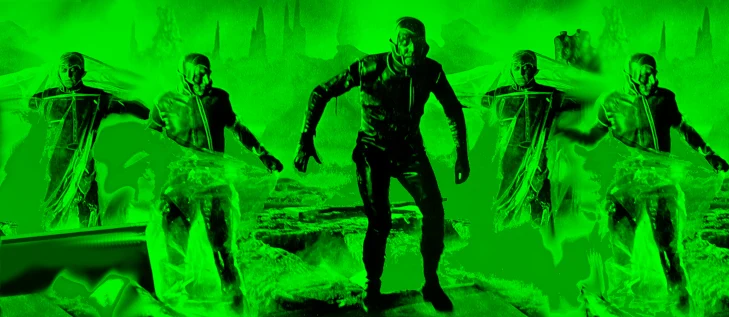
While the Argos is being repaired some crewmembers report seeing strange lights. Mark and Sanya eventually investigate a derelict alien craft nearby. It is littered with the skeletal remains of grotesque alien creatures. When the astronauts’ hastily buried casualties begin returning from their graves, a terrible secret finally comes to light: spectral Auran beings can possess dead bodies and turn them against the living. This time, ‘Plan 9’ is in Outer Space, not from Outer Space.
Here in the U.S. Planet of the Vampires was distributed along with more conventional A.I.P. releases, like Daniel Haller’s Die, Monster, Die. Bava’s wild visions of colored smoke, weird lighting and the strange costumes are more expressive than the psychedelic exploitation films that would follow from A.I.P.. Bava could generate clever visual effects and complex lighting schemes at a dizzying pace. The spaceships could belong to Buck Rogers, and the planet Aura could be a mythic Hell from Bava’s Hercules in the Haunted World.

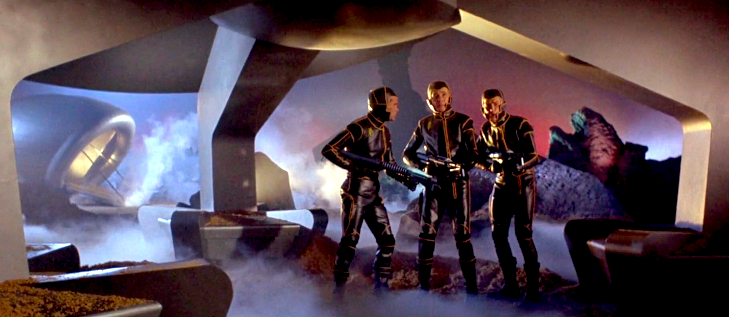
Barry Sullivan’s captain and Norma Bengell’s assistant stay clear in our heads, but most of the the other spacemen are a blur lacking distinct personalities (or distinct voices). The crewmembers fight, shoot ray guns, and dash from one place to another, and we quickly lose track of who’s who. It’s more rewarding to concentrate on the impressive designs and especially the excellent costumes. The black leather space outfits look like warm-ups for the next year’s Diabolik. Those high collars are great, if not very comfortable-looking. The stylishness pre-empts any question about ‘pressure suits’ — even the helmets are great designs.
The storytelling suffer a bit from one production decision. The Argos was meant to land intact and the Galliott was to be wrecked, but it was too tempting to keep both spaceships in good repair for budgetary reasons: the one studio set could serve for both ships. The result is that we lose track of which ship we are on at any given time. We never get a handle on spatial relationships. That large main interior has good design components but simply looks too empty, as if the producers decreed, ‘make it look bigger.’
But nothing disturbs the eerie atmosphere. The ship interior and the smoking, foggy landscape outside are largely assembled from modular units — sliding doors and blank wall panels inside, interchangeable rocks outside.
Robert Skotak’s excellent book on Ib Melchior has a chapter devoted to the film, understandably concentrating on Melchior’s contribution. The most novel idea in the screenplay could work in a ghost story as well: the spacemen perceive ‘peripheral vision’ Auran phantoms, that they only glimpse out of the corners of their eyes. Bava doesn’t attempt this kind of subtlety — we instead see flashing blips, and brightly glowing orbs. We can imagine an “Aura-Vision” effect with hints of phantoms in the corners of the frame…. but knowing how theatrical projection varies, any effect placed at the screen’s edge could easily be masked off, and go unseen.

Science fiction is the only genre in which success was once measured by the ‘realism’ of the special visual effects. Bava’s in-the-camera composite illusions do have their limitations. His planetary vistas often have a sharp foreground and background, but a fuzzy mid-ground, a photographic impossibility that unmasks many faked flying saucer photos. But Planet also features shots too clever to yield to easy analysis. When the film was new we certainly didn’t realize that Bava had filmed some spaceship shots underwater. Commentator Tim Lucas’s explanations point out things we missed. Now I have to go search for an errant finger caught on-camera holding a miniature.
And who wants realism, anyway? Bava’s alien phantasmagoria is more interesting than the Death Valley scenery and fake studio caves of Robinson Crusoe on Mars. Bava kept his films small-scale to avoid surrendering artistic control to outside experts or the optical departments of labs — who would answer to the producer, not Bava. This autonomy made Bava a one-man effects artisan-genius. Nobody confuses Ray Harryhausen’s animation with that of anyone else, and the same goes for Bava’s work. We know a Bava picture as soon as we see the way scenes are lit.
The eerie Auran atmospherics are strong in the scenes of the rising of the ‘Vampires’ from their impromptu crypts. A slow-motion effect is achieved with optical step printing. It is there in the original Italian version. We know that Bava rarely used opticals, but this film also has a few spaceship shots that are optical composites.
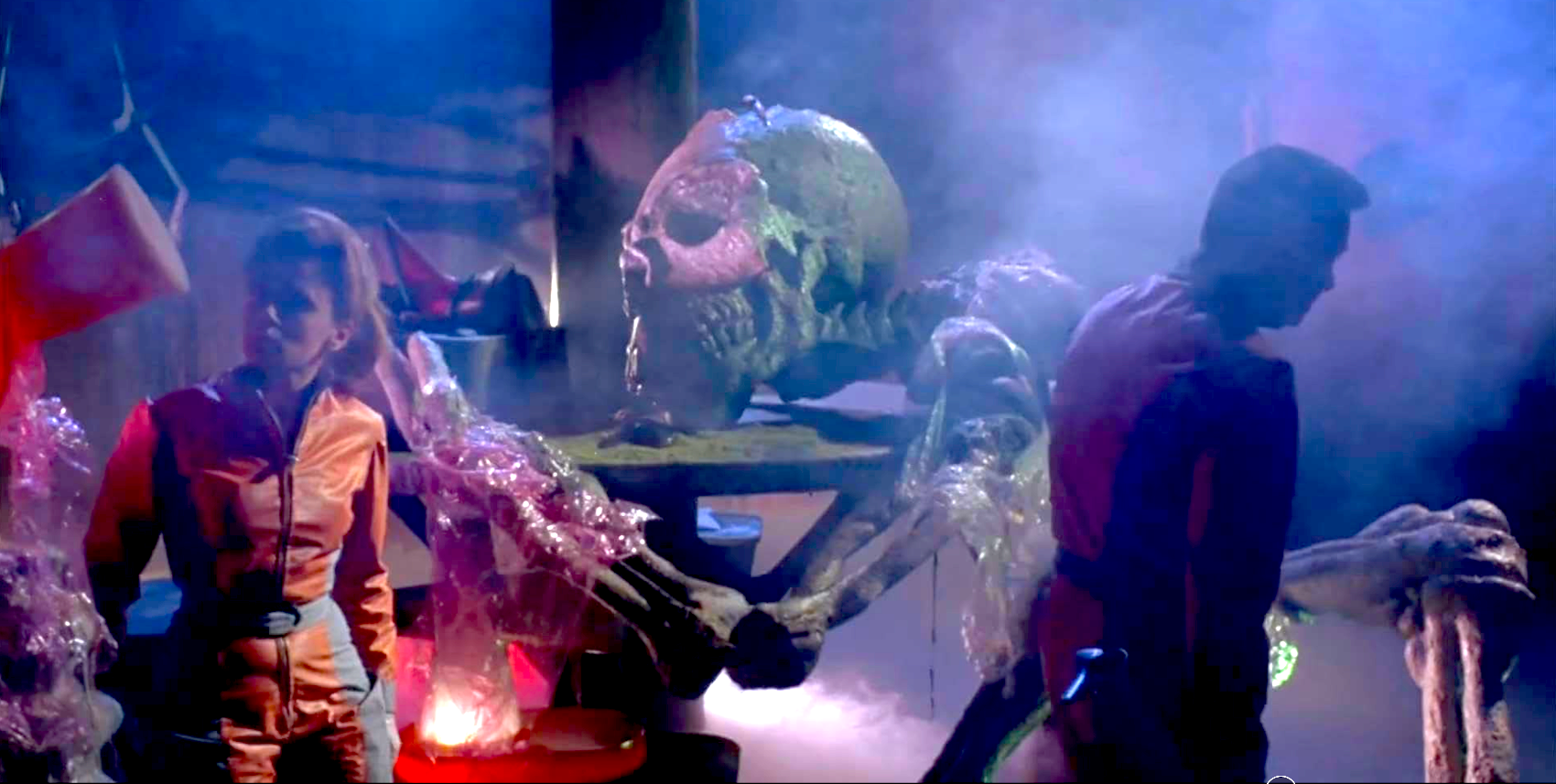
The most striking sequence is the investigation of a derelict alien spacecraft, where Markary and Sanya find giant skeletons that look like spiders with human skulls. Good sound effects add to a claustrophobic effect, as they work to free themselves before an ancient mechanism can evacuate the oxygen from the chamber interior. Back in 1965 we assumed that the skeleton was the remains of an Auran. Only after Ridley Scott’s Alien came out did we pay closer attention to the dialogue in these scenes — the grotesque skeletons are of another species trapped by the ‘demon planet’ Aurans. Tim Lucas notes that the skeletons outside of the wrecked ship are posed much like the dead human bodies found back in the Galliot, another detail that never occurred to us.
After finally seeing the original Terrore nello spazio in such amazing quality, we’re now much bigger fans of Planet of the Vampires. The Italian audio track is beautifully mixed and modulated. The Italo vocal artiste is an excellent match for the American actor Barry Sullivan, yet similar to voices used for other Argos and Galliot spacemen.