
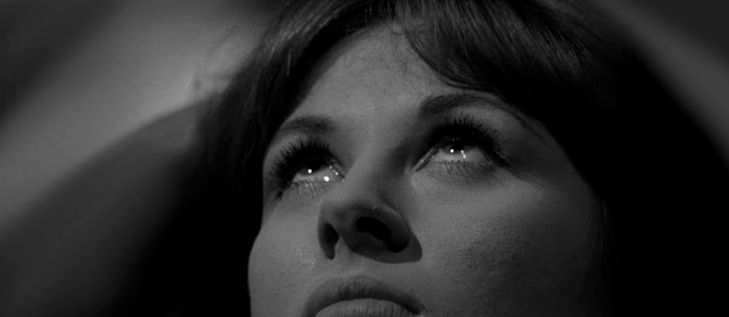


Nice: another notable London-filmed sci-fi movie to evaluate.
The English science fiction film can hold its head high, thanks to superb pictures like Quatermass and the Pit, These Are the Damned, The Abominable Snowman, The Day the Earth Caught Fire and Village of the Damned; I imagine we can chalk up much of the brilliance of 2001: A Space Odyssey to its English talent as well. Although it doesn’t rate much respect these days Things to Come is also a monument of sci-fi filmmaking.
Often forgotten are smaller scale pictures of the 1950s and 1960s, of varying quality. The UK didn’t have a full-blown sci-fi monster craze as we did, even if American companies filmed shows like Fiend without a Face in England. English censors also heavily edited sci-fi films deemed too violent or intense.
Several shows began as TV teleplays, that were mostly talk anyway. Theatrical sci-fi thrillers that have this ‘adapted’ quality include The Stranger from Venus, Devil Girl from Mars, The Trollenberg Terror and The Earth Dies Screaming, all alien invasion pictures, more or less. The main giveaway is a tiny cast in a limited setting: five or six ‘ordinary people’ in a country pub or inn must confront visitors from outer space.

In the 1950s producers Leslie Parkyn and Julian Wyntle had each made popular titles on their own; in 1958 they teamed up with a company called Independent Artists. Their quality output included some classics ( This Sporting Life, Tiger Bay) and fantastic fare we know well: Circus of Horrors, Night of the Eagle. In 1963 Independent Artists backed producer Albert Fennell’s Unearthly Stranger, yet another Brit sci-fi filmed on a tiny scale, with just a few actors.
The cast of quality performers guaranteed some attention in the English film scene; the show was reasonably well reviewed in ’63 with some critics praising the fact that the movie has no monster. For the U.S. American-International picked it up for distribution. Its given release year is 1964, although Variety didn’t review it until 1965. It reached American television at almost the same time. A.I.P. handled Unearthly Stranger differently than most of their aquisitions — they didn’t re-edit it, change the title or alter the music score.
The story involves a stealth invasion from outer space, an espionage scheme to stall our technological progress. All we see are five actors; most of the action takes place in a small office and a country cottage. There are a couple of moments of conflict and a few interesting weird touches, but no real violence. Sound effects take the place of special effects, which pleased the reviewers. Performed in earnest, the show impressed us as teenagers. It now comes off as a well-acted but minor effort.

Exactly what IS Project TP 91?Professor Munroe (Warren Mitchell) returns to his office at the Royal Institute for Space Research, tells his colleague Prof. John Lancaster (Philip Stone) that he’s solved the problem they’ve been working on, and promptly dies in agony from an unknown cause. All of his project notes have disappeared, leaving his collegue Dr. Mark Davidson (John Neville) to work alone on the Institute’s secret project, a scientific breakthrough that could make space travel unnecessary:
“We’re trying to find a way of projecting ourselves into another world through the power of thought.”
It sounds as if the plan is to travel into space with something akin to ‘astral projection.’ They could visit planets even if atmospheric conditions made physical survival there impossible. These must be some pretty intelligent scientists: Mark Davidson carries around some schematic drawings and occasionally plays with a slide rule, as if he were working on a basic engineering problem.
Security Major Clarke (Patrick Newell) joins the group, bothering secretary Miss Ballard (Jean Marsh) to no end; Clarke informs only Lancaster that disappearances of key scientists working on similar projects have occurred in other countries. John protests, but Major Clarke insists that Mark not be told about the apparent danger to his person.
Mark returns from a holiday in Switzerland with a new bride, Julie (Gabriella Licudi), who remains quietly at home. She loves England and Mark, and seems content. Major Clarke cannot find any record of Julie anywhere, and insists that Mark be taken off the project. Incensed, Mark continues to work at home, where he spends more time with his new bride. He observes that Julie sleeps with her eyes open, that she doesn’t blink and that she doesn’t have a pulse (!). Julie already knows who John is before they are introduced. John sees Julie remove a very hot casserole from the oven without burning her hands. Julie becomes seriously distraught when she walks to the store and finds that her mere presence frightens a baby and elicits a strange, frightened reaction from a group of schoolchildren. When Julie cries, her tears leave burn marks on her face.
Unearthly Stranger’s screenplay is not very clearly thought out. Like a TV drama, the show is 80% dialogue. John and Mark unload reams of exposition about the project, discussing their theories in ridiculously basic terms. Yet at least once they touch on concepts that we recognize from books by Philip K. Dick: creating real things by a concentration of thought. The talk ‘telegraphs’ dangers to come, leaving us to wait for John and Mark to catch up with things that are obvious almost from the beginning:
“While we work on the problem of mental projection, what if someone out there in space is doing the same thing and coming here? Ha, ha, how silly.” (Paraphrase.)
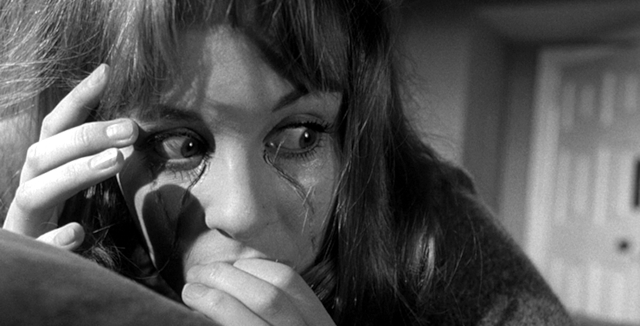
The basic setup is sketchy at best. The project doesn’t seem to require a laboratory, a staff or any special resources; Mark has only his slide rule and a photo of the moon on his wall. Why is Prof. Munroe’s corpse being held in a room downstairs? If the project is secret, why is its presence announced on a plaque outside the building?
Despite the good acting, the rudimentary screenplay requires that the scientists not be capable of adding 2 + 2. Both John and Mark accept Julie at face value, only seeing her as an attractive female, a ‘good catch’ and a wife to make Mark happy. It doesn’t matter that she has no identity, that her past in Switzerland is a clean slate. What does Mark know about her?
All of the above considerations pale when we realize that neither Mark nor John think Julie’s unnatural qualities are worth following up on, especially that trivial ‘no pulse’ thing. Well, nobody’s perfect.
The security angle is equally dodgy. Prof. Munroe and Mark are both allowed to work on the project at home. The scientist’s secret notes go in a safe, but no copies are made. Scientists abroad are dropping like flies and Prof. Munroe suspiciously croaks the same way, yet no big-time security alert goes up. John and Mark discover that Munroe’s coffin is empty, which ought to make them suspect Major Clarke or Miss Ballard, or both of them. No, nothing to report here!
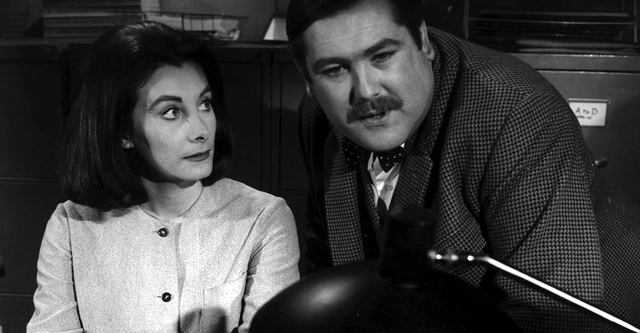
The story idea for Unearthly Stranger is by Jeffrey Stone, who spent most of his time as an actor. The credited screenwriter would seem an odd choice for a British film: Rex Carlton, a writer and producer of odd fare like The Brain That Wouldn’t Die, and a couple of pictures with the independent schlockmeister Al Adamson. The screenplay seems fairly well written until all the unlikelihoods and loose ends get in the way.
The story is told in flashback by a man ‘recording the facts while he’s still alive,’ reminding us of the predicaments faced by Peter Stenning, Miles Bennell and even Walter Neff. The lean budget keeps us tight with our five main characters, only hearing about events happening elsewhere. We hear about Julie long before we meet her, and she only has one scene to herself. A flashback (inside the bigger flashback) to Switzerland is very short, avoiding ‘getting to know you’ chit-chat — or any talk that might immediately seem screwy, with Julie unable to explain herself.
So we’re forced to accept Mark and Julie’s relationship as a given. Mark is a proper gent who doesn’t go overboard with affection, even in private. The men talk about Julie, but nobody ever really talks to her. Mark’s lack of curiosity ought to be insulting — he doesn’t even care to sit down and say, ‘tell me about your life,’ or better, ‘who the hell are you?’ Major Clarke complains about Julie’s lack of a footprint in anybody’s records, in Switzerland or elsewhere. She would surely attract official curiosity even without a connection to Project TP 91: how did she come to England without a passport? Don’t arrivals need to register locally, and divulge a minimum of information about themselves? It’s all pretty foolish.
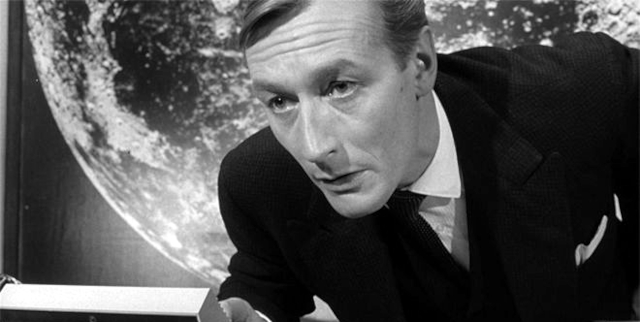
We love John Neville from Terry Gilliam’s The Adventures of Baron Munchausen, made 25 years later. His excellent acting and screen authority lend this thriller substance and credibility despite the Swiss-cheese storyline. Both Neville and co-star Philip Stone excel in delivering their somewhat forced ‘business as usual’ dialogue. The most natural screen presence belongs to Jean Marsh’s secretary, who for most of the picture has little or nothing to do. Pretty Gabriella Licudi may be dubbed with a different voice. She racked up quite a few credits, but I’ve only seen her in a bit part in the 1967 Casino Royale.
Put the Blame on Mame, even if she’s a Phantom From Space.
What continutes to interest genre critics about Unearthly Stranger is its gender politics — I should think Kat Ellinger would chew this film up and spit it out. The filmmakers carefully tiptoe around their espionage-suspense story, oblivious to the fact that their casual misogyny is showing. Miss Ballard is introduced with a remark that she “doesn’t rely on facts, but only on the unknown, what she can fear deep down.” Where that ‘fear’ idea comes from isn’t explained. When Mark and John finally decide to proactively determine Julie’s planetary origin, just talking to her is never considered. They instead prepare to anaesthetize her against her will, like a lab animal. They’re almost as reprehensible as the awful scientists in the ultimate sexist sci-fi, Kurt Neumann’s She Devil.
The upshot is that Julie is more of a threat simply because she’s a woman, and less because she’s a ‘thought being’ projected from outer space. Again, females are treated as an alien species, with a different, suspect agenda.
Although Julie’s experience on Earth is undeveloped her situation suggests a kinship with Gene Fowler Jr.’s superior sci-if drama I Married a Monster from Outer Space. Just like that movie’s alien Tom Tryon, Gabriella Licudi’s Julie goes ‘off mission’ and decides she likes being a human and living among people. But she’s ‘unnatural’: babies and children perceive her as evil. The playground kids back away to their school building, like little robots. The misogyny is complete: a woman that repels innocent children is unnatural, you know, burn the witch and all that.

First-time director John Krish had a great deal of TV experience. Much of his direction is admirable, especially considering the limitations of the film’s sets. He occasionally blocks scenes in what I would call a ‘Live TV style’: characters take turns facing the camera to deliver key dialogue. One scene ends with the construction later lampooned in the comedy Airplane!: reacting to frightening news, John swivels in close-up to stare at the camera, with a stunned look on his face.
Krish tries to enliven Mark’s midnight panic with tilted camera angles and decorative shots of circular stairwells, etc.. He is less compelling with action moments. When two men try to restrain a struggling woman Krish cuts to several shaky hand-held short cuts of the three of them grappling. It feels too long, too prolonged, as do those opening shots of Mark running in panic from unseen assassins.
The final scene pulls off an excellent surprise twist, a nice jolt for the audience. John and Mark then learn that ‘projected’ alien phantoms have been among us for twenty years, tasked with a specific mission. A movie staged on a bigger scale would have delivered this surprise twist perhaps halfway through, allowing the ‘invasion’ to develop further. We’re instead left with an intriguing bit of sci-fi paranoia. The reasonably well-directed finale is a non-sequitur that teases the ‘women can’t be trusted’ angle, without resolving anything.
Executive producer Julian Wyntle would proceed to become a co-producer (with this film’s Albert Fennell) of the extremely successful TV series The Avengers.
