

 Sometimes when writing up an impressive disc collection destined to become a Gift Box of choice for film fans, it feels like one is writing a personalized Spiegel’s Catalog for holiday buyers — the kind with disposable income and difficult giftees to please. This item ought to do the trick.
Unpacking Criterion’s leviathan monster box The Complete Kubrick, one wonders what Stanley would think. When he passed away, he can’t have been too pleased by the state of home video. We began reviewing around the time Mr. Kubrick left us, when the first DVDs yielded widescreen images nothing like the amazing, movie-theater-ready 4K discs of 2026. One of the first laserdiscs we saw was 2001: A Space Odyssey — an NTSC ‘souvenir’ with what, 480 lines of resolution? Who complained? It was a miracle, even if we had to flip discs every 30 minutes.
We remember the online kerfluffles when a first round of Kubrick DVDs hit the market in full-frame, open matte versions, with alleged Kubrick quotes saying that’s how he wanted them shown. Kubrick was a film genius who at the time didn’t want to be distracted from his obsessive work patterns. We ‘imagined’ that he would tell Warner home video, ‘I’ll not squawk about those DVDs and VHS tapes, if you ease up on some of the overages on Eyes Wide Shut.’ That’s a total fantasy from a reviewer, but there has to be some reason Kubrick didn’t make demands of the discs. This was a man who left nothing to chance. Many of his features arrived at theaters with personal notes from Kubrick, asking the projectionist to please show his film this and that specific way.
Criterion’s boxed set is a compendium of previously released encodings. Rather than 12 separate packages, the one box contains 4K and Blu-ray versions of each film, plus six more discs with overflow extras.
We trust that readers don’t need these movies explained. A number of entries carry a link to a relevant DVD Savant or CineSavant review.


Killer’s Kiss
1955 / B&W / 1:37 Academy / 67 min. / Previous CineSavant Review from 06/28/22
Starring: Frank Silvera, Jamie Smith, Irene Kane.
Cinematography: Stanley Kubrick
Written by: Stanley Kubrick (uncredited) and Howard Sackler (also uncredited, the film bears no writing credit)
Producer: Morris Bousel, Stanley Kubrick
The chronology begins with Killer’s Kiss but doesn’t skip over Kubrick’s 3 short films or his first experimental feature. They are included in the video extras, most of which are on the Blu-ray disc copies. The first two short films were sold to RKO’s short subjects unit.
The transfers are excellent, missing only RKO logos. His first film Day of the Fight is present in two versions, Kubrick’s original and RKO’s slight recut, which carries a different commentary. The color short subject The Seafarers is in better quality than we remember from before.
Kubrick’s proto-experimental feature Fear and Desire, from a Kino Classics release, is in fine shape as well. It’s presented in its extended original 70 minute cut, that re-premiered just a few years ago.
Killer’s Kiss shows Kubrick trying a second near- one man show, and pulling it off quite well. His story is clear, we care about the romantic leads. It works because the setting on the big city sidewalks capitalizes on Kubrick’s urban photographic background. He doesn’t try to emulate Hollywood with his action scenes, and his evocation of a Manhattan dance hall practically feels like a documentary. The disc is given two interview featurettes, one with critic Geoffrey O’Brien, and a second testimony from filmmaker Alexander Singer, who was Kubrick’s best friend and worked with him on Day of the Fight.

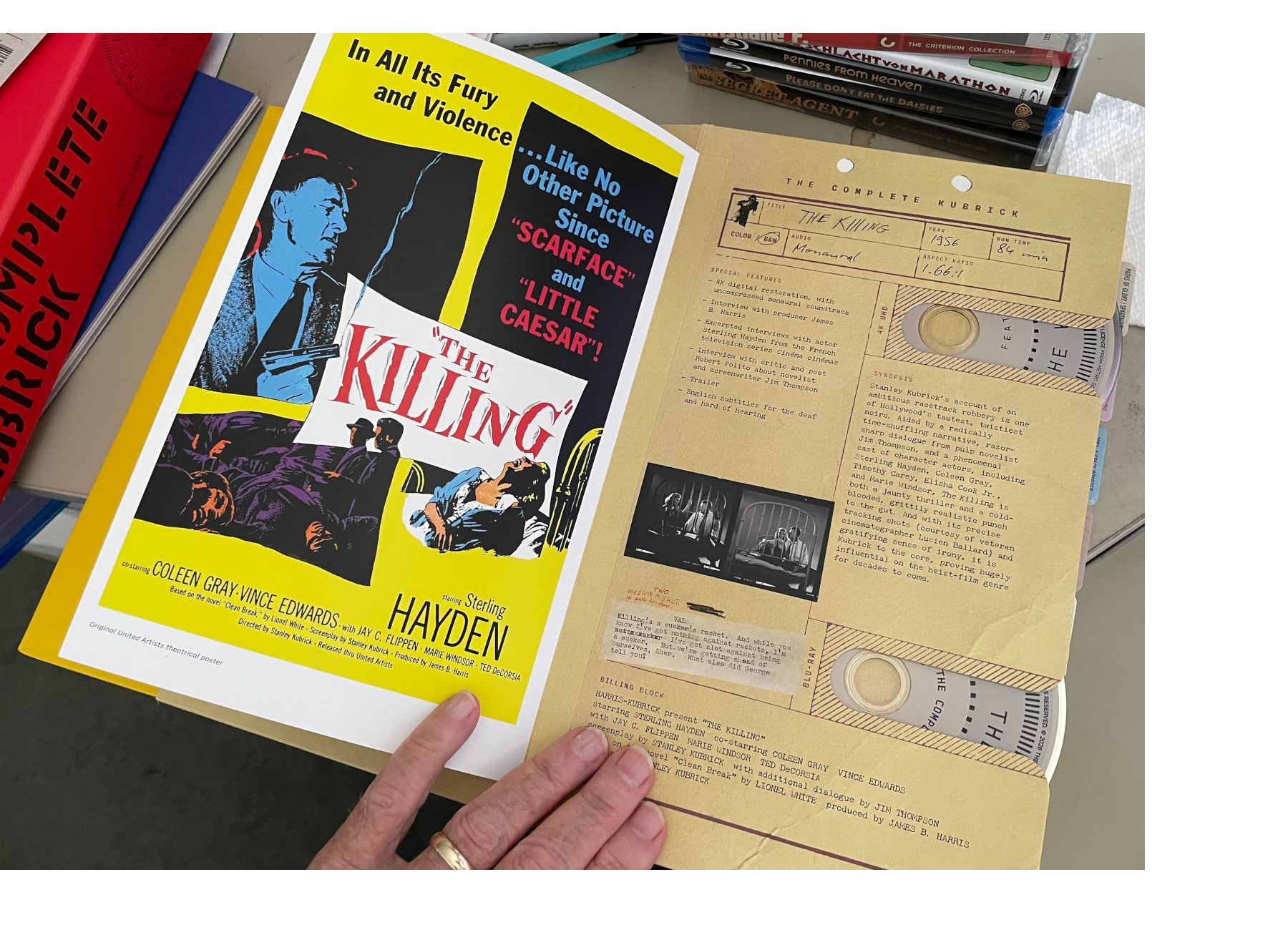
The Killing
1956 / B&W / 1:66 widescreen / 84 min. / Previous CineSavant Review from 07/27/2022
Starring: Sterling Hayden, Marie Windsor, Elisha Cook Jr., Coleen Gray, Vince Edwards, Jay C. Flippen, Ted de Corsia, Joe Sawyer, James Edwards, Timothy Carey,.
Cinematography: Lucien Ballard
Music Composer: Gerald Fried
Written by: Stanley Kubrick from the book ‘Clean Break’ by Lionel White
Dialogue by: Jim Thompson
Producer: James B. Harris
United Artists considered Killer’s Kiss good enough for a minor theatrical release, and thought enough of its maker to get involved with his first Hollywood feature. The Killing has a strong cast of film noir names. It also was given a dialogue pass by Jim Thompson, now a cult hardboiled legend but then living from paperback sale to paperback sale. James B. Harris partnered with Kubrick as producer, a winning collaboration that stuck for three successful features.
The movie may have played without a great deal of fanfare, but Hollywood took notice — the film’s time experiment and its arresting, oppressive tension (that pounding music!) gives it an edge over most of the noir output of the 1950s. Kubrick called it a learning experience, but it’s a genuine classic, an annihilating heist picture with intellectual appeal.
The 4K disc is touted as a new digital restoration, as the last Blu-ray was from 2011. We really like the video piece with producer Harris, apparently an ideal creative associate for Kubrick, and from Robert Polito, whose profile featurette on Jim Thompson is a must-see.
Stanley Kubrick’s account of an ambitious racetrack robbery is one of Hollywood’s tautest, twistiest noirs. It is aided by a radical time-shuffling narrative, razor-sharp dialogue from pulp novelist Jim Thompson, and by a phenomenal cast of character actors that includes Sterling Hayden, Coleen Gray, Timothy Carey, Elisha Cook Jr., and Marie Windsor. The Killing is a cold-blooded pulp thriller, a punch to the gut. With its precise tracking shots and gratifying sense of irony, it’s Kubrick to the core.

Paths of Glory
1957 / B&W / 1:66 widescreen / 88 min. / Previous CineSavant Review from 08/14/2022
Starring: Kirk Douglas, Ralph Meeker, Adolphe Menjou, George Macready, Wayne Morris, Richard Anderson, Joe Turkel, Timothy Carey, Suzanne Christian, Jerry Hausner, Emile Meyer, Bert Freed.
Cinematography: George Krause
Music Composer: Gerald Fried
Written by: Stanley Kubrick, Calder Willingham, Jim Thompson
From the book by: Humphrey Cobb
Producers: James B. Harris, Stanley Kubrick, Kirk Douglas
Paths of Glory is yet another giant step for Kubrick — an alliance with one of Hollywood’s biggest stars gave him a great deal of latitude for his indictment of ugly politics in the trenches of WWI. Kubrick’s every choice seems right, something that Douglas surely noticed. It’s also obvious that Kubrick knew that it was best to keep his patron-star happy: at every step of the story, Kirk’s character is given Oscar-bait oratory. The fact that Douglas’s Colonel Dax is just an observer for the final scene can only be attributed to the actor-producer’s realization that Kubrick’s finale was sure gold.
The movie screams anti-war statement, with ordinary soldiers persecuted to bolster the careers of generals. But Colonel Dax is not some innocent from the sticks. We wonder why he only now becomes aware of the murderous hypocrisy around him — he’s shocked, shocked to find gambling going on in this establishment. The saving grace is that writers Cobb and Willingham depict the same kind of cowardice and treachery at lower levels of the ranks as well. When we despair over the raw deal handed madman actor Timothy Carey, we know Kubrick is working real magic.
Just the same, I made the show required viewing for my boys, along with Gallipoli.
A French documentary in the extras points up an angle we didn’t expect: in the actual case dramatized in Humphrey Cobb’s book, the first ‘coward’ soldier to be chosen for execution was jewish … the Dreyfuss Affair brought antisemitism out in the open, but it didn’t change it.

Spartacus
1960 / Color / 2:20 widescreen / 196 min. / Previous CineSavant Review from 10/17/2015
Starring: Kirk Douglas, Laurence Olivier, Charles Laughton, Jean Simmons, Peter Ustinov, Tony Curtis, Woody Strode, John Gavin, Nina Foch, Herbert Lom, Charles McGraw, John Ireland, Nick Dennis, John Dall, Herbert Lom, Joanna Barnes, Harold J. Stone, Peter Brocco, John Hoyt, Richard Farnsworth, George Kennedy.
Cinematography: Russell Metty
Music Composer: Alex North
Screenplay by: Dalton Trumbo
From the novel by: Howard Fast
Producer: Edward Lewis
Here’s where Kubrick joined the ‘cinema firmament’ — all because he managed his career advancement so well. Kirk Douglas had a great deal of power on his next movie at Universal, and didn’t hesitate to fire top director Anthony Mann after only a few days of ‘creative differences.’ Stanley got the nod to step in and direct the massive epic Spartacus, but with control over the script and the cast in the hands of producer Kirk. Kubrick complained about everything, yet made the most intelligent epic to date, and one that openly challenged the Blacklist. The film still has the feel of a Kubrick picture, with some of the most adept actors in the business (Laurence Olivier, Charles Laughton, Peter Ustinov, Jean Simmons) scoring big with bold characters. The director lets his mindset show in the awesome depiction of a formal Roman battle plan — an entire valley covered with troops trained to fight like a machine.
We still like our first review of the show, in which we linked to Duncan L. Cooper’s reportage of an ideological conflict between Howard Fast, Dalton Trumbo, and to a lesser extent Douglas and Kubrick. What was the best way to present the heroic character for a modern audience? Should he be a ‘Large Spartacus’ or a ‘Small Spartacus?’
We never owned Criterion’s lavish laserdisc of Spartacus, with its input from many talents that passed away before the advent of DVD extras. Many items appear to be from that original set of extras — interview material from Peter Ustinov, and an entire audio commentary with an analysis by Dalton Trumbo. Also included is the old documentary The Hollywood Ten, produced to plead for the HUAC invitees convicted of contempt of Congress.

Lolita
1962 / B&W / 1:66 widescreen / 153 min. / Previous CineSavant Article from 09/06/2024
Starring: James Mason, Shelley Winters, Sue Lyon, Lois Maxwell, Cec Linder, Peter Sellers, Peter Cushing, Christopher Lee, Roberta Shore.
Cinematography: Oswald Morris
Music Composer: Nelson Riddle
Screenplay by: Vladimir Nabokov from his novel
Executive Producer: Eliot Hyman
Producer: James B. Harris
Some lovers of Nabokov’s book say that Kubrick’s adaptation is a betrayal of its source, yet the screenplay for the ‘unfilmable’ novel was done by the author himself. Shelley Winters, Sue Lyon and especially James Mason do amazing work with the edgy material, obviously trusting in their director. Kubrick was now capable of generating new studio pojects, and from Lolita forward, each Stanley Kubrick project was a potentially career-ending risk. But the master chess player had faith in his calculated moves; each succeding picture became a cultural event, the talk of the industry, and more often than not a bold experiment with film form that stretched the definition of the word, ‘commercial.’
The MGM release Lolita was also given a Criterion laserdisc release, in 1992. This Complete box appears to have generated a new extra, an interview about Kubrick between authors Jonathan Lethem (The Fortress and Solitude) and Kevin Wynter (The Contract). They’ve also lined up vintage TV show pieces with Sue Lyon and Vladimir Nabokov, and some interesting camera tests.

Dr. Strangelove, or: How I Learned to Stop Worrying and Love the Bomb
1964 / B&W / 1:66 widescreen / 95 min. / Previous CineSavant Review from 06/07/2016
Starring: Peter Sellers, George C. Scott, Sterling Hayden, Keenan Wynn, Slim Pickens, Peter Bull, James Earl Jones, Tracy Reed.
Cinematography: Gilbert Taylor
Music Composer: Laurie Johnson
Written by: Stanley Kubrick, Terry Southern, Peter George
From the book: ‘Red Alert’ by Peter George
Producer: Stanley Kubrick, Leon Minoff
We rather thought that Peter Sellers’ performance threw Lolita out of whack, adding a skin-crawling discomfort comic aspect without ever actually being very funny. Kubrick, satirist Terry Southern and Sellers had a field day with Kubrick’s next exercise in high-wire career daring, Dr. Strangelove, or: How I Learned to Stop Worrying and Love the Bomb. After struggling with a dead-serious approach to nuclear armageddon, Kubrick took a Black Comedy approach that can’t have made the studio establishment feel secure. The filmmakers gambled on their own understanding of the relationship between comedy and horror, and made the world’s scariest taboo topic into a hopeless farce. It clicked with moviegoers … a collection of absurdly exaggerated characters were inter-cut with a hyper-real depiction of the airmen of SAC in nuclear combat — ‘toe to toe with the Russkies.’
Sellers’ three comic characters are brilliant. Unthinkable events play out in a realistic context, the most disturbing being the meticulously precise ‘combat vérité’ battle sequence at Burpleson AFB. The alignment of nuclear posturing with sexual frustration is a comic constant. When Kubrick had to settle for less-than-ideal rear projection to show his B-52s in flight, do you think he felt motivated to take on a monumental visual effects challenge? On the Beach had convinced the world that a nuclear war could end humanity, and Dr. Strangelove convinced us that the embarrassing state of the human condition — our inability to act in a concerted civilized manner — is what made the nuclear precipice seem so near.
Strangelove has been given excellent extras over the years by both Criterion and Columbia/Sony. As always, we jump at the chance to hear Kubrick talk about the subjects he chooses, even if he shies away from divulging all of his secrets. We also note the film’s ‘coming attraction’ trailers, which in 1964 were far in advance of the industry norm.

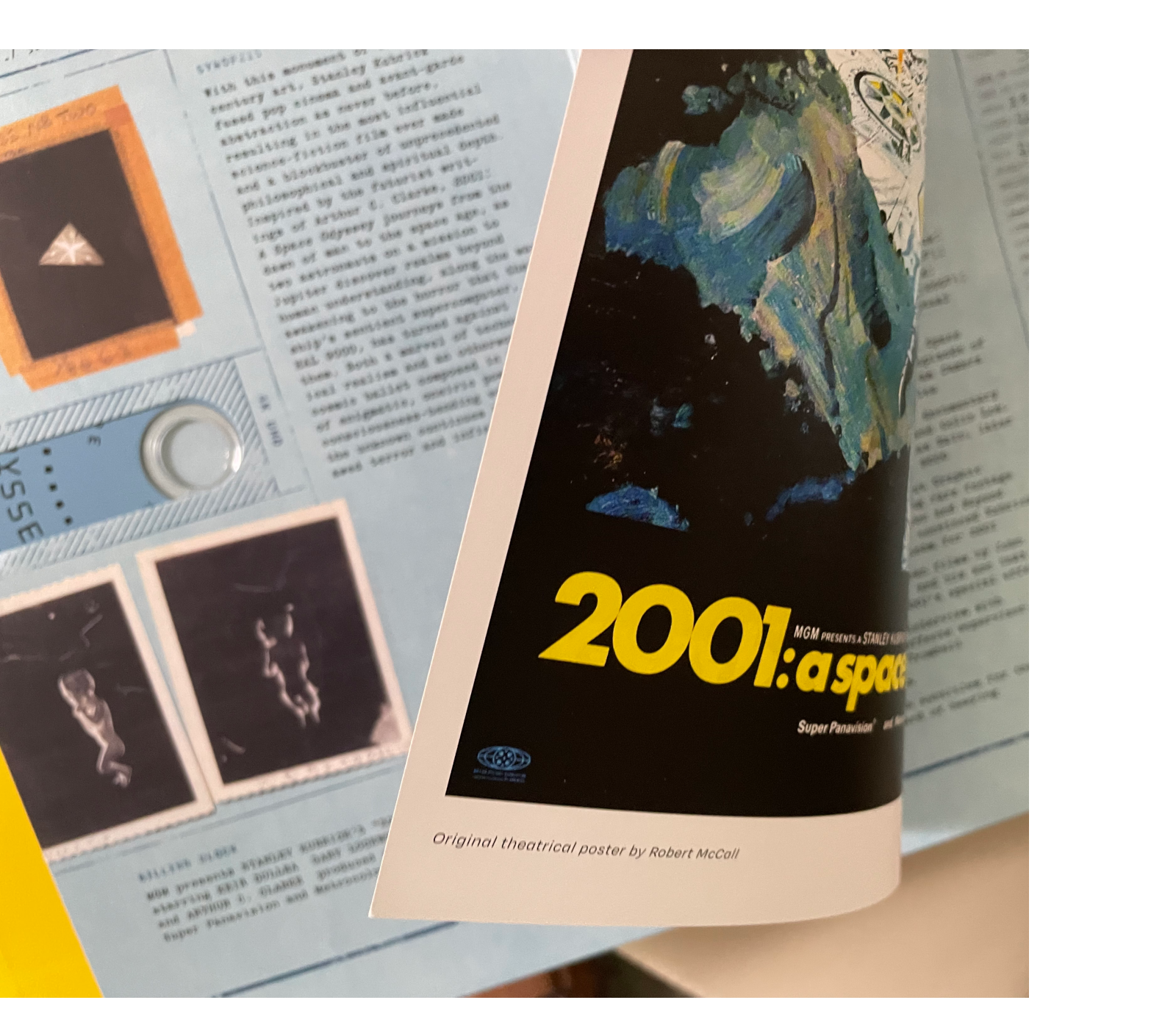
2001: A Space Odyssey
1968 / Color / 2:20 widescreen / 149 min. / Previous CineSavant Review from 06/16/2024
Starring: Keir Dullea, Gary Lockwood, William Sylvester, Daniel Richter, Leonard Rossiter, Margaret Tyzack, Robert Beatty, Sean Sullivan, Douglas Rain, Vivian Kubrick.
Cinematography: Geoffrey Unsworth
Production Designers: Ernest Archer, Harry Lange, Tony Masters
Screenplay by: Stanley Kubrick, Arthur C. Clarke
Suggested by: the story ‘The Sentinel’ by Arthur C. Clarke
Produced by Stanley Kubrick
Plenty of people still ask what the big deal is with Kubrick’s 2001: A Space Odyssey. Those that didn’t respond to the wonder of next-generation visual effects had little patience for a storyline that refused to billboard any human character, concentrating instead on the will of the species to unlock the secrets of the universe. Instead of an intrepid Buck Rogers, we’re given academics, political dodgers and eventually a pair of ultra-efficient astronauts trained to make calm decisions in a crisis — ‘maintaining an even strain.’ It was Kubrick’s biggest gamble, to peg his 12 million dollar movie on a concept with less warmth than an Antonioni drama.
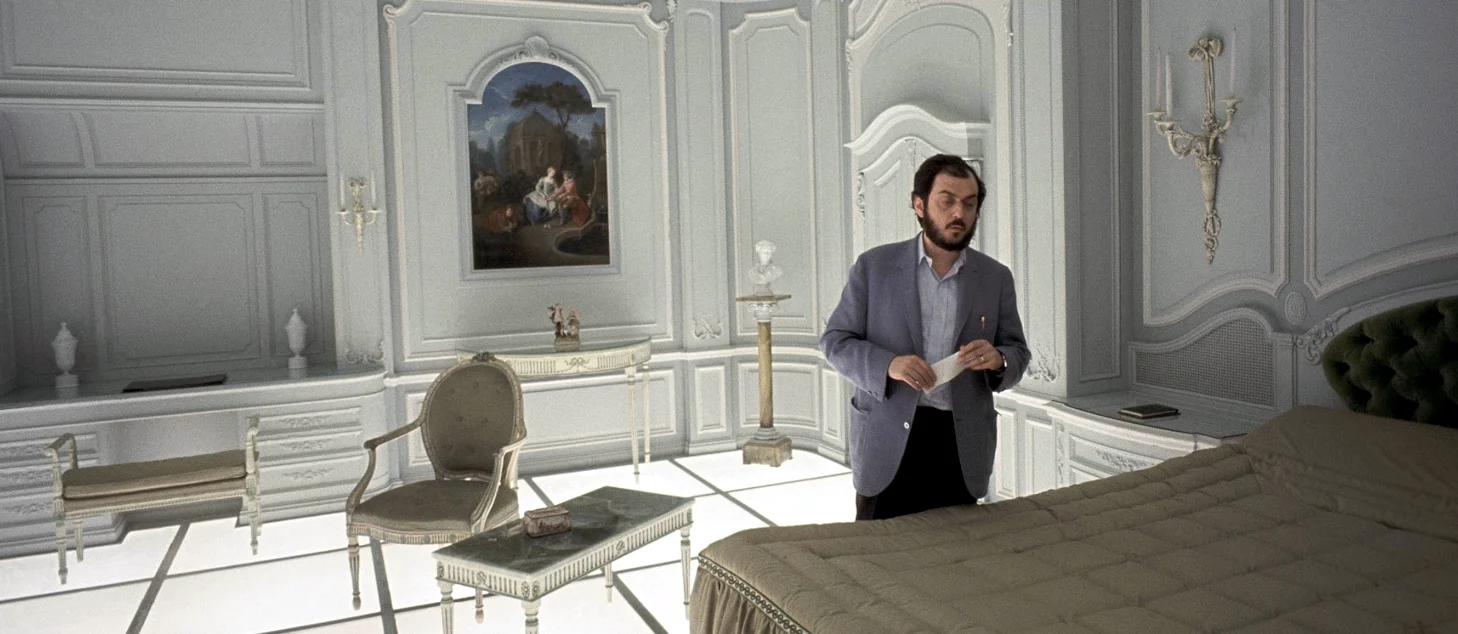
This one separated the dreamers from the pragmatic types. We were astounded by the realism in Kubrick and Arthur C. Clarke’s vision of a future just 33 years away. Talk about ambition — Kubrick needed ways to depict an alien presence without having to get into the weeds of physical particulars. Douglas Trumbull’s ‘Star Gate’ came to the rescue, for without it Kubrick’s finale would have been limited to shots of landscapes with distorted color, and micro-cinematography of oil smears. The solarized images of glaciers and Monument Valley were a let-down, but Kubrick’s expressive oil smears had the right cosmic ‘ethereal cereal’ feel. The French hotel of the future felt like an art movie dodge, but Kubrick’s finale pulled his show out of the fire with the semi-transparent Star Child, a wham-bang union of music and bizarre imagery.
Kubrick took modern film technology to a new level. 70mm Super Panavision staggered those of us fortunate enough to see 2001 on a giant curved Cinerama screen.
Criterion produced a very early laserdisc package with a great quantity of fascinating extras. Enough of them are here to require a second Blu-ray disc. In a new item, we see clips from a mid-’60s film about space travel that steered Kubrick to important technical and artistic personnel.

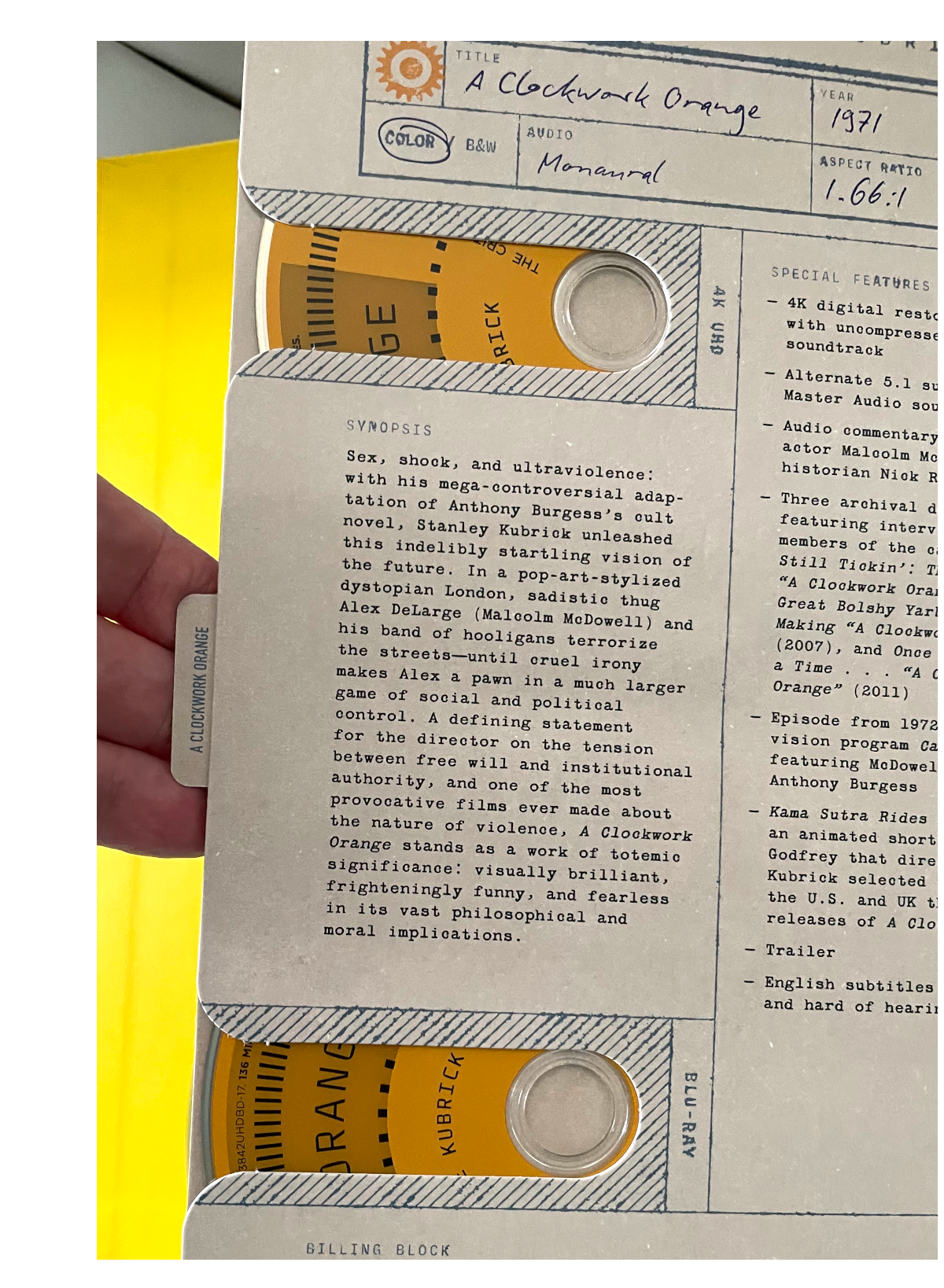
A Clockwork Orange
1971 / Color / 1:66 widescreen / 136 min. / Previous DVD Savant Review from 05/28/11
Starring: Malcolm McDowell, Warren Clarke, Patrick Magee, Michael Bates, Adrienne Corri, Aubrey Morris.
Cinematography: John Alcott
From the novel by: Anthony Burgess
Produced and written by: Stanley Kubrick
For A Clockwork Orange Stanley took on a different kind of science fiction challenge. 2001 had been rated ‘G’ just as the world’s censors moved to ratings systems, opening up a commercial conduit to rougher adult subject matter, with every broken barrier decrid by the so-called Moral Majority. The filmmaker found himself drawn to Anthony Burgess, who wrote about social breakdowns on all levels. A behavior modification solution combines drugs and torture is meant to brainwash vicious rebellion out of existence, yet is the kind of scheme guaranteed to create a Frankenstein’s monster. The future of ugly housing blocks, decadence and depravity running unchecked, is not very attactive. We also cringe at futuristic audiovisual shows with content simplified into basic viewing needs: beauty, sex, violence. The setup foretells today’s brain-dead ‘reality’ programming, in which viewers turn themselves into brainwashing subjects.
Kubrick elects to film his movie so that it looks like exploitation trash from the future — garish sets, wide angle lenses that distort victims and perpetrators alike. Even the story conceit is ugly in its predictability — that Malcolm McDowell’s nasty villain will be transformed into the victim of social forces far more malicious. Aspects of Clockwork feel like an UglyVision revisit of the delinquency theme of Joseph Losey’s These Are the Damned. It’s certainly consistent. David Gaudio convinced me that it takes the narrative form of a mirror. In the second half, McDowell suffers an inverted patterns of reversals on his previous predatory behavior.
Intentionally off-putting, yet in its own way visionary — I believe that Burgess’s thug argot was said to be English influenced by Russian syntax. A Clockwork Orange joined the ranks of unpleasant but dynamic 1971 films that might have gotten an ‘X’ rating: Straw Dogs, The Devils.
Criterion’s extras give us a chance to see and listen to Anthony Burgess. We also get an encoding of Kama Sutra Rides Again! a much lighter adult animated piece chosen by Stanley Kubrick to accompany his movie in theaters.
Barry Lyndon
1975 / Color / 1:85 widescreen / 185 min. / Previous CineSavant Review from 01/26/2026
Starring: Ryan O’Neal, Marisa Berenson, Patrick Magee, Hardy Krüger, Steven Berkoff, Gay Hamilton, Marie Kean, Diana Körner, Murray Melvin, Frank Middlemass, André Morell, Arthur O’Sullivan, Godfrey Quigley, Leonard Rossiter, Philip Stone, Leon Vitali, Wolf Kahler, Ferdy Mayne, George Sewell, Michael Hordern .
Cinematography: John Alcott
Production Designer: Ken Adam
Produced and Written by Stanley Kubrick
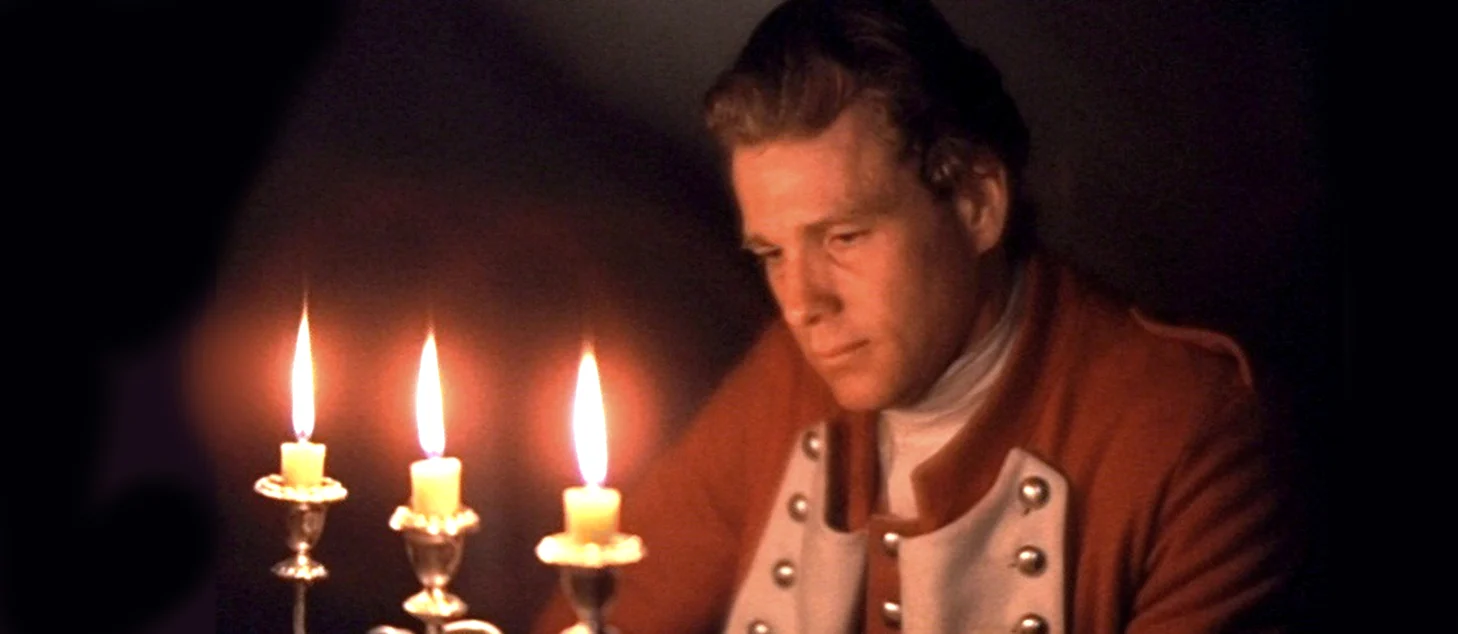
After abandoning an ambitious Napoleon project, Stanley Kubrick devoted more years to research before filming Barry Lyndon, utilizing much of the same research. The rogue’s progress of an Irish lad determined to make good is told through selected scenes, ironic narration and a filming style that works hard to emulate great art from the period. It’s an art film with plenty of ‘commercial’ content — scandals, pistol duels, highwaymen and more than one ornate battle scene, recreated in realistic detail.
Ryan O’Neal’s presence and cooperative nature makes him a good fit; Kubrick doesn’t allow us to accept him as a Tom Jones--like rogue hero. Chance is on Barry’s side more often than not, but his mulish intransigence eventually trips him up, leaving us with a vivid image of a bygone century, but little emotional connection.
The movie’s most startling innovation was filming without standard film lights. Kubrick designed his own extra-fast lenses, to shoot many scenes by actual candlelight. More than anything else, that aspect evokes the world of the 18th century.
Due to the length of the movie, Lyndon is given two full Blu-ray discs. As the show is all about the design of what’s on screen, the extras include audio input by Kubrick on everything from cinemtography to costumes, and very nice piece by Sir Christopher Frayling on designer Ken Adam.
The Shining
1980 / Color / 1:85 widescreen / 144 /119 min.
Starring: Jack Nicholson. Shelley Duvall, Danny Lloyd, Scatman Crothers, Barry Nelson, Philip Stone, Joe Turkel, Anne Jackson, Tony Burton.
Cinematography: John Alcott
Music Composers: Wendy Carlos, Rachel Elkind
Written by: Stanley Kubrick, Diane Johnson from the novel by Stephen King
Executive Producer: Jan Harlan
Producer: Stanley Kubrick
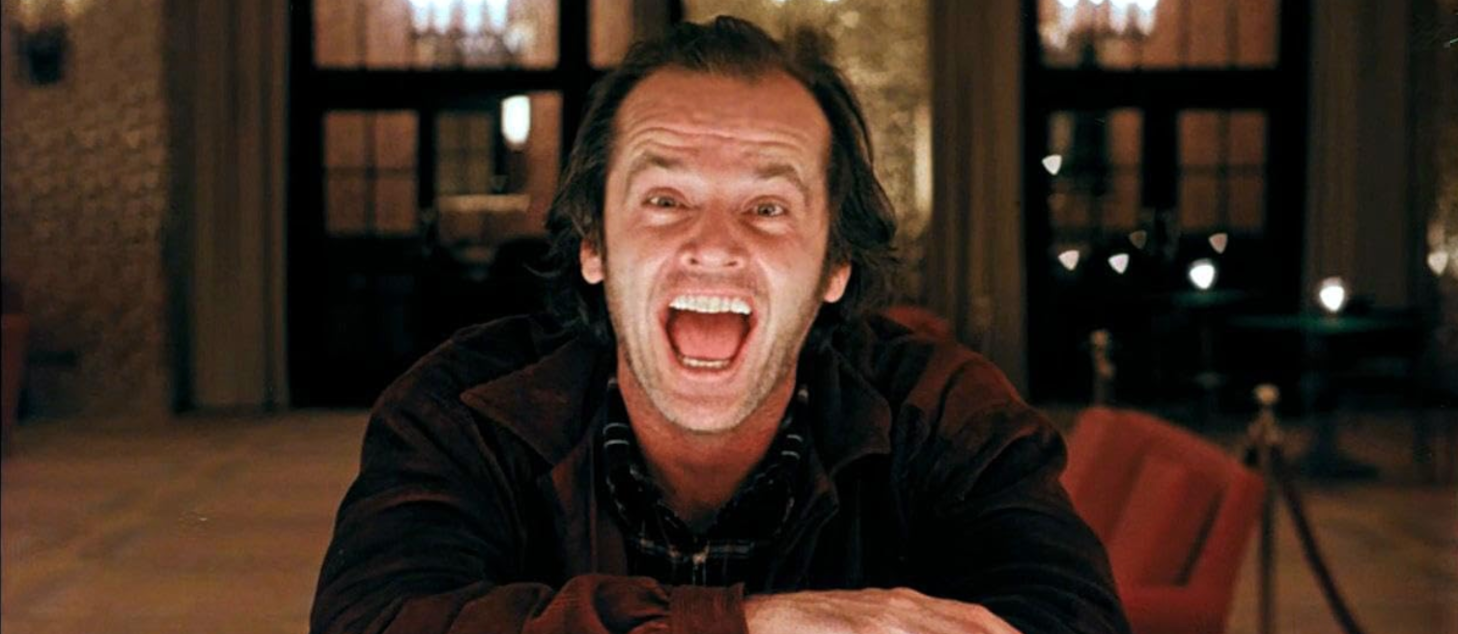
Every Kubrick movie has its controversies, and reactions to his The Shining were sharply divided between those that deemed it a masterpiece, those that judged it with comparisons to Stephen King’s novel, and those that didn’t see what it was trying to achieve. The performance of Shelley Duvall becomes unbearably intense, yet some early scenes play so loosely, they look like raw rehearsals. The spooky atmosphere is augmented with symmetrical compositions that make us think the camera is becoming psychotic. The mix of psychology and supernatural elements leaves a web of odd detail that has launched more than one obsessive study, finding cabalistic meanings in every room number and physical anomaly. For our money, we think Jack Torrance’s cosmic visits to bartender Joe Turkel fulfill everything Kubrick was after.
The set has two UHD discs for this title, the second being for a much shorter international version. Included are a stack of excellent films documenting the movie, starting with Vivian Kubrick’s 1980 Making of show, remastered in 4K. Individual featurettes profile cinematographer John Alcott and the film’s English studio, and demonstrate the flexibility of a Steadicam camera support rig.

Full Metal Jacket
1987 / Color / 1:85 widescreen / 116 min. / Previous DVD Savant Review from 08/05/2012
Starring: Matthew Modine, Adam Baldwin, Vincent D’Onofrio, Lee Ermey, Dorian Harewood, Kevyn Major Howard, Arliss Howard.
Cinematography: Douglas Milsome
Music Composer: Vivian Kubrick
Written by: Stanley Kubrick, Michael Herr, Gustav Hasford from a novel by Gustav Hasford
Producers: Jan Harlan, Michael Herr, Stanley Kubrick
After a decade of big budget Vietnam films from Cimino and Coppola, we wondered what Kubrick would have to say about the war, so many years later. He divided his picture Full Metal Jacket into halves, finishing with the expected large-scale ‘in country’ combat. It is good, but nothing could top the impact of the equally savage first half, a grueling ordeal in a boot camp. Is it a specific indictment about Marine Corps. training, an extension of François Reichenbach’s 1957 Les marines? Kubrick’s drill sergeant breaks men down with profane horror psychology. One Marine cadet goes mad, which seem appropriate in context, yet we’re not convinced that military training is a factory for sociopaths.
The most impressive thing about the film’s second half is Kubrick and Alcott’s credible vision of a Vietnamese cityscape / battleground, recreated in England. It even feels tropical. Kubrick also gives us something he usually denies us, an indentification figure. The presence of Matthew Modine’s easygoing soldier-journalist really helps.
To our surprise, we see that the Reichenbach short film is one of the extras. Another short from 1968 may explain Kubrick’s use of a Disney song as a curtain closer. Also good is another short film about the endless archives of Kubrick’s research materials, and notable items left over from his movies.
Eyes Wide Shut
1999 / Color / 1:85 widescreen / 159 min. / Previous DVD Savant Review from 03/15/2000
Starring: Tom Cruise, Nicole Kidman, Sydney Pollack, Todd Field, Marie Richardson, Rade Serbedzija, Leelee Sobieski, Vinessa Shaw, Julienne Davis, Abigail Good.
Lighting Cameraman: Larry Smilth
Music Composer: Jocelyn Pook
Written by: Stanley Kubrick Frederick Raphael inspired by ‘Traumnovelle’ by Arthur Schnitzler
Producers: Jan Harlan, Stanley W. Cook, Stanley Kubrick
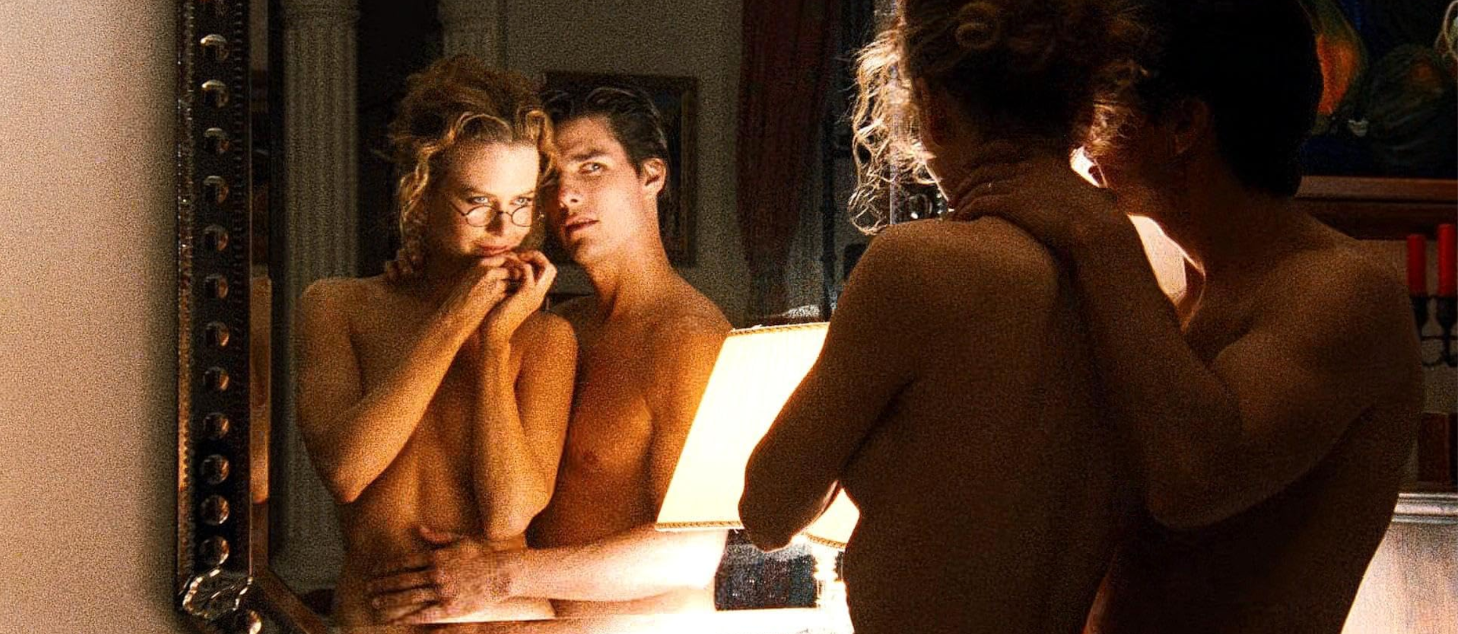
This writer wasn’t particularly responsive to Kubrick’s final film Eyes Wide Shut in 1999, yet it’s just too darn interesting to set aside as some kind of failure. It’s a weird picture, again filmed in England through the construction of an entire New York street set. Critics wondered if its slightly ‘off’ quality was related to the fact that Kubrick hadn’t lived in New York for decades. It is also too easy to wonder if the sexual fantasies of the original novel (from around 1900) really translate well when transposed forward one full century. But the story still hooks us, despite the somewhat despairingly cold, ‘am I being fulfilled?’ concerns of Tom Cruise and Nicole Kidman’s wealthy & spoiled Manhattan couple.
The ‘unknowable’ mysteries stack up — marital evasions that put a relationship in doubt, a nightclub entertainer’s connection to a grandiose ritualized sex club that may even use murder to guard its secrets. Cruise’s philandering doctor takes the bait more or less like the Puritan Young Goodman Brown. He might as well be wearing a sign around his neck reading, “I am curious Callow.” Looking for a vague sexual Shangri-La, he investigates a hidden shadow world only to get himself in over his elitist neck. Don’t this husband and wife have any deeper ties than their self-directed sex fantasies?
Eyes Wide Shut is not a terrible finish for an auteur; we applaud Kubrick’s attempt to construct a bizarre sex club around images that look like a Feuillade serial gone hyper-sexual. This title fills three Blu-ray discs for supplemental material, annotating EYS but also including Kubrick career assessment and wrap-up documentaries from Jan Harlan and Gregory Monro. Also intriguing is a docu focusing on Kubrick’s many films that were proposed but unfinished. The director left behind volumes of research and prep materials.