
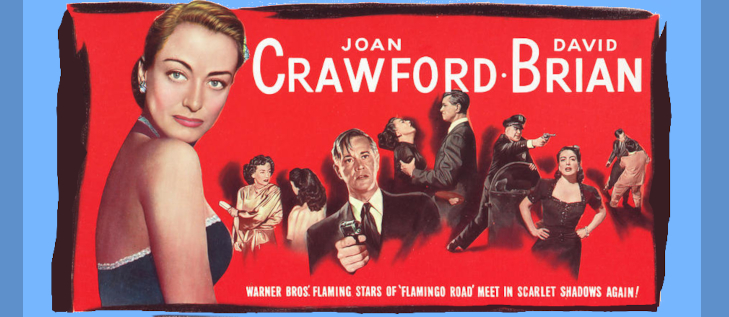


As a child I remember being told that the movie censors had made a big exception for Gone With the Wind, to let Clark Gable say ‘damn’ on screen. A word like that would never be part of a film’s title . . . or so I was told. Joan Crawford’s postwar career makeover took her image in a sentimental, psychological direction in Possessed and Humoresque. She then turned Tough with a capital T for Flamingo Road, trying to make sassy and vulgar her new style. Did Joan seek out sordid characters because her competition Olivia de Havilland & Bette Davis were unsuited to play them?
The Damned Don’t Cry sees Queen Joan going full-on gangster. Perhaps she noted James Cagney’s high-powered, ultra-violent hoodlum comeback and decided to hitch a ride on the brutal crime trend. Crawford’s slide into her new tough-woman persona is something to behold. For the rest of her career, her roles became crazy-mirror reflections of her angry personality: always misunderstood, always under attack, always being betrayed. As Frankie Valli woould say, big girls don’t cry either.

“Call Me CHEAP?” — Nothing’s cheap when you pay the price she’s paying!
This straight-faced gangster saga is easily the most fun of all of Joan’s Warners pictures after Mildred Pierce. It’s a trashy exposé of the rise and fall of an unlikely high-society gangster’s moll. Crawford, director/lover Vincent Sherman and producer Jerry Wald are 100% serious, yet the too-fast pace and over-emphatic characters can make it seem to be a parody of the whole genre. In other words, it’s irresistible.
The overly convoluted storyline makes Joan Crawford’s character into the David Copperfield of cheap tramps. Whatever you do, don’t expect subtlety.

↑ Miserable, penniless housewife & mother Ethel Whitehead (Crawford) angers her overworked oilman husband (Richard Egan) by buying her son a bicycle they can’t afford. One tragedy later, she realizes that her marriage is over. Ethel abandons hubby for a job at a cigar stand in the city, but soon becomes a model for a clothing sales firm. Sleazy good-time model Sandra (Jacqueline deWit) shows her how to make extra cash entertaining clients after hours, and Ethel blooms into a hard-talking tough girl. She meets an accountant, Martin Blackford (Kent Smith), the first of a series of introductions that lead both of them to the confident and ruthless big-time syndicate gangster George Castleman (David Brian).
Martin becomes the financial brains behind Castleman’s expanding gambling empire. Ethel is soon the big boss’s ‘special interest’ even though he is already married. Because Castleman affects a sophisticated public relations image, Ethel needs to remove some rough edges. ‘Society’ maven Patricia Longworth (Selena Royle) coaches Ethel in the finer points of classier dress and lifestyle. The makeover includes a name change to ‘Lorna Hansen Forbes,’ a moniker that makes the rounds of the society columns.
Returning from a season in Europe, Lorna is just getting comfy with George when he uses her as bait to investigate his Palm Springs operation. Is the local hood Nick Prenta (Steve Cochran) really scheming to steal a piece of Castleman’s empire of crime? Lorna’s efforts to gain Prenta’s confidence prove too successful — he proposes marriage. When she learns that George’s reaction will be to have Nick killed, Lorna begins to panic. Gee, those morally-challenged flashy gangsters’ dames have really tough personal problems.
It’s easy to distinguish this Crawford vehicle from her more prestigious Warners work: studio head Jack Warner opts not to give himself a producer credit. The Damned Don’t Cry combines a standard gangster plot with elements of the true story of Virginia Hill and Benjamin ‘Bugsy’ Siegel, an organized crime scandal then only a few years old. Nick Prenta is associated with a desert gambling Mecca. He has serious disputes with his mob overlords, just as did Bugsy Siegel.

Crawford’s forte in the 1930s had been a rags-to-riches Cinderella fantasy, playing a poor manicurist or whatever who blossoms into an impossibly glamorous cosmopolitan. This time around the transformation is from ‘innocent & impoverished’ to ‘worldly & corrupt.’ Ethel Whitehead’s downtrodden oil field hausfrau is barely a step from the depression-era portraits of demoralized shack dwellers. In her new life Ethel abandons her moral foundation and picks up a sassy, anything-goes attitude. Her stint selling cigars lasts just long enough for a dress salesman to notice her legs. That’s followed by another time-jump transformation: the formerly mousy, chaste Ethel is now a gum-chewing tramp. She saunters into a man’s office wearing only a slip.
Joan Crawford’s reborn Lorna Hansen Forbes is a perverse characterization, a garish Imitation Of A Sensual Woman. Nowhere in The Damned Don’t Cry is it confirmed that Ethel is actually sleeping with any of the men that find her so devastatingly attractive; we’re meant to understand that her admirers are too dazzled to make such crude demands. The birth name Whitehead sounds like a pimple but Ethel completely reinvents herself. The right application of clothing, makeup and manners make her worldly and glamorous. Didn’t Crawford do much the same, transforming herself into a top MGM star? How much of Damned is quasi-autobiographical?
Joan the Auteur.
Joan appears to have supervised every aspect of the show, directing her writers and personally choosing the cast. She found her co-star David Brian on the New York stage; he had already starred with her in the slightly more serious Flamingo Road. Brian’s brassy, staccato speech communicates considerable gangster authority. His George Castleman claims to be part of the new era of corporate organized crime, yet his obsession for Lorna brings out his primitive Scarface/Little Caesar qualities. Brian’s throwback mob boss is a good match for Crawford’s over-sold passion. Their high drama is played straight, but Crawford-philes ‘read’ her films on a simultaneous second level, as an intentional/unintentional parody.
Typical is a scene in the back of a car in which Crawford lectures Kent Smith, telescoping ten years of film noir loser philosophy into a few super-cynical sound bites:
“Don’t tell me about self-respect. That’s something you’ve got when you’ve got nothing else. Look, Marty, the only thing that counts is that stuff you take to the bank. I know how you feel. You’re a nice guy. But the world isn’t for nice guys. You’ve got to kick and punch and bull your way up because no one’s going to give you a lift!”
I’ve always believed that Comden and Green had Crawford’s speech in mind when writing their musical comedy The Band Wagon. Fred Astaire’s tough-guy Rod Riley struggles to stammer out the line,
“Don’t tell me about Ethics, baby — you can’t spread Ethics on a cracker!”

Sledgehammer Dramatic Overkill.
Crawford’s writers show a cartoonish knack for oversimplifying main story points. Crawford’s character can’t choose a life of crime for any of the usual reasons, it has to be the result of an extraordinary tragedy. We wonder to what degree Crawford channeled her own humble (and hidden) childhood into the film’s mawkish ‘failed first marriage’ prologue. Ethel’s awful shack of a home is right in the middle of a Signal Hill oil field, an ecological disaster that looks like a joke from a Tex Avery cartoon. Her in-laws have also been defeated by life, with the grandfather (Morris Ankrum) looking like a walking corpse.
Ethel’s drawn and bloodless face is also exaggerated, to better contrast with her later rise in crime-glamour. Like her precursor Mildred Pierce, Ethel is so devoted to her beloved son that she buys him a bicycle that will break the budget. No ordinary guilt trip will suffice: afraid that the audience might not sympathize with Ethel, the screenplay opts to have her adorable son get squirshed by a truck!
Released the same year, Cy Endfield’s noir Try and Get Me! lends a disturbing political edge to an identical working class tragedy — some audiences thought it played as Anti-American. The Damned Don’t Cry fixates on a single message — nobody could be blamed for making an escape, any escape from Ethel’s hellish situation. What will become of Ethel’s husband (a solid early appearance by Richard Egan) is not important. All that matters is What’s In It For Joan.

Ethel swaggers around the dress factory like a two-bit Carmen, turning milquetoast Kent Smith into putty in her hands. She swaps cheap insults with Jacqueline deWit’s sour-faced Sandra. → She’s a genuine trouper, letting herself be used as a no-respect version of Eve Arden. Crawford appears to have carefully chosen her supporting actresses, so that none will distract viewer attention from La Joan, not for a microsecond. We can see that Ms. deWit has been dressed, scripted and directed to come off as less attractive.
Jacqueline DeWit is given the film’s sharpest dialogue barb, a crack that equates chastity with sexlessness. Commenting on their lonely lives as models, Sandra spits out her rationalization for accepting dicey ‘get together’ dates with the dress buyers:
“All this living by yourself — that’s for channel swimmers.”
Were the censors too ignorant to pick up on the slur joke? Warners’ Young Man with a Horn from the previous year — also produced by Jerry Wald — presented Lauren Bacall as a fairly undisguised lesbian character.
The only other female roles are even less competitive. Mrs. Castleman (Edith Evanson of Rope & The Big Heat) is a neurotic wreck, emotionally crushed by her powerful husband. Ethel doesn’t seem bothered in the least.
Nor is Selena Royle a challenge to La Joan’s supremacy. Although presented as much older than Lorna, the accomplished actress was in fact born just two years before Joan Crawford. Royle’s film career would come to an end as soon as her name appeared in the blacklisting pamphlet Red Channels. That may explain why an actress of Royle’s distinction ended up in 1953’s Robot Monster.
No one’s denying that Joan Crawford was once one of the most arresting actresses in Hollywood. By this film her “I’m so gorgeous” posing no longer convinces. The ga-ga reactions this more mature Crawford elicits from dame-crazy males are hilarious. She turns the heads of dress buyers and bookkeepers as if she were Venus on the half-shell … in a tight sweater.

Yes, Lorna is the incredibly magnetic focus of all male desire. Both hoodlum chieftains become obsessed with her. George Castleman has pretentions to respectability. He sees Lorna as the perfect ‘intelligent’ mate, and trusts her so much that he can send her on a secret mission to learn Nick Prenta’s secrets. But raw jealousy causes this nationwide syndicate boss to lose all sense of judgment.
Actor Steve Cochran was apparently a real-life lady killer. He had specialized in oily thugs, from The Best Years of Our Lives through White Heat. Despite Cochran’s outstanding performance and some very good dialogue, we can’t see what attracts the wolfish Prenta to Lorna — was Palm Springs struck by a plague that killed every woman under 45? Where did Lorna pick up her polished wolf-management skills? Prenta is soon begging her to marry him.
Kent Smith’s Martin Blackford also changes his stripes. The spineless former accountant trembled at the thought of ordering an expensive nightclub meal. Now in Palm Springs, he’s talking like a Corleone consigliere, telling Lorna that her spy mission will result in a mob bloodbath, with Nick Prenta the first victim. Poor Lorna doesn’t realize how potent she is — every man she influences instantly goes to pieces.

The Damned Don’t Cry treats Joan Crawford’s character with the solemnity afforded Charles Foster Kane. Who exactly is Lorna Hansen Forbes? The media can’t get a straight answer, and neither can Nick Prenta — none of his syndicate lackeys seems to know who the Big Boss is stepping out with lately. Joan Crawford re-uses the Flashback Bookend narrative format that served her so well in Mildred Pierce. By starting with a murder and telling the story inside-out, James M. Cain’s acid critique of bourgeois ambition was reconstituted as a trendy noir murder mystery.
The big conclusion pays off in a burst of violence in Palm Springs. Battered and bruised, Lorna bawls her eyes out at the notion that, gee, murderous organized crime mobsters might actually start killing each other for real. The movie’s title makes us wish that Martin Blackford would take one look, suddenly sober up and shout at Lorna:
“Crying? Are you crying? There’s no crying in gangland!”
The return to the flashback bookend reunites the doomed characters at that little shack in Signal Hill, for more blood-letting. The final apology for our heroine is delivered by bit player Dabbs Greer: to get away from that awful oil field Ethel Whitehead might be forgiven anything. Is that epitaph a stealth autobiographical comment from Joan Crawford?
Key scenes were filmed in and around Palm Springs, where until at least 1970 the dry desert air was crystal clear. Movies like The Satan Bug make the low desert resort look extremely attractive. One of the movie’s featured locations is the ‘Twin Palms Estate,’ a famous house built for Frank Sinatra in the late 1940s. Writers frequently suggest that Sinatra entertained his own mobster friends there.
We’re told that Nick Prenta’s home movies give us a glimpse of an un-billed Ann Robinson, as one of the babes glimpsed at his pool party. The story is also told that the handsome springboard diver seen at a Palm Springs resort is none other than Strother Martin in his first uncredited film appearance. Wiki says that his nickname was ‘T-Bone Martin,’ and that at 17 he won the National Junior Springboard Diving Championship.
