
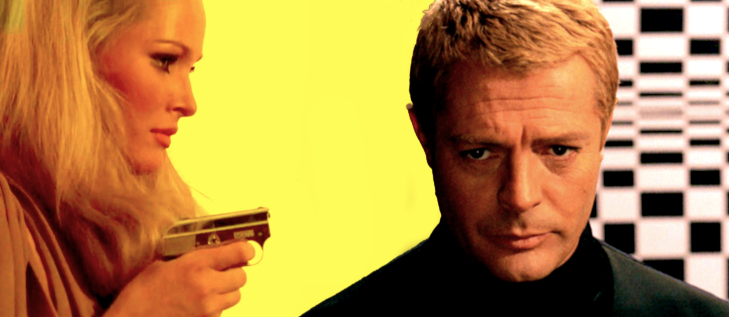


Pop Art was all the rage in 1965, even if the art world that spawned it was already moving on to newer ideas. The culture was saturated with Pop graphics and design; it elevated the appreciation of comic book graphics. Over in Italy, the filmmaker Elio Petri had been making politically-sensitive dramas, such as the crime story The Assassin with Marcello Mastroianni. With the emergence of James Bond, everybody was looking for exotic thriller ideas. Petri took a detour from his realistic fare to direct the high-visibility Sci-fi fantasy The 10th Victim La decima vittima, a project shared by top producers Carlo Ponti and Joseph E. Levine.
The production signed two of the hottest stars of the day. Marcello Mastroianni had worked with Petri before, and Ursula Andress had become world famous as the first ‘Bond girl’ in Dr. No. She was often touted as the most beautiful woman in the world. Her brief spate of superstardom included notable appearances in What’s New Pussycat, The Blue Max, Casino Royale and Hammer’s She.

The 10th Victim was a decent hit in Europe. It didn’t make much of a box office impact here, but some of its imagery did. Publicists found plenty of media coverage for its teaser prologue, in which Ursula Andress kills a man with a spiky silver bikini top that shoots bullets. Readers of Playboy couldn’t miss the photos of Andress symbolically cutting a necktie from her prey, amid applauding nightclub patrons. In France, La decima vittima made the cover of Midi Minuit Fantastique, without Ms. Andress. ←
What might initially seem a shallow guns ‘n’ sex comedy is actually an insightful satire on modern morality and Western culture’s fascination for violence. American patrons in 1965 saw the film only in its English language re-dub; the original Italian soundtrack mix lifts it a few notches upward in the science fiction genre of dysfunctional futures.

Witer Ennio Flaiano (Nights of Cabiria, Otto e mezzo) and Tonino Guerra (L’Avventura, Blow-Up) contributed to the fanciful screenplay, based on a prophetic 1953 story by the noted Sci-fi scribe Robert Sheckley. In 2079, years after World War III, the dominant worldwide interest is The Big Game, an organized murder ‘sport.’ It’s a lawful, regulated system with hunters, victims and prizes. Participants must alternate between playing hunter or victim.
Is the act of killing a primary Human Need?
The rules if The Big Game are strict. The penalty for killing the wrong person or an innocent bystander can can earn one 30 years in prison. The promoters insist that The Game makes for an excellent substitute for war, channeling mankind’s violent tendencies into a regulated spectator sport. After successful kills, Italian ace Marcello Polletti (Marcello Mastroianni) squares off in a battle of wits with American Caroline Meredith (Ursula Andress). She’s a cheerfully lethal, cold-blooded pro. He’s in the throes of a domestic dispute, seeking an annulment while resisting a marriage demand from his longtime lover Olga (Elsa Martinelli).
They say that big money diminishes major sports, and the entry of advertising money has changed The Big Hunt. A simple murder competition for fame and cash has been raised to a much higher level of deception. Popular contestants are approached by advertisers wishing to license an exciting kill as the centerpiece for an ad campaign. In turn the players create ambushes for live TV that can serve double duty as product commercials. Caroline tries to trick Marcello into an elaborate trap just outside the Coliseum. Marcello plots to lure Caroline into a pool so cameras can record her being eaten by a crocodile. To get paid the extra ad money, he mustn’t forget to recite the advertiser’s product slogan.

The broad farce logic of this futuristic Italy allows for some amusing, ironic situations. Roads are named after Fellini and Rota. Comic books are revered as great literature. When a Big Game killing happens right in front of a pair of police patrolmen, they first check the killer’s Game license. They then congratulate him over the body of his victim — and write him a parking ticket. A public announcement at the Big Hunt headquarters repeats, “A killing a day keeps the doctor away.”
As the players are also TV performers, the most popular are always looking for interesting locations to stage their murders. One player complains that killings are no longer allowed in nursery schools, a joke that now ought to fall very flat. In the film’s opening, ace cacciatrice Caroline confects to knock off her latest victim in New York City’s kinky ‘Masoch Club,’ just off Wall Street.
The tone overall is light. Director Petri’s satirical target is modern violence, not any particular political entity. Softening touches keep 10th Victim from skewing as sardonic as Ed Neumeier’s RoboCop. The party atmosphere is not spoiled by gore or trauma. Every victim dies a dramatic but neatly bloodless death.
We also note that the filmmakers are careful to steer clear of Italy’s censors. It is carefully established that the Vatican is still in full operation in 2079, and does not condone ‘the Hunt.’ The absence of divorce in Italy has been carefully preserved. Marcello is cruel to the women in his life, but he dotes on his parents. Even though the law requires that the elderly be put into homes or euthanized, Marcello hides his old folks away in a secret room in his house. Caroline doesn’t have a problem with old folks, as she was born in the “Hoboken Fertilization Center.” Roman culture favors odd preoccupations. For many, church-going has been replaced by Designer Faith Systems. For a day job, Marcello leads a sun-worshipping cult that hasn’t been paying well lately. He proudly boasts, “I get 20%.”

Always a new, gruesome double cross in the works.
Robert Sheckley’s short story is said to be wickedly funny. The basic idea is a dystopian extrapolation of Richard Connell’s 1924 short story The Most Dangerous Game, in which a deranged nobleman hunts people on a private island. The 10th Victim’s ‘legalized killing’ idea likely inspired dozens more cheap ‘murder game’ movies. Petri’s film remains engaging throughout, but the story loses some forward momentum in the second half. Once the novel situation is established, the Marcello and Caroline characters don’t develop further. Both remain shallow and selfish, so we don’t really identify with either. That leaves us with a mechanical resolution to their ‘romantic problem.’ It makes us think a bit of John Huston’s much-later romance between a hit man and a hit woman, Prizzi’s Honor.
The cynical world pictured doesn’t leave much room for us to believe in Marcello and Caroline’s romantic sincerity. These top stars always look attractive together, but there’s not all that much sexual chemistry between them. Cool cat Marcello usually plays passive in his sex comedies, relying on a highly sexed female co-star to get into gear. His most successful co-star was Sophia Loren, whose sex appeal always seemed multi-dimensional. Ursula Andress’s appeal is almost exclusively visual. As she indeed looks capable of cold-blooded murder, she is well-cast. But the Sci-fi satire hovers between slapstick irony and light comedy, a Pop Art spin on “Homicide, Italian Style.”

We get the feeling that much of the movie was staged for exteriors to save money, and the sunny visuals don’t always support the idea of a Pop Art super-future. The cars of 2079 are vintage 1965. There are numerous futuristic interior sets, but ‘normal’ upscale interior decoration in 1960s Italian design magazines already looked futuristic. We do see scores of intriguing Mod costumes. Some don’t seem all that practical. They include a brief glimpse at some latex space suits repurposed from Mario Bava’s Planet of the Vampires.

Although the art direction is futuristic / comic-book in style, the camera direction is too conventional to capture the kinetic flavor of a comic book graphics. Two years later, Bava’s Danger: Diabolik would capture the tone precisely, making audiences feel as if they are in a comic book. Occasional scenes do make the grade, such as Caroline’s dance in the Masoch Club. One of the assassination attempts also comes through well, a killing directed to play out before the camera of a ‘Ming Tea’ commercial. A corps of mod-attired dancers add choreography to the TV ad.
In today’s information jungle, a big chunk of network and cable TV is infested with reality programming, true-life crime docus alternate with scripted/unscripted ‘action games’ that make contestants compete in dangerous-looking stunts. Elio Petri’s focus frequently shifts from the mechanics of The Big Game, to his culture’s turn toward sensational amorality. Marcello Poletti is famous and rich, but he’s also bored. He needs to be in imminent danger, just to keep his blood circulating.

Beautiful Elsa Martinelli was at the end of a very short Hollywood career. Her American fame is really for just one picture, Howard Hawks’ Hatari!, although she was ‘introduced’ ten years before in a Kirk Douglas western. We want to see a full restoration of her weird French horror film filmed in Technirama. Also in the cast are Salvo Randone, who played in seven Elio Petri pictures, and Mickey Knox, the Hollywood actor who relocated to Rome in the 1960s and had a busy career as a dialogue coach and dubbing director. He is now most noted as an English-language screenwriter for Sergio Leone.
This fantasy is accepted as the odd film out in Elio Petri’s career. He would soon earn respect as a writer-director of political films, often held in the same esteem as those by Francesco Rosi. Petri often collaborated with actor Gian Maria Volontè, and won an Oscar for Investigation of a Citizen Above Suspicion. We’ve also reviewed Petri’s The Assassin, We Still Kill the Old Way, The Working Class Goes to Heaven and Property is No Longer a Theft.
Few Sci-fi writers of Robert Sheckley’s generation became rich. It’s possible that a magazine syndicate reaped the fee when his original short story Seventh Victim moved from the page to the screen. The prolific writer ended up writing the tie-in novelization to go with The 10th Victim. The full story is written up in a chapter of S.M. Guarentino’s book on movie novelizations, Light into Ink.


Sheckley’s original story was titled The Seventh Victim, upgraded to the Tenth Victim for the movie and the novelization. Of course, the concept of a hitman dating a hitwoman was part of Richard Condon’s novel Prizzi’s Honor, which John Huston did an excellent job of adapting as a film.
I always just assumed that the existence of another film called The 7th Victim was the reason for the alteration of the title.