
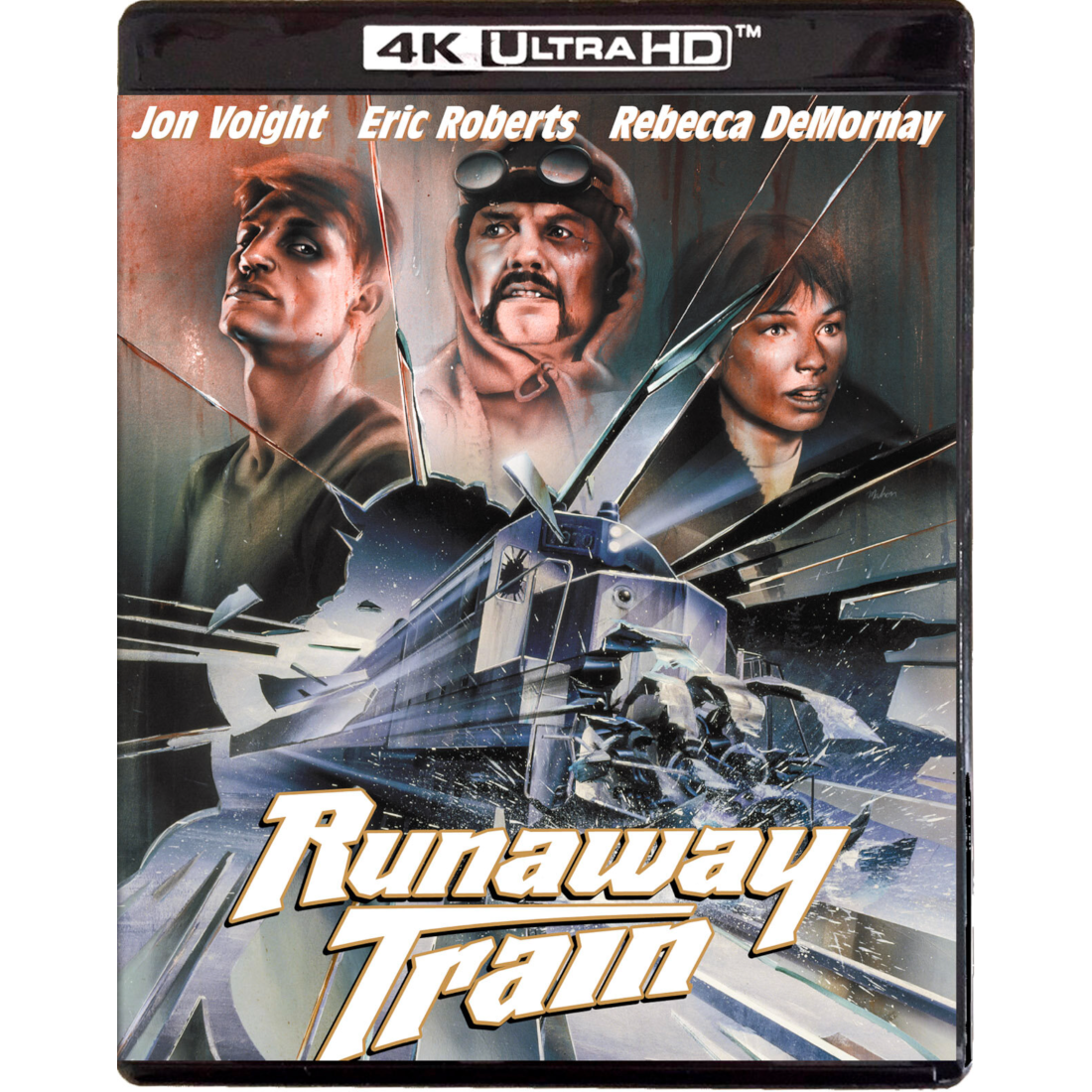

Everybody had good things to say about the action film Runaway Train, right from the get-go. Even with Cannon’s patchy distribution effort, its success made it easier for Menachem and Yoram to attract big investment dollars at Cannes. I remember seeing local news coverage of the filming here in Los Angeles. The production took over the crumbling Pan Pacific Auditorium, to shoot large-scale special effects using enormous train mock-ups.
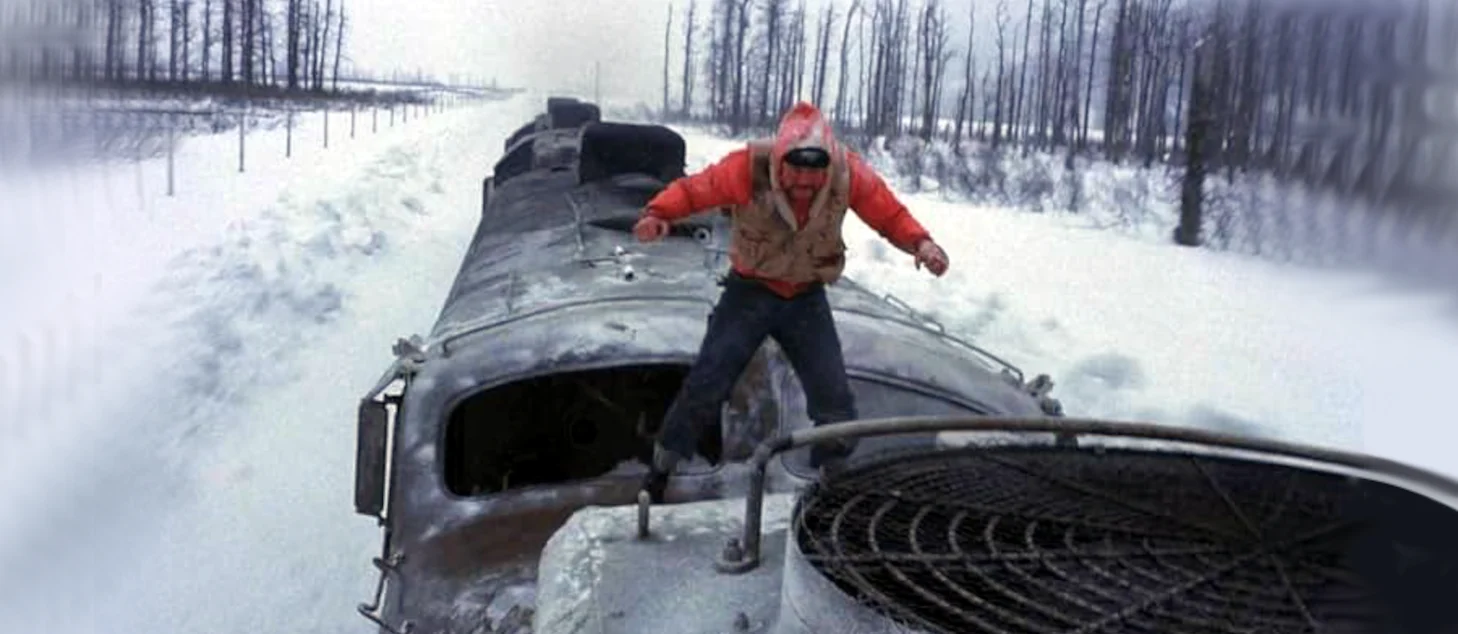
I’m jumping to review Runaway Train for a third time because the quality is greatly improved. I say more below, but the short explanation is that the original negative was accessed for this new 4K scan. On previous videos, much of the film seemed to mush together in a kind of silver grayness. Now it all stands out sharp as a tack. The wind-blown snow is not some optical effect. Every third shot makes us think, ‘Thats a heck of a killer take, done on a moving train, with a feeling of immediacy we’d never expect to see.’ And this is before Computer Generated Imagery. Most shots are not visual tricks done with those full-sized train mock-ups.
Runaway Train can boast a high-toned pedigree, as its source is a screenplay written by the highly respected Akira Kurosawa. But Andrei Konchalovsky’s directing contribution is what filled theaters. The show is two hours of relentless action, with a single-mindedness of purpose. It isn’t just that there’s no narrative fat. Little time is wasted on sidebar stories or deep character background. At least two-thirds of the running time is spent on a snow-covered freight train barreling through a frozen wilderness, out of control.
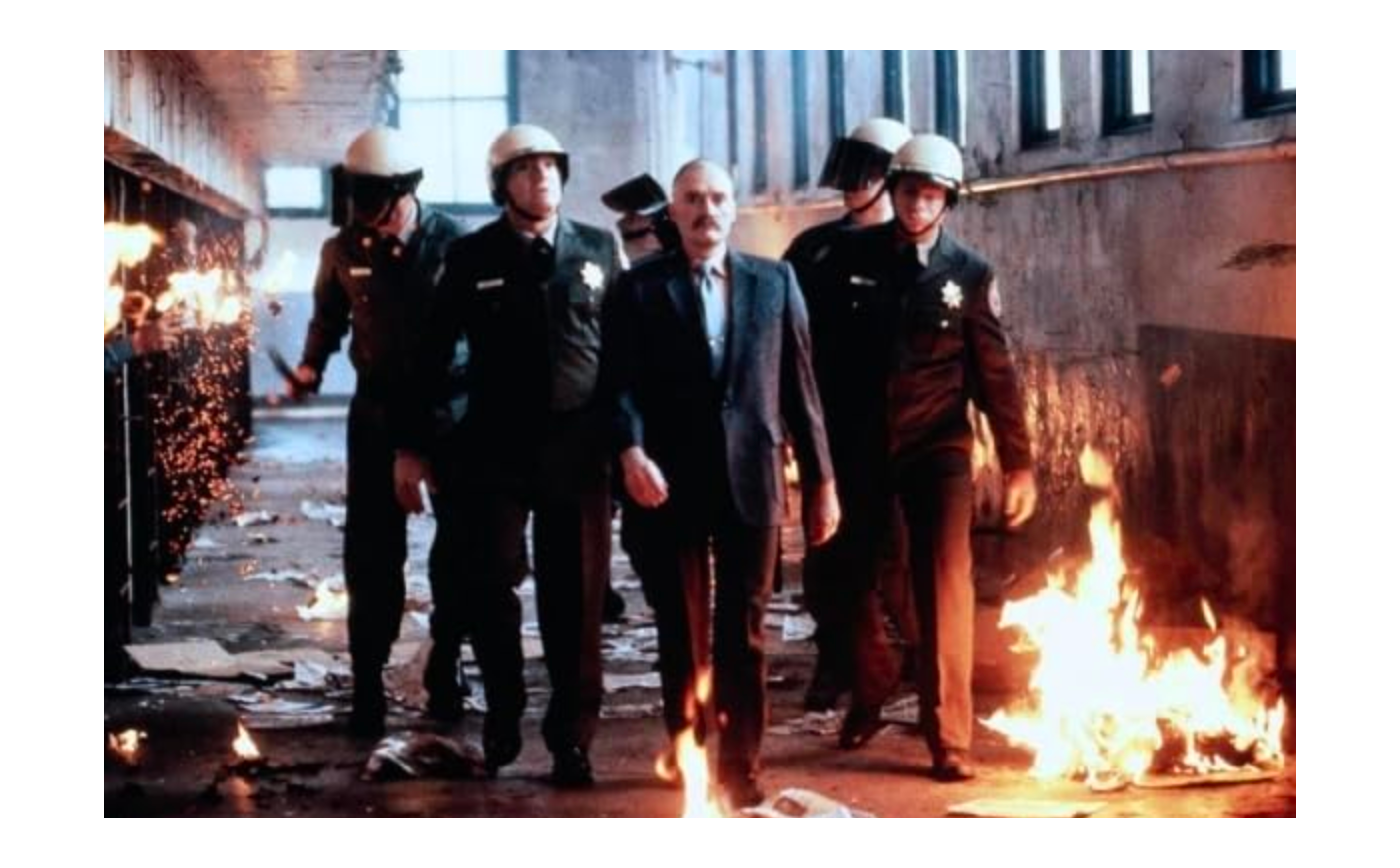
The movie has the simplicity of a graphic novel — everything is exaggerated, yet believable. Alaska’s Stonehaven Maximum Security Prison is a hellhole in a constant state of near-riot. Prisoners and guards alike have been driven mad by the psychotic Warden Ranken (John P. Ryan), who is notorious for bragging on TV about how he treats the ‘animals’ in his care. Rankin’s equally legendary ‘star’ inmate is Oscar ‘Manny’ Mannheim (Jon Voight). Manny hasn’t left his isolation cell in three years — Ranken had the door welded shut. A court order springs Manny from that confinement, but Ranken retaliates by paying a prisoner to murder him.
When that fails Manny determines to use an escape route through the sewer. His brother and fellow convict Jonah (co-screenwriter Edward Bunker) can’t come along, so Manny allows prison boxer Buck McGeehy (Eric Roberts) to join him to flee into the terrible winter snow. Luck presents them with an opportunity in the rail yard: they hide themselves aboard a string of fast freight engines just pulling out. What they don’t know is that the engineer has had a heart attack: they are trapped on a speeding train, unable to reach the lead locomotive containing the shutdown controls. They are soon joined by Sara (Rebecca De Mornay), a railroad employee caught on board because she was sleeping on the job.

Ugly, explicit dialogue makes Stonehaven seem the worst possible place to be incarcerated. The movie has the tone of a Paul Verhoeven picture without Verhoeven’s off-putting excesses. Kurosawa’s screenplay was reworked by a pair of experienced writers. Paul Zindel also wrote the fine play The Effect of Gamma Rays on Man-In-the-Moon Marigolds. Former convict Edward Bunker contributed to the excellent Straight Time, the movie in which Dustin Hoffman plays a paroled thief. The soundtrack crackles with good dialogue, even in the more cartoonish prison scenes. When Ranken sends a hit man to kill Manny during a boxing bout, the entire prison population knows what’s going on.
When a movie’s characters do little more than scream at each other for two hours the effect can be mind-numbing. It’s bearable here because every outburst gets us closer to the psychology of the characters. Jon Voight’s Manny is your standard Rebelus Extremus, a Spartacus with bad teeth, scars around his eyes and the stigmata of a fresh impalement through his left hand. That wound only makes Manny a little less tough than he might be. Voight wears eye-damage makeup through the entire picture, even in the frozen location. That alone is impressive.
The character dynamic is tense from the outset. Buck is an insecure motormouth desperately in need of approval; he idolizes Manny for all the wrong reasons. Manny freaks out several times during the train ride ordeal, lapsing into uncontrollable rage. A simple access door that won’t open makes him thrash around like a mad bull.
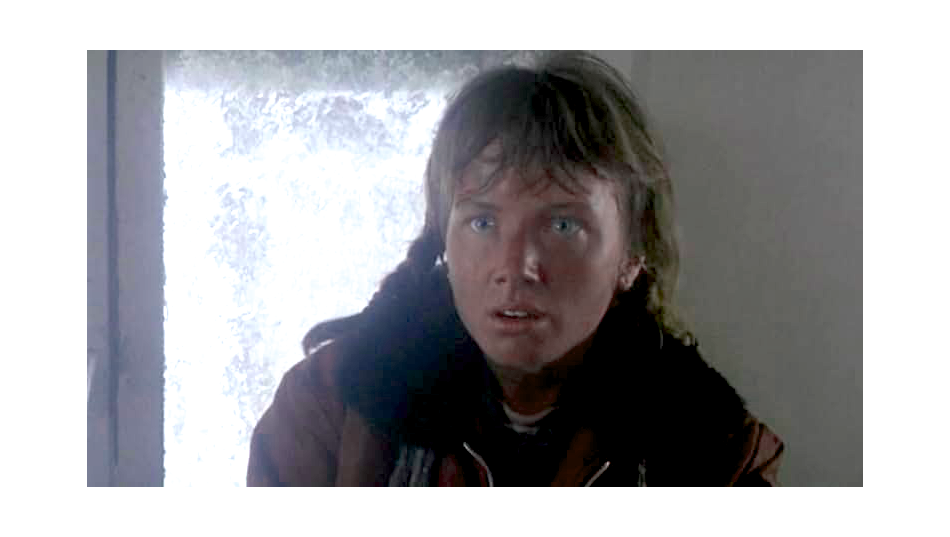
Most commercial movies in 1985 needed ‘a girl’ somewhere in the proceedings. The talented Rebecca De Mornay does great things with the role, even though her Sara serves to dispense exposition and to ask tough questions of the deranged Manny. Frequent cutaways take us back to the management chaos back at the railroad control headquarters, scenes that remind us of the excellent crime thriller The Taking of Pelham One Two Three. Train master Kyle T. Heffner is proud of his computerized MS-DOS train system. Kenneth McMillan is a welcome presence during all the yelling and arguing. Should they derail the train, or let it continue and hope for the best?
The great John P. Ryan (The Missouri Breaks, The Right Stuff) plays the maniacal Ranken almost like the villain in a superhero story. For him Manny might as well be The Great White Whale. The film gets away with the unlikely gag of having a helicopter pace the train at 80-90 mph, so that a man can try to transfer to it via a rope ladder. It looks pretty damn real. Is there extra pay for that? Director Konchalovsky’s action finesse betters that of Spielberg’s Indiana Jones movies. The action feels more credible, and less cartoonish than that of the later Tom Cruise Mission: Impossible series.
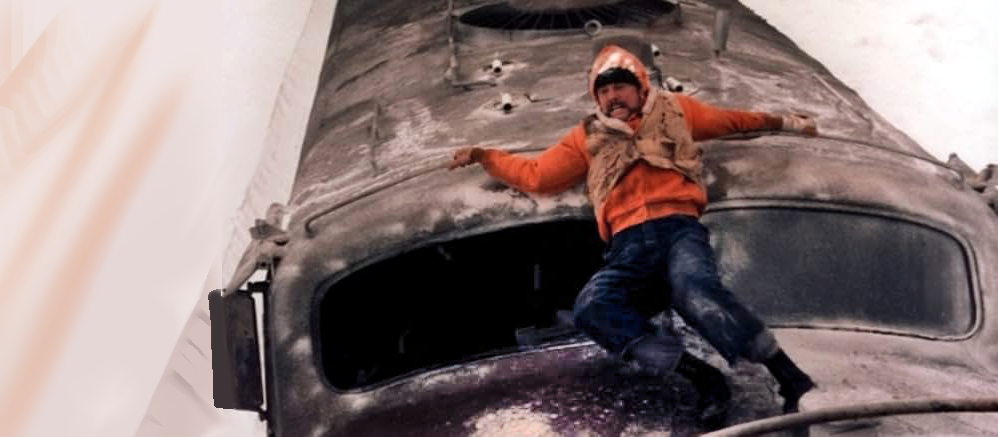
The camera crew and effects experts on Runaway Train pull off illusions so good that they’d never be noticed come Oscar time, although the film was nominated for Henry Richardson’s editing. What amazed viewers in 1985 was the apparent realism — CG Imagery hadn’t yet compromised the notion of suspension of disbelief. We get so many great angles of our actors on the moving train that we really believe they’re out there in the elements, hanging onto the speeding, frozen juggernaut. Sticking one’s head out a window at 80 mph isn’t recommended, and doing it in the frozen air would hit one’s face like sandpaper.

Process photography with train mockups saves the day — the angles are so fresh, it doesn’t even look like process photography — possibly front-projection. The camera isn’t locked down, and in fact, jostles all over the place, imitating the difficulty a cameraman would experience filming on a speeding locomotive. If my recollection is correct, the behind-the-scenes featurette showed some shots being filmed silent-movie style, with rolling backdrops of painted canvasses of trees (a side angle) or the railway bed (down angle). Blurred with the camera shutter and equalized in the film grading, the old-fashioned trick works especially well with close-ups, when characters are hanging between the cars.
Any time you see anybody working around a real train, be very aware of the everyday hazards and the potential price of a simple miscalculation. There’s plenty of frightening stunt work in Runaway Train, filmed way out in the snow in Alaska and Montana. The show never cheats on these visuals. Chalk that up to the Russian director, eager for a technical challenge. The realistic veneer is everything — the movie wouldn’t work at all if we didn’t believe what we were seeing.

The third act gives Manny several philosophical ‘author’s message’ speeches. We like the idea that somebody is giving some thought to what all this mayhem might mean, even if it’s a sticky gum-wad about man’s eternal struggle for freedom. Manny is a mad dog in search of an apocalypse yet also a tortured soul. He tells Buck that the most beautiful thing in the world would be a menial job that offered peace and anonymity. When Sara speaks the word ‘animal’ again, Manny gets all up in her face, ready to kill — and then says simply that he’s something worse than an animal: ‘human.’ Awards voters were duly impressed, as Voight was nominated for Best Actor by the Academy and won the same with the Golden Globes. We also like that Runaway Train’s finale has the guts to skip exploitation fireworks, to instead end on an art film vibe. I don’t recall anybody saying they felt short-changed.
Runaway Train became a moderate hit, which for Cannon Films was the equivalent of a worldwide blockbuster. It allowed Andrei Konchalovsky to proceed to my favorite of his films, Shy People. The expensive Louisiana-shot drama is of no particular genre, and would never have been made otherwise. The Cannon Group ground out hundreds of awful movies, but also a few gems.

Cannon dropped the ball and actually financed a GOOD film!
Hard to believe Jon Voight used to be a good actor.