



Kino’s ongoing series ‘The Golden Age of the Exploitation Picture’ has creeped through every vintage sensation that could be 4-walled, carnival style, sometimes with sexes segregated and nurses in attendance. Some are halfway serious and others were just lurid junk, all claiming educational value to get past wary local censors. Back in the ‘thirties, New York residents would slip away to New Jersey, and curious Kansas City, Missouri folk might cross the river to Kansas City, Kansas to check out forbidden fare. Just think, with just one disc you can move your TV room to the BAD side of town.
Volume 13 of the series gives us a pair of pictures partly produced by civic-minded entities in the U.S. and Canada, efforts aiming to stem the flood of VD that was estimated to affect over 10% of the population at large. These weren’t sleazy productions but serious attempts to legitimize fare rejected by the incoming Production Code — rejected with the decision that ‘education’ films had no place in the movie entertainment industry. Both films are professionally produced and star known actors, albeit in some cases actors with careers in retrograde.

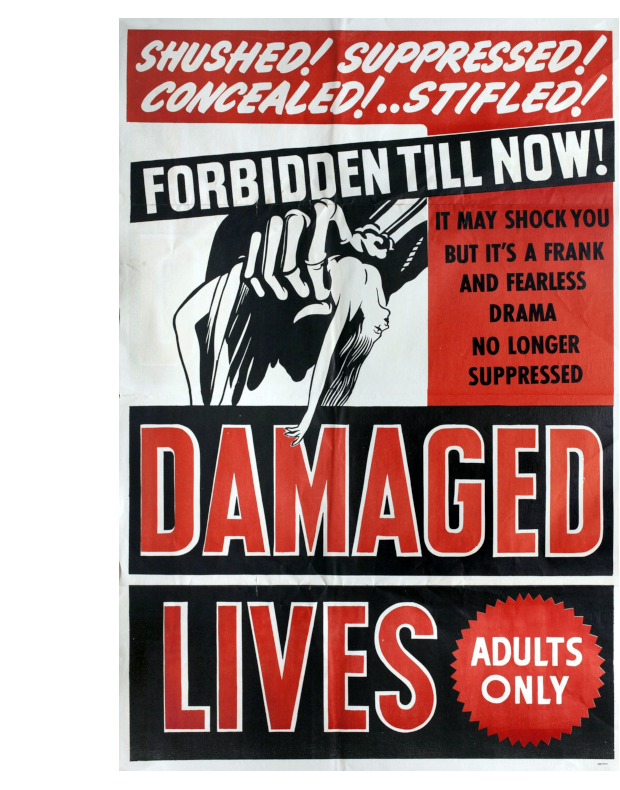
Damaged Lives
1933 / B&W / 1:37 Academy / 70 min.
Starring: Diane Sinclair, Lyman Williams, George Irving, Almeda Fowler, Jason Robards Sr., Marceline Day, Charlotte Merriam, Murray Kinnell, Harry Myers, Victor Potel, Cecilia Parker.
Cinematography: Allen G. Siegler
Film Editor: Otto Meyer
Written by Donald Davis, Edgar G. Ulmer from the play Les Avaries by Eugène Brieux
Produced by J.J. Allen, Maxwell Cohn, Nat Cohn
Directed by Edgar G. Ulmer
Damaged Lives is a serious pre-Code drama with a special added-interest factor: its director is Edgar G. Ulmer. The cult figure’s more obscure work is slowly arriving on Blu-ray — just weeks ago Kino released a double bill of his late-career science fiction pictures. Ulmer directed this drama before his famous Univeral horror film with Karloff and Lugosi. Although a rush job (reportedly 8 days) it plays well and features two standout sequences that can be praised as ‘stylistically notable.’ It’s also Ulmer’s first talkie directing credit. How reliable were his English-language skills in 1933? At one point a drunken character calls another a prick, loud and clear.
The somewhat klunky story comes from a French play that became the template for cautionary ‘innocent guy runs afoul of forbidden sin’ stories. The young heir to a shipping company Don Bradley (Lyman Williams of Supernatural) is engaged to the ‘quality’ woman Joan (Diane Sinclair) but gets enticed into a wild night of partying that ends in the bed of party girl Elise Cooper (Charlotte Merriam of Night Nurse). Don keeps his actions secret and after a quack doctor tells him he’s perfectly fine (for $100) goes through with the marriage. Only when Joan becomes pregnant does the truth come out. When Don goes back to see Elise, a terrible scandal ensues. Will the marriage survive? What about the baby?
Damaged Lives wants to be progressive but still implies a heavy ‘wages of sin’ message. Yet Elise is actually a fun date unaware of her contagion, and the story shifts some of the blame on a night of booze & ‘lessened inhibitions.’ Elise and Don are amused by older men that consort with loose women and prostitutes. One of them is stone drunk the whole time — sure enough, he’s played by the adroit Harry Myers, Charlie Chaplin’s drunken millionaire in City Lights.

The way the cops and Don’s own family drill him with questions about his indiscretion shows us how thin is the veneer of respectability: Don is too dazed and too stupid to trust the health of his wife and future child to a real doctor. The result might as well be a supernatural curse. In a classic scene, a doctor takes Don on a ‘horror tour’ of various Syphilis victims seen one at a time through separate doors. It’s as if the clinic is a Zoo of Venereal Horror, or the chain of horror rooms from The Masque of the Red Death.
The worst we see is a man with spots all over his body; the real horrors are saved for the ‘lecture’ reel shown after the feature. We’re told that having a separate ‘hard’ reel allowed the travelling exhibitor to judge the local level of censor tolerance before springing images with graphic gynecology and diseased gore on his audience. Imagine the prudish media world of the 1930s, where even mild profanity and vulgarity was strictly back-alley entertainment. Some of these images would definitely inspire fainting spells — and likely scare young people into thinking that sex itself is evil.
The disc commentator Eric Schaefer wonders if a fancy setting — Elise lives in a swank art deco flat — were designed by Ulmer, but the director more likely helped choose it from standing sets available at General Services Studio (where I worked 50 years later!). We’re told that some local censors excised the ‘victim sideshow’ sequence in the clinic — and also a harmless scene in which the married couple embrace in a shared bed.

Two sequences guarantee Damaged Lives a high roost in the Ulmer filmography. The first is an artful set of superimpositions over a close-up of poor Joan as she realizes that her unborn baby may be striken with a horrible disease. Joan has been acting like a zombie since she got the news, and now we see a brief montage of faces, silhouettes, etc., expressing her mind-numbing despair. When they get home, Joan and Don are confronted by a friend bearing the gift of a bassinette for the baby — the new life and hope that Don has cursed with debilitating afflictions. ↓
Ulmer’s second standout scene is Joan’s attempt at a murder-suicide, to obliterate the unthinkable shame and sin and evil that has descended on them. We already have Elise’s example; the ‘loose’ woman considered the infection a death sentence as well. Joan moves around the apartment like a phantom, with good close-up angles of the knobs on her gas oven, etc.. A classical piece comes in softly, breaking the silence, reminding us of Ulmer’s interest in music. For 1933 it’s an unusually expressive scene.
The acting honors all go to the women. Diane Sinclair is touching as the loving, unsuspecting Joan, who cannot face the shame and horror in her future — possible physical and mental damage plus a new status as a social pariah. A doctors downplays the stigma, but then plucks a small child away from Joan, protecting him from the sin-plague she carries. Joan’s best friend is played by Marceline Day, the star of Buster Keaton’s The Cameraman. Several of the actors had one or two big roles but almost nothing after ’33 or 34′ — we wonder if playing in a film like Damaged Lives was a symptom of a declining career, or a prime cause.

It’s good that we identify with Diane Sinclair’s pathetic wife because George Lyman is a weak leading man. He looks great but carries an uncomprehending look on his face at all times. Don Bradley represents upscale complacency, the entitled kind that comes with the assurance that bad things happen to ‘other people.’ Don places his self-image and social standing over good health for himself and his loved ones. Even if this kind of cluelessness was (is) the norm, we don’t like Don at all. Don’s best friend is a doctor, played by Jason Robards Sr. (of Isle of the Dead).
The screenplay implies that prosperous swells like Don are too status-insecure to be honest with anyone about humiliating personal secrets. And no matter what the ‘good doctor’ says, his attitude is the same as that of the cops and various family members: Don has crossed a line into Unspeakable Sin territory, and dragged Joan and the baby down with him. We’re grateful for the film’s tentatively positive ending, but the message is still that
ANY kind of sex relationship outside of sanctified,
blood-tested, law-ordained marriage is a ticket to oblivion!

Damaged Goods
1937 / B&W / 1:37 Academy / 59 min. / Marriage Forbidden, Forbidden Desire
Starring: Pedro de Cordoba, Phyllis Barry, Douglas Walton, Arletta Duncan, Ferdinand Munier, Esther Dale, Clarence Wilson, Greta Meyer, Frank Melton, Dorothy Short.
Cinematography: Ira H. Morgan
Production Designer: Frank Dexter
Film Editor: Holbrook N. Todd
Written by Joseph Hoffman from the novel by Upton Sinclair from the play Les Avaries by Eugène Brieux
Produced by Phil Goldstone, Irving Starr
Directed by Phil Stone (Goldstone)
We’re told that one reason the 1933 Damaged Lives looks so professional is that it was actually produced by Columbia Pictures under a shadow company, ‘Weldon Pictures.’ It was soon reissued, perhaps with alterations, under the sex-sational exploitation titles The Shocking Truth and The Kiss that Kills.
The same story had been made at least twice as a silent picture. The famed author Upton Sinclair thought the subject so important that he asked for permission to adapt the play into a novel, and from it was produced a second sound version called Damaged Goods, that is even more serious about the major public health issue. Sinclair’s political opinions come through strongly, with story twists that regard Sexually Transmitted Diseases as a symptom of class warfare.
Upton Sinclair makes some pertinent changes to the story line. At his own bachelor party, George Dupont (Douglas Walton of The Bride of Frankenstein and Murder, My Sweet) sleeps with Margie (Phyllis Barry), one of a number of girls ‘hired’ for the occasion. When he feels sickly, George sees his reliable doctor, who tells him to put off his marriage by at least three years, so his Syphilis can be cleared up.
Thinking he’s protecting his future, George instead stupidly hides the truth from the family of his sweetheart Henrietta (Arletta Duncan), the daughter of a Congressman who would surely show him the door. Just as in Damaged Lives George goes to a quack who fakes a cure. George then marries Henrietta — and the horrible secret comes out when their baby is born.
As 1937 is no longer the pre-Code era, the suicide scenes are out. They’re replaced by insightful new wrinkles that relate VD to class and economic differences. The call-girl Margie admits she knew she had Syphilis but doesn’t care, as her life was ruined when she was seduced as a teenager, and she doesn’t mind what affect she has on ‘respectable’ people. George’s own mother Mrs. Dupont (Esther Dale, an excellent performance) focuses on defending the family name. She tries to keep Henrietta ignorant of her malady. Mrs. Dupont also promises the baby’s wet nurse, Bertha (Greta Meyer) a $1,000 bonus to stay with the child all the way through weaning. Bertha instead blackmails the Duponts, for her silence regarding the family’s shame.

In other words, VD thrives on social inequality. The rich make it a reason to shun those less well off, and the poor don’t mind taking advantage of it to strike back against social oppression. This is a much more ‘communist’ movie than anything by The Hollywood Ten.
Get Thee Behind Me, Syphilis!
The issue returns to basic social hygiene with the character of Dr. Walker, played by the familiar character actor Pedro de Cordoba, who gets top billing. With impassioned fervor, Walker attacks the self-serving notion that VD is a moral issue, that people who have it are depraved. His zeal to destroy Syphilis is like Dr. Van Helsing’s to destroy vampirism: both ‘diseases’ flourish in a culture of ignorance, superstition and denial. That jerk George doesn’t deserve Dr. Walker’s help, but he’s in good hands. De Cordoba’s performance reminds us of Peter Cushing, too! ↓
Neither the pre- nor the post- Code versions of this story have any salacious content to speak of. No lovemaking is depicted, and the closest to nudity are a couple of brief shots of a woman dancing on a table. The illicit lovers in the first film disappear behind closed doors to have sex; George and Margie just exit the frame, as a hastily discarded wine glass falls symbolically to the floor. If it hadn’t fallen, would George have had better luck?

The ‘loose’ women in both films don’t look or act depraved, just . . . agreeable. It’s too bad that simple adventurism had to entail such a tangle of guilt and disapproval. Society mothers apparently keep their ‘good daughters’ ignorant of everything, yet foolishly assume that boys from good families have ‘clean blood.’ The young brides are doubly victimized. Dr. Walker tries to drive home the idea that assigning social guilt is counter-productive. Henrietta’s Congressman father at first declares that he wants to kill George, but then admits that he also sowed wild oats before marriage. Dr. Walker effectively argues that he was no better than George, just luckier.
Upton Sinclair’s assessment was spot on: just a few years later antibiotics like penicillin made Syphilis and Gonorrhea much easier to stop — but that ignorance and social prejudice keep them alive. As was the norm in the 1930s none of these topics was considered fit conversation in polite society. Characters in both movies dance around Subject A without saying anything, expecting the other person to understand that VD has entered the building. For that matter, nobody says the word ‘pregnant’ anywhere either.
These movies remind me that when I was married in California, a law was still in place that required blood tests to take out a marriage license. Being just as ignorant as the men in the movies made 40 years earlier — what, I could get VD too? — I had to ask why. The clerks at the courthouse didn’t want to answer me directly!
