
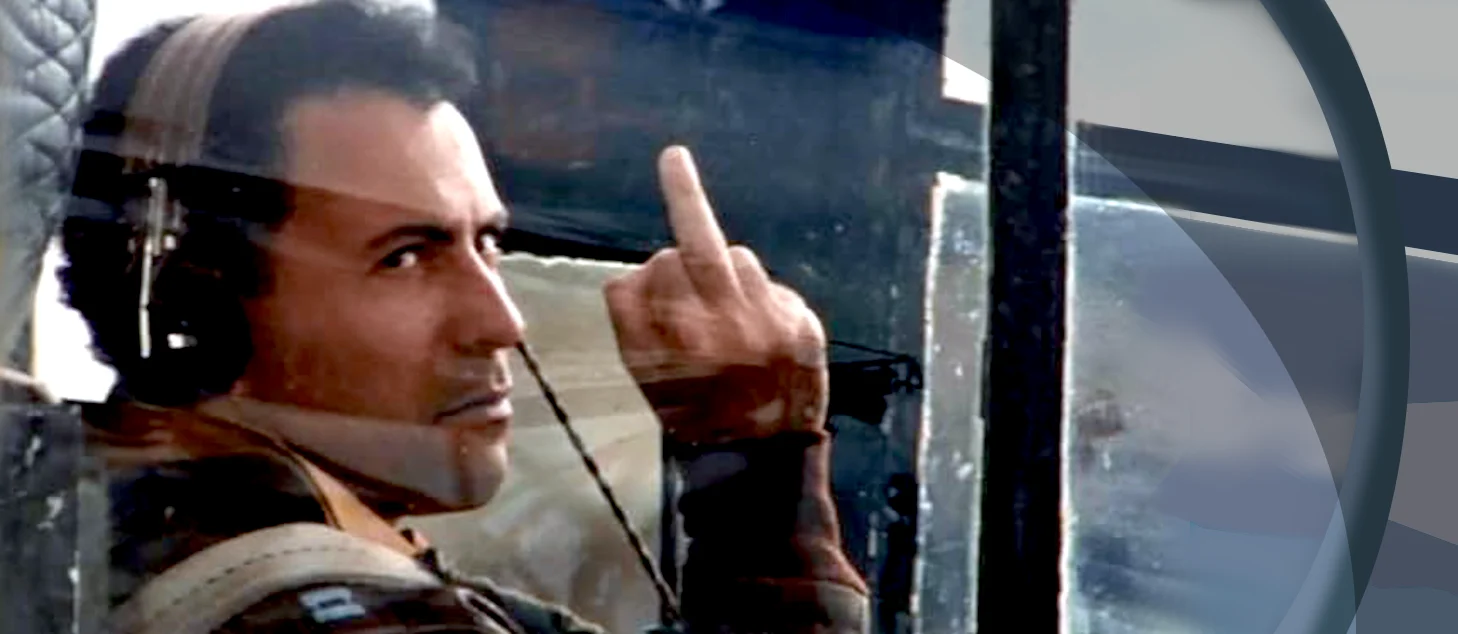


Director Mike Nichols spent 1969 directing a dream project in Mexico, with an all-star ensemble cast of big names eager to be associated with the genius who made Who’s Afraid of Virginia Woolf? and The Graduate. The glorious ‘director’s decade’ was getting underway, and an adaptation of Joseph Heller’s wicked satire about World War II seemed the greatest movie anybody could make.
Produced as an expensive epic, Nichols’ Catch-22 is a fascinating black comedy that can’t quite translate the odd vibe of fatalism in Joseph Heller’s acclaimed novel. The superb cast does fine work with the original’s many inspired dialogues. A dry airstrip with real airplanes becomes a comedy stage for Heller’s cast of airmen, with absurd names like Duckett, Korn, Dreedle, Moodus and Daneeka. The laughs are technically accomplished and beautifully performed … but Heller’s droll despair sags toward a kind of hipster cynicism.
Sporadically funny, the show is actually more successful as a horror tale. We sympathize with Alan Arkin’s everyman bombardier, a poor sap caught in a war-bureaucracy nightmare, but we’re too shell-shocked to invest in him. Screenwriter Buck Henry pre-empts our emotional commitment with shock gore effects. The unpleasantries repelled mainstream audiences, that fled back to the relative security of Robert Altman’s M*A*S*H. Altman’s gross-out gore was less upsetting, and its brand of frat boy humor less challenging.
What is this Kerouac / Kesey dissenter doing, plunked down in John Wayne territory?
The author was indeed a B-25 bombardier on the Italian front, and flew 60 missions, but he never claimed that his novel was realistic. An A.A.C. base has been established on the island of Pianosa: afraid of losing his life on missions over Italy, unrepentant slacker Yossarian (Alan Arkin) desperately tries to get exempted from combat duty. Insane men can’t fly, but no matter how crazy he behaves, nobody pays him any heed. His superiors keep raising the number of missions one must fly. Yossarian’s fellow airmen passively accept these discouraging orders. Indeed, the insanity of the war only seems to feed their personal aberrations.
The wildest is mess officer Milo Minderbinder (Jon Voight), a wheeler-dealer who bribes the C.O. Colonel Cathcart (Martin Balsam) into letting him establish a corporation. Minderbinder soon has the entire air wing working for his personal profit. The other airmen accept Milo’s crimes without comment. Yossarian remains psychologically isolated with his personal Catch-22 nightmare: Crazy men can be relieved of duty. But wanting to get out of combat shows that you know the war is crazy. Therefore you must be sane, which means that you must keep fighting.
‘Doc’ Daneeka: “You got it, that’s Catch-22.”Yossarian: “Whoo! That’s some catch, that Catch-22.”‘Doc’ Daneeka: “It’s the best there is!”
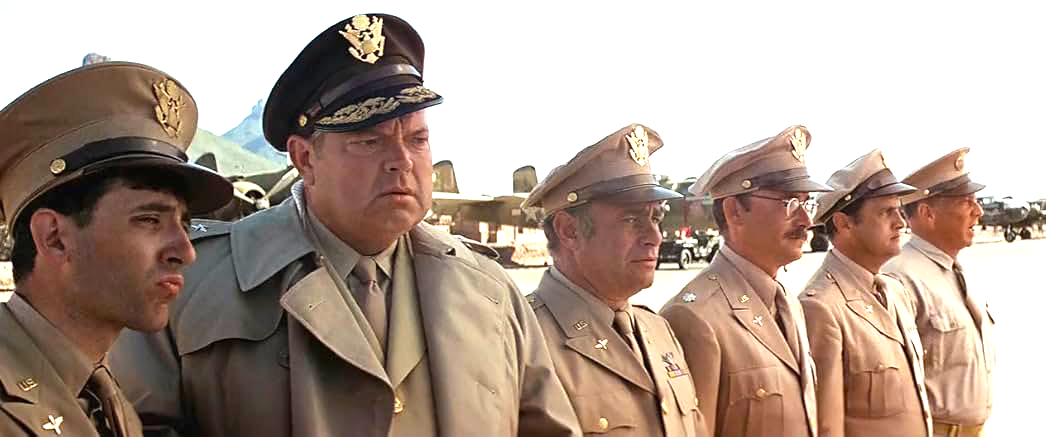
Catch-22 is nobody’s favorite film, but it’s still an impressive show — funny, bizarre, and remote at the same time. Its all-star casting was a major deal in 1970, with ambitious actors jumping at Heller’s scores of weird characters. From Psycho came Martin Balsam as the infinitely corrupt C.O. Colonel Cathcart, and Anthony Perkins as the woefully ineffective chaplain, so desperately trying not to offend anybody. Orson Welles’ General Dreedle is one of the few conventionally ‘spoofy’ characters, but Welles does honor the spirit of the ensemble. Bob Newhart had already contributed a comic ‘stand up’ performance to a combat picture; his painfully intimidated Major Major suffers for being lost in the military bureaucracy.
Special guest performances come from Paula Prentiss and Richard Benjamin, who had been married since 1961. Benjamin had finally made a mark theatrically in Diary of a Mad Housewife; his emcee-like control tower speeches as director Major Danby hit the perfect note. A star from ten years before, Ms. Prentiss’s great talents were never fully tapped. Her flighty Nurse Duckett is lusted after by various airmen, and has one dedicated scene with the talented Elizabeth Wilson, of The Graduate. They tend a burn victim completely covered in a cast, performing a sick gag with bottles of saline and urine.
Mike Nichols would continue his Graduate partnership with comic and writer Buck Henry on The Day of the Dolphin. Henry gives himself some good dialogue as Colonel Korn, Cathcart’s right-hand crony. The two of them work up a nasty sardonic disdain for the airmen under their command.
Nichols clearly had his pick of acting talent. Fresh from Midnight Cowboy came the newly minted star John Voight, a perfect choice for the soulless glad-hander Milo Minderbinder. From the same film came Bob Balaban to play the insane pilot Orr, who keeps surviving crashes and coming back for more abuse. The equally talented Martin Sheen had distinguished himself in The Incident and The Subject Was Roses. As the pilot Dobbs, he fits his personality into the ensemble. Three years later, Sheen achieved a starring hit in Terrence Malick’s Badlands.
Singer Art Garfunkle won a chance to join Nichols’ crazy crew, as a fairly sensible pilot, Nateley. That celeb casting does the film no harm, and Garfunkle returned for a more demanding role in Nichols’ Carnal Knowledge. After almost a decade, he came back to play a similarly conflicted male in Nicolas Roeg’s strange and extreme Bad Timing.
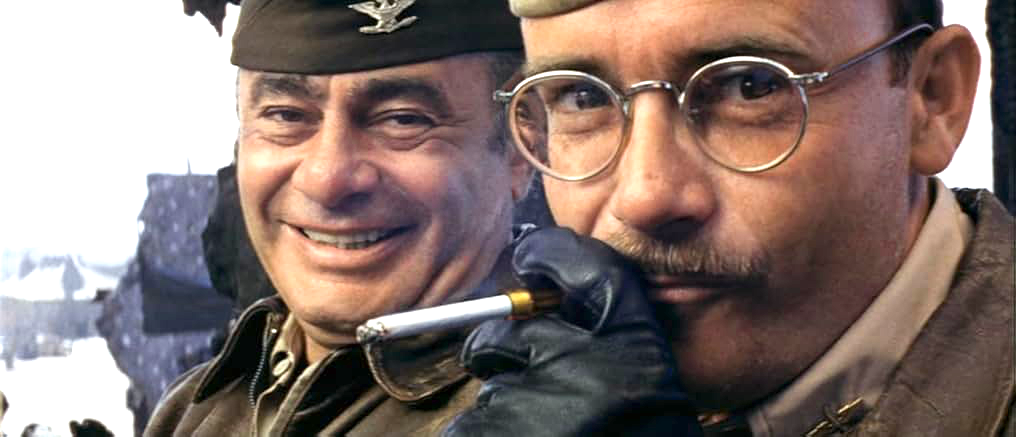
Catch-22 was our first exposure to the distinctive personalities of Austin Pendelton (Moodus, General Dreedle’s nepotistic assistant), Peter Bonerz (the somewhat short-changed character McWatt), and Charles Grodin (obnoxious navigator Arfy Aardvark). All made their mark in features and TV. The one actor really cheated is Seth Allen, whose Hungry Joe is reduced to little more than a special effect.
Detractors may have a point when they describe the show as a shifting series of black comedy standup routines. The dialogue is brilliant but cryptic; there’s always the sense that we are going to be victimized for trying to care about what happens to these reluctant bomber pilots. It’s as if the clown comedians in It’s a Mad, Mad, Mad, Mad World entertained us by killing each other, or dying in gory car crashes.
Despite the encyclopedic cast, Nichols and Buck Henry never let Catch-22 crumble into a series of cameos. Nor do they lose focus on Alan Arkin’s strong portrayal. Yossarian’s anxiety and fuss never becomes tiresome. He tries everything, including sitting naked in a tree at the squadron’s reception for General Dreedle. Yossarian is the Everyman character that the show needs. Every time his missions approach the number to rotate him away from combat flying, Cathcart and Korn raise the quota. Franz Kafka goes to war!
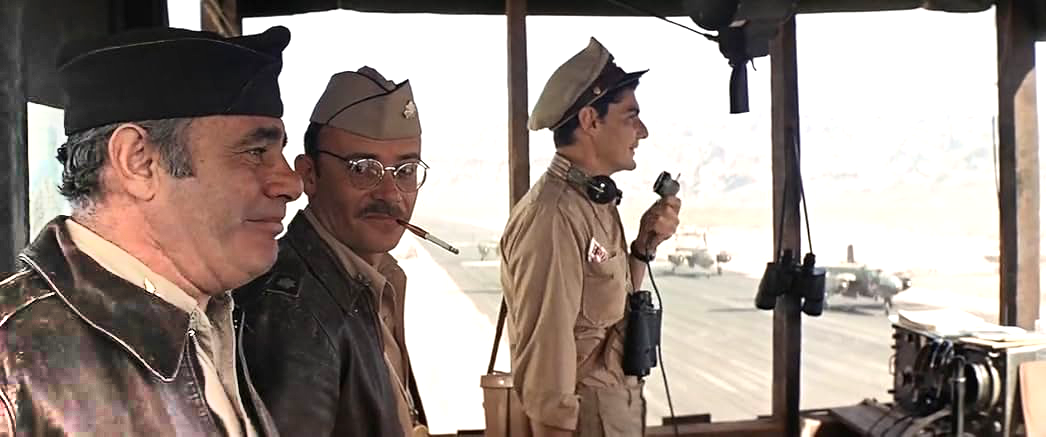
Alan Arkin was always a lovable actor, but Nichols and writer/actor Buck Henry give us little hope that things are going to work out for Yossarian. In this nightmare war, part Twelve O’Clock High and part Dante’s Inferno, we need someone like Yossarian to latch onto. As the jokes get sicker they begin to resemble tortures. Cathcart and Korn expend lives to make their performance records look good. General Dreedle is obsessed with ‘bombing patterns’ that look good in aerial recon photos.
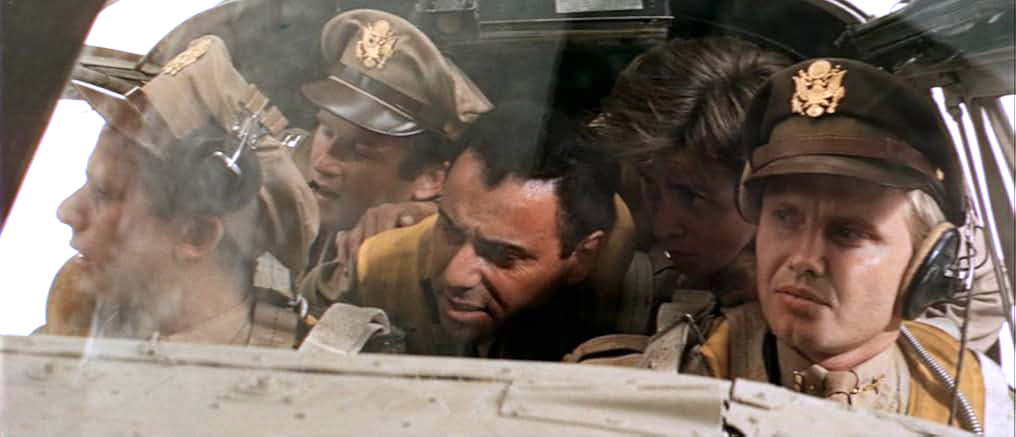
The film’s second classic audio exchange is an existential failure of communication over an airplane intercom, delivered like a comic misunderstanding:
Pilot: “Help him! Help him!”Yossarian: “Help who?”Pilot: “Help the bombardier!”Yossarian: “I’m the bombardier, I’m all right.”Pilot: “Then help HIM, help HIM!”

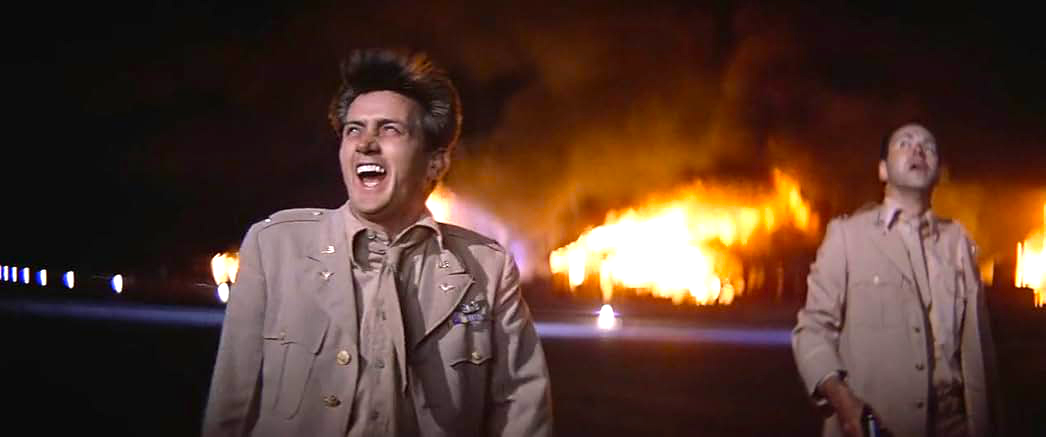
With the plane interior presented as a dream-like limbo, the exchange is absurd-disturbing, especially when the dream recurs as a running gag. It pays off with some appallingly graphic gore. Black Comedy becomes sadistic Grand Guignol. Audiences felt anxious — why are we being punished like this? We begin to fear that things will only get worse. Even Paula Prentiss’ full-frontal dream sequence has a disturbing quality. The violence eventually spills over, when Yossarian discovers that one of his colleagues has committed a horrible crime.
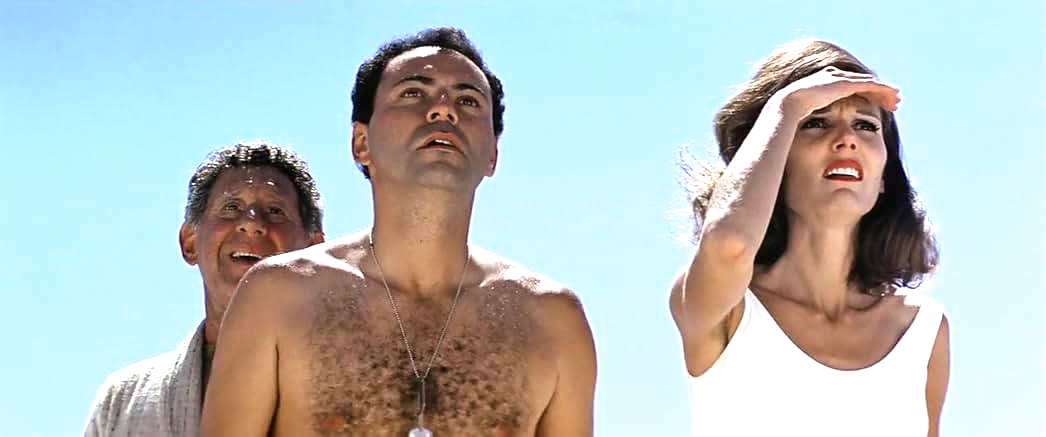
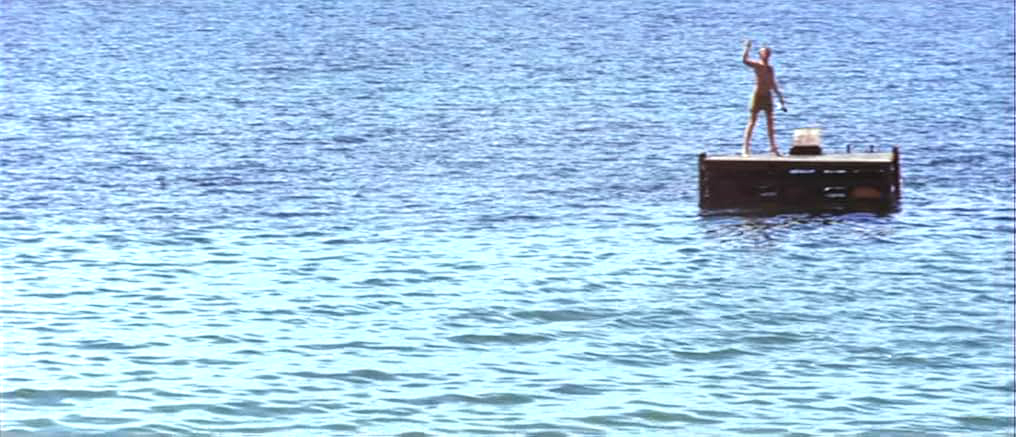
The story would seem to suggest that war encourages more senseless acts of violence. The most traumatizing scene plays out on a featureless beach that resembles a painting by Salvador Dalí. It’s straight from the book: a character named Hungry Joe meets a grotesquely awful end, while standing on a swimming raft. *
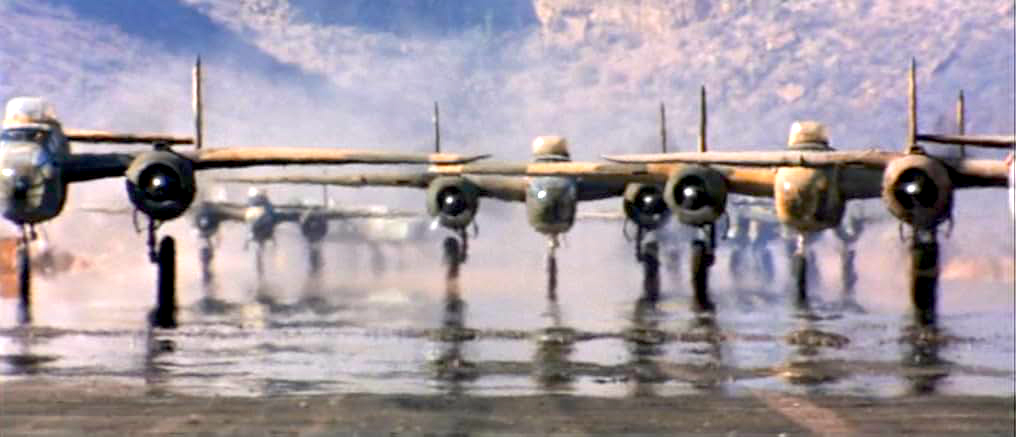
The movie is mounted on a giant scale, with at least a dozen B-25 airplanes flying all at once. Tallmantz aviation assembled a small air force on an airstrip in the town of San Carlos, Mexico, very near the port of Guaymas. As explained in his audio commentary, Mike Nichols used this air force as background color for dialogue scenes. Nichols and cameraman David Watkin tried to achieve whole scenes in single unbroken takes, like the ooh-ahh dazzlers that Orson Welles had pulled off for Touch of Evil. Long, complex shots truck with characters while multiple aircraft taxi in the background. A big mission takeoff scene ends with a telephoto shot taken from hundreds of yards away. In the foreshortened perspective, the planes look like kites hovering in the hot air.
One trucking shot with Martin Balsam and Jon Voight along the side of a runway concludes with the gag of a plane crashing. A master shot up front begins with a pan across planes taxiing and taking off, to Yossarian with Cathcart and Korn in the headquarters building. Planes circle in the distance while they talk. The view follows Yossarian’s exit until an assailant comes at him with a knife. The unbroken scene is almost three minutes in duration. Not much work there for the negative cutter.
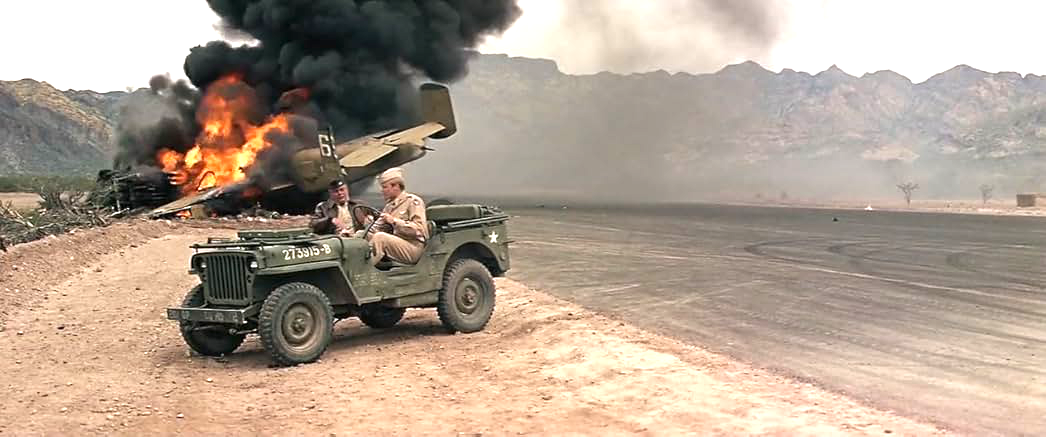
The director’s ideas for master shots required the airplanes to idle in place for long periods of time, propellers spinning. The fliers complained that the abuse was burning up the air-cooled engines. Nichols admits that he all he cared about was getting the shot he wanted. This is the film where helicopter cameraman John Jordan, who had already sacrificed a foot shooting You Only Live Twice, lost his life in yet another aerial filming accident.
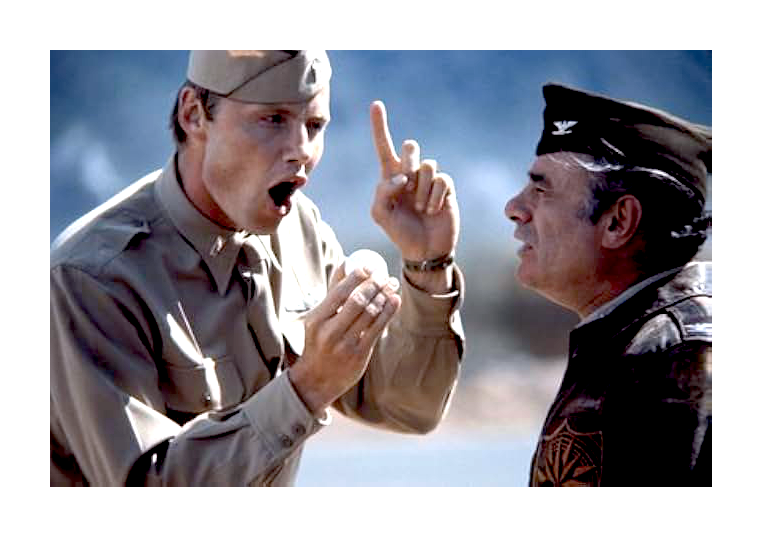
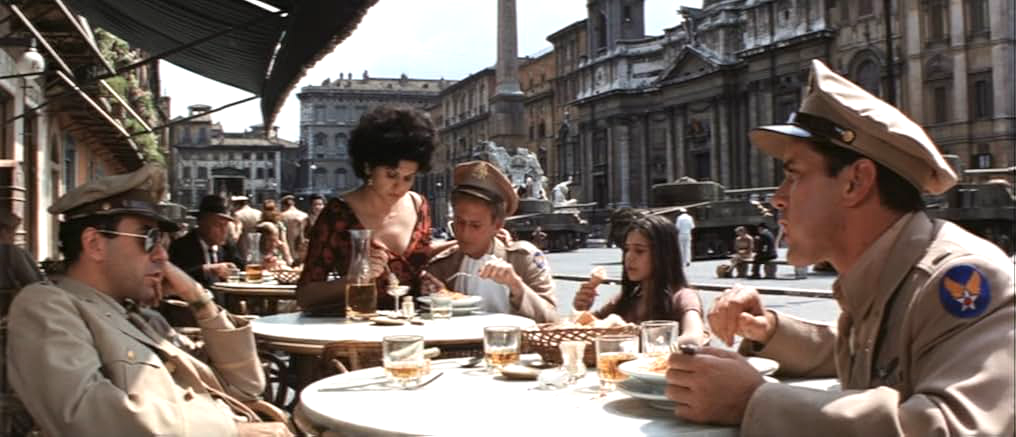
Milo Minderbinder’s profiteering turns both the airfield and the local town into a horror show of vice and corruption. By the time he’s riding around with an armed entourage, like Mussolini, the movie’s overall point begins to blur. We understand that big scams preyed on official army procurement, but the connections aren’t there to argue that the insane economy of WW2 founded a new kind of American corporate tyranny. We instead see a realistic story populated by characters as exaggerated as those in a comic book.
Catch-22 is not overtly pretentious, but it also doesn’t rally the audience behind its premise. We like Yossarian but feel that he’s already doomed. Audiences unfamiliar with the book wouldn’t understand this horror take on a standard service comedy, like Richard Quine’s amusing Operation Mad Ball. The year before, Sydney Pollack directed the very stylized, quasi-fantastic war movie Castle Keep. It also wants to make a weird, ironic statement about war, but it functions first as a conventional combat action tale. Undemanding viewers likely endured the ‘deep’ artsy scenes, to get to the more satisfying battle action at the finale.
Joseph Heller purists complained that important book characters had been dropped to cut the story down to size. That’s hardly the point now — Catch-22’s grandiose scale and impressive talent roster are what make the film so interesting. Movies like this are no longer made — any actor big enough to star in a movie doesn’t want to risk being buried in an ensemble cast. Mike Nichols would move away from the experimentation of his first four pictures, but never again tried a show as sprawling or technically complex as this one. All those special performers and all those amazing pre- CGI images … we can’t resist.
In today’s regulated industry, it’s exhilarating to think that once upon a time, filmmakers were entrusted with millions to make so many commercially risky movies.
“Catch-22 is nobody’s favorite film”: maybe not all-time favorite, Glenn, but in the top 5 around here.
They assembled 17 B-25s for the film. Also interesting is the 1973 unsold pilot for a ’22’ TV series, starring Richard Dreyfuss.
Hey Glenn – thanks for your (as always) informative review. I’m just curious – did Nichols mention in his commentary about how Welles had wanted to make his own version of Catch-22?
Sorry David, I don’t remember !
I think he did mention it and Nichols felt bad about it. The commentary is available on the DVD version.
When I saw this as a kid, I was always disturbed by the cameo by the actor who played the gangster from “Bullitt” showing up at Arkin’s surgery saying, “We got your pal”. I have never heard anybody else talk about it or explain it. Watching it now, I find Minderbinder to be the most hateful, despicable character. He just seems right out of today’s headlines.
Found the Facist.
“Alan Arkin was always a lovable actor” Not in “Wait Until Dark,” not at all.
I remember the Hungry Joe gore effect exactly as you describe it, from a revival screening around 1980 in Sweden. My guess is that European prints retained the effect.
Thank you Lars!