
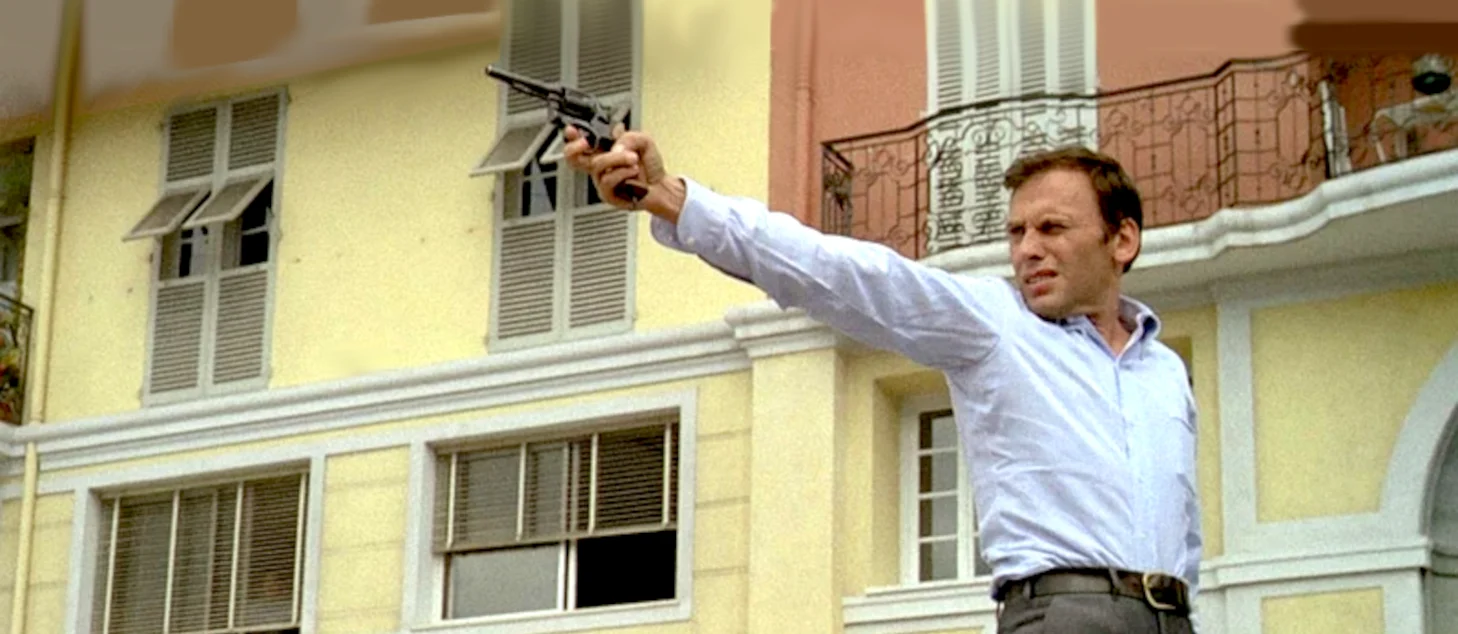


Journalist-author Philippe Labro has unique experience to direct a paranoid crime film — as a reporter he talked to Jack Ruby a few days before Lee Harvey Oswald was shot. Having studied and worked in the U.S., it makes sense that Philippe and his writer Jacques Lanzmann would adapt an Ed McBain ’87th Precinct’ novel to fit a French setting. Basically a serial killer tale, Labro’s Without Apparent Motive (Senza mobile apparent) has a notable cast and slick production values, and was reviewed in 1971 as a stylish murder thriller.
Author McBain was an alternate pen name for the prolific Evan Hunter, whose Blackboard Jungle would be filmed by Richard Brooks and whose book King’s Ransom would become the Kurosawa classic High and Low. Evan also managed to turn Daphne Du Maurier’s oblique novelette The Birds into an Alfred Hitchcock classic. He ought to be better known — we’re awaiting a remastered disc of Frank Perry’s long-unavailable dark thriller Last Summer … which was also adapted from a book by Evan Hunter.
Philippe Labro’s show now feels like a fairly mechanical cross between an episode of Columbo and any of a thousand crime series presently streaming. It also feels like a budget affair. Actor Jean-Louis Trintignant is always an interesting presence, but most of his co-stars make limited appearances. In compensation, the camera loiters over views of the photogenic harbor city Nice — and there’s a noted film score by Ennio Morricone to enjoy.

Detective Stéphane Carella (Jean-Louis Trintignant) returns from an amorous weekend with his girlfriend Jocelyne Rocca (Carla Gravina of Toute un vie). No sooner is he back on duty than a mad sniper begins claiming victims. One businessman is killed in an open-air meeting and another as he is about to dive into a pool at a private party. They are upscale citizens, which throws a lot of pressure at the police to solve the case quickly. Carella becomes involved with the stepdaughter of one of the victims, Sandra Forest (Dominique Sanda) but no connections between the killings come together. Victim #3 is someone Carella knows intimately, who dies right in his arms on the Nice waterfront. Other potential victims are the astrologist Hans Kleinberg (Erich Segal) and TV personality Julien Sabirnou (Sacha Distel); as Sandra Forest is working with Julien, Carella’s men must rush to protect them.

A connection between the victims is finally made when Carella interviews Helene Vallee (Stéphane Audran). It involves theater director Frances Palumbo (Paul Crauchet of Le Cercle rouge) and a married couple (Laura Antonelli, Jean-Pierre Marrielle).
The nicely-titled Without Apparent Motive has a better reputation than it deserves; we admit that the music of Ennio Morricone is what made the show a must-see. Producer Jacques-Eric Strauss was behind Henri Verneuil’s lavish super-production The Sicilian Clan, but this show feels rushed, by-the-numbers.
The script and direction are mostly generic, with most of the visual appeal provided by the swank locations. Director Labro covers his scenes but does little with his camerawork; it’s possible that all the shots were set up by the cameraman Jean Penzer (Get Out Your Handkerchiefs). He’s competent and most shots are attractive without being particularly memorable. Few scenes require lighting for night. There are some nice touches, such as the sniper killings being almost silent — the high-powered rifle is silenced.

Jean-Louis Trintignant carries the picture. He appears to embellish his part with eccentric bits of business, in an effort to give it more interest. Stéphane Carella is a highly-respected detective, treated with great deference by his loyal lieutenants. They carry his luggage; and he enforces his authority like a military officer. High public officials at like Carella is a celebrity. When one of the victims turns out to be Carella’s present girlfriend, nobody worries about a conflict of interest. Carella solves crimes with brain power, going off to stare out the window when it’s time to think.
The name actresses aren’t given much to do but ‘be there,’ and tend to fall back into model-like actions and poses. Stéphane Audran recounts the story of a violent orgy that took place years ago, but there’s little drama to her revelation. The film’s exploitative nature shows when Dominique Sanda is introduced with a topless dressing scene. Carla Gravina is likewise partly disrobed for one scene with Trintignant. Audran wears an open neckline dress that’s frankly not very attractive at all.
When we finally meet the ‘mystery woman’ played by Laura Antonelli ( Malizia), she walks through her scenes with a displeased expression, while actor Jean-Pierre Marielle does all the talking. The film’s highlight ends up being Inspector Carella’s marathon sprint around the harbor, trying to catch up with the mystery sniper. At least Jean-Louis Trintignant’s exhaustion looks real.

There are no standouts in the cast. The only surprise is seeing author and screenwriter Erich Segal, of Yellow Submarine and of course Love Story. He’s not bad as as the astrologer, and his French is very good. Segal’s only other film appearance appears to be a bit in Noel Black’s Jennifer on my Mind.
Director Labro steers suspicion toward one character as a surprise villain … but a chance peek at a wrist uncovered by a glove spoils that bit of directorial misdirection. Aside from Ennio Morricone’s catchy main theme and his cues for chases and transitions, what we mainly remember from Without Apparent Motive is Jean-Louis Trintignant’s effort to enliven his character, and the film’s leisurely pace. Many scenes are given full entrances, exits, walk-ups and walk-downs. That sunbaked beach town Nice looks so good, only occasionally does this material feel like padding.


Home video suppliers are getting really ‘smart’ about their releases. Without Apparent Motive is not available streaming or on YT or DVD or Region B that is, I’ve exhausted all sources. Trouble is, I & many others won’t buy blind. So this will go into one of my many lists hoping for a future streaming release. C’est La Vie!