


Themroc was a mystery film back in 1973; at the UCLA Research Library’s Theater Arts Reading Room, my first job was typing cards to index the contents of film periodicals. One review stood out from the other foreign titles I couldn’t read for its still photos of actor Michel Piccoli screaming like a madman. Themroc remained an unknown item; I never found a word written about it in English. It was later lumped in with other films in (somebody’s idea of) the spirit of the May ’68 strikes. That ill-defined call to revolution produced its share of pictures with anarchic, allegorical and absurd premises. Themroc outpaces most simply by not being a flat-out bore. The inspiration may have been some the more radical scenes in Jean-Luc Godard’s Week end; director Claude Faraldo gives his story a feeling of purpose. Star Michel Piccoli is charmingly animated in the title role. On the basis of what we see here, he’d have made a good silent movie personality.
Although Themroc has a rich audio track, silent movies come to mind because the movie has no dialogue, just gibberish talk plus the main character’s grunts, groans, shouts and screams. No screenwriter is credited. The word ‘Themroc’ may mean nothing; critics decided it was the main character’s name just to make describing the film easier. Actors Béatrice Romand, Marilù Tolo, Francesca Romana Coluzzi, Patrick Lewaere and Miou-Miou appear in parts big and small. We’re told that the many supporting parts are played by a theater group. They’re a lively and distinctive bunch.

Claude Faraldo offers an alternative to socially-aware Elio Petri films about downtrodden working men who strike or commit crimes — why not Reject Everything and go primitive? A handheld camera records a big day in the life of maintenance painter Themroc (Michel Piccoli) in grubby naturalistic terms — upon which is superimposed an amusing ‘direct mime’ performing style and some truly radical ideas. It’s no surprise that the movie saw a lot of coverage in higher-end film magazines: it has a lively star, plenty of nudity and it breaks taboos. When Themroc checks out of his humiliating ordained role in The System, he doesn’t do things by half measures.
The show challenges the audience right away, with A Day At Work That Changes Everything. Our hero Themroc lives with his mother (Jeanne Herivale) and sister (B&eaacute;atrice Romand) in a cramped apartment. We soon realize that he has few if any inhibitions about sex. He makes eyes at every woman he sees, and engages in an incestuous flirtation with his sister. Themroc’s primitive instinct for freedom is bursting to get out; whenever he’s alone he’ll let loose shouts and screams. An irate boss whacks him in the nose, getting his overalls all bloody; Themroc takes this in stride and submits when the workplace security men usher him into various offices to wait for a dressing-down. His mischievous smiles repeatedly evoke positive responses from women. While waiting for the boss he performs oral sex on a secretary (Marilù Tolo), who loves every minute of it.
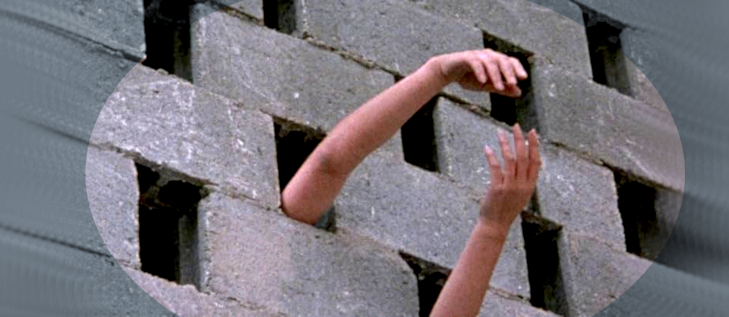
Themroc picks up the germ of a new idea … watching a demolition crew pull down an ancient building, his face is transfigured with joy. Back at home, he begins an open sex relationship with his sister, which causes his distraught but powerless mother to take on a serious nervous tic. With some stolen masonry, he seals off part of their 2nd floor flat; he then uses a sledge to bash a large hole in an exterior wall, with a rope ladder to enter and exit. Before you can say ‘Fred Flintstone’ he begins tossing his possessions out of the cave opening — furniture, valuables — causing a hazard to those walking below. Themroc is turning himself into a 20th century cave man. Forget cults and communes; he’s a primitive dropout, a nation of One.

Along with some well-judged editing, Faraldo’s excellent direction orchestrates other elements well. Béatrice Romand’s nudity is near-constant yet seems a well-judged part of the concept. Themroc’s neighbors react in different ways, making us think a bit of Rear Window. One man is moved to beat his wife, while a female neighbor (Francesca Romana Coluzzi) is so inspired by Themroc’s revolt that she climbs the rope ladder and spends the night with him. She then returns and directs her passive husband to turn their apartment into a cave dwelling, the same way.
The police show up but can do little. They fuss and prance about, but none seem willing to confront Themroc directly, as if cowed by his elemental power. Security men, subway conductors and cops on the street can do nothing with a man who doesn’t bow to their uniforms and badges. Some hollow uniforms turn tail when he screams like a madman; others intuit that he’s just a lot of trouble and ignore him. The riot squad that turns up when Themroc rains furniture on his neighbors are just as ineffectual. The cops may be okay as individuals, but in their paddy wagons they molest their female arrestees.

The odd thing is that Themroc’s anarchy appears to be contagious. His neighbors become liberated, and mimic his anti-social destructive behavior. In the chaos at the siege of Themroc’s apartment building, several cops take the opportunity to rape a young woman. That’s the effect Themroc has on people … does True Liberation mandate the breakdown of society?
Claude Faraldo’s achievement is turning this abstract farce into a coherent movie. He communicates his points well, using non-verbal storytelling. Everybody talks gibberish; since the English subtitles all say ‘gibberish talk here’ we soon turn them off. That conceit isn’t belabored, and in fact focuses us on the emotions in the voices as opposed to the meaning of what’s being said. Themroc’s grumbing, shouting and screaming — he favors bathroom stalls for scream concerts — directly express a suppressed male spirit desperate for self-expression.
The stumbling block in Faraldo’s absurd soufflé is his sexual politics, which posit a world where Real Men rule and women are just around to gratify their sex urges. A man who knows his own wants and isn’t afraid to act on them is the master of all women he sees. Save for the mother, every woman on view is a sexy item. Themroc’s coy smiles in stairwells stop being cute after Babe #3, but every female in the working world behaves as if his Natural Un-repressed Maleness were projecting irresistible pheromones. The humorless secretary instantly welcomes Themroc’s sexual advance under her desk. Back at home, Themroc’s sister becomes a docile sex slave, sticking by his side and pestering him for more. When the neighbor woman spends the night with Themroc, sister waits below, patiently accepting whatever access she’ll be allowed. It’s Alley Oop time, even if caveman Themroc drags nobody by the hair.

The idea to achieve working class liberation by dismantling civilization is all-male, no girls allowed. Frankly, we’re surprised that the absurdities don’t fall flat long before the gender politics go sour.
This takes us only partly into the third act; things get even more dire before the show is over, with more basic social taboos tossed to the winds. The gendarme’s union won’t be pleased, but after 50 years of exploitative extremes, the shock value has likely diminished somewhat for viewers with no cultural memory of earlier times. European critics liked edgy movies as much as did American reviewers, just because sensation attracts attention. Themroc does its bit for bad taste and became a critical curiosity in Paris for a few months in 1973-74. In terms of mainstream awareness, it likely came and went in a vacuum, remaining obscure — but chic! — for half a century. It’s more than a curio, as Michel Piccoli lends dignity to everything he does. W e like him a lot better here than in Marco Ferreri’s difficult-to-interpret Dillinger Is Dead.
Piccoli was one of France’s most cheerfully adventurous actors. Here he approaches middle age physically fit, with a shock of curly red hair that at times takes on a slightly Bozo quality. He was unafraid of controversy and took on some truly weird projects. No longer easy to see is a picture he made the next year, Le trio infernal (The Infernal Trio), which is listed as a black comedy. His character, along with Romy Schneider and Mascha Gonska’s, climaxes a string of murders for profit by dissolving corpses in acid … all portrayed in gruesome detail. Mmmm Good! What’s for dinner?

