

We got our first good look at The Whip and the Body in a 1993 American Cinematheque screening series on the great Mario Bava. That particular Saturday night double bill at the Director’s Guild also gave us our first look at Blood and Black Lace. Host Joe Dante may have provided one or both prints for the screening; his guests were the charming actress Harriet White Medin and newly-crowned king of fantasy-horror magazine publishing, Tim Lucas. *

As with a number of Bava films, before articles by Alain Silver and James Ursini, we knew The Whip and the Body only under the quizzical title What!, directed by one ‘John M. Old.’ It showed up in B&W on Los Angeles’ KHJ Channel 9 somewhere around 1966. Fellow horror fans recognized Christopher Lee but couldn’t follow the story at all . . . we don’t remember seeing the film’s key whipping scene. If the broadcast had been in color, we might have recognized the signature of Mario Bava — we had already been inoculated with Bava’s utterly fantastic color designs, having seen and liked his marvelous cinematography in the two popular Hercules movies. ‘Oohs and Aahs’ accompanied Bava’s giant close-up of the suicidal Queen Omphale.
Between 1959 and 1966 there were perhaps a dozen core classic Italo thrillers that mixed delirious Technicolor atmospherics in their horror content — Blood and Roses, Mill of the Stone Women, The Horrible Dr. Hichcock and Bava’s own Black Sunday, Black Sabbath and Kill, Baby… Kill. The appeal of a film could often be found in its visual atmosphere, or in a single oneric image.

The first Gothic Eurohorrors were adult films with themes that related horror directly to sex — Fans initially fixated on the hauntingly erotic presence of Barbara Steele. Experiencing a major hit with Black Sabbath, Bava immediately followed up with this startlingly original scare show with an unexpectedly adult theme: sadomasochism. The lead role would seem perfect for Barbara Steele, but it went instead to the exotic Dahlia Lavi.
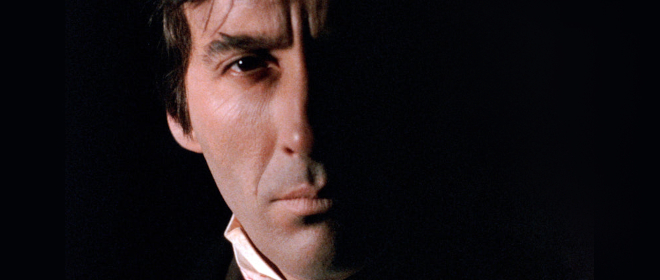
The Whip and the Body is a satisfying Gothic melodrama, sub-category ‘corridor-wandering terrorized heroine.’ Christopher Lee provides the sadism, and Daliah Lavi the intense sexuality. The beautiful Nevenka (Lavi) is married to Christian Menliff (Tony Kendall), but has also been the lover both of her father-in-law Count Vladimir (Gustavo De Nardo) and her Black Sheep brother-in-law Kurt (Lee). The film opens with the silhouette of a rider on the beach at sunset. Kurt returns to the seaside Menliff castle bearing nothing but his noble title and a reputation for wickedness. He receives a frosty reception from the entire household. The maid Giorgia (Harriet White Medin) blames Kurt for the suicide of her daughter years before. She keeps the killing dagger in a glass case. The beautiful Nevenka knows that Kurt is still a sexual threat, and fears and loathes him more than anyone.
Kurt’s presence destabilizes the household. Accosting Nevenka on the beach, he first roughs her up, and then whips her with a riding crop until her clothes are torn and bloody. The crazy revelation is that Nevenka likes the brutal treatment. The relationships become even more complicated. Another murder occurs in the Menliff castle, and Kurt is the obvious culprit. But nothing about the erotically obsessed Nevenka is so simple.

The sex + violence theme was not common in 1963. Unlike the censor-restrained output of England’s Hammer Films, this film and Riccardo Freda’s The Horrible Dr. Hichcock are over-achieving eye-openers, with subject matter too racy for their own advertising taglines. In the U.S. most horror was second-tier theatrical fare, ignored by critics. The censors couldn’t have been paying attention when they okayed The Horrible Dr. Hichcock for general release, with its open theme of necrophilia.
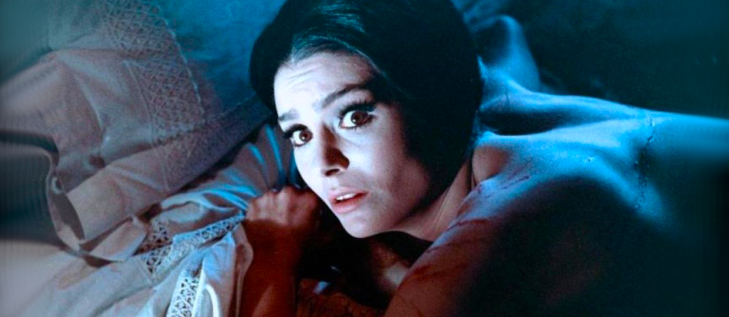
Although not explicit in its depictions, The Whip and the Body’s adult content got into considerable trouble with the Italian censors. Its perversity is communicated almost completely by suggestion. What we remember are the intense faces of Christopher Lee and especially the fierce-eyed Daliah Lavi.
Did Barbara Steele swear off horror after freezing in stone coffins in The Horrible Dr. Hichcock, or did she pass on Whip to accept a dream acting assignment for Federico Fellini? Daliah Lavi is much more than a Barbara Steele substitute, as some have labeled her. She’s less of an icon but somewhat more expressive as an actress. The Whip and the Body masquerades as a stock Gothic and develops into something much more sophisticated. The primary writer on both films was Ernesto Gastaldi, working under the name Julian or Julyan Berry.

In both Hichcock and Whip the adult horror angle is psychological, not supernatural. A direct comparison can be made to Jack Clayton’s celebrated The Innocents, an upscale horror film from the Henry James novel The Turn of the Screw. In the book, the ‘haunting’ of Deborah Kerr’s governess remains ambiguous. We don’t know if undead ghosts are visiting the children in her care, or if the governess is imagining them. The screen adaptation has a tougher time maintaining its ambiguity. Since we experience the ghosts right along with Deborah Kerr, it’s fairly clear that the phantoms are the creations of her fevered, sexually frustrated mind.

Deprived of a literary context, The Whip and the Body neverthe less achieves much the same psychosexual frisson as The Innocents. Richly colored images do much of the storytelling. As the ‘facts’ of Nevenka’s haunting become more contradictory, the more closely we must watch her behavior. Surface reality eventually ‘breaks down,’ as we begin to identify more closely with Nevenka’s delirium. Bava and screenwriter Gastaldi reveal the truth through a ‘dual reality’ stylistic device that’s just plain great filmmaking. A final image recalls a surreal moment in the Luis Buñuel film Death in the Garden, when a dead snake ‘comes to life’ while being eaten by ants, writhing and curling. Burning in a pile of ashes, Nevenka’s whip curls ands twists, as if were still ‘alive’ as well.
Bava goes for melodramatic intensity, restricting the horror element to Nevenka’s distorted perceptions . The stunningly beautiful Dahlia Lavi broods over her secret sins while cowering in fear and trepidation. Her response to the disturbing whippings give the film a genuine sadistic/erotic charge. In what amounts to a glorified guest appearance, Christopher Lee’s performance is nicely shaded. The domineering, wanton Kurt is all too aware that his vice fulfills Nevenka’s twisted desires.
At the height of his creative powers, Mario Bava makes this one of his most sensitive works. Nevenka’s relationship with the mysteriously resurrected Kurt is essentially a loving one, if violently perverse. The nocturnal wanderings down creepy corridors, a given in this branch of the genre, are exceptionally expressive.
The castle-on-the-beach setting allows Bava to once again shoot on his favorite location. He returned to this same broad beach for numerous shows. Glass matte tricks confect different structures on the rocks to the North — castles or modern houses, as per the requirements of Erik the Conqueror, Danger: Diabolik, and 5 Dolls for an August Moon.
Bava’s camera all but embraces Daliah Lavi, finding images both tasteful and erotic. To the extent that actresses thrived on ‘looking good’ on-screen, Bava must have been adored by the leading ladies on which he lavished his color lighting — Sylva Koscina, Syliva Lopez, Leonora Ruffo, Michèle Mercier, Susy Andersen, Eva Bartok, Claude Dantes, Norma Bengell, Fabienne Dali, Marisa Mell.
Italian audiences of this time must really have preferred English horror pictures — Italian producers were still passing their work off with bogus Anglicized on-screen credits. Co-producer Elio Scardimagia was reduced to ‘John Oscar.’ Mario Bava is saddled with one of his most dubious aliases, ‘John M. Old.’ Because several of his films were signed with these alternate names, reviewers and critics of the ’60s and ’70s found it difficult to collate them as the work of a single artist. This surely accounts for years of delay in the critical assessment of Mario Bava in the English language.