
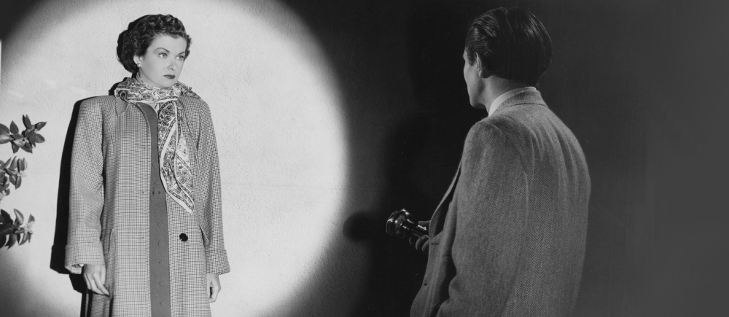


Nobody forgets Joan Bennett’s film noir appearances — she has a dark, moody quality that even Dario Argento appreciated. In The Woman in the Window she’s a male fantasy come to life, and in Scarlet Street she’s a cheap tease who ensnares a lonely clerk. She expresses a less glamorous kind of despair in 1948’s Hollow Triumph (The Scar) as a single woman plagued by low esteem. In a burst of core Noir depression, Bennett’s lonely office receptionist muses that
“…you never can go back and start again. Because the older you grow the worse everything turns out. You don’t see it happening to you, it just happens. You wake up one morning and there you are and anything goes and that’s all right too.”

After 22 years playing girlfriends, lovers, party girls and femme fatales, Bennett checked the calendar and took her first ‘mother’ role in what may be her most interesting picture, produced by her husband Walter Wanger. A year later, she’d make the transformation complete as Liz Taylor’s uncomplicated middle-aged mom in Father of the Bride. Bennett would soon move on to TV and the occasional leading role, but no longer as the reigning sex object. 1949’s The Reckless Moment is for Bennett a transitional picture. Her character is old enough to have children that are young adults. She may be approaching middle age, but she’s not some bourgeois hausfrau. She risks everything to protect her daughter, a move that inadvertently leads her down a crooked path, where more than one kind of danger is hiding. A man is involved…
French director Max Ophüls had a tough time getting work when he fled to America during the war; his first Hollywood picture didn’t come about until 1947. Of his four U.S. films The Exile is good, Letter from an Unknown Woman is a masterpiece; and Caught was compromised by reshoots. The lesser-known The Reckless Moment is an almost perfect hybrid, a film noir that tilts away from hardboiled expectations and toward a postwar ‘women’s picture’ sensibility. A comparable domestic film noir is André de Toth’s minor classic Pitfall, but it is primarily the story of a man. As with many other Ophüls pictures, Reckless Moment is mostly told through the woman’s POV. With Joan Bennett starring as a level-headed woman caught in a bind, the naturalistic Reckless is a tragedy with a streak of romantic sacrifice.

With her husband away doing extended construction work in Europe, Balboa housewife Lucia Harper (Bennett) discovers that her tearaway teenaged daughter Bea (Geraldine Brooks of Possessed) is stepping out with Ted Darby (Shepperd Strudwick), an older ‘art dealer’ that Bea met while at art school in Los Angeles. Lucia tries to stop the affair by visiting Darby in his cheap hotel in Los Angeles, a place frequented by gamblers. The thoroughly sleazy Darby agrees only if Lucia pays him money. Bea ignores her mother’s pleas and threatens to leave with her ‘sophisticated’ new beau. To Lucia’s horror, Darby ends up dead under the pier near her house. Assuming that Bea killed him, Lucia dumps the body farther away and hopes the episode is over. It instead becomes much worse. Darby owed money to the gambler Nagel (Roy Roberts) and as an IOU had already handed over letters linking Darby to Bea, for possible future blackmail use. Nagel now wants $5,000 to keep Bea clear of the scandal around Darby’s death. Nagel sends an Irish hood, Martin Donnelly (James Mason) to negotiate and collect. Lucia bristles at the reaction of her father and son to the presence of a handsome stranger in the house. Donnelly is impressed with Lucia and her warm family. He soon softens and claims to take her side, but can she trust him?

The Harpers of Balboa Beach are often described as middle class folk, yet they have a nice house on the ocean and a live-in maid. While her husband is away rebuilding Europe, Lucia drives an old car. Her desperate mission is to hold the family together after making the dreadful mistake of covering up a death. In complacent America, it is the business of attentive mothers to intervene if a child takes a step away from the path toward a successful, secure future. The most squeamish scene for parents happens right up front, the rebellious daughter turns against her mother: Bea dismisses Lucia as a Fool who Knows Nothing about ‘real life.’ When Lucia finds the body, she should of course have informed the authorities — but that would link Bea with Darby. It’s so much easier to move the body and be done with the problem.
The Reckless Moment presents a believably convincing intersection between Lucia’s suburban beach-side life and the sleazy, predatory world inhabited by Darby and Nagel. Everybody has an angle. Darby has cultivated the gullible Bea for the express purpose of collecting a payoff. Lucia is taken aback to find that Darby sees her only as a mark to be fleeced. She has nobody to confide in or to ask protection from. People will do anything when they must hide something, and everybody has something to hide. This kind of setup was pitched at a far more melodramatic level in Michael Curtiz’s Mildred Pierce, where the one expecting a payoff was Mildred’s own daughter.

This is James Mason’s third American movie and his second American picture for Ophüls — he clearly chose his first pictures for their directors. The unusual Martin Donnelly is a new-to-America hoodlum, and as handsome as a movie star. We don’t expect sensitivity in a gambler’s thug, and perhaps the film’s weakness is that Martin strains credibility, just as did James Mason’s equally sensitive doctor in Ophüls’ Caught. But Mason makes Martin just as sympathetic as Lucia: he’s a friendless man looking for human connections, and it seems natural that he would fall in love with her. We know Martin is hooked when Nagel tells him to wise up, that he’ll never be respectable like Lucia Harper. In a marvelous nod to fatalistic amor fou, Martin continues to protect the married woman, He takes a chivalrous stand even though it may destroy him.
The screenwriters resolve everything with more action at the Harper’s boathouse down by the water. Technically speaking, this is one of those noirs that begins with a single misstep that then snowballs into big trouble, like Mickey Rooney’s bit of dishonesty that throws him into a Quicksand of crime. Lucia’s punishment is that she’ll now have a dark secret. A strange Irishman has made a dent in her life, one that she can’t acknowledge but will never forget.
An obligatory scene in ’50s domestic movies is the ‘square up’ in the final reel, that brings the social and moral problem back into balance, at least in terms of ‘what the neighbors will say.’ In most respects the problem is solved, the family-threatening crisis has passed. The only person who knows how Lucia feels is her live-in maid, Sybil (Frances E. Williams), who has covertly supported her through the entire ordeal. How much will Lucia tell her husband? How much should she tell him?
