

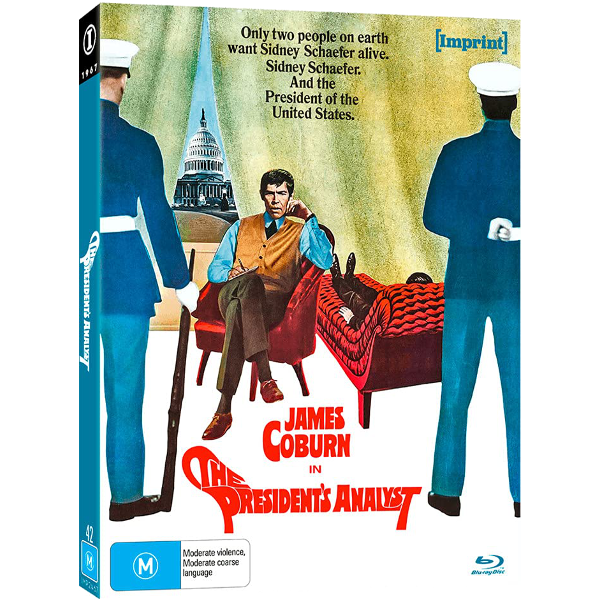
![Viavision [Imprint] 42](https://cinesavant.com/wp-content/uploads/2020/08/6350viavision0820.png)
At the beginning of his tenure as a full-fledged movie star James Coburn made two fine pictures. A Blu-ray of the superior caper film Dead Heat on a Merry-Go-Round is still nowhere to be seen. But newly released as an import is one of Coburn’s very best.
A wonderfully sane comedy about modern madness, The President’s Analyst soared over the heads of the audience in 1967 – and is still the best all-round political satire of the late 1960s. Its light-hearted topical lampoons are still relevant, and its futuristic observations are truly prophetic. The talented Theodore J. Flicker wrote and directed, enlisting a corps of fresh, very hip theater talent. What might have been a collection of improv routines coheres into a fall-down funny spy spoof, with important things to say about suburban living, hippies, high technology and government intrusions into our privacy.
After his star breakthrough as Our Man Flint, James Coburn threw himself into some offbeat projects with varying degrees of success. The faux-hip western Waterhole #3 doesn’t play well today due to a thick coating of retrograde sexist humor; rape is jokingly called ‘assault with a friendly weapon.’ But The President’s Analyst is an original, inspired film comedy. Coburn helped set a brilliant writer-director free with a great script, at just the right time. The disc commentators say that Analyst was the first feature green-lit by Paramount’s new production head Robert Evans.

Uptown Manhattan psychoanalyst Dr. Sidney Schaefer (James Coburn) is given the nod to serve as LBJ’s analyst. He relocates to Washington only to discover that the job is a nightmare: for security reasons Sidney cannot unburden his own psyche after absorbing the President’s daily problems. Ethan Allen Cocket of the CEA (Eduard Franz) and his professional associate Dr Lee-Evans (Will Geer) are sympathetic to Sidney’s dilemma but the diminutive head of the FBR Henry Lux (Walter Burke) disapproves of his live-in girlfriend Nan Butler (Joan Delaney). Sidney becomes paranoid, and convinced that his life is in danger. He goes on the run, hiding out with the Quantrills (William Daniels, Joan Darling), ‘average American liberals’ that prove to be gun-toting wackos in a polarized political climate. Real spies from all over the world indeed try to kidnap Sidney, and Henry Lux dispatches his midget FBR agents to kill him as a security risk. Luckily, Sidney has two loyal allies on his side. CEA hit man Don Masters (Godfrey Cambridge) and Russian espionage ace Kropotkin (Severn Darden) happen to be the best of friends. Don Masters especially wants Sidney alive — he needs to resume his analysis!
Skit comedies based on talent gathered from theatrical comedy groups had a pretty spotty record in the 1960s. Philip Kaufman’s unusual, esoteric Goldstein and Fearless Frank come to mind. The stand-up skit material in The President’s Analyst is integrated into a smart story that moves like a house afire. No sooner are we introduced to a parodic vision of Washington’s competing security agencies than we move on to White House jokes and a devastating lampoon of trends in suburbia. Before any particular idea can become stale the script jumps to the next level. The jokes are consistently funny and the satirical barbs are sharp. The wild Science Fiction ending actually finds something profound to say.

Coburn gets to flex a bit of his own personality here, not just flash his toothy smile. Dr. Schaefer’s gong-ringing good-guy shrink plays amiable straight man to a cast of crazies. This is comedian Godfrey Cambridge’s best role. His Don Masters opens the film with a killing in broad daylight, and then delivers a wholly unexpected soliloquy about racism. From that point on Cambridge has us in his pocket. Severn Darden’s chummy, garrulous KGB top spy Kropotkin turns out to be equally in need of Dr. Schaefer’s psychoanalysis. The film’s comic tone is seductively subversive: America’s secret police organizations are practically at war with each other, but the top secret agents of the U.S. and Russia eagerly team up to oppose a threat bigger than mere national interest.
The fresh sketch material gives everybody room to shine. New discovery Joan Delaney comes on as a submissive love object and then asserts her independence against Schaefer’s suggestion of a ‘constrictive’ marriage. Barry McGuire is the Barry McGuire of Eve of Destruction fame, the former ‘New Christy Minstrel.’ His hippie guru impersonation is priceless, as is Jill Banner’s ‘Snow White,’ a commune love child dreamily obsessed with sex. Horror fans will remember Ms. Banner from Jack Hill’s ultra-strange Spider Baby. Audiences in 1967 gasped and laughed when The President’s Analyst got away with a shot of Banner’s bare bottom, albeit framed in a wide shot from a hundred yards away.

Writer-director Flicker’s view of the politically polarized home front is as exaggerated as an Al Capp cartoon — but with more finesse. William Daniels and Joan Darling are Wynn and Jeff Quantrill, pistol-packing, karate-chopping ‘good’ suburbans. Wynn is proud to be thought typically American yet advocates that gassing would be too good for his ‘fascist’ neighbors, the ones that fly the flag every day. The Quantrill boy Bing (Sheldon Collins) bugs Sidney’s phone call with his ‘Junior G-Man’ kit, and cheerfully alerts the FBR. When the first spies try to seize Sidney on a Greenwich Village sidewalk, the Quantrills retaliate as a coordinated killing team. We laugh because it’s the logical extension of a free society that celebrates vigilante violence. Enemies lurk everywhere, you know.
We enjoy scattershot black comedy satires even when they don’t quite hang together, like George Axelrod’s frequently brilliant Lord Love a Duck. Theodore Flicker maintains better control over his satiric aims, focusing on the emerging ‘Security State.’ In 1967 average Americans thought they had a right to privacy against government snooping. After learning that Don Masters and the CEA have learned all his secrets, Sidney protests that “the sanctity of a psychiatrist’s office is sacred.” After the 1971 Daniel Ellsberg/Pentagon Papers break-in, that line became a ‘zinger moment,’ earning audible audience GASPS. There may be no better example of life imitating art.
The ‘CEA’ is presented as an intellectual Ivy league think-tank. Ethan Allen Cocket’s office is a cozy academic retreat, with women sitting on the floor and men smoking pipes. The ‘FBR’ is a terror organization run by a repressed midget who only hires agents shorter than himself. Lampooning an actual Edgar J. Hoover security protocol, a messenger seen entering Henry Lux’s office must trace a certain pattern on the rug when approaching his desk, or risk being shot. When FBR agent Sullivan (Arte Johnson) puts a gun to Sidney’s head, he snaps that he’s just following orders with perfect Joe Friday cadence. On another occasion Sullivan’s ‘squire’ assistant Ballantine (John Gunn?) advises young Bing Quantrill not to use ethnic slurs.

Director Flicker gets some fine, extremely efficient storytelling down on film. Many shots serve more than one function. When Joan Darling’s Jeff Quantrill greets her fellow Karate classmates at the curbside, across the street we see not only a boy being reprimanded by his mother, but also an early hint of the omnipresent ‘TPC’ overlords. The Phone Company’s sly and insidious presence is established through casual,’insignificant’ details, like the gradual proliferation of ‘special project’ insignia in the paranoid sci-fi precursor Quatermass 2. My son Daniel pointed out another early hint of The Phone Company’s omniscience: during the Greenwich Village spy pursuit one agent finds himself trapped and unable to escape …. from a phone booth. Oooooh — were all phone booths rigged to operate like Venus flytraps?
A not-so obscure fact about The President’s Analyst is that the FBI and CIA were directly identified in the script and during filming; they were renamed and re-voiced in post-production. Thus every line where FBI or CIA was spoken has been very noticeably re-dubbed to ‘FBR’ and ‘CEA’, as can be seen in the mismatch of actors’ lips. Producer Stanley Rubin confirmed this when I recorded a commentary with him in 2008. It’s interesting that in 1967 a movie might lightly mock the Army, the Navy, Congress and even the President, but our secret police systems had no tolerance for such spoofery.

“Please, no Russian, I’m spyin’!
The second act is a dizzying spy chase. An unending parade of secret agents and national operatives compete to kidnap Sidney, as if Antonio Prohias were in charge. Even Canada fields a team of deep-cover spies. In one of the film’s best showcase scenes, an international cross-section of killers wipe each other out trying to kill Sidney as he and his hippie girlfriend Snow White are getting acquainted in a field. The sequence is shaped as a proto- music video for an amusing Barry McGuire song, ‘Changes.’ The song was replaced for the film’s TV version, ruining the joke. The full original music track was restored for videodisc.
On a first viewing The President’s Analyst is completely unpredictable. Just when we fear that the giddy storyline will lose its grip or run out of ideas, Flicker pulls his trump card: ominous, visionary science-fiction. In the TPC’s computerized headquarters, the corporate spokesman Arlington Hughes (Pat Harrington) condescendingly explains why it’s imperative for Dr. Schaefer to use his influence on the President. Hughes’ sales job is accompanied by an animated Public Service Announcement, a glib ‘infotainment’ piece that perfectly skewers the corporate Epcot mentality seen in the Disney Tomorrowland TV disc. TPC’s aspiration is to implant in the brain of every newborn child tiny communication devices called ‘Cerebrum Communicators.’ In 1967 this concept of total interconnectedness was extreme fantasy; cell phones, the Internet, Facebook, etc., have made it a daily reality. Corporations want to privatize our bodies, hooking us up like the Krell in Forbidden Planet and making us pay them for the privilege.
So Flicker’s real nemesis is technological tyranny. Cold War rivalries are trivial compared to the depredations of vast corporations set on monetizing humanity (see También la lluvia). One painless biological alteration to our body will guarantee that we’re never again late with the phone bill. Flicker’s bio-cyborg communications conspiracy sounds like something David Cronenberg might imagine. Are we far away from The Outer Limits‘ Demon with a Glass Hand?

You Say You Want a Revolution?
The film’s climax sees Sidney, Don and Kropotkin engaging The Phone Company’s private army in a comic book gun battle. TPC’s faceless uniformed guards fall like tenpins and the shooting is bloodless — it’s so nice when armed rebellion can be so stylishly antiseptic. The pacifist Sidney refuses an M16 of his own, until Kropotkin insists that he stop considering himself above the fray: “You wanna save the world? Take the gun!”
The exchange is a lot more than just funny. It acknowledges that effecting liberal social change is a frustrating process; change takes decades, can look ineffective and makes do-gooders feel impotent. The opposition is more likely to use force as a first option, and force is sexy. Seduced by a machine gun, the non-violent Sidney becomes an instant Che Guevara.
The show could have found a satisfactory finish just by freeze-framing on the image of Sidney plunging through a cloud of orange smoke. Theodore Flicker instead astounds us with a topper twist that flips The President’s Analyst one more time. The funny-but-chilling Christmas conclusion ends on a vision of Phone Company automatons monitoring Mabuse– like spy screens, shedding sincere robot tears for our Yuletide happiness. Science Fiction mixes with Charles Dickens good cheer. There has never been a more precise film image of the Brave New World to come. Much of the world now lives on the Internet, and generally accepts that our every move is being monitored by corporate computer programs.
The IMDB tells us that a vocal White House tourist is none other than Universal favorite Kathleen Hughes (It Came from Outer Space) — the spouse of co-producer Stanley Rubin. In another bit part is actress Dyanne Thorne, several years before her notoriety as Ilsa, She-Wolf of the S.S..

