

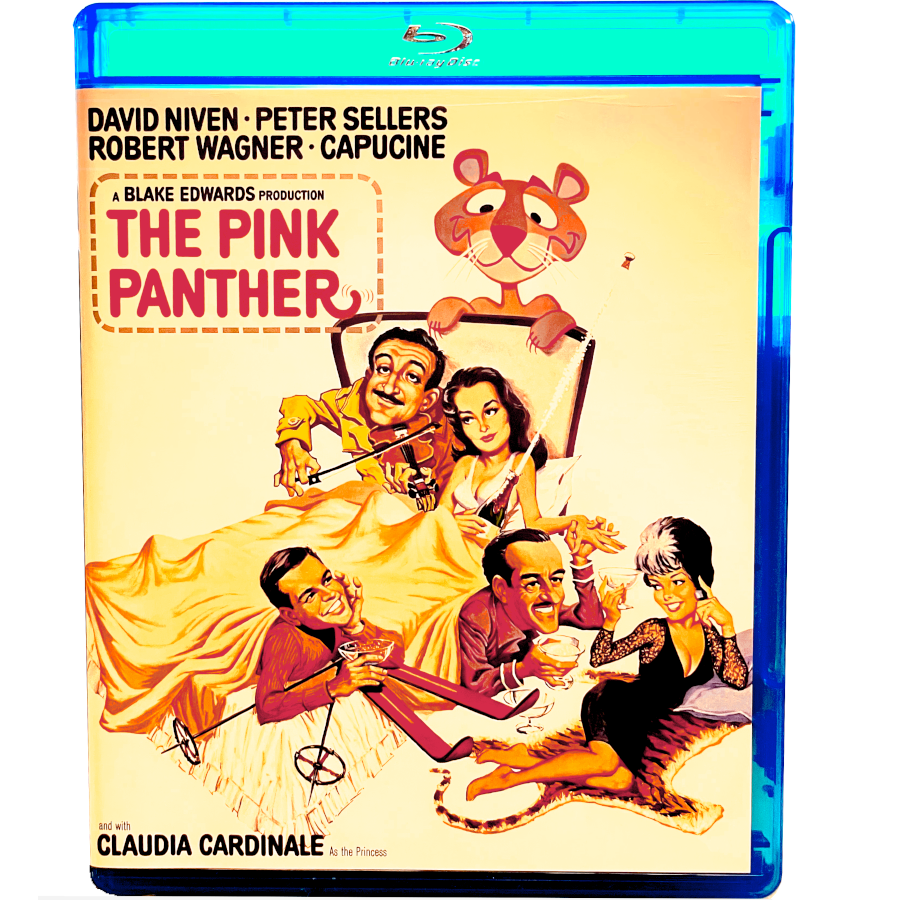

In 1964 The Pink Panther was the most sophisticated movie this kid knew, a fully adult comedy with terrific music. It was grown-up stuff, no question. We thought Peter Sellers was a laugh riot. People were saying that the utterly charming David Niven would have been a perfect James Bond if he were a little younger.
The show is drenched in what then passed for European glam, the allure of supposedly sexier continental manners. The milieu is the Jet Set that hangs out in Alpine chalets for the skiing season. In Hollywood terms, it means affluent adults snuggling around designer fireplaces, wearing bright woolen sweaters. It was partly the Playboy ideal of the time, in the magazine’s photo layouts and cartoons. Gorgeous women in ski garb, ready to mambo; eager guys who can afford the hotel bills. At night they drink liquor and bedroom-hop.

Writer-director Blake Edwards had made a couple of decent comedies at Universal-International starring Tony Curtis but he became a household word writing and producing TV’s Peter Gunn and Mr. Lucky, shows that connected him with composer Henry Mancini. Edwards then ascended to the top with a string of big successes for Cary Grant, Audrey Hepburn, Glenn Ford and Jack Lemmon. That’s when he was enticed to link up with the Mirisch Corporation, which in four short years had corralled some of the most commercial directors in Hollywood: John Sturges, Billy Wilder, Robert Wise, William Wyler.
Walter Mirisch’s days with Allied Artists were far behind him. Blake Edwards was given the film finance equivalent of a blank check. The Pink Panther and The Great Escape appear to be Mirisch’s first big pictures filmed in Europe. It was an Italian shoot, with top talent in front of and behind a big-format Technirama camera.
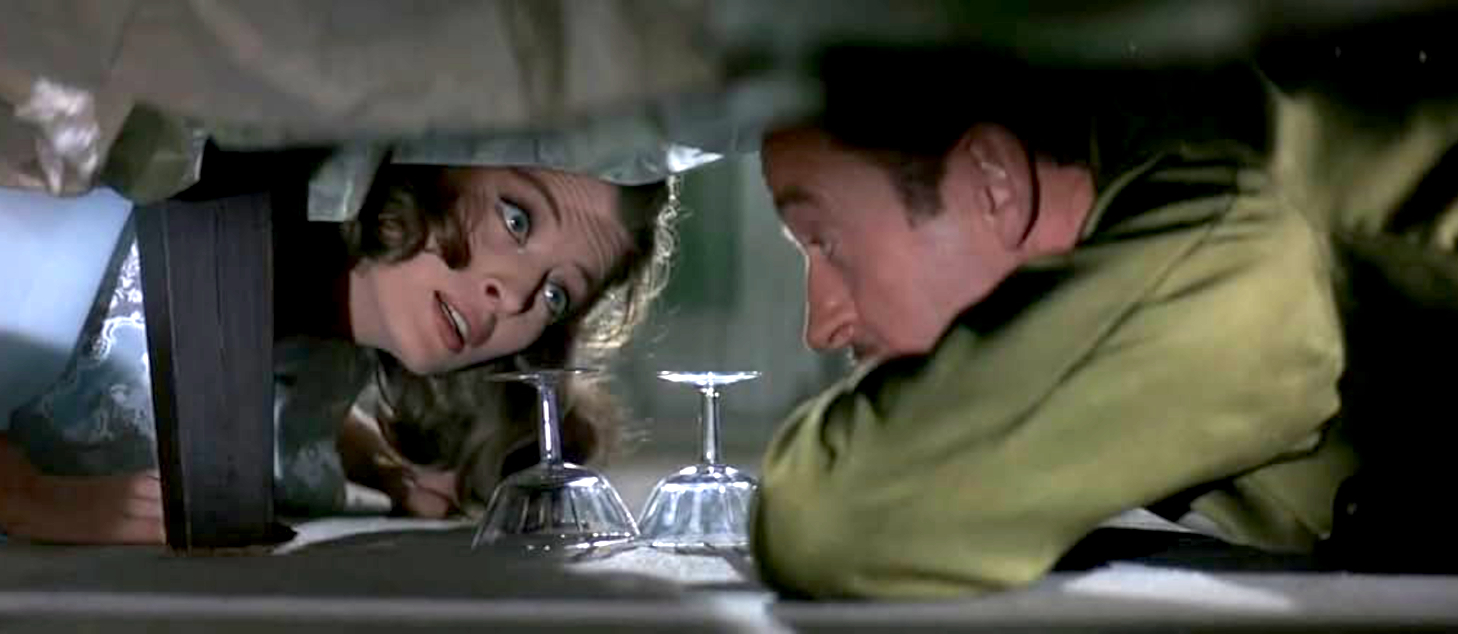
Edwards’ latest successes had mostly been serious dramas, but The Pink Panther would be a comedy farce, complete with slapstick sight gags. His writing collaborator Maurice Richlin had co-written Edwards’ Operation Petticoat and shared an Oscar for Pillow Talk.
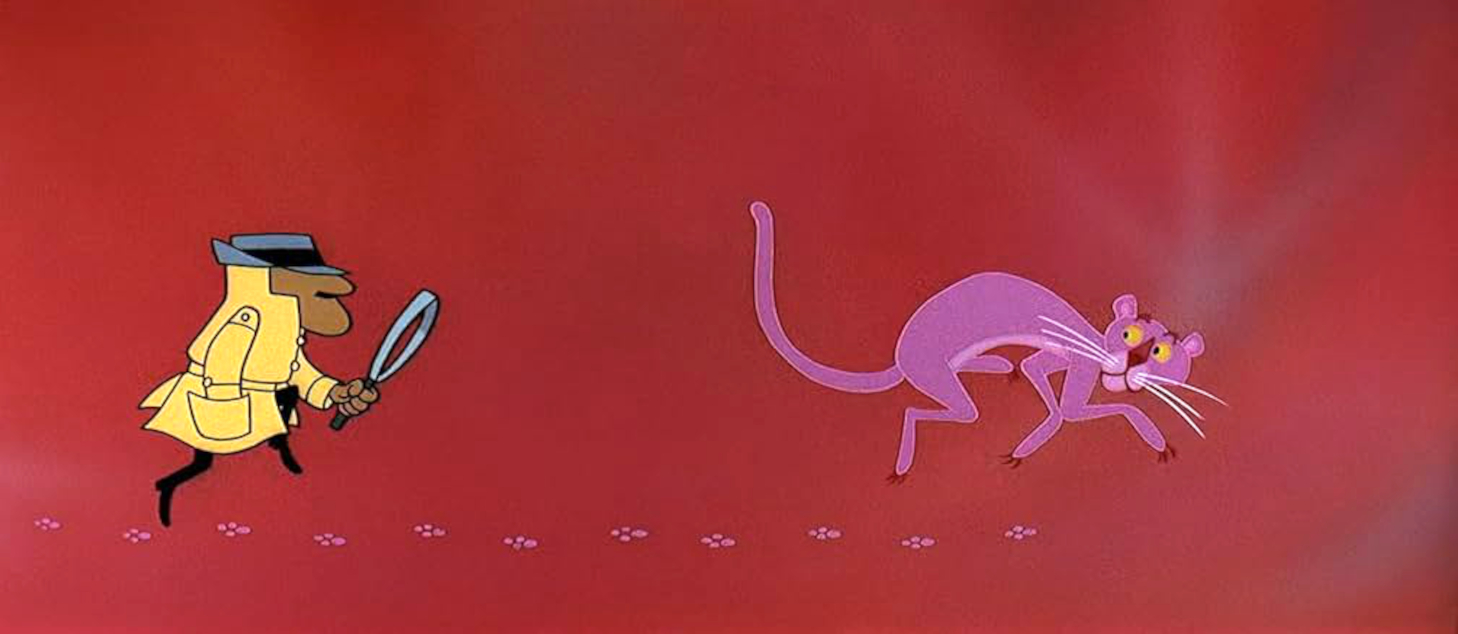
The music and the comedy were American, derived from the romantic jewel thief genre that gave us saucy pre-Code classics by Lubitsch and Borzage. A current light thriller with a similar setup was by Alfred Hitchcock. Those films were not full-on comedies. Blake Edwards’ approach was consciously made much broader, almost like an animated cartoon. Just to set the tone, a fully animated cartoon main title sequence was commissioned. It invented a cartoon character from a dialogue reference to an image seen inside a fabulous diamond.
The picture appears to have come together smoothly, after an almost disastrous start. Capucine replaced Ava Gardner late in the game, a switch required few alterations to the script. But the production also had a firm commitment from Peter Ustinov, who dropped out almost on the eve of filming. His last-second replacement Peter Sellers forced hasty rewriting and re-scheduling. Blake Edwards later said that, instead of a sober police official, Inspector Clouseau would be a “funny, pathetic, bumbling, lovable” character. In other words, another main character in an already crowded cast.
The one-off comedy crime caper became a lasting franchise, sustaining Peter Sellers’ career and creating one of the few cartoon characters with a recognition factor to rival the greats of Disney and Warners. 61 years later, a big draw for disc collectors is that Kino’s new Blu-ray is newly remastered from Technirama elements, and looks sensational.

Edwards’ and Richlin’s movie is a bit overpopulated, and on the long side for a comedy with such a thin premise. But it is also a very comfortable two hours, what with the dazzling locations and Henry Mancini’s smoother-than-smooth music score. The winter playground of Cortina d’Ampezzo is the setting for a major attempt to capture the notorious jewel thief ‘The Phantom.’ A group of jet-setters alights in Cortina, where the heiress Angela Dunning (Brenda de Banzie) holds court. The French Inspector Jacques Clouseau (Peter Sellers) arrives with his wife, the svelte Simone (Capucine), convinced that The Phantom will arrive to attempt to steal ‘The Pink Panther,’ a priceless diamond owned by the young, beautiful Indian princess Dala.
But Inspector Clouseau is the last person to know what’s really going on. Playboy Sir Charles Lytton (David Niven) is secretly The Phantom; his main assistant and mistress is none other than Clouseau’s wife Simone. Complicating matters, Sir Charles’s young nephew George arrives (Robert Wagner). Equally crooked, George’s ambition is to follow in his uncle’s footsteps, both in crime and in seducing beautiful women.
The episodes shift from bedroom mix-ups to sneaky maneuvers on the ski runs, to Clouseu’s bumbling attempts to lay a trap for The Phantom. There’s some competitive friction between Sir Charles and George, as the grinning nephew chats up both Simone and The Princess. It all leads to a gala costume party with a comic car chase through the Alpine town, and both with uncle and nephew dressed as gorillas. Clouseau does indeed capture his quarry, but a series of (very broad) comic reversals may give our thieves the last laugh.
The Pink Panther is a general-audience hit that confirmed Peter Sellers (finally) as an internatonal star with name recognition — Edwards, Mirisch and United Artists were so sold on Sellers that the first ‘Inspector Clouseau’ follow-up A Shot in the Dark was on screens just a few months later. A great deal of attention is given to the Clouseau character, a clueless cuckold who makes arrests only by accident.
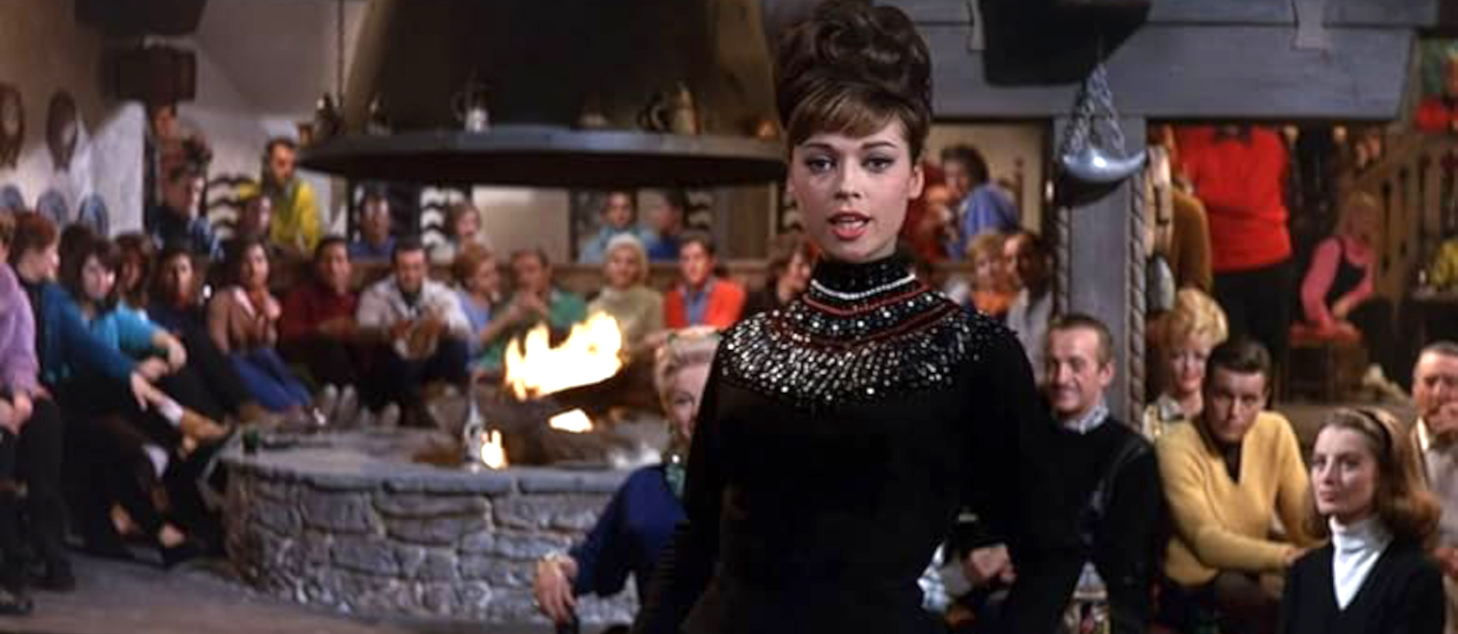
Peter Sellers all but hijacks the picture. The filmmakers must shoehorn the Inspector into various scenes, a ploy most apparent in the film’s stylish musical performance by Fran Jeffries, ↑ choreographed by Hermes Pan. Seller’s Clouseau is just another witness bopping to the music on the sidelines, and vamping a bit of conga-line action. Some of his comic bits with Capucine now seem drawn out, as she and Robert Wagner hide in closets, etc., to fool the silly detective husband. Yet Sellers’ comic schtick feels fairly fresh compared to the routines of the initial male leads Wagner and Niven.
The always-grinning Robert Wagner is winning enough as the punk thief-acolyte, full of bluff and bravado. David Niven strolls through the picture exuding charm and self-confidence, but not the keen wit that he was known for off-screen. The relationships are very much like an animated cartoon — Clouseau declares his Javert-like intentions but is a crimefighting failure. ‘The Phantom’ and his cohorts never break a sweat.
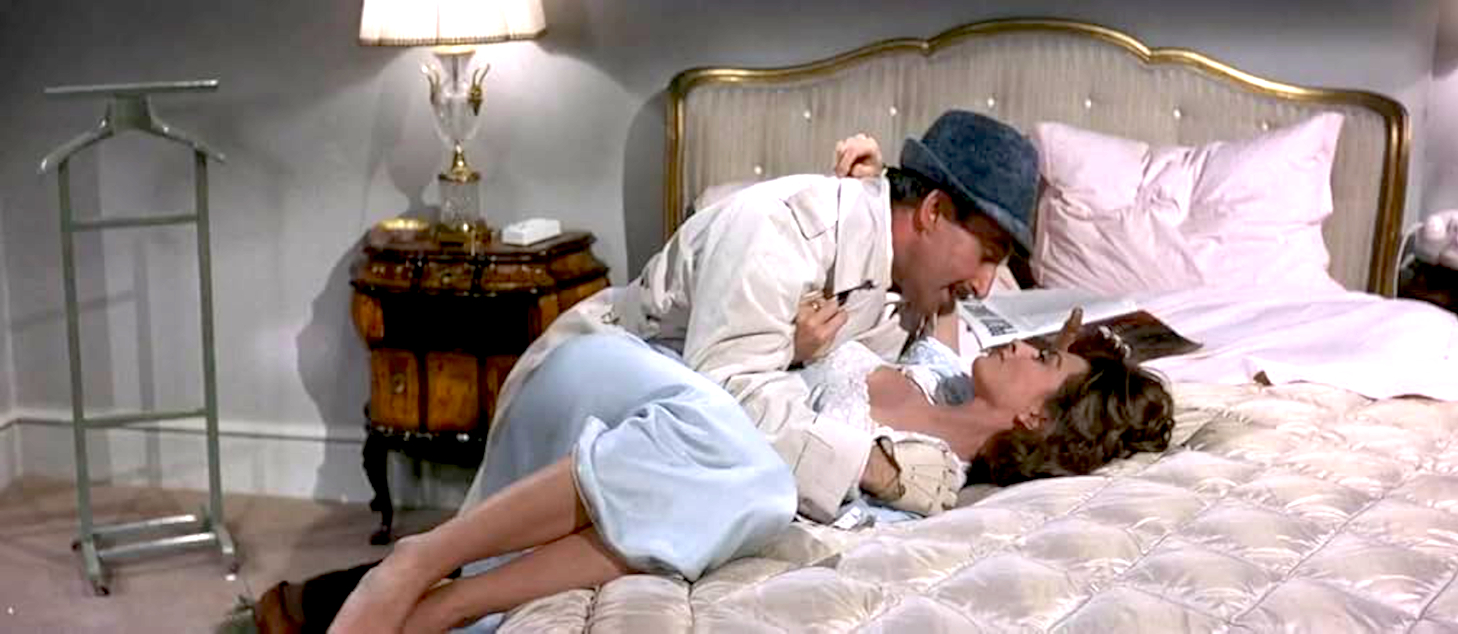
Capucine does her best with a strange role — a woman making a fool of her husband while aiding in sneaky jewel thievery. The movie’s idea of sophistication is that we accept her adulterous deception as just part of the fun … Europeans are like that, haven’t you heard? But any potential sex action is sublimated into the criminal machinations, themselves none too serious. Sir Charles and George fumble through their heist just like Laurel & Hardy; unconscious women are dragged around rooms like girls in one of Buster Keaton’s famous silent movie gags. Not that there’s any comparison in comedy direction.
We don’t want to pick the movie apart, as it’s a nostalgic favorite. When we think of what the show does right, we go right to its peppy musical number, with its spirited fake-Italian song Meglio Stasera.
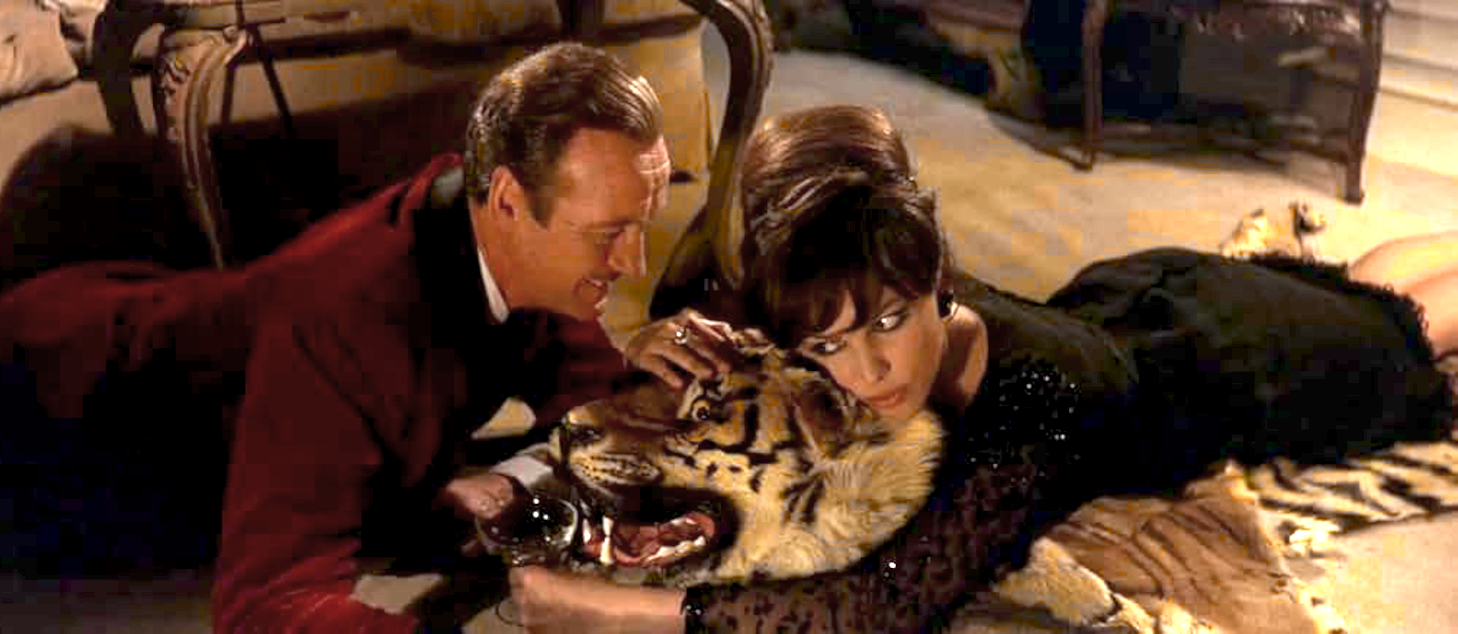
European star Claudia Cardinale is provided with a glorious ‘introduction’ to American audiences in this film. She was already known to art film fans, through films by Fellini and Visconti. She’s front and center in the film’s most memorable, most iconic scene. Sir Charles gets close and warm with Princess Dala on the floor of her snowbound chalet. She lounges on a Tiger rug while they converse, creating an instant effortless erotic fantasy. ↑ Ms. Cardinale’s American career didn’t really take off, after a series of non-performing romantic vehicles opposite John Wayne, Rock Hudson, Rod Taylor and Tony Curtis. But her stellar image remains firmly attached to her superb characters in big-budget westerns by Richard Brooks and Sergio Leone.
The movie tells us to relax and just have fun, which was the aim of many a mainstream ’60s movie. Everybody remembered Holly Golightly’s dawn visit to Tiffany’s, not the parts of the movie dealing with her murky moral issues. Panther has a gallery of very attractive and pleasant characters, accompanied by the comfort of Henry Mancini’s easy-listening music score.
We were completely uncritical of Sellers until his welcome was worn out by some lackluster ’70s vehicles. His stock was also devalued by the diminishing returns of entries in the continuing Pink Panther franchise. We’re glad that Sellers went out with a superb late-career performance. Blake Edwards spent several more years looking for success as the king of big-budget comedy. We saw and loved The Great Race and The Party, but never got all the way through What Did You Do in the War, Daddy?, and didn’t warm to his sometimes very witty ’70s comedies.
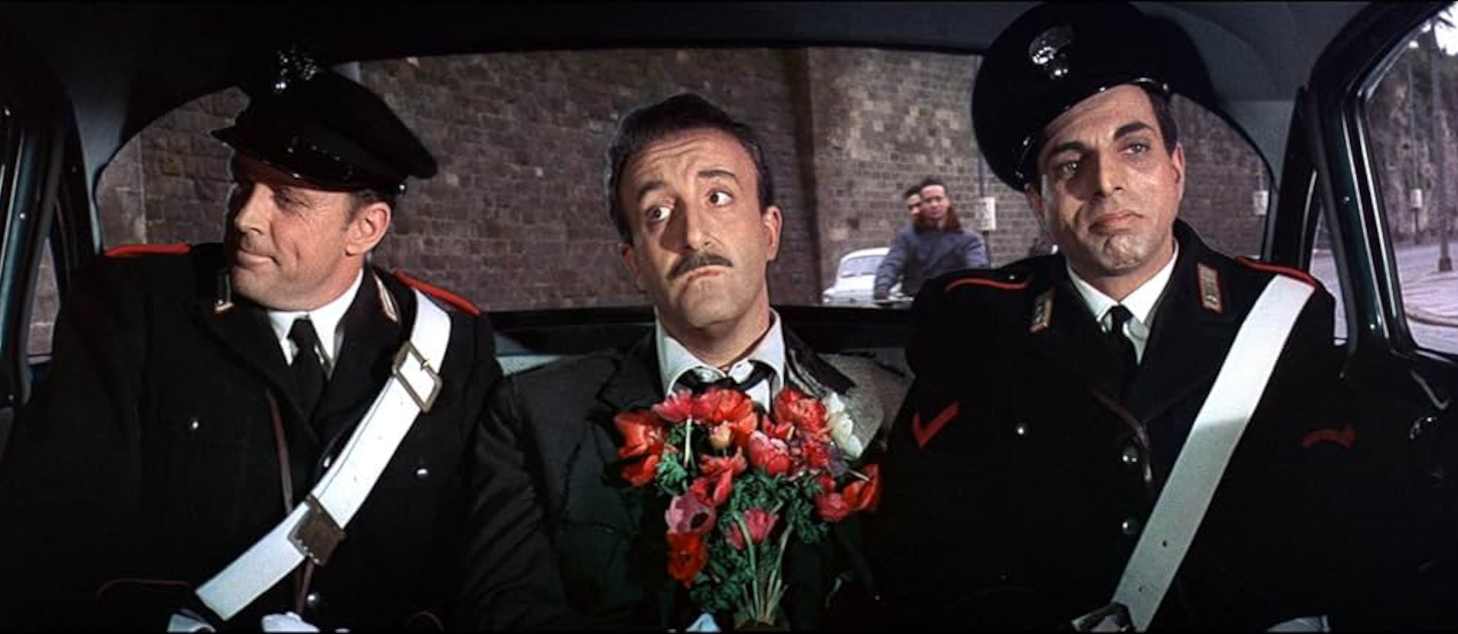
In as much as I love the first movie, it’s the ending in regards to Peter Seller’s inspector character that goes downhill for me. Seriously, it’s almost as if Blake Edwards got trapped in the story with no escape plan, and whipped out the lamest conclusion he could come up with! Just terrible. Everything about “The Pink Panther” from the beginning and the middle is perfection…and then THUD! Oh well, can’t win them all…
Ding, ding, ding. You articulated what I finally realized is why I’m pretty ‘meh’ about this movie, Chris: the ending is a dud. [Also, like Glenn noted, it’s too long.]
A minor correction: it got released in ’63, not ’64. The sequel got released in ’64, and that was actually the first one in the series to give Clouseau the lead role (alongside Elke Sommer, one of the hottest babes to have ever walked the face of the Earth).
Those who know the whole series might be surprised at the absence of Kato and Commissioner Dreyfus, but that’s because Clouseau isn’t the lead character.
I should note that I liked What Did You Do in the War, Daddy?. Like MASH and Catch-22, it shows that the best way to make fun of war is with comedy.
As opposed to ‘making fun of war’ with drama? Tragedy?
Why would you or anyone make fun of war?
A highlight of the wonderful score was the accordionist Frank Marocco, the go-to accordion guy in the film studios at the time. He was a talented and versatile musician who excelled at bebop. In the Pink Panther his beautiful tone and phrasing are featured on “Cortina” and “The Lonely Princess” and of course on “It Had Better Be Tonight”. Although not generally well known in North America he was a popular participant in accordion forums overseas and was a spokesman for Italian-made Victoria accordions. One can find videos of his performances of jazz standards online. He was a hip and beautiful cat who added some secret sauce to the flavour of the Pink Panther soundtrack.
Very interesting Mr. Popov, thank you!