

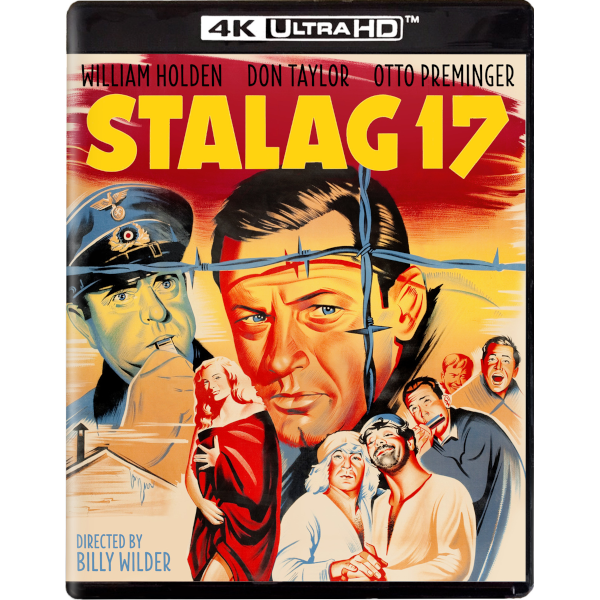

A month before the release of his 1951 blacker-than-black film noir Ace in the Hole, writer-director Billy Wilder may not have known that he’d next be adapting a play just opening on Broadway. Donald Bevan and Edmund Trzcinski’s Stalag 17 was a big hit, and another feather in the cap of stage director José Ferrer. The opening night cast gave John Ericson his Broadway debut. Harvey Lembeck and Robert Strauss were there as well.
Stalag 17 became Billy Wilder’s ticket out of the box office penalty box. Wilder’s last huge success had been his Oscar winner The Lost Weekend seven years before. Sunset Blvd. was successful and admired but not the kind of blockbuster the studio expected from its top producer-directors. The studio and particularly the press hated Ace in the Hole. When audiences shunned it, the title was changed to The Big Carnival. Around Paramount it was known as ‘Ass in the Wringer.’ Wilder got the message: no more noir fatalism. He took a hard right turn, from acid social comment over to surefire comedy material.
Billy Wilder began a search for a new commercial career path. Going through a series of writing partners, his next efforts would be two romantic comedies and a tribute to an American hero. Wilder prided himself on being a do-it-all creative powerhouse but the first two are from Broadway plays by other writers. Although he liberally re-wrote everything he touched, his next fully original screenplay would be The Apartment, written with I.A.L. Diamond 8 years later.

No distant locations this time out: the scruffy wilds of Woodland hills stand in for the mountains of Bavaria. It’s a cold winter in a German POW camp in 1944. The prisoners are American sergeants, and one barrack is the focus of deadly intrigues. The elected barrack leader Hoffy (Richard Erdman) determines that an informer has been telling the Germans about their escape attempts. When two men are shot after using a tunnel, the Sgts’ intelligence officer Price (Peter Graves) suspects the cynical, anti-social J.J. Sefton (William Holden). The barrack is supposed to operate as a communal survival & escape effort, but Sefton is an unapologetic loner looking out only for himself. He always comes out ahead on his betting pools, even wagering on whether escapees will escape or be shot. Sefton uses his winnings to amass a chest of luxuries like cigarettes and wine. He trades regularly with the guards, even for visits to the Russian women’s compound. This makes him a very unpopular man. Sefton maintains a tough-guy front but knows that if the real informer isn’t caught, he might wake up with his throat cut. He’s already taken a beating just out of principle.
Despite that description, Stalag 17 goes down in the books as a war comedy. Some critics see both it and Wilder’s The Seven Year Itch as a hedge against his preference for the darker subject matter that audiences rejected. They hadn’t found postwar black market corruption to be irresistibly funny. His Hollywood Gothic Sunset Blvd. was aimed at a somewhat rarified audience, and Ace in the Hole’s outright indictment of the American system seemed to offend everyone.
Stalag 17 may have broken new ground for comedy. Before this, we’re not sure that Hollywood had made a prison camp story that even partly played for laughs.

You mean we can laugh at Nazis now?
Wilder doesn’t give up his hard edge, but his humor this time out is much broader. Twenty years before M*A*S*H, the men-in-uniform comedy found its full expression, with jokes and slapstick and goofball comedy schtick. It doesn’t matter that the setting is a miserable POW camp. Sefton’s inventive, screwy schemes include organizing real Rat Races as a betting event. He’s somehow acquired a telescope, and charges his pals to peek through it at the Russian women’s shower room. Cue lots of mugging from dame-hungry dog-faces.
Wilder also brings on the coarse clowns. Robert Strauss and Harvey Lembeck’s baggy pants extroverts are straight from a burlesque stage. Some may find their unrestrained antics tiresome. Wilder uses Strauss’ fantasy girlfriend Betty Grable as an excuse for drag humor: when Strauss imagines that Lembeck is Grable, the illusion is played almost identically to Mack Swain’s mistaking Charlie Chaplin for a giant chicken in the silent classic The Gold Rush. Wilder borrows from the best, and adds his own hint of perversity.
Wilder even salts the dialogue with a few movie in-references. The character Cookie (Gil Stratton, the big-time sports announcer) narrates the movie. His voiceover asks why there aren’t any prison camp movies, and tells us that he’s sick of movies about Frogmen (a recent Robert Wise movie), Flying Leathernecks (a Nicholas Ray movie) and Guerillas in the Philippines (a Fritz Lang movie).

His long-time writing partner Charles Brackett no longer in the picture, but Wilder still balances the yuk yuk humor with a sober context. The business with escapees being shot is suspenseful and engaging. The camp is no joke, with the bodies of two dead GIs laid out on the assembly field. The prisoners live in a depressing sea of mud, while vigilantism threatens in the ranks. The already unstable Duke is ready to execute Sefton just because he’s sick of his face. Wilder cast the great Neville Brand, a genuine war hero who was already established in noir as a murderous psycho.
Wilder’s excellent cast includes the noted presence of director Otto Preminger as the martinet Camp Commandant. Wilder had previously scored a casting coup by using the colorful Erich von Stroheim to play Field Marshall Rommel in his exciting WW2 spy movie Five Graves to Cairo. The joke here is that Otto Preminger’s nasty temperament was already well-known; half of Hollywood thought he treated actors as might a Nazi. Also featured is Sig Ruman as Sgt. Schultz, a deceptively jolly German guard. Ruman was a noted member of Ernst Lubitsch’s stock company, and Wilder used him when he could, all the way until 1966’s The Fortune Cookie.

J.J. Sefton is an ideal role for William Holden, who excels as a smart-talking loner with a caustic edge. Sefton doesn’t mind being hated if he’s winning. He’s king of the hill in the barracks, part of a dynamic that soldiers (and men in general) know well. Author James Clavell would later turn his personal POW camp experiences into the similar but very unfunny drama King Rat.
It’s no secret that actor Holden and director Wilder were close friends. Billy Wilder’s Sunset Blvd. had saved Holden’s career, and now he was a top Hollywood star. After Stalag Holden showed his gratitude in Wilder’s next picture Sabrina by happily playing a secondary role as the ‘other guy,’ a funny heel who doesn’t get the girl. Twenty-five years later, Holden starred in Wilder’s Fedora, when the director was not finding it easy to launch new projects.
Wilder took plenty of flack from film critics that accused him of cynicism, misogyny, and general Bad Manners when discussing his fellow Hollywoodites. Andrew Sarris insisted that Stalag 17 reveals Wilder as an artistic fraud. For Sarris the sell-out moment is at the end when J.J. Sefton exits into the escape tunnel. He ducks out of sight, and then pops back up to give a hearty smile and wave to the comrades he’s been sneering at for two hours. Sarris claimed that Wilder was playing it safe for commercial purposes.

Wilder may have played it safe elsewhere too, to avoid more accusations of a down-on-America attitude. The GIs turn on Sefton like a lynch mob, but their beatings are never serious. They smash his telescope and break open his trunk of goodies, but they don’t steal anything. We all know that Uncle Sam’s soldiers would do anything really bad, right?
Billy Wilder didn’t suffer direct attacks by the HUAC, that clobbered other directors then making socially critical movies less caustic than Ace in the Hole. He openly criticized what was happening to the Hollywood Ten. But historians fixated on the Blacklist could confect an argument that Stalag 17 is Billy Wilder’s contribution to Hollywood movies about lynching and denunciations for profit — but with an inverted dynamic. The opportunist-capitalist J.J. Sefton is unjustly persecuted by the group, blamed for committing crimes against the communal good. His fellow sergeants wrongly want to kill him as a traitor, but they’re really jealous and resentful of his success, and punish him for his indifference to the will of the majority. Hokey smokes, Ayn Rand would likely be a backer of J.J. Sefton’s self-centered amorality. (Note: This written before listening to the audio commentaries.)
Wilder’s barracks ensemble is certainly effective. Don Taylor (The Naked City) is a wealthy flier passing through; Sefton resents officers and rich boys so they clash immediately. The expressive Richard Erdman (Cry Danger) is solid as the group leader, a voice of reason over emotion. ‘Chipmunks’ creator Ross Bagdasarian is seen singing, but gets no credit. We revere Billy Wilder as Hollywood’s most consistently funny and entertaining writer-director but Stalag 17 has never been a favorite. Unlike most of his pictures, there aren’t a great many new things to be discovered on repeat viewings.


Surprised you didn’t mention how it was totally ripped off by “Hogan’s Heroes,” right down to carrying over “Sgt. Schultz.”
It’s Cadavra from the Errors and Omissions department! Why surprised? Who wants to grant Hogan’s Heroes any attention? : )
I’ve always thought that “Hogan’s Heroes” owed more to John Sturges’s “The Great Escape” than this film. “Escape” had been a huge hit just a couple of years before “Heroes” premiered while “Stalag 17” was over a dozen years old by then.