


Relegated to lesser status among the films of director Robert Aldrich, the massive Titanus production Sodom and Gomorrah is one of those ‘subjects for further research’ movies that rewards one’s curiosity. Interest in the show has been kept alive by the Sergio Leone Connection — a credits deal and versions controversy that has persisted (at least in the U.S.) because an apocryphal longer and more explicit Italian version was nowhere to be seen. All we’ve seen has been a substandard DVD from the 20th Century Fox Cinema Archives. The same version shown on the Fox Movies cable station.
The German company Explosive Media made its name by specializing in Italo westerns; one of its initial triumphs was creating a full-length English-language version for Sergio Sollima’s The Big Gundown. Now Explosive’s Ulrich Bruckner has done much the same with this even better-known Robert Aldrich epic, overseeing a restoration from the original Italian elements. This is a worldwide Blu-ray debut; a domestic version may be less likely because 20th-Fox/Disney presumably controls the U.S. rights. The disc includes two separate Italian release versions of the film. Quick disclaimer: I contributed an extra to the disc.

Bible epics don’t come more Biblical than Sodom and Gomorrah, which today sounds like a title for a sexploitation picture. From the early pages of Genesis was cooked up a tale about a clash of cultures (to put it mildly) between a Hebrew tribe looking for a home and an entrenched pack of pagan hedonists that live only for sinful pleasure. The Bible version of the story isn’t much more complicated, but it makes the Hebrew leader Lot seem just as perverted. Hugo Butler’s screenplay drops Abraham from the story, giving his good qualities (and best scenes) to a more idealized Lot. Two cities are folded into one, and the Bible account’s miraculous/supernatural content is all saved for the conclusion. Until then Sodom & Gomorrah sticks with an epic about tribal politics and the humbling of a flawed chieftain.
Searching for a new home in the Jordan Valley, the Hebrew tribe of Lot (Stewart Granger of Madonna of the Seven Moons and Moonfleet) comes upon the city of Sodom & Gomorrah. The capital of vice and cruelty is ruled by Queen Bera (Anouk Aimée of Lola and La Dolce Vita), a consummate schemer whose main problem is to ward off a powerful warrior tribe called the Helamites. Bera must also keep at bay her openly seditious brother Astaroth (Stanley Baker of Eve and Zulu), who has made a traitorous back-door deal with the fierce Helamite leader Segur (Daniele Vargas of Caltiki, il mostro immortale). Bera strikes her own deal — the Hebrews can farm the land on the other side of the river if they pledge to defend against the Helamite threat. Bera indulges Lot’s indignant moral posturing, and allows him to offer sanctuary to some of Sodom’s escaped slaves. She also gives Lot her educated body slave Ildith (Anna Maria Pierangeli aka Pier Angeli). At first disgusted to live in a tent, Ildith falls in love with Lot. Instead of taking the Hebrew religion she does what she can to get Lot to accept the luxuries and privileges she believes a ‘great man’ should enjoy.

Lot is a strong leader in war, and his strategies defeat the Helamites. But he betrays his values by accepting Bera’s invitation for the Hebrews to enter the wicked city. Under Ildith’s influence Lot soon becomes a rich man in the salt trade. Queen Bera now uses him to rid herself of the second threat to her crown. When Lot learns that the perverted Astaroth has defiled both of his daughters, he lets loose his prideful rage — thus undermining his own sense of self-worth. Bera takes full advantage of Lot’s desire for punishment, unaware that by corrupting him she’s crossed a line with the Hebrews’ Jehovah, triggering a disproportionate divine intervention.
Sodom and Gomorrah invests major Italo filmmaking resources in an ambitious, commercially risky epic. Titanus sent a massive production company to Morocco, whose Royal Cavalry was enlisted to stage a large-scale battle. When the Hebrews are on the march we see thousands of extras spread out across the desert. Visual effects were required to depict a massive flood and the concluding destruction of the city. Immediately prior to his success with the 007 franchise, production designer Ken Adam created a terrific, fully-imagined ancient kingdom, primitive but lavish. Costumes and makeup distinguish the humble Hebrew tents from the luxuries of the Sodomites, as seen in the conversion of Pier Angeli’s Ildith from gilded slave to burlap-clothed peon.

Ken Adam also came up with an icon for the wicked cities, a logo combining male and female figures that suggests polyamorous possibilities. As Italy’s censorship was similar to our own, the film itself is resolutely chaste. An opening title sequence directed by Maurice Binder depicts a post-orgy sleep-in with at least a hundred participants, all fully clothed and modestly posed. There are no sex scenes of any description, although some suggestive highlights do light up the perversity scoreboard. Bera and Astaroth briefly suck each other’s fingers, suggesting incest. We are only told that the wicked Astaroth has ‘known’ both of Lot’s daughters, Shuah (Rossana Podestà) and Maleb (Claudia Mori), but in one scene he attempts to hand off the lust-besotted Shuah to his top lieutenant.
Critics scoffed that the advertising promises sin and depravity for a show that delivers less sex and gore than the average sword ‘n’ sandal programmer. Despite some talk of special cruelties, we only see the torture-murder of one of Astaroth’s unfortunate lovers (Scilla Gabel of Mill of the Stone Women) and one elaborate torture device, a sadistic Wheel Of Fire on which Queen Bera literally roasts men that displease her.
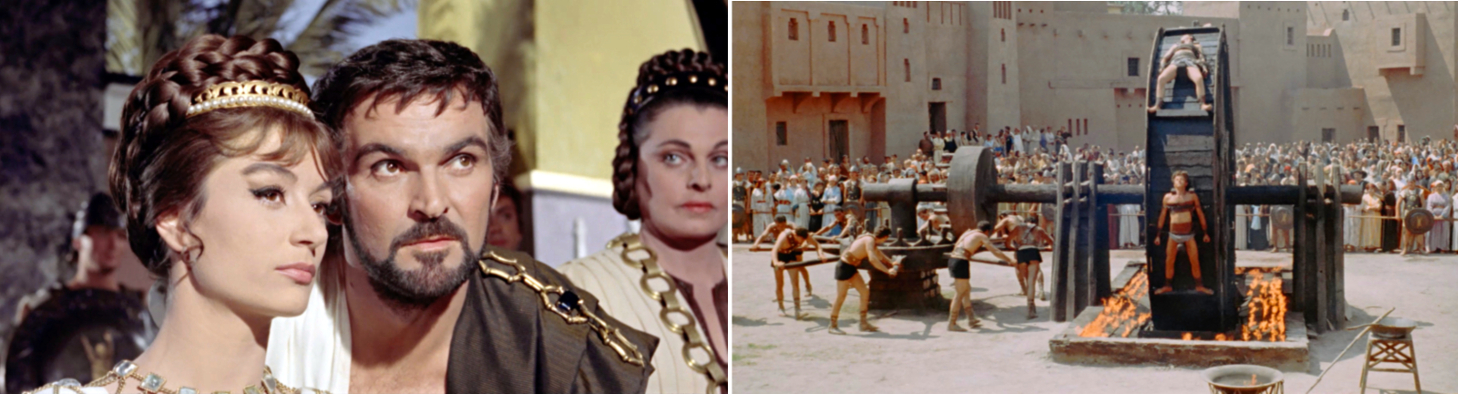
But the movie feels depraved: the well-cast Anouk Aimée and Stanley Baker communicate bored decadence and radiate cruel, sick thoughts. Baker’s cowardly creep Astaroth betrays anyone foolish enough to trust him. His ruthless use of women seems very modern, in the way Rossana Podestà’s Shuah becomes addicted to his rough treatment. Do the daughters of overbearing, controlling fathers rebel by giving themselves to abusive men? Ms. Podestà had a busy career but peaked early with the title role in Robert Wise’s Helen of Troy (1956). She does imply that her Shuah enthusiastically embraces the shameful excitement of illicit sex.
Anouk Aimée’s Queen Bera would intimidate the average Vincent Price screen villain — she’s a genuine connoisseur of evil. Wearing an ever-present sly smile, Bera relishes inflicting pain and torture. No overt lesbian content is needed, what with the lip-licking glances exchanged between Bera and her newest slave-toy acquisition, Orphea (Mitsuko Takara). Orphea supplies one of the film’s more erotic dance scenes, gyrating for Bera’s pleasure.
The dances are edgy, with plenty of suggestive body motions (for 1962). The third features the twin stars Alice and Ellen Kessler, with one of them dressed in male drag. But their performance is reduced to just a few cutaways — we don’t know if it was abbreviated for too-suggestive content or just to speed things up. I note that the dance ends with the ‘male’ twin suddenly in a different costume … either that was part of the act, or the editors folded two dances into one. The Kessler Twins are glimpsed elsewhere in Bera’s court and (I think) during the apocalypse sequence. If they once had a more substantial presence it got lost in the final cut.
The most original character is Pier Angeli’s Ildith, a sophisticated ‘experienced’ woman who must adjust to new, unglamorous duties as a Hebrew. An orthodox reading of Sodom and Gomorrah might make Ildith a villain: she’s the one who seduces Lot away from his Jehovah-fearing humility, toward the glitzy upscale luxuries of the Wicked City on the hill. Jehovah was never much of a feminist. The original story says almost nothing about Lot’s Wife, but Hugo Butler’s script makes her story into a harsh, worst-case warning about marrying outside one’s faith. Here Jehovah makes Ildith suffer a grotesque fate just to teach Lot a lesson in obedience to Hebrew values.

That brings us to Stewart Granger, essentially miscast in an almost impossible role. Lot is a principled but narrow-minded ‘great man’ who denies his own egotistical nature. When dispensing leadership values to his people, Lot is a sermonizing wet mop. He’s at his best as a fighting general; we’re impressed by his defense against the Helamites. But the script does a poor job of tracing Lot’s character arc. Compromising his agrarian values, Lot is suddenly wheeling and dealing salt futures and stacking coins like a miser. Just one scene later he’s at Bera’s royal table, boozing with Ildith and enjoying the dancing girls. I realize that the issue at stake is fairly weighty: how does a devout people live in a secular, tempting world? Stewart Granger doesn’t give much to these scenes. He’s even worse when moping in a woe-is-me, lock-me-up self-pity party. The man freed by a heavenly miracle doesn’t seem fit to lead anybody anywhere.
That said, it’s unclear if any actor could make a better Lot. It’s not easy being charismatic when your faith directs you to enforce such restrictive rules. Lot must retain our allegiance even after he fails his own principles, a tall order with little help from the screenplay.

Familar from other genre films is Giacomo Rossi-Stuart (The Last Man on Earth) as Maleb’s sweetheart. With his dubbed tough-guy voice Daniele Vargas makes a formidable villain, and we wish the striking Scilla Gabel had a larger role. The whole show is post-dubbed. I’m pretty sure Anouk Aimée performed in English. Italian audiences must have known various supporting actors from their roles in earlier classics. Feodor Chaliapin (Moonstruck) is introduced preaching from a soapbox. He explains the evil city’s slave economy in an inexplicably terrible ‘exposition dump’ in an otherwise polished screenplay.
What is with Robert Aldrich’s weird direction on this show? The editing negates anything like an epic feel. Aldrich doesn’t have to copy David Lean but the choppy cutting trims fine mastershots down to insert length. Groups of people are always marching and moving, and there are great angles on riders entering and leaving by the giant gates (added to a real Moroccan ‘mud city’ by Ken Adam). Aldrich, or whoever had final cut, seems determined to use every angle that was filmed. The shots change too fast to linger on anything. The first time I saw Sodom and Gomorrah the quick cuts made me think the mud city was a special effect illusion that the film was trying to disguise. Nope, that incredible city is full-sized.

Elsewhere the editing pace follows the philosophy of ‘never use one cut when four will do.’ Even trucking and crane shots are interrupted by awkward cuts. The constant parade of short, static angles makes the film jumpy, indecisive. But Sodom and Gomorrah doesn’t ‘feel’ like a longer movie that was cut down. Also, the editing leaves no clues that more salacious content was filmed and then removed.
It’s easy to trace the ‘apocalyptic’ thread through the career of Robert Aldrich. At least three of his films feature a literal nuclear threat. His Kiss Me Deadly quotes the story of Lot’s Wife, and then replays it substituting atomic ash for salt. There’s no denying that the Pillar of Salt remains one of the most unforgettable images from The Bible. Jehovah first smites the general Sodom/Gomorrah district with a nasty earthquake, and follows with what looks like a nuclear blast.
Frankly, what really keeps Sodom and Gomorrah on track, lending power and gravity to its not-always compelling filmmaking, is Miklós Rózsa’s emotionally stunning music score. It enforces dramatic continuity throughout. With Rózsa’s music behind him even Stewart Granger’s anguish feels appropriately tragic. Aldrich’s movie was released here without much fanfare. It may not stand with the honored epics Ben-Hur and El Cid but it’s far more prestigious than the average costume drama. We chalk it up as an entertaining, impressive show that could have used a more compelling central performance.


The article mixes up the versions. The “Originale Fassung” of 1962 on Disc 1 is the long version (154 minutes); the “Gekuerzte Fassung” of 1973 on Disc 2 is the short version (117 minutes).