


RKO’s major release Rachel and the Stranger opened in New York on September 18, 1948, just seventeen days after a particularly scandalous Hollywood arrest: the film’s newly-minted star Robert Mitchum was busted for possession of Marijuana with starlet Lila Leeds. Changing values and Mitchum’s hepcat persona reversed what just a couple of years earlier would have spelled career death for most any other actor. Perhaps Errol Flynn’s legal travails smoothed the path for Mitchum, but the attendant publicity helped rather than hindered the box office for this lively frontier romance.
Rachel and the Stranger is a worthy niche western that takes place around 1820, long before the post- Civil War genre standard. The time frame might even precede by a few years RKO’s superlative early Louisiana Purchase epic The Big Sky (1952). Howard Hughes took possession of RKO sometime in the Spring or early Summer of 1948, so he might not have had time to interfere with the release of Rachel. But he likely had a lot to do with keeping Robert Mitchum’s neck off the Hollywood chopping block. With industry veterans being smeared and ostracized for offenses ‘moral’ (Charlie Chaplin) and political (Communist sympathizers and progressives), Mitchum’s timing was impeccable.

Production chief Dore Schary left RKO soon after Hughes came aboard, but he had brought a full spectrum of liberal (and leftist) writers, producers and a director or two to the studio. The stories Rachel (1941) and Neighbor Sam (1942), were taken from a 1945 book by Howard Fast, a Communist party member who later went to prison for three months for refusing to cooperate with the HUAC. Fast is best known as the author of the source book for Kubrick/Dougas’s epic Spartacus. Screenwriter Waldo Salt would be blacklisted in 1951 for likewise refusing to testify before the HUAC; twenty years later he would stack up screenwriting Oscar nominations and wins: Midnight Cowboy, Serpico and Coming Home.
The light romantic triangle Rachel and the Stranger is Early Americana with no telltale political taint whatsoever. It’s about gentle, God-fearing frontier folk that keep the Sabbath and respect the institution of marriage. Well, maybe there is a faint leftist tilt, if one takes the notion of a bondswoman being something like a slave… contracted into servitude in a forced marriage with (potential) sexual servitude as well. Loretta Young doesn’t share the debasement that Jean Simmons endures in Spartacus. But the tease is certainly there, a very mild tease.
After losing his beloved wife to sickness, frontier farmer Big Davey (William Holden) grieves for a full winter with his son Davey (Gary Gray of The Next Voice You Hear…). In the Spring he takes off to the local stockade (a communal fort for protection from Indians) to find a wife. He buys out the contract of the bondswoman Rachel (Loretta Young). As they’ll be sleeping under the same roof, the local preacher (Tom Tully) decides that they need to be married, so as not to outrage decency. Rachel has no choice in any of this. She walks back to the farm behind Big Davey’s horse, not knowing what exactly her duties as a wife will be in these odd circumstances.
Rachel finds herself hiking to her new home, never having had a conversation with her husband and not knowing if she’ll be sharing a bed with him that same night. She makes herself useful even though little Davey doesn’t accept her and Big Davey mostly ignores her. Trying to measure up, she practices shooting, as the first wife was apparently a good shot. Rachel’s unrewarding living arrangement changes when the family friend Jim (Robert Mitchum) drops in, talking polite, playing his guitar and showing a big interest in the un-kissed bride. He even brings Rachel a dress as a gift. After not giving the woman a thought, Big Davey suddenly feels jealous. A lively love triangle forms and Jim is more than ready to simply walk away with another man’s (sort-of) bride. But what does Rachel think of all this?

Gentle could be the key word for Rachel and the Stranger. The usual violent Western concerns are not present for most of its running time, which makes the wild Indian siege of the last act all the more unexpected. We’re instead caught up in the marriage arrangement, the details of which are neither avoided nor exploited. The amusing aspect of this is that, well, Rachel clearly enjoys being fought over. Looks-wise, both men are prime catches. By 1948 young William Holden was established as a leading man but had been acting for ten years and not getting plum parts. He’d wait two more years before his big opportunity with Billy Wilder.
After his Oscar nomination for The Story of G.I. Joe and a solid hit with Out of the Past Robert Mitchum was riding high. Howard Hughes considered him RKO’s most valuable asset. Although it went against his tough-guy image, Robert Mitchum is no slouch as a singer. His faux-guitar fingerwork is weak, but he’s quite good warbling the novelty tunes. I still say there’s a bigger story in Mitchum’s marijuana bust exploit … which didn’t harm his image, or impede the success of this confirmed family picture. Where were the ‘decency’ picketers that plagued Charlie Chaplin’s Monsieur Verdoux?
Loretta Young was flying higher than either of her male co-stars, thanks to a pair of big popular successes in a row. The Bishop’s Wife was an instant Christmas classic, and for The Farmer’s Daughter she earned a Best Actress Oscar. Around this time Loretta had undergone a full persona overhaul; instead of the brazen actress of fifteen years previous, who took up with Clark Gable on location, she was now associating herself with spiritual themes and patriotic politics.
Competent director Norman Foster (Woman on the Run) and ace cameraman Maury Gertsman rose to the challenge, as Rachel and the Stranger is put together with the kind of sensitivity we ascribe to director Jacques Tourneur. The storytelling isn’t rushed; time is allotted to just let characters behave. Holden’s big Davey seems rather clueless, not being instantly aroused by Young’s Rachel. No matter how modestly she dresses, Rachel’s lips could mesmerize most males at forty paces. We stay alert because we know that sooner or later Mitchum’s Jim will drop by and ignite the romantic fireworks.

Mitchum’s Jim enters strumming a guitar and singing. He’s so good that we make no associations with singing cowboys. He ends up strumming while Rachel plays piano and little Davey sings along, with Big Davey sulking in the background. Not only didn’t Big Davey invite his wife to bed, he didn’t even ask if she played a musical instrument. The carefree second act with both men competing for the female is both funny and instructive. For the men the deal soon becomes a matter of dollars and cents. Rather than just seducing Rachel into high-tailing it into a new relationship, Jim tries to buy out Big Davey’s investment, with profit. Hey, maybe there is a Communist influence at work here… we know perfectly well that all American marriages are 100% love, and never made for something as base as economic security.
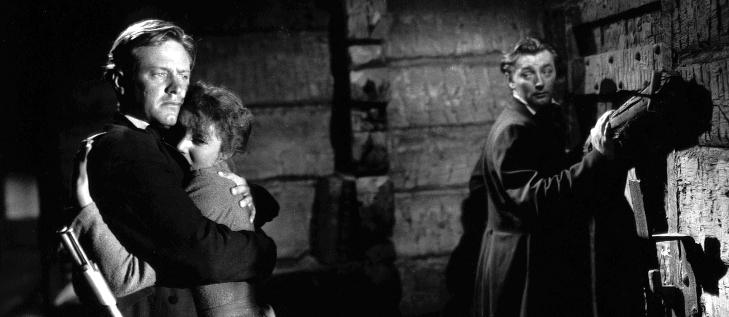
When Rachel and the Stranger resolves in a standard action scene we’re almost a little disappointed. The Shawnees attack, serving as figurative marriage counselors. Naturally, in the dark of the night the defenders still somehow shoot a score of them. Mad magazine once lampooned frontier women clichés by joking about a ‘frontier wife’s gun’ that, when fired into the air by a woman with her eyes closed, killed an Indian on a galloping horse fifty yards away. Rachel has already earned little Davey’s respect by shooting a marauding cougar, and for the final firefight she becomes a regular Annie Oakley. This must be the original NRA household.

The stars are great, the dialogue is smart, and Rachel and the Stranger makes us smile. It therefore comes out way ahead of the curve. 1948 audiences were likely charmed by its positive attitude, in a year of ever-darker films noir.
Only years later would we learn that movie tough guy Robert Mitchum also wrote poetry and sang songs; perhaps we should have realized that his recording career wasn’t a novelty stunt. In addition to the classic pop single he recorded for his production Thunder Road, he cut at least one Calypso album. For Rachel he recorded several folksy songs that work very well in context. A 78rpm record with six songs was released; at least one of the tracks includes the singing voice of co-star Gary Gray. Writer Waldo Salt wrote the clever lyrics for Roy Webb’s music.
The movie is one of several RKO westerns from 1948. Besides three or four Tim Holt series entries, there was Return of the Badmen, Robert Wise’s noirish Blood on the Moon (just out from the WAC), John Ford’s classic Fort Apache, plus Station West, with tongue-in-cheek dialogue for Dick Powell that could have been written for Philip Marlowe. Rachel appears to share an exterior set with Howard Hughes’ The Big Sky, which wouldn’t go before the cameras for four full years. The stockade/fort where Big Davey buys Rachel looks exactly like the one that Kirk Douglas and Dewey Martin invade in Sky to rescue their Indian scout Pore Devil (Hank Worden) from rival fur traders.

