

What are the Odds Against Tomorrow?
Remember to Kiss Tomorrow Goodbye,
because Tomorrow Is Another Day.
Despite everyone loving his calypso records, the handsome Harry Belafonte was just too threatening for white America in the 1950s, probably because he spoke his mind more frequently than did Sidney Poitier. The studios and Otto Preminger tried to find a place for both Belafonte and Dorothy Dandridge, but his clear-eyed refusal to feign contentment kept him from the embrace of mass movie popularity. The Zanuck film Island in the Sun teased at an interracial romance between Belafonte and Joan Fontaine, but the pair are never allowed to even touch each other. Ten years later, Petula Clark grazed Belafonte’s forearm when sharing a song on a TV special, and network lawyers wanted to cut it out.

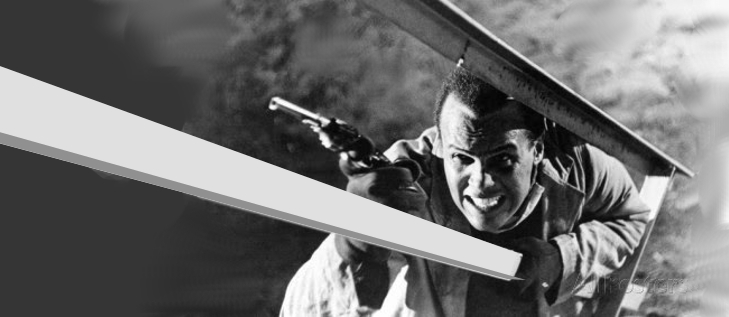
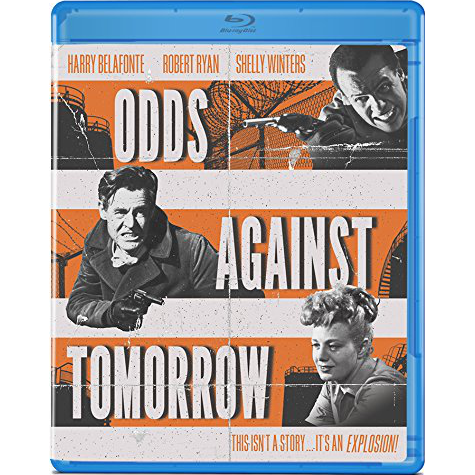
Perhaps Island in the Sun was an inducement for the entertainer to form his own production company. 1959 saw two Harbel films in theaters, MGM’s science-fiction thriller The World The Flesh and The Devil and a United Artists release produced and directed by Robert Wise, Odds Against Tomorrow. The tough-minded heist picture is a throwback to earlier noir crime capers, with the obvious addition of a racial theme. It’s well done in all respects, but we’re not sure of the exact message that the picture leaves us with. Will criminal gangs be more successful if they can overcome racial intolerance?
It’s another of Robert Wise’s hardboiled dramas about tough guys and gals under pressure: Run Silent Run Deep, I Want to Live! The hyper-efficient Wise’s reputation with Hollywood moneymen was so good, his participation was a main greenlight factor for his next picture, the risky West Side Story. Not known as an actor’s director, Wise nevertheless excelled when his films were as well cast as this one. The frontline players are a rogue’s gallery of noir losers. Belafonte’s sympathetic gambling addict is opposed by Robert Ryan’s bitter malcontent, yet another variation on the maladjusted problem men he played in noirs as varied as Crossfire, Act of Violence and On Dangerous Ground. Shelley Winters and Gloria Grahame had plenty of experience as conflicted, dangerous women; for each this outing was something of a farewell to the genre. The marvelous Ed Begley is in the middle of everything. He’s utterly convincing as the cop gone bad, a nice guy determined to make that one big score. Begley and Ryan had played well together in perhaps the best of the rogue cop movies, Nicholas Ray’s On Dangerous Ground.

The story source is a book by William P. McGivern, who made his name earlier in the decade for his stories about rogue or corrupt cops: The Big Heat, Shield for Murder, and the on-the-button-titled Rogue Cop.
It’s a cold winter in New York. Disgraced policeman Dave Burke (Ed Begley) lost his badge because he wouldn’t inform on the mob, but he’s too smart to take a ‘charity’ job from gangster Bacco (Will Kuluva of Crime in the Streets). Dave needs two partners to rob a bank in the upstate burg of Melton. Jazz singer and xylophonist Johnny Ingram (Harry Belafonte) initially says no, but his gambling debt to Bacco and his separation from his wife and child force him to change his mind. The aging ex-con Earle Slater (Robert Ryan) initially turns Dave down simply because he doesn’t want to work with a black man. Earle’s personal demons revolve around humiliating challenges to his self-esteem. He can’t find a suitable job, while his hardworking wife Lorry (Shelley Winters) supports him. Too easily enraged by young punks, Earle boosts his failing masculinity by submitting to the advances of his stray-cat neighbor, Helen (Gloria Grahame). Both Earle and Johnny soon decide to come in on Dave’s scheme to rob the bank. The plan sounds great, but the friction between Earle and Johnny is caustic. Dave does his best, but the mutual hatred is uncontrollable.

The accomplished Odds Against Tomorrow shows off Robert Wise’s talent for gritty atmosphere. The streets are oppressively chilly and Johnny Ingram’s nightclub milieu evokes a much more convincing mood than similar material in other movies. Belafonte gathers a good little group of actors to sketch the musicians and the cloak-room girlfriends that habituate Johnny’s club. His domestic troubles include his suffering wife Ruth (Kim Hamilton) and daughter Eadie (Lois Thorne). One very good scene has the drunk and despondent Johnny interfering with another performer, a very good bit with singer Mae Barnes (her only feature film performance). The cheerful elevator operator Mel Stewart (Nothing but a Man) jokes first with Earle and then with Johnny, receiving very different responses. Club bouncer Robert Earle Jones of Wild River slips Johnny a gun, at a bad time. Jones is the father of the great James Earl Jones.
Physically the film can’t be faulted. The trip to Melton gives the impression that the whole world is against this ill-chosen trio of thieves. The long afternoon wait is given over to the realistic passing of a bleak day, giving all three men plenty of time to think about their supposedly foolproof crime plan. Robert Wise had pulled some technical tricks in the past, as with the particularly fast deep-focus lenses he used on his earlier noir The Captive City. Here he goes one step further and experiments with infra-red film, which is sensitive to heat as well as light. Green registers as white, making bright sunny exteriors appear bitter cold. A car on a turnpike passes some grass, which looks as white as ice. Earle Slater’s introduction sees him walking into the sunlight on a sidewalk, and he’s so bright that he could have been composited into the shot with a traveling matte. That’s the most extreme use of the infra-red trick, but its use enforces a consistent, ‘different’ look throughout the picture.

In noir we always want to know why people choose to commit antisocial crimes — perhaps we relate because we wonder what our personal aptitude for crime might be. Johnny Ingram is menaced by Bacco’s minions, including a scary Richard Bright, a gay enforcer with behavior so skewed, he may also be a drug addict. Bright eventually became Michael Corleone’s right hand factotum in the second two Godfather films. Belafonte’s touching scenes with his daughter are contrasted with his disastrous meeting with Bacco, where he pulls a gun in frustration. Johnny holds up his end of the heist beautifully, but he can’t take Earle’s vicious insults.
A detail overlooked by many viewers reveals Dave Burke to be as deceitful to Johnny as Earle Slater: it looks as though he makes a deal with Bacco to force Johnny to come in on the robbery. Even if Johnny’s ‘odds against tomorrow’ crime gamble goes well, Bacco will make certain that he’s still behind the eight ball. Three white guys oppress him in different ways, even Dave, who thinks he’s Johnny’s friend.
Earle’s scenes with his understanding, loving Lorry are beautifully judged — the nicer she is the more upset Earle becomes. His reaction to Helen’s teases are priceless, especially when Helen asks in a whisper about the rumor she’s heard: “What was it like when you killed that man?” Some of these moments touch strongly on the vibe we get from books by Jim Thompson: these are unhappy people in sordid situations, finding out what they’re really capable of. Earle Slater is technically the ‘hooligan’ character, aligning with Sterling Hayden’s Dix Handley in The Asphalt Jungle. But otherwise there’s no comparison. John Huston all but embraces his crooks in sympathy and understanding. Odds Against Tomorrow simply watches its maladjusted thieves scratch and tear at each other.

The film’s most indelible scene is a barroom confrontation between the experienced Earle and a punk soldier (Wayne Rogers of TV’s M*A*S*H) showing off for his girl (Zohra Lampert of Splendor in the Grass). When Earle goes out of control he’s a dangerous brute who doesn’t know his own strength. We don’t know the circumstances of Earle’s convict past, but we easily believe that he could kill a man with one blow. Earle doesn’t even get to savor his fairly-won victory. Condemned once again as a villain, he must hurry away in case the cops arrive and look into his background.
The actual bank robbery is too well done to spoil here. It’s not the slick caper of The Asphalt Jungle but the details appear credible enough. Robert Wise’s angles have a carefully storyboarded feel: precise, but also predetermined. We certainly understand the interpersonal forces that make the robbery fall apart. Earle is so filled with hate for Johnny that he refuses to follow the plan. In short order everything goes straight to hell.

The last two minutes may be what keeps Odds Against Tomorrow from reaching classic status. The delicate character nuances disappear as the two foes do battle with each other, forgetting even about self-preservation. The story also takes an unwelcome leap into ‘Aesop’s Fables’ territory. A hasty borrowing of the action finale of White Heat is frustratingly unoriginal, as is the bleak oil & mud finish.
A cop delivers the kiss-off dialogue zinger, a leaden irony more appropriate for the capper of a morally instructive Twilight Zone episode. Perhaps the idea for Odds Against Tomorrow began with this deep-dish faux deep-think finale? After a ninety-minute tour of grinding personal failures that blight the lives of flawed men, the shallow plea to Love Thy Neighbor comes off like a Sunday School lesson.
