


Do you remember the scene in Jean-Luc Godard’s Alphaville, when Lemmy Caution meets Harry Dickson, a spy who has failed in his mission? He’s played by actor Akim Tamiroff. Pulp fiction detective Harry Dickson was as well-known in France as Sherlock Holmes; Americans don’t know anything about him. Many of the numerous Dickson stories were written by the prolific author Jean Ray. who also worked in comic books. But Ray is now best known for a 1943 gothic horror novel called Malpertius — something else that remained mostly unknown in the U.S.. A film of Malpertuis was made in 1971, but it continued Jean Ray’s Tradition of Obscurity — it apparently received no English-language release when new. Some versions later on were retitled The Legend of Doom House.
Belgian director Harry Kümel enjoyed an international hit with his erotic horror item Le Rouge aux Lèvres, aka Daughters of Darkness. The pleasingly atmospheric vampire yarn benefitted from a fantastic beach hotel location and a superb performance by the legendary Delphine Seyrig.
Its success apparently launched Kümel to adapt Jean Ray’s much more ambitious horror tale, a bizarre fantasy with many characters and a premise difficult to translate to film. When we read about this unseen show in Phil Hardy’s Encyclopedia of Horror, we still couldn’t picture it: Hardy described the premise as ‘about an old seadog who discovers a number of the Olympian gods, and has a taxidermist sew them into human skins.’ But we find out that Hardy’s description is all back-story … maybe. The show is really a surreal meditation on the uneasy coexistence of two incompatible worlds.

We reviewed a 2006 DVD from a company called Barrel Entertainment, that had excellent extras. It also carried two versions of the film, which had a disastrous premiere at Cannes in one version, and was then re-cut in another. The fairly expensive production sported a number of noted stars and actors — Orson Welles, Susan Hampshire, Michel Bouquet, Mathieu Carrière, Jean-Pierre Cassel, Daniel Pilon. The disc extras say that director Kümel was backed by United Artists, which apparently declined to release Malpertius internationally.
That DVD of Malpertius has been borrowed a lot, by curious friends that couldn’t picture what the film could possibly look like. To us it looks as if Harry Kümel’s brave attempt to capture the ‘weird, brilliant’ novel came up against literary ideas difficult to adapt to the film medium. The movie at all times looks original and feels like it’s going somewhere. But it can’t make anything satisfying out of material that refuses to find a dramatic conclusion. Oh sure, it’s easily interpreted as an abstract dream narrative …

Malpertuis (Mahl-pear-twee) goes against the low-budget trend of early ’70s Eurohorror. It is a handsomely appointed macabre fantasy with horror overtones, enacted by a top-rank cast. It most resembles a haunted house tale. Returning after many years, the sailor Jan (Matthieu Carrière of Young Törless) cannot not find his old home or the relatives he left behind. He is tricked into entering the strange house and gardens of Malpertuis, inhabited by an odd collection of bourgeois neurotics and borderline madmen. All await the impending death of their patron, the bedridden Cassavius (Orson Welles).
Cassavius has but one rule for his ‘guests’ — they must forever stay within the walls of Malpertius. Jan is happy to reunite with his sister Nancy (Susan Hampshire of The Three Lives of Thomasina). She wants to leave as soon as possible, but the manipulative Cassavius tempts Jan to stay and become his direct heir. One inducement is the offer of a marriage to the redheaded, enigmatic Euryale (Hampshire in a second role). At Cassavius’ passing the will is read. The inhabitants of Malpertuis will receive large sums in gold, but only if they continue to stay. Nancy elects to leave with her lover Mathias (Daniel Pilon), an ambition that comes to a violent end. Jan is seduced by Alice (Hampshire again), one of three malicious sisters. He loses favor with Euryale, and cannot make her look at him.

Meanwhile, other residents continue their weird behaviors. When not feverishly counting his money, Cassavius’ henchman Dideloo (Michel Bouquet of The Bride Wore Black) skulks about like a petty crook in a Feuillade serial. Lampernisse (Jean-Pierre Cassell of Army of Shadows) lives in rags under the stairwell. He wails in fear that the house’s gaslights will be extinguished or stolen. Mad taxidermist Philarette (Charles Jannssens) babbles about stuffing all of the others, one by one. At one point Jan escapes the haunted Malpertuis, but has he really?
Malpertuis is fast moving, richly colored and brightly lit. Editing and art direction give the odd house the feeling of a haunted maze with weird attic rooms. Jan sets out to catch vermin in the attic, and later finds a strange piece of human flesh in the trap. Does the house itself eat people? Cinematographer Gerry Fisher often picked odd assignments (Accident, Sebastian, Ned Kelly, The Offence) and his visuals rival the slick giallos that were coming from Italy.

But we wonder if director Kümel was overwhelmed by this bigger production, with so much talent to manage. He had terrible problems with Orson Welles, that would have broken the concentration of many more experienced directors. In a new interview tells us that Kümel didn’t protest when United Artists imposed an editor on the show, to rush a cut to Cannes. UA did allow Kümel to re-edit the footage his own way … even though the negative had already been cut.
Malpertuis is carefully constructed to invite a psychological interpretation. Hints abound that the house might merely be a manifestation of Jan’s disturbed mind, a la The Cabinet of Dr. Caligari. Jan’s old home by the canal has mysteriously disappeared, and a family he meets briefly in the street seems to mirror his own lost relations. The characters inhabiting Malpertius are fully formed eccentric personalities; some seem reasonably normal and others quietly deranged. The most successful are the several women enacted by Susan Hampshire. Each presents a contrasting appearance. Jan is soft and affectionate, and Euryale seems to be in a strange trance. She will not look directly at Jan, a quality perhaps carried over from Greek myth. Because Jan’s two lovers so closely resemble his sister, his hallucinations have a suggestion of incest.

The film’s main problem is easy to pin down. Matthieu Carrière’s Jan is handsome, but he’s too passive to win our sympathy. We never identify with him. It’s difficult to sympathize with a someone so unfocused; we think about his hair as much as we do his reactions. When Jan ‘betrays’ Euryale to bed the promiscuous Alice, hopes for a romantic solution fall apart. The overriding sense of shapelessness eventually wears down our patience. Kümel avoids Kafka-esque clichés but doesn’t create a ‘world’ we can engage with, especially not in the finale, that (maybe) warps time and space.
We can’t help but contrast Malpertius with other more successful horror fantasies. We never get a handle on the whys or hows of Cassavius’s guests not being able to leave the house. They aren’t presented cinematically. Luis Buñuel made an entire feature from the irrational idea of party guests being unable to go home, and somehow captured an absurd quality that all but defined surreal cinema.
In an early scene, Jan chases a mystery woman through narrow, maze-like streets. Every time he turns a corner, she has somehow gotten way ahead of him. But Jan barely reacts to this frustrating dilemma. By contrast is an almost identical scene in Mario Bava’s classic Lisa and the Devil. Elke Sommer chases after Telly Savalas through some narrow Spanish lanes. Bava immediately communicates Sommer’s disorientation and the ‘impossibility’ of what’s happening. What we remember from Kümel’s sequence are the attractive old-world streets.

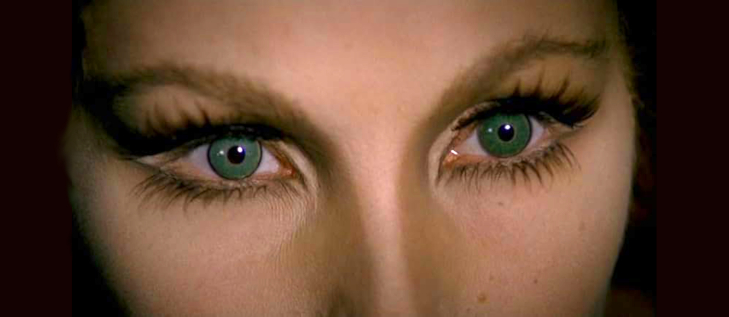
All that business about Greek gods sewn into human skins? Don’t expect to see a literal depiction of that. Our strongest memories are of individual images: the raucous red light district and the prostitute Bets (Sylvie Vartan), the fair-haired Jan awaking in a strange room that seems to have adjusted to fit his personality, and almost everything with Hampshire’s fascinating Euryale. Her red hair, blue eyes and superb makeup create a character both attractive and sinister. Orson Welles was at this time performing for every producer who could pay his price, even Bert I. Gordon. Welles’ intimidating Cassavius is basically seen from one angle, with the same pinched scowl on his face. He nevertheless makes a strong impression, even with his self-applied theatrical makeup.
Viewers schooled in mythology may be at an advantage when assigning meaning to events in this enigmatic show. Was Malpertuis an inspiration for Mario Bava’s Lisa and the Devil? Both films begin with a disoriented innocent chasing an elusive figure; each becomes a prisoner of a household of perversity, murder and madness. Both stories end with an existential riddle. The difference is that Bava’s haunted house projects a consistent aura, one of death and putrefaction. Festival attendees rejected both movies; Malpertius saw a continental release but Lisa’s was especially brief. It was then was partly re-shot and converted into an ugly, exploitative rip-off of The Exorcist.
Malpertius will interest fans interested in serious genre experimentation, to push horror in new directions. It sounds as if the Jean Ray book had ‘unfilmable’ episodes that Harry Kümel was unable to rework for his feature. His generous budget was probably spent on his name cast. It was unfortunate that the show hired Orson Welles, if he was as uncooperative as some of the extras say he was. The real problem was the casting of the film’s male lead, but a good Welles performance would really have helped.


Hot take: Orson Welles was a blowhard that undermined everybody, treated other people badly and just could not accept the fact that his best years were so far behind him! Self indulgence does not talent make, and it’s so hard for me to get behind Welles “talent” when he spent the majority of the remaining part of his career post-“Citizen Kane”/”Touch of Evil” practically becoming a liability rather than an asset to his own productions as well as others. Adding to it, Welles really had a nasty havbit of “taking the money and run” and burining a lot of bridges behind him: he’s practically similar to Andy Milligan in that regard! Harry Kümel’s personal accounts of Orson’s bad behavior show that the man was such a one-off! Really, what did Peter Bogdanovitch see in the guy?
I knew people who worked with Orson, and they all ,without exception, thught the same things as above.
I would’ve loved to be a fly on the wall to see the behind-the-scenes shooting of that Paul Masson champagne commercial Orson did in an alleged “drunk” state, constantly blowing his lines and not knowing where he was! The outtake footage is on YouTube, but I’ll bet the atmosphere on set was DEADLY that day. Oh Orson: how the “mighty” have fallen!