
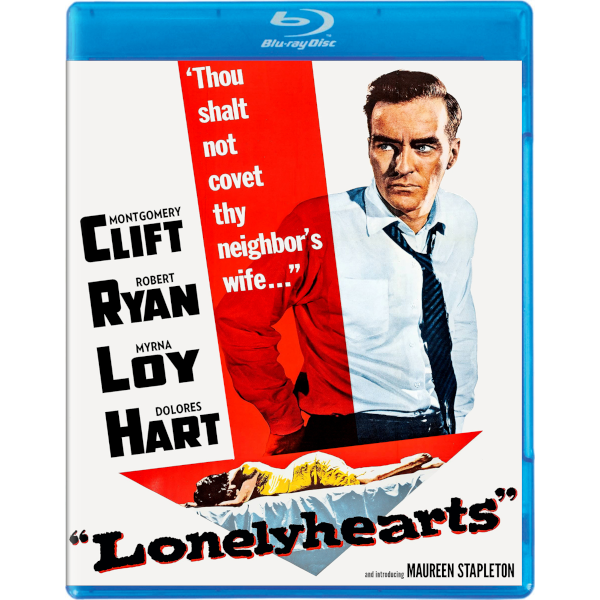

Beginning as a writer, Dore Schary excelled as an executive in the post-war film business, helping the ‘social comment’ movement along at RKO with shows like Crossfire and The Boy With Green Hair. He also tapped into the mainstream at MGM, gaining the advantage over his rival L.B. Mayer with winners like Battleground. Schary’s cultured approach led to unusual fare like The Next Voice You Hear, and he made Vincente Minnelli into MGM’s most consistent auteur. But Schary also stuck up for directors like William Wellman and John Sturges. He was personally responsible for pushing Forbidden Planet through the Metro factory, even when he knew his tenure was coming to a close.

Schary only made three more feature films after leaving MGM. His first independent production is a small-scale item with big star talent that he surely thought might become a major sensation. With his baleful but brilliant novella The Day of the Locust, the troubled writer Nathanael West created his own genre of social comment and proto-existential despair. His even more emotionally devastating Miss Lonelyhearts (1933) charts the downward spiral of a sensitive and caring news writer tasked with an ‘advice to the lovelorn’ column. Instead of dispensing homilies and formula advice, he absorbs the heartbreak and misery in the letters. West’s portrait of a weak man doomed by his own decency is not for anyone who has ever seriously thought of suicide.
When Daryl F. Zanuck optioned West’s book in 1933, the Hays Office responded with a furious letter calling the book obscene and degenerate. But the resulting film Advice to the Lovelorn transformed West’s tale of Depression horror into a light romantic comedy. Twenty-five years later, Dore Schary’s screenplay has more similarities to the original novella than does a 1957 play adaptation by Howard Teichmann that ran for only a few performances.
When announcing his production, Schary gave its title as The Hellbox, an old term for a typesetter’s box for used type. The project doesn’t sound like a box office bonanza, although we give Mr. Schary the benefit of the doubt for wanting to try something different. Appearing years later on the Dick Cavett Show, he came off as a sincere writer-producer who just wanted to make great movies.

Diary of a Country Priest meets Sweet Smell of Success.
Released in 1958, Lonelyhearts can be grouped with other movie adaptations produced from live TV dramas, like Paddy Chayefsky’s Marty and J.P. Miller’s The Days of Wine and Roses. We never learn what city we’re in. The Chronicle is a small town paper housed in a small office, where an idealistic journalist might thrive or languish depending on his creative drive.

Still struggling with his new, post-accident face, star Montgomery Clift is ideally cast as the insecure young writer (now given the name Adam White) with a fine mind and a sensitive soul. Adam’s steady girl is the honest and wholesome Justy (Dolores Hart), who yearns for the day that they can marry so she can stop taking care of her brothers. To that end Adam pursues a newspaper job from the Chronicle’s editor Bill Shrike (Robert Ryan), a misanthrope whose words drip with contempt for human nature. Robert Ryan was too often taxed with beady-eyed, hate-filled characters, but Shrike is an especially difficult challenge.
With a near-psychotic zeal, Shrike tags White as ‘yet another phony idealist.’ He hires the young man as an experiment, to prove his cynical theories to his wife Flo (Myrna Loy). Shrike insists that there is no motivation beyond personal gain, that every ‘selfless do-gooder’ person is a fake, running a con game on his fellows.
Shrike puts Adam in charge of the ‘Miss Lonelyhearts’ column. He’s not asked to provide wise advice or moral guidance, like Mary Worth on the comic pages. The Miss Lonelyhearts mailbag yields problems for which there is no solution, no constructive answer. Common sense and compassion won’t help a 16-year old who lost her nose in an accident and wants to know how to find a boy friend.
Told to grow a thick skin, Adam instead absorbs the cumulative misery. He responds bitterly to his editor’s badgering. Shrike enjoys watching the young man squirm and struggle, like a cat playing with a mouse. But Adam continues to take his task seriously, and his despressed state naturally affects his relationship with Justy.
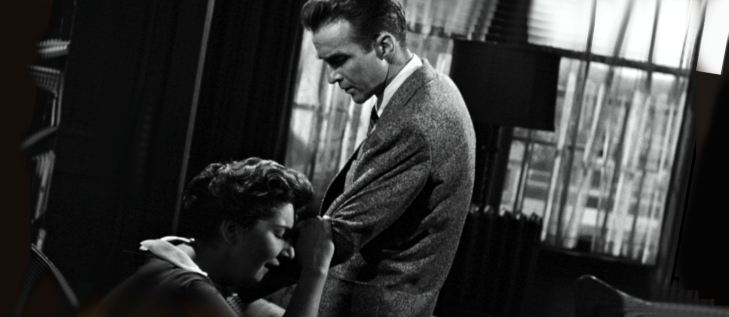
If it weren’t for Adam’s healthy connection to Justy, Lonelyhearts would be an unbroken string of poisoned relationships. Bill Shrike’s game with Adam is just a side amusement to his constant needling of his unhappy, borderline alcoholic wife Flo. After years of emotional mistreatment, Flo responded to Bill’s neglect with a brief affair. The unforgiving Shrike has used that as a weapon ever since — when she introduces Adam, Bill makes an ugly joke about the young man being her potential lover. The mental cruelty leads Flo to drink more than she should — a sad reality check on the nature of drinking presented in Loy’s The Thin Man movies. Even when Shrike is struck with a tender feeling, their history of unhappiness makes a reconciliation impossible.

Real calamity threatens when Shrike suggests that Adam contact one of his writers, to discover for himself ‘that they’re all fakes, too.’ Adam meets with the initially grateful Fay Doyle (Maureen Stapleton), who paints a picture of herself as lonely and mistreated in an empty marriage, desperately in need of male attention. Adam is so moved that he makes a huge mistake with Fay. He finds out almost immediately that she’s been dishonest, just as predicted by Shrike. She now blames Adam for taking advantage of her, and threatens to do something about it. Adam then discovers that Mr. Doyle (Frank Maxwell of The Intruder) is nothing like Fay’s description, but genuinely concerned for his unstable missus.
Thus do good intentions lead to hell, as Bill Shrike insists. Adam has set himself up for a horrible fate … though readers of West’s novella will note that Dore Schary’s screenplay deviates from this at the last minute. The film is bookended with ‘for publication’ speeches between Adam and Shrike, leading to a resolution-closure incompatible with Nathanael West’s vision of limitless misery.
Dore Schary retains West’s stylized, compressed dialogue for Bill Shrike, which contrasts strongly with the more natural speech of the other cast members. Shrike thinks and speaks as a never-ending editorial condemning humanity as rotten to the core, in polished epigrams dripping with sarcasm. His florid/acid speeches would be mesmerizing in a theater, but the average movie patron likely hit a wall of disbelief: ‘Who talks like that?’ Robert Ryan delivers this universal loathing for people with self-satisfied enthusiasm:

“I enjoy seeing youth betray their promises. It lights up all the numbers on my pinball machine.”
We readily recognize the theatrical tradition of newsmen that talk as if they were writing Front Page copy, but this film’s setting is realistic, very un-stylized. Bill Shrike’s Mephistophelean antagonist is a hyper-verbal John Claggart, to Adam White’s Billy Budd. Fixated on preventing Adam from making peace with the world, he comes off as a cultured psychotic, ready for a breakdown of his own.
Two of Dore Schary’s post-MGM productions were directed by Vincent J. Donehue, a busy TV director of the 1950s. It’s too easy to dismiss Lonelyhearts as an overcooked episode of Playhouse 90 — Donehue’s overall solid direction and the excellent acting approach the standard set by Elia Kazan and Sidney Lumet. Montgomery Clift’s typically committed performance shows Adam struggling under the weight of all those suffering readers. His ‘imitation of Christ’ is involuntary — he takes no vows and begs for a different writing assignment. But he cannot help but assume the burden of those that write to his advice column.
Was Schary perhaps a fan of French director Robert Bresson? Changes to the original novella make Lonelyhearts’ structure seem even closer to that of Bresson’s Diary of a Country Priest.
Yes, when converted to standard dramatic form West’s story does feel somewhat rigged. The sensitive Adam tries to shield Justy from his psychic dilemma, when she seems just the kind of caring and helpful woman to help him deal with his emotional logjam. Schary’s revision opts for the conventional trope of Justy ‘going the extra mile’ to be with ‘her man.’ What seems obvious now is that the pragmatic, honest Justy could answer the Miss Lonelyhearts mail the right way — cherry-picking ‘safe’ letters suitable for print and writing personal notes to the ‘hopeless’ letters, simply showing understanding and compassion.

Remember Myrna Loy’s housewife in The Best Years of Our Lives, describing to her daughter how her ‘ideal’ marriage had suffered bad patches? Loy’s Flo sees a less fortunate woman crushed, discouraged and humiliated by a bad marriage. The first victim of her husband’s poisonous, degrading philosophy, Flo may meet him after work each night simply for the opportunity to drink, and maybe see other people.
Flo must mostly drink alone. Adam indeed frequented this particular bar in the hope of meeting the editor of the Chronicle, and was fortunate to connect with Flo. Nothing Flo does seems innocent to Bill Shrike, who isn’t happy unless all around him are caught up in his web of sardonic disapproval.
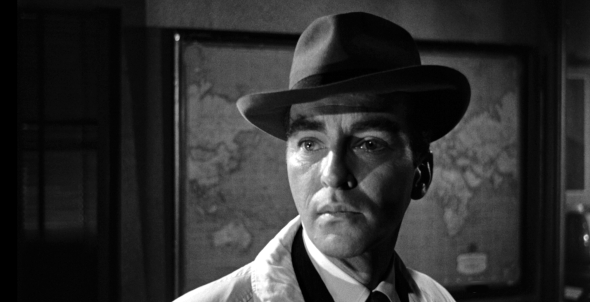
Ready for some serious gloom? Most everyone in Lonelyhearts is demoralized. Fellow paper writer Ned (Jackie Coogan) resents Adam for taking the Lonelyhearts job, which Ned actually wanted; his other office mate Frank (Mike Kellin) is more of an easy-going joker. We also learn that Adam has other reasons to struggle against a sense of inferiority. Adam White’s personal background is as traumatic as some of the sad cases in the Miss Lonelyhearts mail. Adam identifies himself as an orphan. He’s changed his name and refuses to acknowledge his father, Mr. Lassiter (Onslow Stevens).
Broadway star Maureen Stapleton also claimed awards in film. Her Fay Doyle won the first of four Best Supporting nominations. Always a powerful presence, she’s a reason to see Airport again, and she won her Oscar for her supporting role in Warren Beatty’s Reds. Her contribution to Lonelyhearts is just three or so scenes, yet her forceful character practically wipes Adam White off the screen:
“Who are you kidding? Listen, you wanted a sad story, you heard a sad story! You also wanted some action!”

Commercially speaking, producer Schary would have had to hit a critical home run for this grim little psychodrama to take off. His finale plays as an onconvincing compromise, saving Adam from ignominious doom and letting some hope and happiness shine in for Mr. and Mrs. Shrike as well. It’s almost as if Pinocchio’s Blue Fairy hit Bill Shrike with her wand, banishing the cynical poison away. For followers of Nathanael West, it’s a major literary betrayal.
Author West simply didn’t believe in redemption. Schary’s adaptation gives us a clash between Shrike’s sadist and White’s suffering idealist, and a revelatory climax that leads to a positive resolution. What we really remember is the anguish of Flo Shrike, of Adam’s father Mr. Lassiter, and of Fay and Pat Doyle. Lonelyhearts can’t possibly become a feel-good movie, even if we admire its earnest dramatics.

