
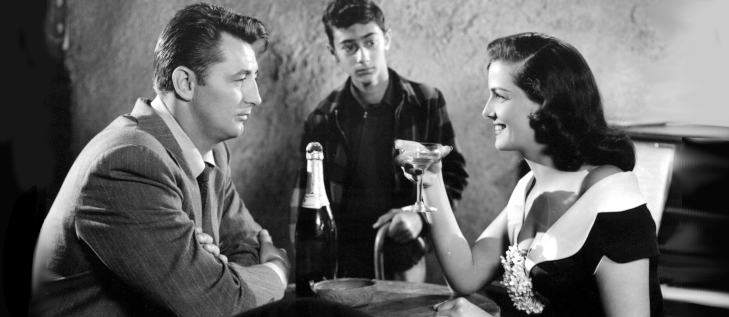


Behold Robert Mitchum, a Hollywood cat so cool that even a weed bust couldn’t stop him. Mitchum’s effortless hipster detachment surely set a standard for Jack Kerouac, if not the whole Beat movement. Nothing fazed his screen image. In the ‘annihilating noir’ Out of the Past , when bad girl Jane Greer started listing her problems, Mitchum steered straight to the kissing phase with a lazy-eyed answer:
“Baby I don’t care.”
Now that’s an original come-on line. Could it have inspired song lyrics for Elvis Presley?

Howard Hughes must have purchased the RKO studio as something to play with. The way he ran it into the ground, one would think he was looking for a big tax-write off. Hughes wouldn’t let his executives make decisions, and he fired more than half of RKO’s highly skilled employees. He held up promising films for months and years with re-writes and re-shoots.
Hughes brought his contract star Jane Russell to RKO, and paired her with the studio’s contractee Robert Mitchum in His Kind of Woman, a noir thriller set in a Mexican resort. When the censors made him tone down the lurid advertising campaign images and slogans, Hughes invited scandal by erecting (cough) a giant billboard with his three stars, Mitchum, Jane, and Jane’s cleavage. It was painted by Mario Armond Zamparelli, the Chief Executive Designer for all of Hughes’s businesses, and stood at Wilshire and Fairfax, right across from The May Company, where nobody could miss it. ↖
His Kind of Woman demonstrated Howard Hughes’ penchant for re-thinking movies when they were almost finished, in essence filming them more than once, in bits and pieces. All in all, the show was delayed for a full 15 months. Eddie Muller makes this inefficient production story into an amusing speech, and this disc’s commentary by Vivian Sobchack covers it as well. With a new ending still not filmed, producer-director John Farrow (The Big Clock) moved on to his next commitment, leaving Hughes to appoint another director to patch things together.

The show begins well enough. Dead-broke gambler Dan Milner (Robert Mitchum) accepts $5,000 from some rather sinister men to fly to Mexico for purposes undisclosed. He has little choice, for local hoods are threatening his life. The secret destination turns out to be Morro’s Lodge, a lavish resort at the tip of Baja California, accessible only by airplane. On the way Dan meets Lenore Brent (Jane Russell), an heiress intent on chasing after another resort guest, the famous actor Mark Cardigan (Vincent Price). Additional sinister types (Charles McGraw, John Mylong) at Morro’s advise Dan to keep his mouth shut and wait. Dan slowly learns why he’s been given money and a free vacation: he’s the pawn in a scheme hatched by Nick Ferraro (Raymond Burr), a deported Mafioso. The hulking Ferraro needs someone to help him re-enter the country under a new identity. ↓

His Kind of Woman begins as an almost existential noir. Mitchum’s Dan Milner loiters around a millionaire’s Grecian columns, and takes an offer he knows is an invitation to trouble. To match Dan’s devil-may-care act, the show maintains a joking attitude, and the comic aspects threaten to take over completely.
That wasn’t the original plan. John Farrow is the only credited director, but the film’s last act is an addition directed by Richard Fleischer, another of Howard Hughes’ favored directors. New scenes were added and others cut; some accounts say that almost the entire movie was re-shot. The improvised storytelling approach slows the pace, stalling the film’s forward momentum. Most noir thrillers wind things up quickly, but His Kind clocks in at a full two hours.

Hughes replaced actors in mid-production. The film began with familiar western villain Robert J. Wilke playing Ferraro instead of Raymond Burr. Did Richard Fleischer make amends to Wilke by casting him in a visible role in Disney’s 20,000 Leagues Under the Sea?
Slick dialog makes Robert Mitchum serve as a low-key joke machine. Dan Milner answers questions with rejoinders that sound almost like Beat poetry. He slouches in and out of scenes, hardly raising an eyebrow when hoods beat him up. He barely reacts when suspicious moneymen offer him a fortune to leave the country on an undisclosed assignment. We wonder if Mitchum invented this pre-Beat hipster attitude, or if he borrowed it from the Jazz and Bebop music scene.
Howard Hughes must have thought His Kind of Woman had everything in the world worth putting into a movie, starting with airplanes. Milner flies to a remote Mexican hunting lodge in a small plane, as does Tim Holt’s federal agent. Jane Russell and her assets entice Milner to cooperate with the obviously sinister goings-on — yet she turns out to be a good gal instead of a femme fatale. The hunting lodge is the perfect Hughes hideout, limited to adventurers, aviators and VIPs; it’s also a Las Vegas-style casino. It’s an enormous indoor set, and ambitious matte work opens it up with dynamic painted backgrounds.
Ripping off a scene from Casablanca, Milner saves a young bride from a sexual predator (Jim Backus!) by helping the husband win at cards. But Milner isn’t as good at figuring out his own role in this fancy-dress charade. The gravel-throated Charles McGraw is appropriately threatening as a Ferraro thug dispatched to make Milner wait patiently for the arrival of a man who will reward him with $50,000 …. for what? It’s a supporting role for McGraw, but by the time His Kind was finally released, the actor had become established as RKO’s new leading man.

Let’s re-think and re-shoot the whole movie! (Almost.)
With most of His Kind of Woman finished, Howard Hughes decided to give it a major story overhaul. An entire new third act was added, stretching the running time just when things should be wrapping up. Vincent Price’s jolly movie star Mark Cardigan gets a promotion to main character status. He quotes Shakespeare while juggling Lenore and his irate wife (Marjorie Reynolds). He reacts to the kidnapping of Dan Milner with a spirited call to arms: “Volunteers will receive roles in my next picture!” All of a sudden the screen is filled with comic-opera Mexican policemen and befuddled hotel guests carrying hunting rifles. Jane Russell’s Lenore stays locked in a closet for this entire ‘Mark Cardigan rescue mission’ sequence. It’s an awkward last-minute re-write compromise: the actress had surely left the film months before.

The slow final act begins with Milner forcibly taken out to Ferraro’s yacht. He escapes, only to be kidnapped a second time. Mark Cardigan’s volunteer army accidentally sinks one boat and commandeers another. That light comedy material intercuts directly with sadistic events on board Raymond Burr’s yacht. Four sailors hold Dan Milner still so a brain-killing drug can be injected into his arm. → Raymond Burr’s sweaty Ferraro perversely waits for Dan Milner to wake up so he can shoot him between the eyes … while Vincent Price waxes mock-heroic in his lighthearted naval assault: “A boat! A boat! My kingdom for a boat!” The two ‘tones’ don’t mix all that well; that and the extended running time knock His Kind of Woman out of the top rank of films noir.
On the other hand, the stars are hugely enjoyable. Vincent Price’s ham actor is great fun. Howard Hughes must have thought so, for Price would be encouraged to steal the show in Hughes’ girlie-show comedy adventure Son of Sinbad (1955). Jane Russell seems to be enjoying herself immensely. She was good friends with Robert Mitchum, and they must have had plenty to talk about, starting with their mysterious boss Howard Hughes. Due to the film’s radically-altered tone, Mitchum begins the picture as a zonked-out hipster and winds it up almost like Bing Crosby in a ’30s Paramount comedy. This surprise factor makes the show great fun at film noir festivals … nobody expects the comedy.
But even if audiences in 1951 liked His Kind of Woman, the crazy way it had been made guaranteed that it could not turn a profit. Like most everything else Howard Hughes micro-managed at RKO, it was just too expensive. Hughes’ meddling scuttled the earning potential of many promising films. The two most often discussed are The Whip Hand and Jet Pilot.

Howard Hughes had become a major Hollywood controversy through a censorship battle with the Production Code. He had promoted Jane Russell as a sex symbol for The Outlaw, a movie finished in 1941 but not released until 1946. The Code Office kept a sharp lookout on Jane’s necklines in His Kind of Woman. But viewers interested in ogling Russell’s figure weren’t treated to a burlesque show, as Farrow’s camera treats the actress with uncommon respect. Hughes had to limit his fixation on Jane Russell’s bust to provocative ad taglines: “They were Two of a Kind!” … “The hottest combination ever to reach the screen!”
The screenwriters did their best to slip ribald jokes into the dialogue. A few aren’t really worth the effort, but one great dirty joke comes through loud and clear. It takes place when Russell finds her way into Mitchum’s hotel room and sees him ironing some money on an ironing board. ↖ The text is easy to find online … we can imagine producer Robert Sparks getting it by the Code Office by distracting the censor during the screening.
The patchwork feel of His Kind of Woman is a real weakness. After taking forever to get going, the show cruises through an action-challenged middle section. Tim Holt’s character seems dropped into the movie at the last minute. Things then switch into action-comedy mode for the extended finale. Because Raymond Burr’s main henchman exits the film before the final battle, director Fleischer must waste time establishing a new set of baddies on Ferraro’s boat.
The new Raymond Burr scenes disclose the identity-swap scheme in the very first scene. This gives us far too much time to think about implausibilities, and there are plenty. To compensate, Raymond Burr’s Nick Ferraro is built up as a psycho-sadist bogeyman … the kind of part Burr had played far too often.

Muller be cursed, but this is one noir I can get behind! It’s hysterical.