
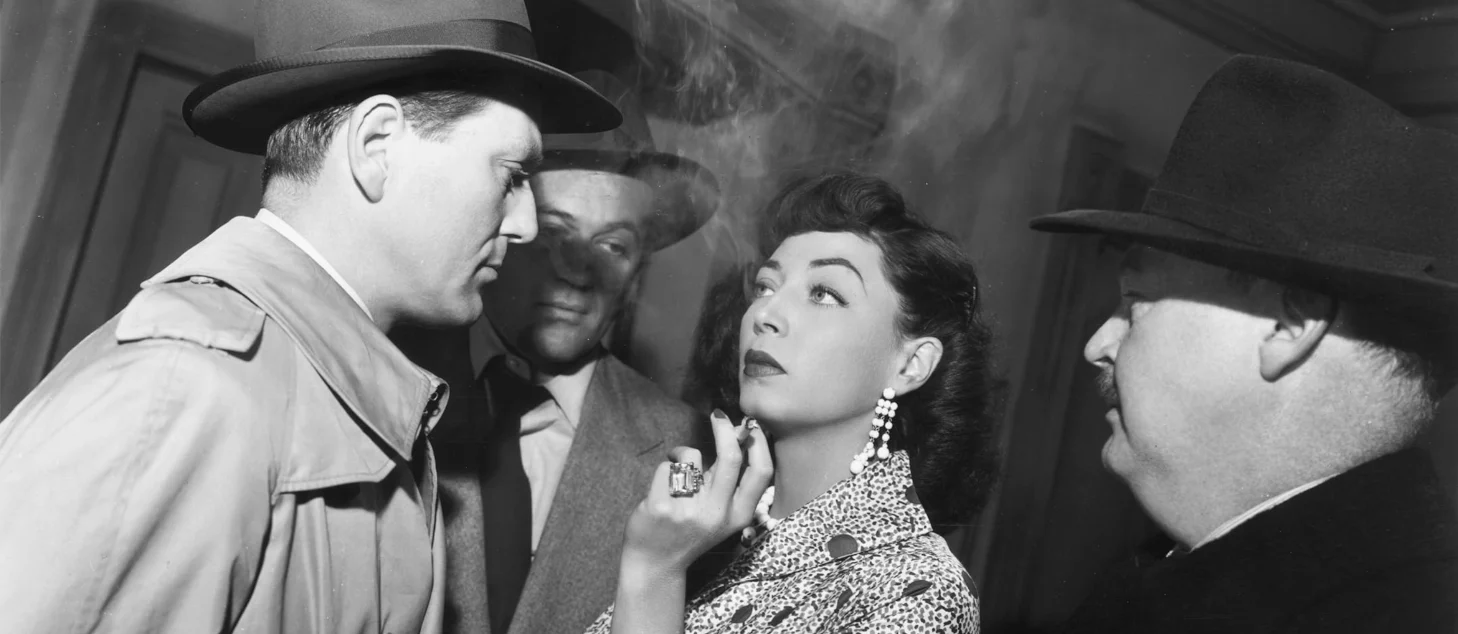
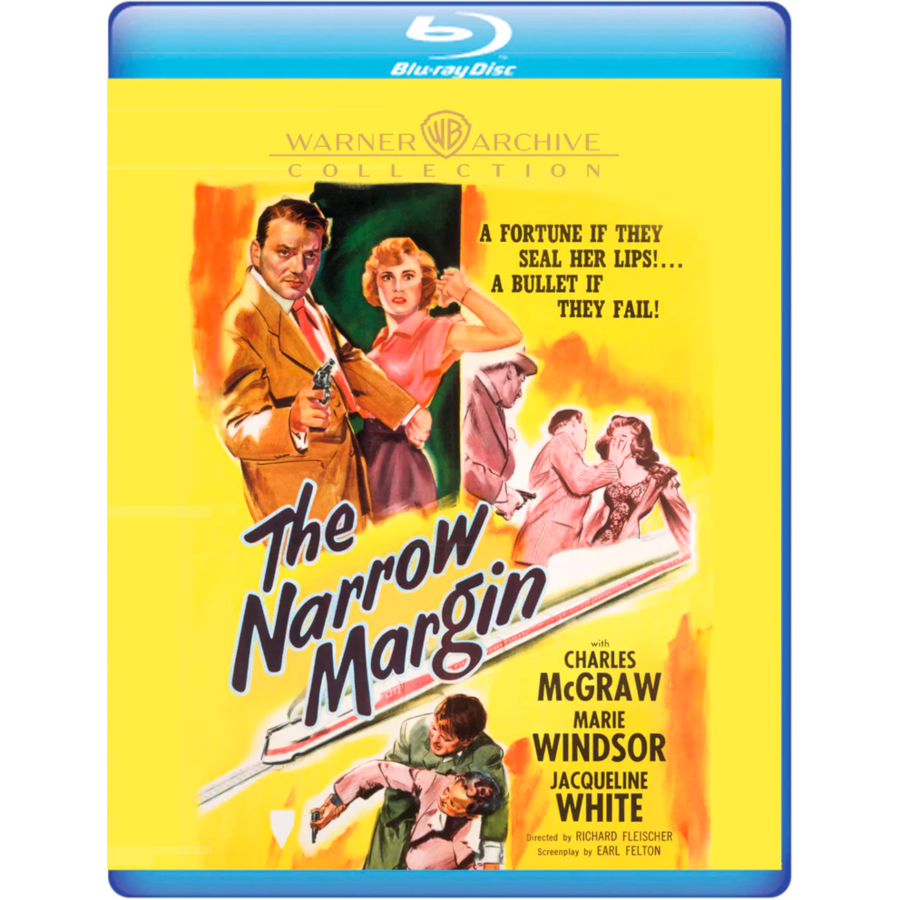

Pay no attention to the terrible poster: the film noir thriller The Narrow Margin should wear a sign saying, ‘Don’t Miss This.’ A gem that captures the flavor of the pulp crime paperback, it became a wonderful rediscovery in the 1970s, when noir consciousness gained popular traction. Would you believe that the classic Out of the Past was once obscure? Films Incorporated had it for a $15 rental in the back pages of their 16mm catalog … in a list of other ‘films of lesser interest.’
‘Tough characters under pressure’ could be a tagline for this modest overachiever. It had been filmed in April of 1950, only to sit for over a year, completed but unreleased. Author Alan K. Rode tells us that RKO’s eccentric owner Howard Hughes had intervened: the story that sticks is that he liked it so much that he wanted it to be a bigger ‘A’ release — and had the crazy idea to substitute its leading players with his big stars Robert Mitchum and Jane Russell. The film’s producer Stanley Rubin carefully explained that doing so could only happen if they junked almost everything that had been shot.
Most everyone at RKO thought Margin was a terrific film that needed no changes, yet it languished for months in post-production limbo. Hughes eventually relented, and limited his meddling to a few re-shoots and editorial deletions. Producer Rubin had to walk a diplomatic tightrope with the mercurial mogul. He had come through with flying colors, yet his career prospects were mired in more irrational decisions. Howard Hughes didn’t look at Rubin’s next film The Man He Found until it was completed … and then decided to retroactively ‘reinvent’ it as well, with alterations that brought it into line with his political preferences.
The rainbow at the end of this career calamity was that The Narrow Margin became a surprise hit of 1952. Hardly anything produced at RKO was finding success, but the public discovered the picture on its own. The unexpected success reminded the industry of Val Lewton’s Cat People from ten years before.
Here’s a judiciously written partial synopsis. Readers unacquainted with The Narrow Margin should best quit reading now, and wait for an opportunity to take it in cold, without spoilers.
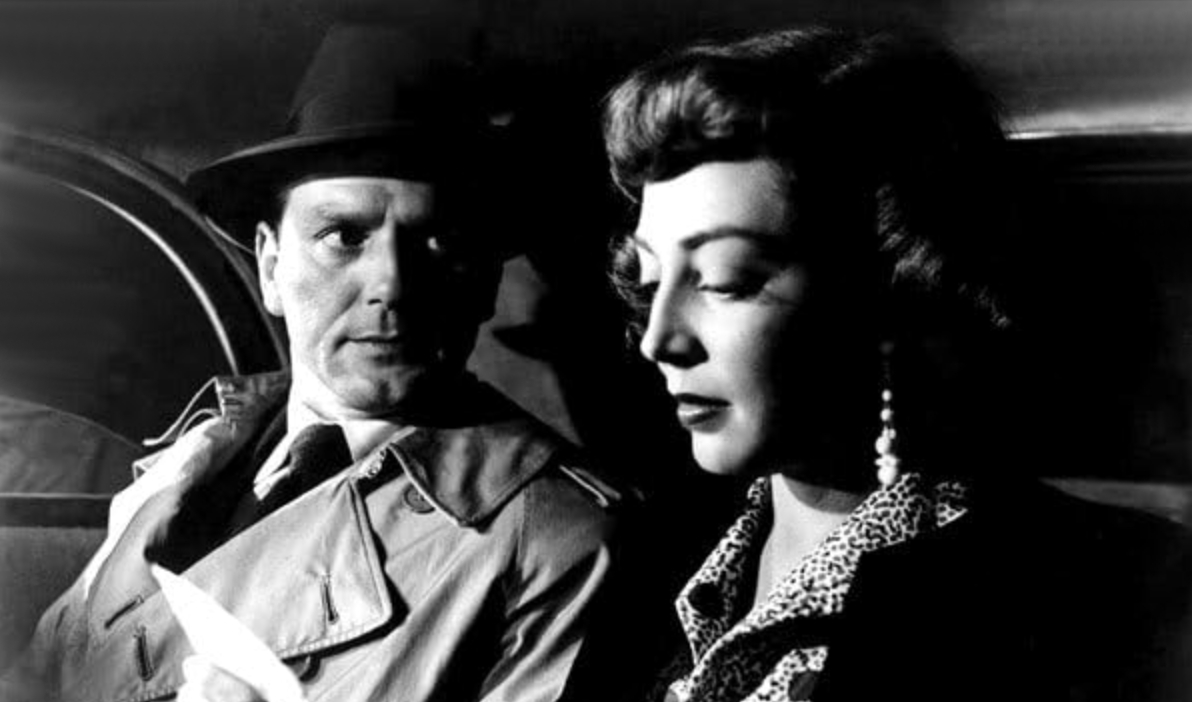
“She’s a sixty-cent special. Cheap, flashy. Strictly poison under the gravy.”
L.A. detective Sgt. Walter Brown (Charles McGraw) has a nail-biting assignment: bring the wife of a slain mobster back from Chicago to testify before a grand jury. Brown and his partner Detective Gus Forbes (Don Beddoe) have only an hour to collect their witness. She’s Mrs. Frankie Neall (Marie Windsor), a cheap-talking cookie for whom Brown forms an instant distaste. But the mob has already dispatched three killers to silence Mrs. Neal. Trouble strikes even before they get her into the taxicab back to the station.
Sgt. Brown manages to get his charge aboard the westbound express, hidden in a compartment. Mrs. Neall is openly contemptous of all cops, especially Brown, and worries that he’ll sell her out. Their lack of harmony doesn’t make it any easier when the killers show up on the same train. It’s difficult to maneuver in the confined spaces. The hoods nose around for Mrs. Neall’s hiding place, hampered by the fact that nobody knows what she looks like. They offer Brown bribes to give her up. A mysterious overweight man (Paul Maxey) also exhibits a suspicious interest in Brown, as does the ethical train conductor (Harry Harvey). Detective Brown then makes a big mistake. He strikes up a dining-car friendship with the beautiful Ann Sinclair (Jacqueline White), inadvertently giving the bad guys the idea that she may be their target for the day. Now Brown must find a way to protect both women.
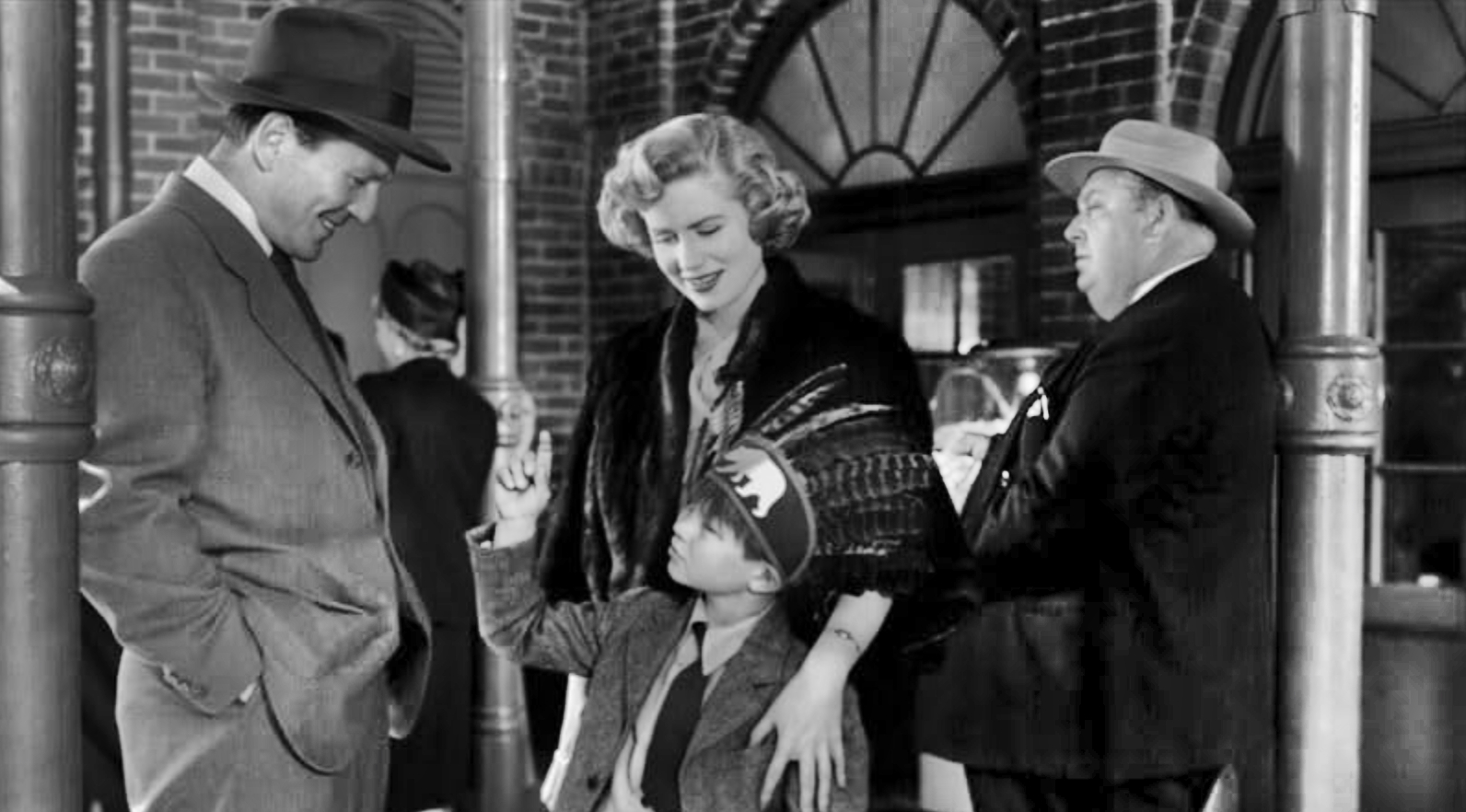
The Narrow Margin is one of the cleverest cat-and-mouse games made in the noir style. There are not ten seconds of slack time in the whole show. A lone policeman on a speeding train must fend off an unknown number of assassins, while not attracting attention to himself or the woman he’s protecting. He’s dealing with intangibles on all sides. Who exactly are the bad guys? Can he be sure that the thug with the pencil moustache (David Clarke) is one of them? How about that quiet ‘fat man’? In the tight train corridors, Sgt. Brown keeps bumping into Ann Sinclair. He must make stupid excuses when she notices him behaving strangely. Her precocious son Tommy (Gordon Gebert) is as unpredictable as Dennis the Menace. The loudmouthed kid immediately figures out that Brown is not on the level:
“Mom, he’s hiding a gun! I bet he’s a robber!”
The Narrow Margin packs major twists worthy of the best detective fiction. We won’t risk discussing the plot any further. 74 years later, its surprises are still difficult to predict.

The underpaid and overburdened Sgt. Brown can’t hide his shattered nerves. He despises Mrs. Neall and comes close to hitting her more than once, yet he must risk his life to shield her from harm. The contradiction shifts The Narrow Margin onto the unstable moral ground that defines film noir. It’s an existential game, playing hide and seek with these persistent killers. Witness intimidation and murder to obstruct justice is a routine activity. The odds favor the mob, even when they can’t locate their target.
“…spend the rest of my time worrying when I’ll be caught up with by some hoodlum holding a first mortgage on my life, payable on demand? Nah — No kind of money worth that.”
Sgt. Brown’s gratingly hardboiled attitude is a rational response to a pitiless world. He feels a momentary weakness when offered a bribe by the oily Vincent Yost (Peter Brocco of Our Man Flint). He’s constantly being told what a fool he is, protecting Mrs. Neall when he could be rich instead. He holds out over sheer stubbornness.
Audiences love the pairing of Charles McGraw and Marie Windsor; that RKO didn’t follow up with another co-starring vehicle seems a big mistake. Their every exchange is a showcase for some of the best hardboiled tough-talk in the movies. We wonder if the credited writer Martin Goldsmith focused on these cynical insults — Goldsmith wrote both the story and the screenplay for Edgar Ulmer’s legendary Detour, the PRC classic with the caustic dialogues between Tom Neal and Ann Savage.
Of equal importance is the film’s realistic impression of being on a moving train, in cramped compartments and claustrophobic passageways. The effect is maintained with the choice of lenses and camera angles. Handheld camerawork imitates the rocking sensation of a train in motion. The Rear Projection to depict the view outside is also excellent … the exterior action always seems connected, especially when a sinister car begins to pace the train on a parallel roadway. Shooting all those RP setups in just 15 days was quite an achievement. The RKO process crew is seen to cheat only once … at one point, a vehicle seen through a train window is driving backwards.
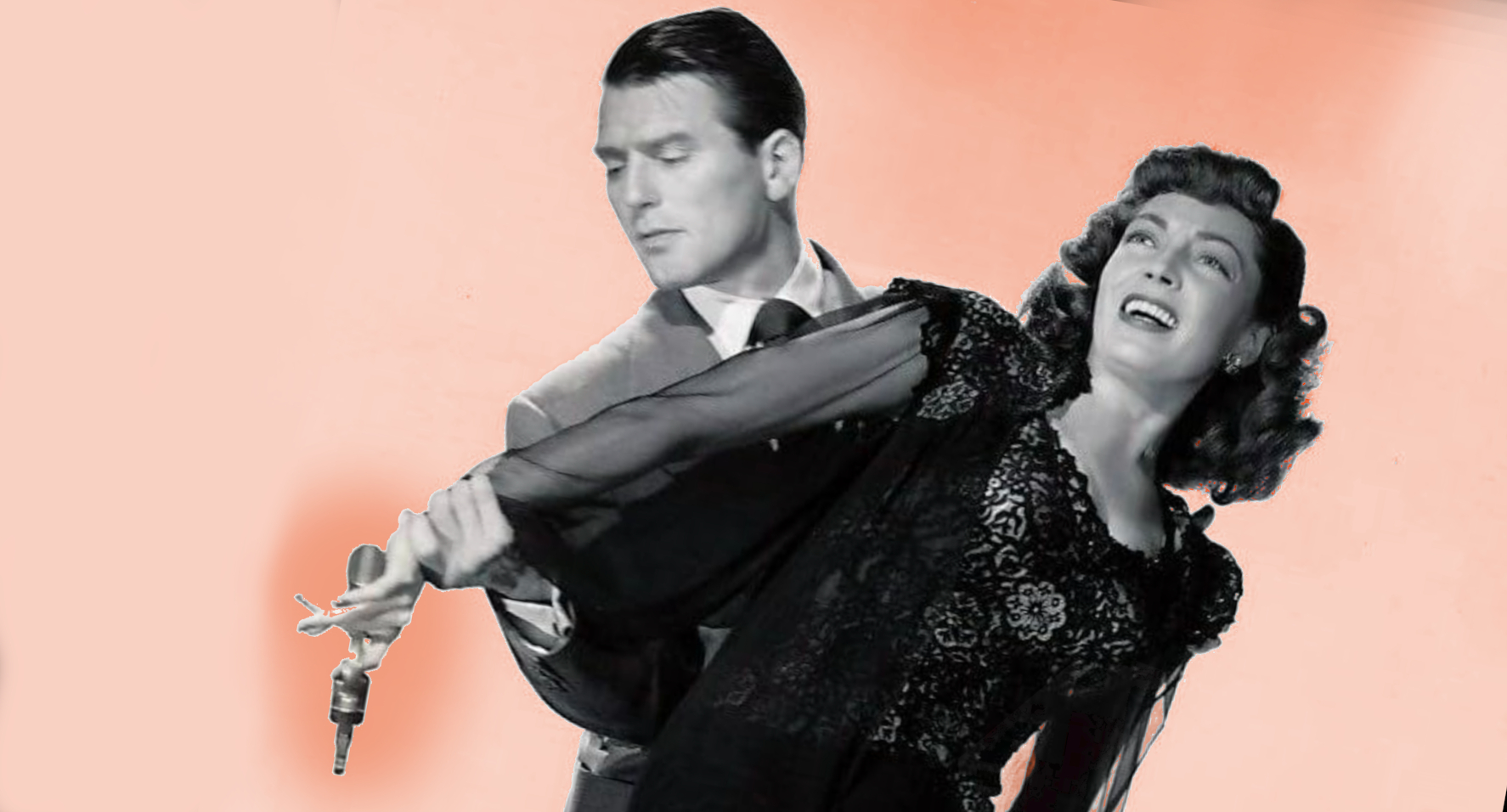
“Well, this is fun. Some protection they sent me.
An old man who walks right into it, and a weeper.”
The film has no soundtrack score, and only railroad noises are heard behind the titles. This reinforces a ‘you are there, this is happening’ tension that keeps our eyes glued to the action. When director Fleischer wants to highlight Paul Maxey as a potential bad guy, a blast of steam noise adds dramatic punctuation. The film abounds with tension-building touches. One cut jumps from a close-up of Marie Windsor anxiously filing her nails, to the identical rhythm of the locomotive’s tie rods chugging away.

Cameraman George Diskant’s lighting is at all times excellent. For a daytime stop somewhere in Colorado, the sunshine on the station platform is blindingly bright. Elsewhere, clever tricks with window reflections add dimension to scenes. ← A reflection in the windows of a train on the next track figures strongly in the audience-pleasing dramatic climax. The gag may have been suggested by the earlier RKO noir Berlin Express. That screenplay’s train travel scenes use a similar on-board plot twist.
The delay in the release of The Narrow Margin helped some careers and perhaps hindered others. Charles McGraw had been plucked from RKO’s pool of tough-guy supporting actors. His specialty had been rugged military men and vicious thugs, most notably in Robert Siodmak’s The Killers and Anthony Mann’s T-Men. The shelving of Margin put McGraw’s best starring work near the end of his brief run as a male lead, instead of nearer the beginning. He soon found himself back playing capable support for stars Robert Mitchum and William Holden.

“You may think it’s a funny idea for a woman with a kid to
stop a bullet for you, only I’m not laughing!”
Our favorite Marie Windsor did not attain top star status either, but Margin showed that she could carry a difficult leading role with ease and style. Her legend was sealed by this movie and Stanley Kubrick’s The Killing. Smaller but notable parts earned her the title of the Queen of sultry B-movie dames, in Force of Evil, The Sniper and City that Never Sleeps.
Director Richard Fleischer had already chalked up a number of decent little pictures. The Narrow Margin launched him as an A-list talent on big-budget projects. He negotiated an amicable release from RKO servitude by overseeing, without credit, Howard Hughes’ calamitous reworking of John Farrow’s His Kind of Woman. Two years later, his big break came with the assignment to helm a lavish Disney epic; Disney hired Margin’s screenwriter Earl Felton as well.
Another big winner from Margin was producer Stanley Rubin. Howard Hughes vandalized two of his productions in a row but Rubin stayed calm. He took his name off The Man He Found when it was changed to The Whip Hand, and left RKO with a good agent and a sterling reputation. Within a year he was at 20th Fox producing Otto Preminger’s epic CinemaScope western The River of No Return, starring Robert Mitchum — and Marilyn Monroe. Irony of ironies, in 1956 Stanley Rubin returned to RKO’s facilities for his own production The Girl Most Likely … the final film shot on the studio lot.
Alan K. Rode’s biography of actor Charles McGraw spells out the changes that Howard Hughes made to The Narrow Margin before its final release. Some re-shoots were directed by William Cameron Menzies, possibly while filming The Man He Found. Hughes was pro-police, and so wanted to delete a subplot explaining that Sgt. Brown’s partner Gus Forbes (Don Beddoe) was on the take. Originally, Forbes told the mob how to ambush the gangster’s widow Mrs. Neall. As it turned out, losing that wrinkle doesn’t harm the story. The hint that Sgt. Brown might be bribed is enough to maintain our concern about corruption. *
Much more damaging is a deletion Hughes made at the finish, that eliminated a sentimental scene that could have been the film’s most powerful moment. (No spoiler here.) We felt that something was missing, way before learning that Hughes had committed some editorial futzing around. You’ll know what it is right away — the show lacks a proper closure for its most daring, heroic character.
As William Friedkin says in his commentary, with the addition of just one soulful shot of a contrite Brown paying his respects to a fallen comrade, The Narrow Margin would have been hailed as a classic.
…And here’s another opportunity to wheel out a recurring CineSavant observation: James Bond 007 author Ian Fleming shamelessly appropriated story ideas large and small from classic Films Noir. We’ve explained how he lifted an entire plot structure from White Heat for his Goldfinger.
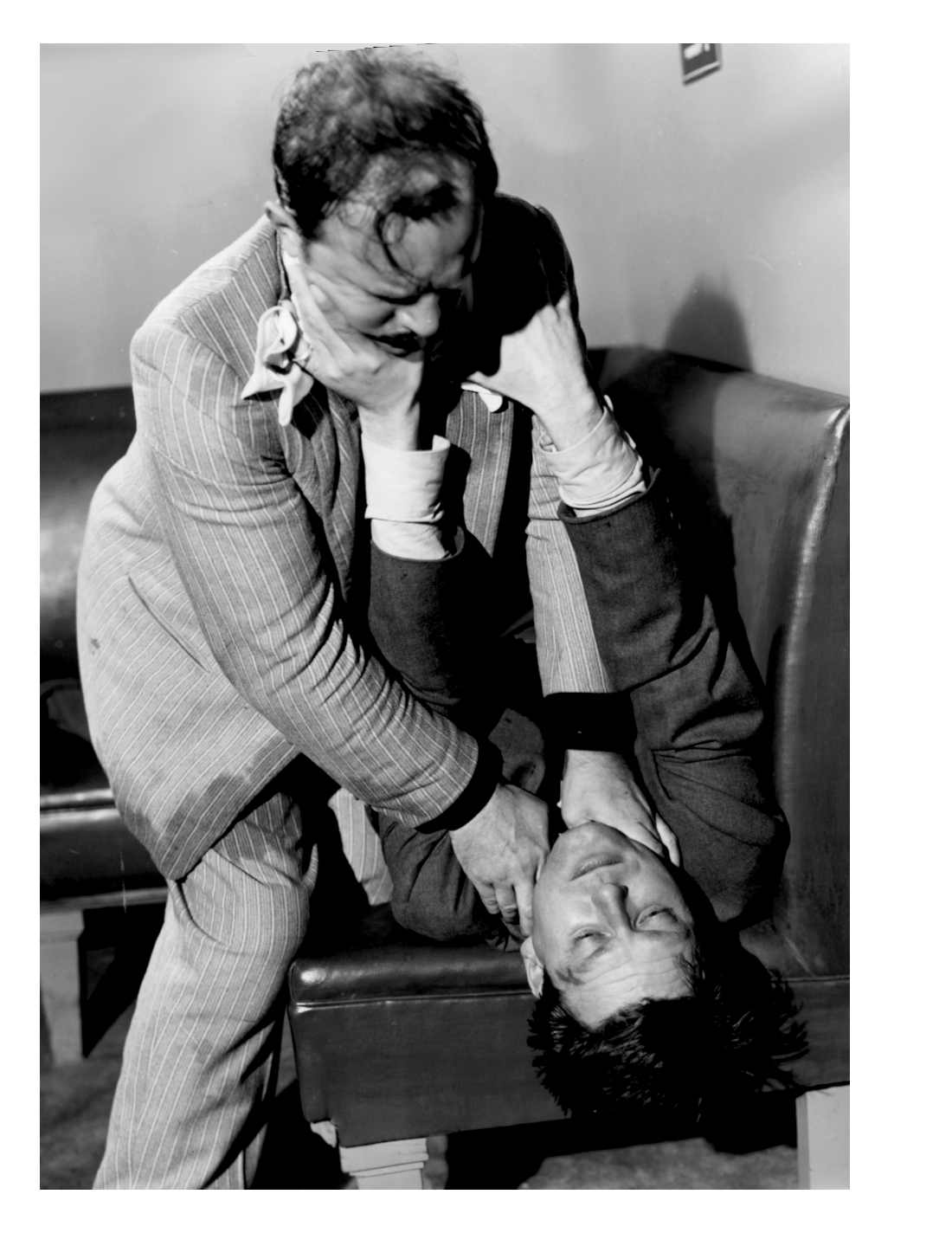
Fleming had already ‘borrowed’ the train setup in The Narrow Margin for his From Russia with Love, namely the suspenseful episode on the Orient Express. James Bond’s flight from Turkey with Tatania Romanova replays a tall stack of story points. Bond must try to communicate at various whistle stops, killers surreptitiously leave and board the train, and a brutal fight takes place in a tiny train compartment. McGraw’s battle with a killer isn’t quite the raw slugfest between 007 and Red Grant, but it has its bare-knuckle moments. It also has a great dialogue exchange —
Thug: “I think you knocked a tooth loose!”
Brown: “Wanna try for none?”
Highly recommended: Alan K. Rode’s book Charles McGraw: Biography of a Film Noir Tough Guy, which recounts fascinating production details for a number of noir classics.


Charles McGraw should be better remembered than (I think) he is. His vicious, racist, and antisemite character Bob Yountis in CIMARRON is one of the best movie heavies ever.
If he should be, he would have been. No one in the world is underrated.
Charles McGraw was born to be a character actor, and he was in a ton of great movies. He was well loved by most movie buffs, so that’s pretty good.
I really loved the book on Charles McGraw by Alan K. Rode. It was so much better than that book about Lawrence Tierney, but I guess there are only so many ways you can write “Tierney got drunk and was later arrested” before it gets old. I remember Kirk Douglas broke McGraw’s jaw in Spartacus and later broke Walter Matthau’s jaw in another film. Kirk told him he must have leaned into the punch even though Matthau was tied up in the scene. I’m happy this is getting a Blu-ray release because I could swear the remake has already come out on 4K.
Sin of sins, I saw the remake (with Gene Hackman & Anne Archer) in a cinema long before seeing the original & was a big fan. I’ve seen the original on DVD a couple of times & thought it just OK. Certainly McGraw & Windsor were great in other films. The WAC Blu-rays ($25 for a single layer Blu-ray?) have become expensive, perhaps I’ll wait for a sale & take a chance. Cheers!
It’s always a good idea to wait a while for a sale on any new Warner Archive title.
Was McGraw the inspiration for ‘McGruff, The Crime Dog’? Discuss.
I recall being bummed out by the ending; I always identify too strongly with some charactors.