
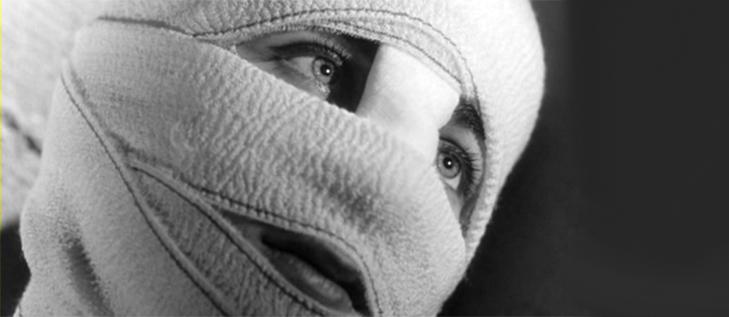


Savant has reviewed Eyes Without a Face twice, for both Criterion’s DVD and Blu-ray, so what’s this third pass all about? I’ve got two major excuses. The first is to review a different edition with different extras, one of them being a short subject by Georges Franju that I’ve been after ever since reading about it in the Raymond Durgnat Franju book back in 1972. The second is to indulge yet another personal essay.
My overall appreciation of the movie, and Criterion’s excellent Blu-ray disc, is viewable here. In general terms, one can’t go wrong with the Criterion release. Eyes Without a Face is a chilling horror picture that, when explained in simple plot terms, sounds like deplorable pulp trash: a mad doctor, awful surgical crimes, exploitative murders of beautiful women. Just the year before, Astor pictures released a really sleazy item called She Demons, in which a laughably inane Nazi doctor tries to restore his wife’s lost beauty. The obvious path to success is through nonsensical experiments that turn ‘jungle women’ into fanged, rot-faced harpies. Unless one was a genre connoisseur and remembered the surgical horror classic Island of Lost Souls, anything mixing evil doctors performing sick surgery on women would in 1959 be considered in totally rotten taste. Throwing in the Nazi angle introduces a further cultural crime, by trivializing the Holocaust.
Eyes Without a Face doesn’t take that approach at all. It is quiet, respectful and has the look of ‘quality’ French cinema. Only limited background exposition is offered for its main characters. Dr. Génessier (Pierre Brasseur) is a celebrity doctor with his own clinic that he runs without supervision. But he maintains a secret surgical lab in his basement for unorthodox experiments. We know that his daughter Christiane (Edith Scob) has a fiancé, but we know little about the origin of Louise (Alida Valli), Génessier’s assistant and criminal co-conspirator. The criminal horrors in Eyes Without a Face are so strong that we immediately look for answers in character details, and run into a series of mysteries. Louise was one of Génessier’s earlier surgical success stories, and she wears a pearl necklace to hide a scar on her neck. What’s that all about? Is Louise Génessier’s lover? Possibly, if he’s at all interested in sex. She seems bound to him body and soul, and goes about aiding and abetting his surgical crimes with the clear conscience of a true believer. Raymond Durgnat went as far as to say that the choker pearl collar makes Louise seem like Génessier’s dog. Canine loyalty knows no morality. Even Hitler had faithful, beloved dogs.

Everybody has pet theories about Eyes Without a Face. From her limited perspective Pauline Kael wondered if Franju wanted to make a statement about medical ethics. Well, duh, that interpretation goes exactly nowhere. An overview of Franju’s work sees isolated characters having difficulty dealing with the general social contract. He often promotes the poetic-subversive notion that the reality we deal with is a mask, behind which lie things we do not wish to acknowledge. All that good meat we eat is derived from the unending slaughter of animals. Not on display in a glorious war museum are the real products of war, maimed and disfigured soldiers. A woman is so desperate to end her domestic despair that she’ll resort to murder, yet the social tyranny is so entrenched that even being caught will not give her closure.
It’s clear in Eyes Without a Face that Franju is wary of respectable men that can operate above the law, without oversight. Like the old French aristocracy, Génessier has wealth, fame, and a grotesquely inflated opinion of himself. His disdain for people is such that his patients interest him only to the degree that they enhance his medical reputation. And he’s so selfish that, to mend his disfigured daughter, he’ll kill any number of innocent victims. Franju questions the sincerity of that motive, too. Génessier is not doing this for Christiane, but for himself. She’s only a symbol of a failure that must be corrected.
In 1959 ‘evil’ medical experiments already conjured visions of Mengele & Co., Nazi doctors that conducted atrocities that Edgar Allan Poe or Torquemada wouldn’t have dreamed up. Some of the research justifications for what was done to captives were genuinely disturbing — pain, horror and death were dispensed for vague ‘political’ research, or to study various methods of killing. How much longer can a flyer survive in freezing water, if he has an insulated flight suit? How little insulation is enough? We have some captured Polish fliers, and plenty of cold water…
Génessier is French through and through, although there were French collaborators that outdid the German occupiers for cruelty and torture. I do remember an old 60 Minutes episode about a ‘celebrity’ French plastic surgeon who did wonders with grotesque facial injuries. In his interview he seemed even more arrogant than Génessier, boasting of his god-like status while smoking a cigar.

Dr. Génessier also brings back thoughts of the French serial killer Dr. Petiot, who claimed to be part of the resistance but may have worked for both sides. Foisting the illusion that he ran an underground railroad to Argentina, Petiot took large sums of money from fugitives wanted by the Gestapo, mostly Jews. He murdered them with fake inoculations; as with the Nazis doing the same thing on a grand scale, Petiot’s biggest problem was disposing of the human remains.
Many of Franju’s images extend motifs from Jean Cocteau. Almost every beautiful image in Eyes conjures a poetic association. The lonely trains in the fog are transporting souls to the next life. The naked trees seem like skeletons. A crossing gate may be trying to warn the student Edna Grüber (Juliette Mayniel) not to continue on a trip from which there is no return. The dogs are suffering humanity, and the doves symbolize both Freedom and Madness. Christiane’s mask is a match for Cocteau’s statues in Blood of a Poet; it brings forth all the usual associations with mannequins. The mask erases Christiane’s facial emotions, leaving us with her staring eyes. Edith Scob’s delicate gestures remind us of fairy tale illustrations. She clasps her hands together in ‘calm’ anxiety, and holds odd poses when she pauses at doorways. Edna arrives at the ‘magic castle’ in the middle of exactly the kind of dark, lonely forest that fairy tale heroines — and practical modern women — should avoid.
One can’t help forming personal interpretations unsupported by the film’s ‘text.’ To us, Génessier didn’t operate on Louise to cure a deformity, but to hide an old identity. Louise entices women into Dr. Génessier’s lair, kidnapping and imprisoning them, and then disposing of their corpses. Did she have criminality in her background? Is she like one of the former prostitutes and cutthroat women in the next year’s Circus of Horrors, who use their repaired faces to begin new lives as circus performers?
We aren’t allowed to get an easy grip on Franju’s movie. It refuses to play familiar dramatic games. The police investigation goes nowhere, defeated by Génessier’s façade of respectable normality. The downhearted fiancé doesn’t come to the rescue like Prince Charming. Part of us doesn’t want him to, considering what he’ll find. Much of the dread in Eyes Without a Face is of ‘the worst has already happened’ variety. We dread Edna’s big escape scene, for fear of seeing her learn what has been done to her. None of these traumas are resolved, which brings unbearable tension to the final scene where Christiane confronts the latest sacrificial victim Paulette (Beatrice Altariba). Lying on the surgery table with linens affixed around her face, Paulette looks just like a nun.

Franju’s movie transcends the horror genre as few films have. I can’t imagine how disturbing it must have been in 1960, with content so much stronger than Psycho. It received no U.S. release when new. Put off by the subject matter, many reviewers chose not to review it at all. It was much easier to dismiss than assess. The progressive French critics were too busy promoting the New Wave to waste praise on The Enemy. Even though Franju was unlike any other director of the older generation, he was still part of the establishment that Cahiers du Cinema used as a punching bag in their manifesto-like reviews.
Eyes Without a Face was an outsider from the start, a pariah in the tradition of ‘Quality Cinema’ but also unlike its cousins in commercial horror. It makes Hammer films seem tame; if Famous Monsters of Filmland ever ran a photo from the movie, Forry surely didn’t risk his kid-safe reputation with a plot description. It’s unclear how many of the ‘mad surgery’ epics made around 1960 actually imitated Franju, as a couple had preceded it. Since genre filmmaking could be very localized, a film would have to be a blatant rip-off to make us feel certain of a specific influence. It’s also apparent that some ideas were just ‘in the atmosphere’ and waiting to congeal in various places. Peeping Tom, City of the Dead and Psycho all came out at the same time. Although very different in approach, they share similar story structures and themes.
Just for the record the (trustworthy?) IMDB gives Eyes Without a Face a January 1960 French premiere, after several 1959 festival showings. When were other ‘medical horror’ films first shown?
Cunha’s She Demons = January 1958
Trivas’ Die Nackte und der Satan = July 1959
Green’s The Brain that Wouldn’t Die = August 1962, but reportedly filmed in 1959.
Romero and de Leon’s Terror is a Man = November 1959
Majano’s Seddok, l’erede di Satana = August 1960
Ferroni’s Il Mulino delle donne di pietra = October 1960
Furie’s Doctor Blood’s Coffin = January 1961
Franco’s Gritos en la noche = May 1962
This of course doesn’t take into account Reginald le Borg’s gothic mad surgery film The Black Sleep from way back in June of 1956, or several Mexican ‘medical horrors’ that had been circulating for the better part of a decade, certainly in Europe if not in the States. Chano Urueta’s El monstruo resuscitado (1953) has mad surgery galore, and it was made in 1953.

