

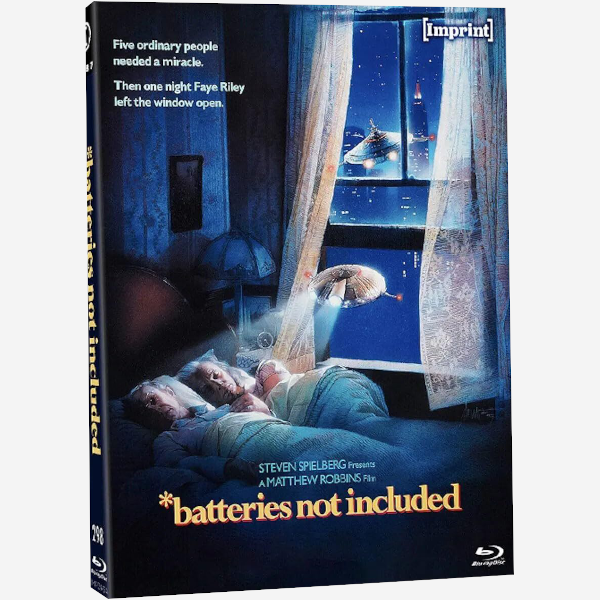
![Viavision [Imprint] 298](https://cinesavant.com/wp-content/uploads/2022/05/6750imprint0522.png)
When visiting the noisy hangar-effects shop for 1941, Steven Spielberg would sometimes hide out in our office just to make a phone call. I once heard him say to somebody, in what context I have no idea, “I’m not going to live long enough to make all the movies I want to make.” Well, Spielberg took a good shot at that ambition, with his long list of personal pictures, closely supervised films by others and even more slightly less hands-on movies juggled by his close producing associates.
Mr. Spielberg made family-film history with E.T. The Extra-Terrestrial, and for the balance of the 1980s he continued to skew family-lite. Naysayers complained about his tendency to imbue characters with a ‘sense of wonder’ attitude, using a few visual devices that became tedious — the truck-ins on beatific faces, ooh-ahh John Williams music stings. That Close Encounters — E.T. riff is also central to 1987’s *batteries not included, but the nature of the project offers a special dispensation. Yes, Spielberg was once again hoping to tap the family market once dominated by Disney. If anybody expected a sequel to Carpenter’s The Thing, they soon found they were mistaken.
Some of the film’s foreign titles translate as ‘Miracle on 8th Street,’ which suggests that *batteries wants to occupy the same soft-fantasy film blanc space as the old Christmas favorite Miracle on 34th Street. With its emphasis on old folks remembering old times, we detect a vein of Frank Capra-type sentiment too. The 1980s were not good years for heartfelt sentimental stories touched by fantasy, but this one has some honest surprises. Did its relative success encourage Spielberg to back John Patrick Shanley’s wonderful Joe versus the Volcano, made three years later? One Joe versus the Volcano makes up for two Goonies-es, although nothing can redeem Always.
According to the filmmaker interviews on [Imprint]’s disc, the core idea for *batteries came from an old Little Lulu comic book that Spielberg admired. Little Lulu devotee “B” would like to know more about that supposed connection. When Spielberg decided the idea might play better as a feature than as a half-hour for his Amazing Stories TV show, Spielberg assigned Mick Garris to write a script that scored a green light from Universal. Matthew Robbins had been a key writer on early work by Spielberg and his USC pal George Lucas, but his directing career was touch and go. Robbins and future creative powerhouse Brad Bird (The Incredibles) added their own brand of broader humor with a rewrite to the Garris script. *batteries may be Mr. Robbins’ most accomplished directing showcase. It maintains an agreeable light spirit, even as its characters constantly interact with wall-to-wall ILM visual effects.

It’s Sesame Street threatened by corporate greed.
The story begins in a darker place than most family films, with an urban-decay update of the old Frank Capra movie You Can’t Take It with You. Shady developer Lacey and Kovacs (Michael Green & John Pankow) have targeted for demolition an old brownstone on Manhattan’s 8th Street. On their secret payroll is street thug Carlos (Michael Carmine), who ‘advises’ the tenants of #817 to vacate right away. Even as the rest of the block is being razed, some residents ignore Carlos’s bribes and arm-twisting. The octagenarians Frank and Faye Riley (Hume Cronyn & Jessica Tandy) have for decades run a diner on the building’s first floor. Frank is seriously worried about Faye, who shows signs of early dementia — she keeps confusing Carlos with her long-gone son Bobby.
Neighbors Sid (Tom Aldredge) and Muriel (Jane Hoffman of Ladybug Ladybug) are intimidated enough to move out, but not so some of the other tenants. The very pregnant Marisa Esteval (Elizabeth Peña of La Bamba and Lone Star) has pinned her hopes on the unlikely return of an absent, uncommitted boyfriend. Struggling artist Mason Baylor (Dennis Boutsikaris of Better Call Saul) is in also in denial of the inevitable. The mentally-fragile gentle giant Harry Noble (Frank McRae of 1941) continues to do microscopic ‘repairs’ to the building, which looks ready to fall down by itself.

What if Invaders from Space just wanted to help out?
Everything changes when Frank notices that various items destroyed by Carlos’s vandals, have mysteriously been repaired. Faye is the one to reveal the existence of little flying saucers, up on the building’s roof. The metallic mini flying machines come in various sizes. They seem to exist to fix things, like the Magic Elves that come to the aid of the Grimm Brothers’ lucky cobbler. They appear to have personalities, and one even becomes ‘pregnant’ with little saucer-lings. One of the newborn saucers doesn’t survive, prompting a ‘MisterRogers’- type ad-hoc burial ceremony. There’s no explaining the little helpers, that busy themselves rejuvenating the building even as Kovacs’ bulldozers threaten its outer walls. Given an ultimatum to empty the building or else, Carlos goes after the largest saucer with an axe. How will the saucers react?
One reason that *batteries succeeds is that its friendly ‘fix-it’ aliens are never explained — we aren’t subjected to a whimsical origin story for them. They’re essentially cartoon characters shoehorned into a semi-realistic framework. Designed by Ralph McQuarrie of the Star Wars franchise, they have metallic bodies and crab-like eyes that light up. The ILM model shop crew roster included Gregory Jein, who lends the saucers a definite ‘mothership’ look this writer knows well. It’s good that the saucers are not anthropomorphosed too crudely; we still harbor unkind thoughts about a robot in The Black Hole that belongs in a Hanna-Barbera cartoon.
The context is Urban Rot, but the presentation says Urban Fable.
*batteries’ human factor engages nicely enough. It chooses to be somewhat warm & fuzzy at a time when pop fantasy culture was turning dark, notably with the Tim Burton Batman reboot. It is not a genre-twisting social critique. A couple of years before, the eccentric, violent Homebodies depicted another group of retirees threatened with eviction. They stay in their apartments by committing murders.
Spielberg liked characters with childlike qualities, and Jessica Tandy’s Faye is a sweet construction. A half-ditzy, half senile old dearie, Faye wears mismatched slippers, smiles at everybody and can no longer make her brain think in a straight line. She nevertheless displays her own kind of wisdom when it’s important to do so. Husband Frank clearly adores her. He lives in a constant state of half-heartbreak, knowing that their happy companionship isn’t going to last forever, whether or not they get to stay at #817. Famed theatrical couple Cronyn and Tandy make the most of their roles without taking on-screen bows. *batteries may not be profound, but the actors make something substantial of its modest graces.

The other actors bring their individual charm to parts that are obvious but good-hearted. Each exhibits different strengths and weaknesses. Third-billed Frank McRae’s Harry is an ex-boxer who cowers in the face of Carlos’s bullying. We like it when Frank Riley must coax Harry to let go of a tiny saucer he’s made into a captive pet. Elizabeth Peña and Dennis Boutsikaris of course have romantic possibilities, what with him a frustrated artist and she an unwed mother-to-be facing an uncertain future.
Faye at first calls the little aliens ‘Fix-its.’ We never know why they come to the aid of these particular folk, but we can guess that the unwritten message is, ‘if people stick together, solutions will present themselves.’ *batteries isn’t in sync with the harsh realities of its time — no drug addiction, depression anxiety, politcial mania — but neither were the classic fairy tales.
Goofball toy saucer-thingies.
The visual effects people took on the big challenge of creating little flying saucers that can evoke the needed ‘Spielbergian wonder.’ The saucers must continually interact with humans on an intimate level, and the effects magic is seldom restricted to cutaways that can be shot separately. This wasn’t a show for improvising during shooting. Most everything had to be nailed down in advance to properly integrate the saucers with the humans.

Writer Mick Garris describes these flying saucers as like ‘the little pixie saucer in CE3K, the one that was always last, saying “wait up for me.”‘ We called that anthropomorphosed saucer ‘The Red Whoosh,’ or just ‘Tinker Bell.’ These saucers are given similar cartoonish qualities, but their actions remain relatively realistic. Nothing is completely absurd, like the B-17 bomber in that Amazing Stories episode that sprouts a cartoon wheel gear so it can land safely. The saucers are just little friendly machine-things from outer space. No ultimatums, no warnings, just interplanetary good will.
Making a decent family movie in the 1980s was a tall order, especially when tots that ought to be seeing Follow that Bird were likely attracted to promotions for Conan the Barbarian and RoboCop. After the miscalculated grue and gristle of Dragonslayer, *batteries definitely wants to be kid-friendly. Although some relatively light swearing is heard, the film doesn’t resort to the new ‘PG-13’ rating, which elsewhere allowed Spielberg and Co. to pepper kid films with rough language. The thug violence stays in check, and the most shocking visual is a (gasp) nude painting. The drama does peak with a revelation about Frank and Faye’s son Bobby. It might be One Subplot Too Far… Faye is more than sufficiently endearing, without summoning the ghost of Edward Albee’s Martha.
*batteries might be a good show to introduce sheltered or sensitive kids to a bit more filmic jeopardy — assuming they haven’t already been preconditioned by random adult programming. Although there’s plenty of adult appeal, Joe Dante’s Explorers would also seem a good middle-step picture for fairly small children — it might even convince a video-game tot that paying attention to a real story can have special rewards.

