


John Ford’s 3 Godfathers is commonly set aside as a minor piece valued less than his top western classics. Its sentimentality doesn’t appeal to western fans that want their cynicism straight up; it’s not likely to show up on a double bill with a Sergio Leone movie. Ford pitches it as a soft Christian fairy tale, and films it with a kind of reverent ritualism — everyone’s clothes look clean, standing in neat lines to wave their hats; horsemen at a railway send-off are choreographed as in a wild west show.
Ford didn’t go into the movie blind, as Peter B. Kyne’s original 1910 story Broncho Billy and the Baby became a popular book made into movies in 1916, 1919, 1930 and 1936. John Ford directed the 1919 version, which starred Harry Carey. That famous cowboy star died in 1947, and is commemorated here with a special title. Harry Carey Jr. gets an ‘introducing’ credit, although he’d already appeared in films by Raoul Walsh, Howard Hawks, Frank Borzage and Robert Wise.
The 1936 version, directed by Richard Boleslawski, is a real find. It’s included as an extra on this disc, and is both very different and very good. Who knew that Chester Morris could be such a good actor?
In terms of approach, the Ford movie that 3 Godfathers most resembles may be 1963’s Donovan’s Reef. Both pictures play out in a stylized reality in which communal meetings are joyful rituals. Ford seems after an ‘innocent wisdom.’ The island in Donovan’s Reef could be a peaceful afterlife for Navy veterans. 3 Godfathers’ tiny Arizona town is a little Utopia of the West.

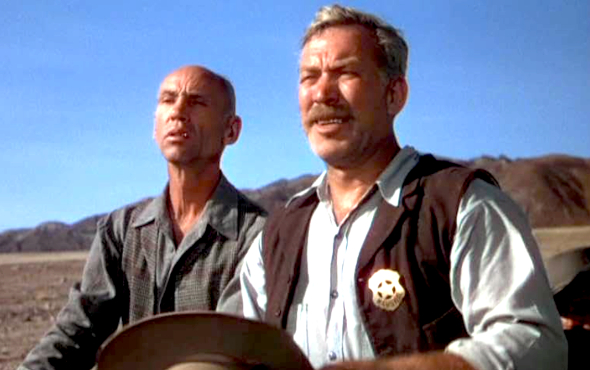
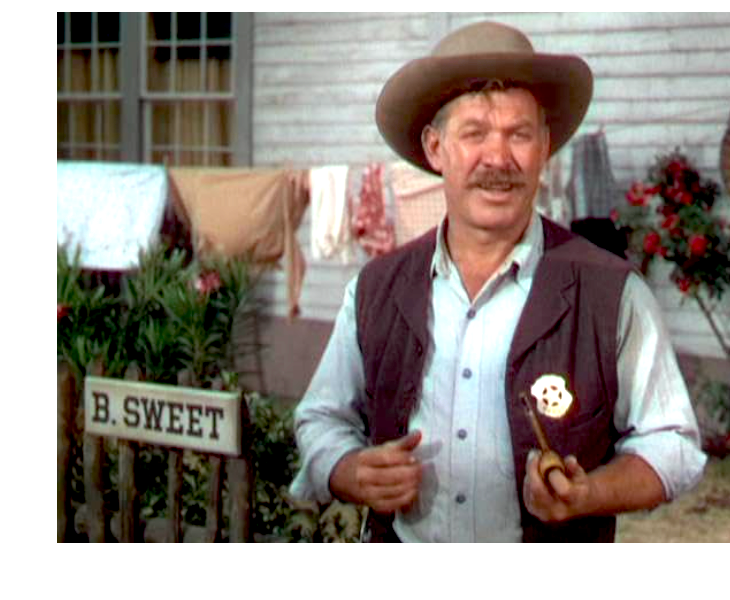
Thieves Bob Hightower, Pedro Rocafuerte and William Kearney (John Wayne, Pedro Armendáriz & Harry Carey Jr.) arrive in Welcome, Arizona to rob the bank, and inadvertently meet up with the Sheriff, Buck Sweet (Ward Bond) as well as the lovely ‘new girl in town’ Ruby Latham (Dorothy Ford). They do take the bank, Kearney is wounded in their escape. Buck Sweet plans to trap the robbers at a railway water stop, but Bob realizes this and heads off toward a more remote well. They find it dry: a foolish greenhorn has dynamited it, died and left his pregnant wife (Mildred Natwick) helpless in a horseless wagon. They promise to save her newborn baby, but the weakened mother dies in childbirth.
With insufficient water, the trio start out on foot for a little town called New Jerusalem. Kearney’s injury has made him weak, but all three know they can’t make it without help. Not only that, Buck Sweet’s posse is now out for blood — thinking that Bob & Co. are responsible for killing the couple and destroying the water hole.
3 Godfathers isn’t that hard to appreciate, if one can see it as Ford’s attempt to recreate an innocent cinematic ideal. It’s got noble cattle rustlers (“Cows don’t shoot back.”), a cherry-cheeked sweetheart, and a Bible message to convince church folk to send the kids. It’s a lot like Ford’s own silent 3 Bad Men, a similarly sentimental fairy tale about a trio of crooks redeeming themselves in the eyes of a young pioneer girl. Remember Strother Martin and L.Q. Jones’ slimy bounty hunters in Peckinpah’s The Wild Bunch? Nobody would have thought to follow that movie with a sweet Wild West story about the same characters rescuing orphans.
Melnitz Hall was the place to be.
In 1975 Nick Peterson and Janey Place put on an all-John Ford screening festival, Sunday nights at the UCLA film school. Lovers of the director saw perfect, seldom screened studio prints of The Wings of Eagles (so-so) and 7 Women (dynamite on a big screen). 3 Godfathers was an incredible Technicolor print. Winton Hoch’s color cinematography of the Death Valley location was intimidating, as if we were seeing an example of an extinct art. The lighting captures the heat of the day but also the cold of the night. By the final scene we’re enjoying all those western shirts in primary colors. The whole world seems to be clean and innocent, even the black smoke that billows from the train engine.

Welcome Arizona has its crime, but even the sheriff is soft on lawbreakers that don’t harm anybody. The thieves are never shown to directly threaten anyone. Wayne charms as an idealized crook who is also a gentleman first class. Pedro Armendáriz’s Pedro is treated with respect, even if the outwardly sheriff is suspicious of everyone. Dorothy Ford’s ‘sweet young Easterner’ can’t wait to say ‘howdy’ to every cowboy in the street, which begins an absurdly abbreviated flirtation.
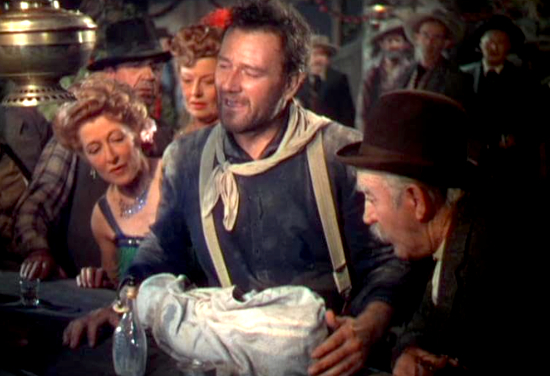
The movie drops unsubtle flags for a Biblical allegory, and an actual miracle occurs to give Bob the strength to stumble the last few miles to New Jerusalem. When it comes to unfair screenwriter’s ploys, we don’t like it when filmmakers endanger children without a good narrative reason. The 3 Godfathers formula somehow gets a pass, even when it brings in the full-on miracle of faith. The whole show is like a Sunday School tale for children, anyway, despite the occasional effort made to ‘get tough.’ Ford was fond of warm & welcoming barrooms, and here gives us one of the most idyllic watering holes ever. Saloon gals surround the new infant — do they not touch him because they’re unclean? A sentimentalized piano player (composer Richard Hageman) gives the rescued infant a big drunken grin.
In other words, Ford’s 3 Godfathers is not a progressive ‘adult’ 1948 western influenced by cynical films noir. The ‘storybook’ structure and sentimental attitude will likely not communicate to viewers that have little patience for older styles. But the show is exactly what its director wanted to make — if Sergio Leone can have his gunslingers stalk each other in drawn-out formal rituals, why can’t Ford visualize a fairy tale western fantasy, with a Bible kicker?
Wayne seems huge in Technicolor; he pitches the fanciful Bob Hightower just right, making fun of the Sheriff’s name (“Perley Sweet, Hah ha!”) but also conveying the delirium of an outlaw convinced he’s going to die (“Steal a man’s mule in this territory? They’ll string ya!”). Ward Bond was finally coming into his own with John Ford too. Bond manages some conviction when the civilized Sheriff Sweet organizes his posse: “They ain’t payin’ me to kill folks.” →
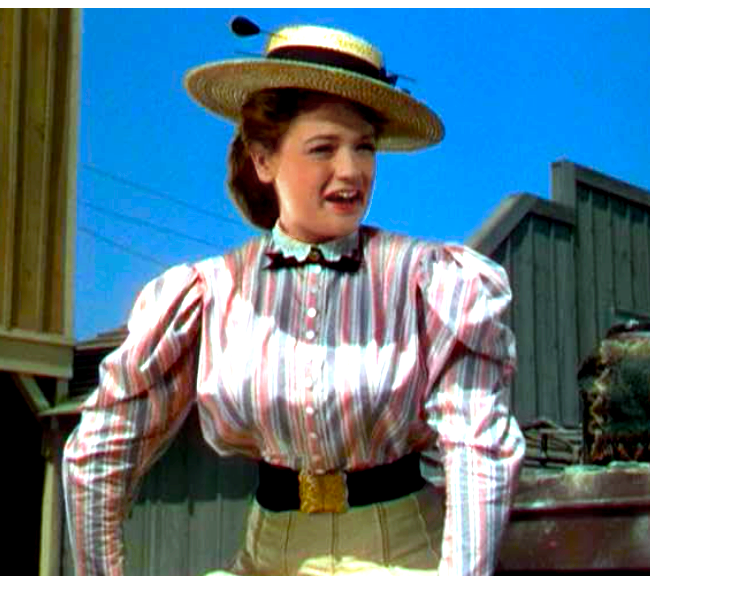
Most everyone we see is straight from the John Ford stock company. We have Mae Marsh from Birth of a Nation. Mildred Natwick played an English prostitute for Ford, when he cast her in her first movie, The Long Voyage Home. Jane Darwell from The Grapes of Wrath is perhaps allowed to be a little too loud and ‘big.’ Dorothy Ford doesn’t look any taller than Wayne’s other leading ladies, but she was six foot, two inches — we love her contribution to Abbott & Costello’s Jack and the Beanstalk. ←
The movie was a rarity for MGM, an independent production on which Metro exercised no production influence. John Ford and Merian C. Cooper’s Argosy Pictures had a number of hits, from which distributors RKO took most of the profits; a single bomb like Ford’s The Fugitive may have made it difficult for Argosy to stay in the black. After the war, it seems that the only sure way for Ford to get a movie made was with John Wayne involved. Wayne’s loyalty to ‘Pappy’ was well-known but we wonder how the relationship developed as Wayne’s industry clout eclipsed that of his mentor.

All the Ford regulars seem to be here. When Jack Pennick, Francis Ford, Harry Tenbrook and Cliff Lyons show up, their faces are as familiar as snapshots from our own family albums. Hank Worden is the first deputy. He had just come from Howard Hawks’ Red River and had tiny roles in Ford’s Stagecoach and Fort Apache. ↑ The rodeo headliner Ben Johnson is mostly seen in group shots, but Ford was likely already grooming him for movie stardom, a push that peaked in the charming, very personal Wagon Master.
And hey, unlike other versions of the story, the baby in 3 Godfathers looks like a genuine newborn. I hope they kept those bright Technicolor lights off her except for the exact few seconds need to get a shot.
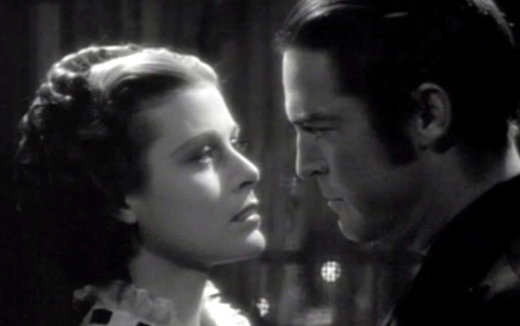
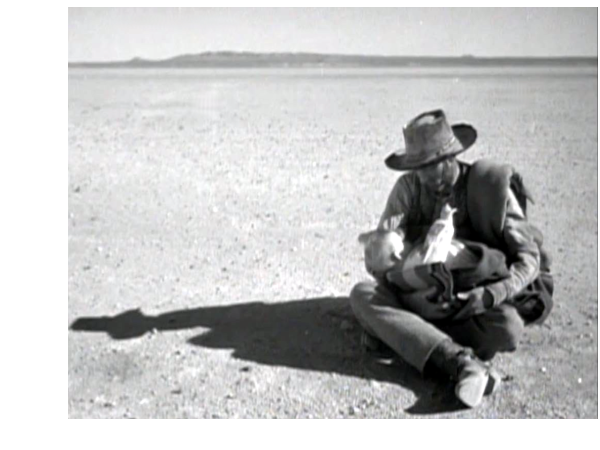
“Who knew that Chester Morris could be such a good actor?”
Well, apart from Boston Blackie, anyone who’s ever seen THE BAT WHISPERS, ALIBI, THE BIG HOUSE, RED-HEADED WOMAN, FIVE CAME BACK, BLIND ALLEY or any of his numerous appearances on Broadway.
Obnoxious maybe, but an opinion… I’ve seen 4 of those pictures and thought he was pretty stiff in them.
I thought he was very good in ‘The Divorcee’ with Norma Shearer. (Reply to ‘cadavra’ and Glenn.)
Though I remember this as a touch too sentimental in the “Fordian” way…your review nudges me into getting the disc and re-watching and I’m certainly eager to see the 1936 MGM film. I’ve just returned from the San Francisco Silent Film Festival, where the 1929 “Hell’s Heroes” was shown. Released in both sound and silent versions, this version of the story is especially grim and downbeat, with great performances from Charles Bickford, Fred Kohler and Raymond Hatton as the protagonists. It’s also wonderfully directed by a young William Wyler!