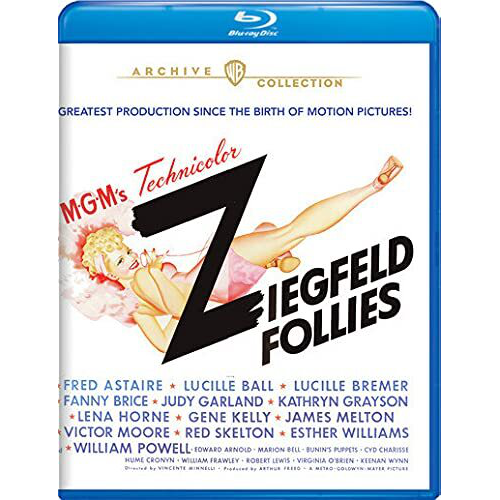
Years in the making! The glory of MGM on parade! Enough studio resources to film twenty pictures were expended on this paean to showman Florenz Ziegfeld. It's really Metro Goldwyn Mayer's Technicolor valentine to itself, showing off the studio's enormous stable of musical talent, along with various of its comic performers. Arthur Freed and Louis B. Mayer's notion of 'something for everyone' results in weird stack of grandiose musical numbers and mostly weak comedy. The biggest draw is the incredible color cinematography that peeks through in three or four jaw-droppingly elaborate musical spectacles. The picture is a workout to find the artistic limits of the Technicolor system.
Cast & credits
Starring (alphabetically): Fred Astaire, Lucille Ball, Lucille Bremer, Fanny Brice, Judy Garland, Kathryn Grayson, Lena Horne, Gene Kelly, Victor Moore, Red Skelton, Esther Williams. Also starring: William Powell (as Florenz Ziegfeld). With (alphabetically): Edward Arnold, Marion Bell, Cyd Charisse, Hume Cronyn, William Frawley, Robert Lewis, Virginia O'Brien, Keenan Wynn. And: The Bunin Puppets
Cinematography
George Folsey, Charles Rosher Art Directors: Cedric Gibbons, Merrill Pye, Jack Martin Smith, William Ferrari (Bunin puppet sequence designer), Lemuel Ayers (design consultant)
Costume Design
Irene (costume supervisor), Helen Rose, Irene Sharaff (Traviata and Limehouse Blues sequences) Musical Direction: Lennie Hayton, Roger Edens Choreography: Robert Alton, Eugene Loring (Traviata), Charles Walters ("The Great Lady Has an Interview sequence)
Film Editor
Albert Akst
Written by
John Murray Anderson, Guy Bolton, Allen Boretz, Irving Brecher, Eddie Cantor, Erik Charell, Harry Crane, Roger Edens, Joseph Erens, David Freedman, Devery Freeman, Everett Freeman, E.Y. Harburg, Lou Holtz, Cal Howard, Al Lewis, Max Liebman, Eugene Loring, Wilkie C. Mahoney, Jack McGowan, William Noble, James O'Hanlon, Samson Raphaelson, Philip Rapp, William Schorr, Joseph Schrank, Edna Skelton, Red Skelton, Frank Sullivan, Kay Thompson, Charles Walters, Edgar Allan Woolf.
Produced by
Arthur Freed Sequence Directors: Robert Lewis (Number, Please), Roy Del Ruth (A Sweepstakes Ticket), Lemuel Ayers (Love), George Sidney (part of the prologue and the Bunin puppet sequence, When Television Comes, Pay the Two Dollars), Norman Taurog (part of the prologue)
Directed by
Vincente Minnelli
It’s July, 2021. If any decisions have been made as to what will be the fate of The Warner Archive Collection, the news hasn’t yet reached these ears. The WAC is still releasing terrific Blu-rays each month, but that release schedule may be running on auto-pilot, from plans and arrangements organized six months ago.
We certainly can’t complain about the present flow of WAC product, especially if one is a fan of musicals. Astonishingly good digital restorations have reached deep into the MGM library, knocking off favorites in sensational HD color and sharpness, showing detail never before seen on home video. Just since last September CineSavant has reviewed stunning WAC discs of The Opposite Sex, The Pirate, Good News, Show Boat, Annie Get Your Gun, Broadway Melody of 1940, and the non-musical but killer-Technicolor The Yearling.
There’s also a new string of Warners Doris Day features that now look far better than they ever have before, starting with Romance on the High Seas. The finishing achievment are long-awaited discs of The Pajama Game and Damn Yankees, great Warner Bros. musicals finally untangled from legal ownership issues.
Ziegfeld Follies arrived at the end of 1945, when the experts say that the MGM musical was at the apex of its popularity. The confident super-production celebrates grandiose excess for its own sake. The gala presentation is ostensibly dedicated to the legacy of the great Broadway showman previously honored in MGM’s The Great Ziegfeld. But it’s really a valentine from MGM to itself, honoring its “All the Stars There Are in Heaven” mantra while plugging the seemingly endless musical talent pool available to the reigning king of musicals, Arthur Freed.
The movie is a revue patterned on Florenz Ziegfeld’s plot-less variety formula: music, comedy and spectacle. It begins like a film blanc, with a pompous trip through a starry afterlive. The view cruises by heavenly temples dedicated to Shakespeare and P.T. Barnum, and finally settles on one monument with the name Ziegfeld. Only MGM would assert that big-time showmen receive VIP treatment in Heaven, and only MGM would place those particular three entertainers in the same pantheon. There we find an angelic Flo Ziegfeld (William Powell) in a sentimental mood, drinking champagne. (←). The real message here is “We’ve got it all.”
Ziegfeld Follies was actually filmed in 1943, and tinkered with for two years. The movie was apparently initially previewed at a staggering 172 minutes. Even at just under two hours (with an added orchestral overture) it sags heavily in the middle. A true revue in the Ziegfeld tradition is a difficult thing to pull off — it’s the kind of show that needs to start big, grow with each unrelated act or segment and finish with the biggest topper of all.
Vincente Minnelli is the supervising director. The whole show is suffused with his lush art direction ideas as well as subtle technical achievements that may go unnoticed. The complicated visual and color effects in some scenes must have been the result of endless testing.
The show has plenty of good material. Each ‘act’ is announced with title card as might be done on a vaudeville stage. The Technicolor lensing is dazzling and probably sufficient in itself to impress many viewers, along with the endless main title procession of star names. In the end, the non-narrative format is what keeps Ziegfeld Follies from aging well. Without a story to follow we lurch from one skit or song to the next. The enterprise becomes tiresome a lot sooner than it should.
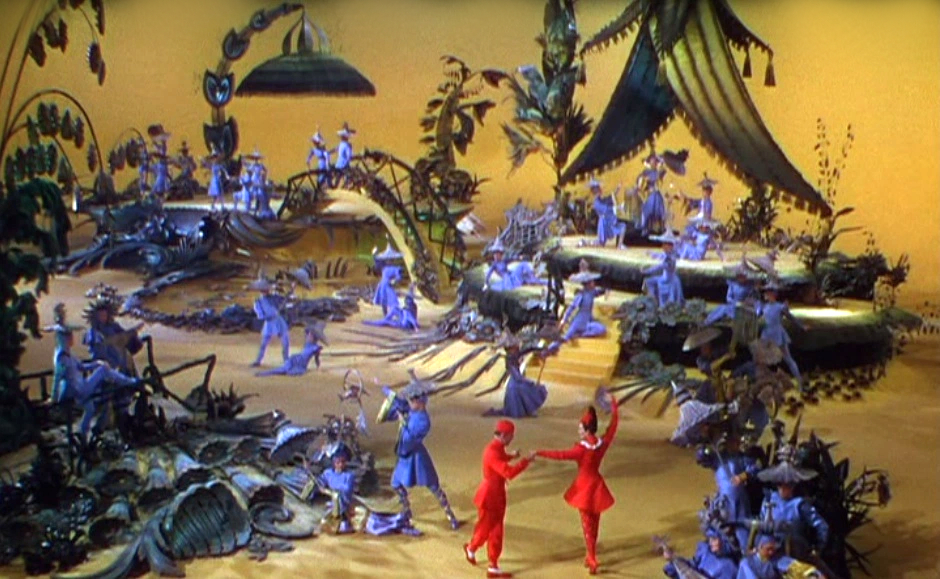
At least a third of Ziegfeld Follies is terrific, keeper material. Fred Astaire’s Limehouse Blues is a dance retelling of Broken Blossoms in Chinatown that reaches for artsy tragedy and succeeds. (wide shot near top ↑) Several of the big numbers in other parts of this show sport grandiose stage constructions that often suggest High Kitsch. The Limehouse ballet takes place in a surreal purple and green landscape that creates a fateful mood for the broken-hearted Tai Long’s romantic dream of Moy Ling (Lucille Bremer, bottom photo ↓).
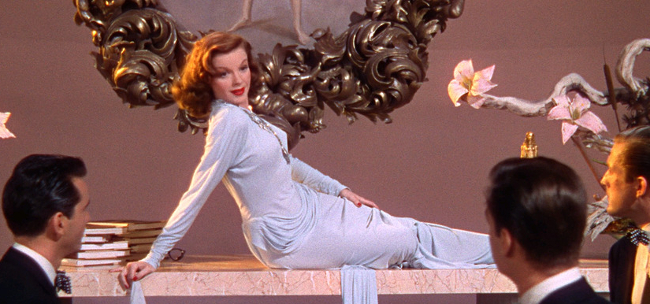
↑ Almost as good is Judy Garland’s musical number, Interview with the great star. Garland is as impressive as ever but the number seems overworked and hyper, trying too hard to yield its few jokes. As stagecraft blocking and dance work it’s slick and precise, nothing to sneeze at. Garland saves the last master shot take by sheer pro willpower: when a lock of her hair keeps falling into her face, she must flip her head several times to get it back. When she finally repositions the hair manually her move is almost invisible — while singing to playback and keeping in step with the intense choreography.
→ Lena Horne sings Love, a torch song given a more elaborate presentation than usual. She leans against a wall or two to sing, and the moving camera seems in synch with the song’s emotions. The ‘tropical’ color design is also beautifully modulated for Lena’s skin tones … she looks terrific, not merely exotic.
Astaire’s other number with Lucille Bremer is a Raffles-like skit with visuals that remind us of his Let’s Face the Music and Dance in an earlier RKO picture. It starts off well with a monocled Astaire doing some good pantomime as an opportunistic jewel thief whose criminal mission is sidetracked by Bremer’s Princess. For this reviewer the number breaks down in an ostentatious and rather ugly set, a construction of moving floors and women leaning against trees that look like white deer antlers. After all the build-up, the resolution of the number’s internal story isn’t very satisfactory either.
Somewhere in the middle range are Ziegfeld Follies’ big stage extravaganzas. The movie opens with a long number called “Here’s to the Beautiful Girls,” a complex pageant involving dozens of troublesome elements — moving cameras, platforms, prancing women and horses — that must have been a huge headache to coordinate. Several long takes blend Astaire’s introductory song, a meat parade of leggy models, and finally an imperious Lucille Ball as an impossibly tall pink lady cracking the whip on a dozen creeping cat girls. (↑) It’s elegant and technically refined, even if the whole thing is wildly overdone, almost garish. Like most of the ‘big show’ art direction in these revue shows, it’s also artistically inert … even the bizarre cat menagerie doesn’t evoke much except surprise.
The same thing goes for the ending, a similar pageant broken up by some smoothly-filmed ballet choreography featuring huge floating mounds of soap bubbles. Cyd Charisse does her best to gazelle through these things without breaking her neck. They somehow keep the bubbles from sticking to her, sparing us the sight of the beautiful Cyd reduced to a soapy Michelin Man. For a few moments we’re entranced by the sheer crazy colors of the globs of bubbles. It’s as if the dancers are trapped in an oversized, psychedelic lava lamp. But the finale comes off as empty and impersonal, a feeling not helped by trilling singer Kathryn Grayson, who has the personality of a cherubic porcelain doll.
These technically sophisticated numbers are all show and little art. Ziegfeld Follies ultimately works overtime to justify Louis B. Mayer’s idea that he was king of the entertainment world, and to prove to other studios that Leo the Lion has the biggest toy box in town. The Esther Williams water ballet is likewise just an empty showcase; what Williams’ ever-smiling face is supposed to communicate has always eluded this reviewer. It’s curious that the Archers team of Michael Powell and Emeric Pressburger should be able to out-wow these visual numbers with (relatively) limited resources available in their English studios – little more than colored lights and cut-out cloth scenery. Even though the Archers could be pretentious (The Tales of Hoffmann) they were always artistically ambitious and had something to say, as in The Red Shoes. They even carried over a musical-operatic aesthetic in their non-musical dramas, like the expressive Black Narcissus.
Some of the other numbers now have dated terribly, or seem to be nostalgic remnants of ideas that may have felt forced in 1946. It’s not often that we get to see Fanny Brice on film; MGM had already ruined her appearance in The Great Ziegfeld by chopping off the whole second half of her signature song My Man. Here she seems a grotesque clown that would only be understood by the people who remembered her on stage. Anyone born later than 1946 will need an explanation for her importance and individuality, as she certainly is nothing like Barbra Streisand.
The legit La Traviata opera scene reeks of the Mayer concept of culture; it doesn’t belong in this stack even if some sources say that Ziegfeld did include such artsy material from time to time. And especially not next to the comic sketches starring Brice, Keenan Wynn, Edward Arnold and Victor Moore, and finally Red Skelton. None now seems particularly funny, although Skelton’s fans are going to love his over-the-top clowning.
That leaves the ‘historic’ pairing of Fred Astaire and Gene Kelly to ponder. While wondering what the title The Babbitt and the Bromide refers to, we get a congenial rivalry, or a spoof of a rivalry, that’s not a whole lot of fun. The two extraordinarily talented dancers kick each other and pull off other tricks, which only encourages the thought that because the real men in the same field are often compared, they don’t like each other. The number seems to be the result of an edict to put them together, as P.T. Barnum would combine star headliners to create a bigger glow. It doesn’t happen: the number’s overall effect is mild and underwhelming.
Hume Cronyn, William Frawley, Peter Lawford, Grady Sutton and Ray Teal either have noted parts or can be spotted along the way; I’ve never noticed favorite Carol Haney, but she’s said to be in there somewhere.
Ziegfeld Follies is a musical favorite for many but it’s a tough sell to new audiences. It’s almost better to sample the acts one at a time, skipping ahead (Heresy!) when individual segments wear out their welcome.
The disc
The Warner Archive CollectionBlu-ray of Ziegfeld Follies justifies itself just by its restoration job alone. The Technicolor images are so cluttered and detailed, that VHS, laserdisc and even DVD didn't begin to do them justice. Some of the art direction is almost overpowering, as are the Technicolor close-ups of the leading ladies, starting with Lucille Ball. Reproducing the original Technicolor 'glow,' the Blu-ray brings back 'all those colors not found in nature.' I can see some kid in Omaha, Nebraska stepping out of a matinee of this show, deciding that reality just can't compete, and going back in just to see the color again.
The audio is presented in a choice of original mono and remixed stereo, as was the DVD. The same extras are ported over from the DVD as well. A featurette docu concentrates on the film's shaky path to the screen. Proposed years earlier, MGM took forever to nail down exactly what acts would appear. Interestingly, Ziegfeld's original stage show is represented in stop-motion animation by Lou Bunin's puppets as part of the prologue. The craziest news is that, after previews, over an hour of completely finished numbers would never be seen again. We're not told if they were lost in MGM's periodic vault fires in New Jersey, or were simply junked.
Movie-specific extras continue with a trailer and audio-only outtakes for three songs. Warners has also stacked two cartoons (Tex Avery's The Hick Chick and the Tom & Jerry short Solid Serenade) and a "Crime Does Not Pay" short subject called The Luckiest Guy in the World. This rather notorious short makes no sense in the series because it's a strange fantasy with the idiotic message that even if a crime is successful, the guilty will be repaid by Bad Karma. It's well made but ridiculously silly, as we all know that in the real world, "The Bad Sleep Well."
Supplements
Featurette Ziegfeld Follies: An Embarrassment of Riches, MGM 'Crime Does Not Pay' short The Luckiest Guy in the World; 2 MGM cartoons: The Hick Chick and Solid Serenade, Audio-only outtakes and rarities: outtake songs "If Swing Goes, I Go Too," "There's Beauty Everywhere" and "We Will Meet Again in Honolulu"; Ziegfeld movies trailer gallery
Subtitles
English (feature only)
Deaf and hearing-impaired friendly
Yes
Packaging
One Blu-ray in Keep case
Final product for this review was provided free by The Warner Archive Collection.