


It’s yet another long review essay on a relatively minor Sci-fi picture … with no apologies. It’s fun to try to connect the dots between them, and see how they relate to the times in which they were made.
We were surprised to see Severin Films take up the cause of vintage Sci-fi, in this case an ambitious independent production made early in the 1950s boom. Producers Jack Rabin and Irving Block got their start doing opticals and matte paintings for independent filmmakers without access to studio facilities, work that continued through the 1950s, for Lippert Films, United Artists, Allied Artists, etc.. Block’s interest in science fiction led to an original story credit on Forbidden Planet. Along with other associates, Block and Rabin provided imagery for scores of fantastic films, for directors Edgar G. Ulmer, William Cameron Menzies, Phil Tucker, Eugène Lourié, Robert Aldrich, Stanley Kubrick, Edward Nassour, Charles Marquis Warren, Hubert Cornfield. They famously talked Roger Corman into basing two of his films around their special optical effects.
The effects work on Robert Lippert’s very successful Rocketship X-M made it possible for Rabin and Block to raise money to produce Unknown World, an unacknowledged update of Jules Verne’s Journey to the Center of the Earth, later made into a big CinemaScope hit by producer Charles Brackett. The duo’s director/editor Terry Morse had been working since the silent era; his main claim to faim was his excellent English-language revision/re-edit of Toho’s Godzilla.

Unknown World has the earmarks of a leftist creative team. Its sober theme is a reaction to the advent of the nuclear era. The main scientist-spokesman believes that a nuclear war is inevitable, a question of When, not If. He also believes that constructive action is possible. It’s not entirely doom time, as in Arch Oboler’s post-nuclear Five. It’s also not the soured epitaph of Joseph Losey’s much-later These Are the Damned, which also begins with an authority figure (Alexander Knox) telling us point-blank that nuclear annihilation is unavoidable.
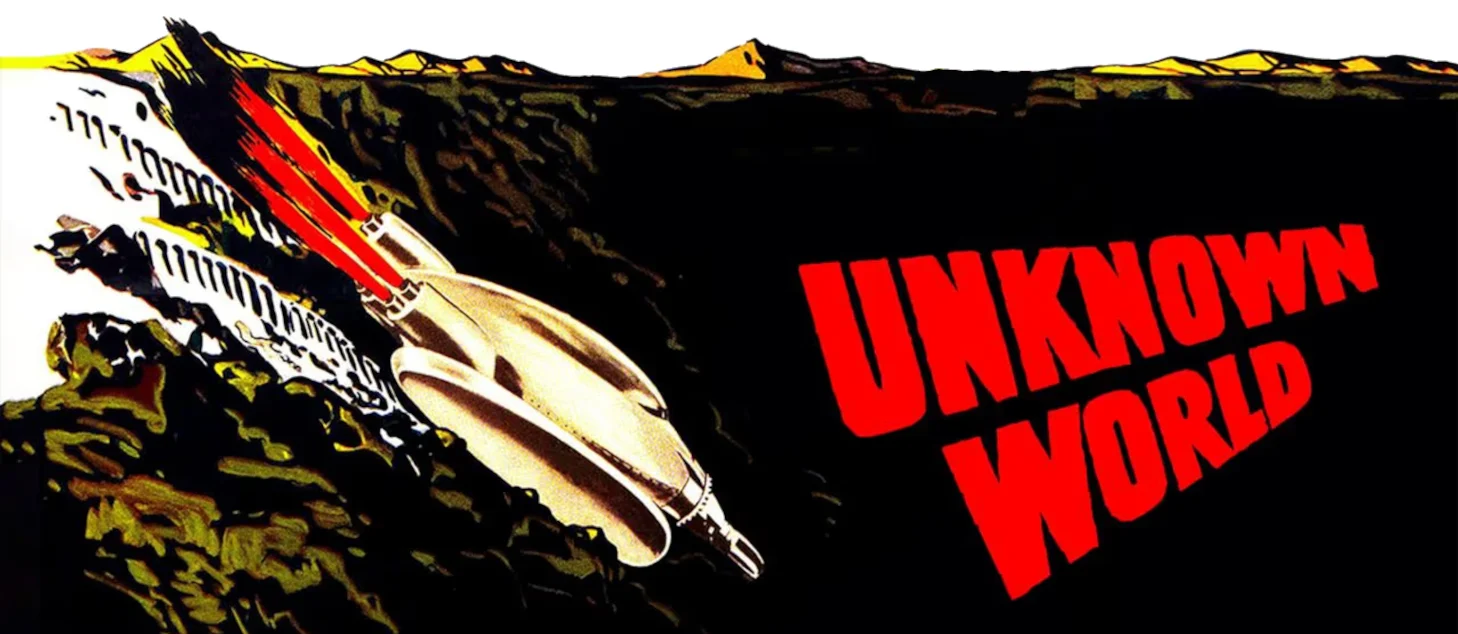
That’s the message in the very Kane- like newsreel that opens Unknown World, immediately after a main title graphic suitable for the cover of a horror comic. Dr. Jeremiah Morley (Victor Kilian) believes that the only way to survive the coming atom war is for some of humanity to move underground for a generation or two, until the radioactivity above ground has subsided. He has collected four more ‘top scientists’ to accompany him on an exploratory plunge into the earth’s interior, to find a suitable cavern where humans can live. The idea is too radical to attract normal sources of funding, but the big $ cash Morley needs is advanced by Wright Thompson (Bruce Kellogg), the playboy heir to an industrial fortune. Wright is willing to spend a fortune just for the adventure, for kicks.

A combo submarine, tank and earth-boring vehicle called a ‘Cyclotram’ is constructed and delivered with its dauntless crew to an Aleutian volcano, and the descent begins. It isn’t what we expect. The Cyclotram’s boring-nose is only used to break through a few thin walls, as the interior of the earth consists largely of nice ramp-like tunnels connecting various caverns. The passengers sit in the vehicle’s main compartment, and sometimes walk ahead, with a spotlight in the background indicating the presence of the Cyclotram. No full-sized Cyclotram mockup was constructed.
Some of the caverns are giant cathedral-like spaces, represented by 2nd-unit work in Carlsbad Caverns. In Carlsbad, we suspect that we’re looking at stand-ins, not the main cast. Most of the subterranean locations use Hollywood’s ubiquitous Bronson Caverns filming location, both the interior space and the exterior tunnel entrances.
The storyline remains sober and rather dry, dealing mostly with the challenges met along the way. Although they encounter fairly normal air pressure and temperatures all the way down, two explorers are lost to toxic gas. When their water supply is accidentally contaminated, they break through a wall and release a geyser of steam. At 900 miles down they find a cavern, where they think it might be possible to live; continuing further, at 1100 miles they discover a subterranean sea, and at 1640 miles a giant waterfall and natural ‘radiant’ light. This last vast cavern is for a while called The Promised Land.

Critics weren’t impressed by the human end of the story. The cocky but cheerful playboy Wright Thompson gets into poorly-motivated fights with Andy (Jim Bannon), an engineer-mechanic who helped dig the Holland Tunnel. The two men also vie for the attention of the one female explorer, scientist Joan Lindsey (Marilyn Nash). She’s an ‘ardent feminist’ yet responds to Wright’s gentle attempts to be romantic. The characters’ talk is almost all technical exposition, but the story does stop for an awkward philosophical discussion or two. Wright talks about the loneliness of isolation, so deep in the ground, which prompts a very short Ayn Rand tiff over whether progress comes from inspired individuals or group-effort teamwork. Experiencing the death of a colleague, and developing serious feelings for Joan, Wright becomes a more responsible member of the expedition.
An ‘almost’ interesting scene begins with Joan growing faint and hallucinating, a kind of ‘rapture of the deep’ thing. The editor attempts to express her state with a choppy montage of water condensing from steam and dripping onto stalagmites. The most progressive moment in the movie may be when Joan’s colleagues make sure she’s okay. Joan doesn’t behave like later Sci-fi females, acting helpless and screaming. Nobody carries her back to the Cyclotram, masculine-heroic-style. They instead leave Joan alone to collect herself with some dignity, aka ‘give her space.’ That’s a big leap forward. Osa Massen in Rocketship X-M was stuck with annoying male small-talk about ‘science and females being incompatible.’
A bit more about this show’s place in the ’50s Sci-fi wave: literary science fiction critics decried the film genre’s immediate retreat into monsters, destruction and disaster. The template for future alien menaces arrived several months earlier with Howard Hawks’ The Thing from Another World. Unknown World stays serious and on topic, skipping Jules Verne’s dinosaurs at the center of the Earth. It instead resolves its ‘atomic despair’ theme with the dark discovery that ‘living things become sterile’ deep in the Earth’s core. Dr. Morley’s notion to flee underground is a dead end. When a massive wave threatens the Cyclotram, the disillusioned Morley doesn’t make an effort to save himself. But Wright Thompson’s newly-found sense of optimistic responsibility takes over. The final message is that there is no place to hide from the nuclear threat. The only way forward is to work for a stable international peace.
In other words, the explorers finally arrive at the common-sense conclusion that the audience had going in … hiding from the atomic threat won’t work. We instead get terrible dialogue about ‘running away from Life’ and ‘running away from Love.’

With the big issue so simply resolved, all that Unknown World can do is paste together its deep-deep-down safari and hope for the best. The literary science fiction critics of 1951 probably got bogged down in Unknown World’s technical shortcomings as much as did the average film viewer. The movie’s science is shakier than its imaginative but unconvincing special effects. The Cyclotram looks wholly impractical for its purpose, being a rounded tank with a drill on its nose and what look like Studebaker tail lights at the rear. That drill bit has blades that expand to cut the equivalent of a railway tunnel through solid rock, at maybe 2 mph. We only see it operate twice, as it is hardly needed. The path into the earth’s interior is ready for any conveyance, from a golf cart to a Sherman Tank.
Joan has brought some rabbits in a hutch. Her odd idea is that if they reproduce, it will prove that the underworld will be terrific for human habitation and child-rearing. One of the scientists says that crops can be grown down there, even without sunlight … better dig up all of those fungus recipes. That dismissal of common sense is matched by the apparent lack of difficulty with the pressure or temperature so deep underground. They eventually plunge below 2500 miles, in an underground ocean.
We’re told that the blacklisted screenwriter Dalton Trumbo contributed to Unknown World, which was signed as original work by the very capable Millard Kaufman. Interesingly, the little argument between ‘one man’ and ‘collective effort’ would later become the basis of an ideological spat between novelist Howard Fast and screenwriter Dalton Trumbo, on the epic Spartacus. Beyond that, the film’s potential ‘subversive’ content is its insistence that atom testing is a slippery slope to an apocalypse. The State Department / AEC’s position was that there’s no real threat from nuclear energy. They wanted Hollywood to concentrate on communist spies and traitors.
By 1951 nuclear scientists were already being tagged as untrustworthy. Some politicos did their best to assign the ‘blame’ for Hiroshima on atom geniuses like Robert Oppenheimer. The tone of Unknown World reminds us a bit of the public education short One World or None, a lecture about the bomb that promotes the idea of international cooperation and maybe even a one-world government. Its ‘technical assistance’ came from ‘The Federation of American Scientists’, which was founded by Manhattan Project scientists.

We admire the special effects in Unknown World even if they don’t take the movie all the way to a level of credibility. The Cyclotram isn’t very convincing as a design or as a completed model. It always looks like a toy with a porcelain shine; Rabin & Block’s matte shots to show people at its hatchway are no more believable than the many shots showing it nudging its way through the frame. The depth of focus on the Cyclotram model is really shallow. The use of long lenses imply a sizable distance from the camera, which makes all the interior passageways seem enormous. Angles through the slot-like viewing port look okay, but the interior really needed to be filmed with wider-angle lenses to make us feel like we’re in a confined space.
The stock-shot newsreel is okay, but there’s no effort to make the new shots of Dr. Morley’s team match them. Under the Earth, there’s little visual consistency, and too much repetition. No matter where they go, we still seem to be in Bronson Caverns or Carlsbad. It bogs down the film’s forward momentum; we never seem to get anywhere. When they film outside the cave entrances they’re in normal daylight, which undermines the later scene in the ‘lumminous cavern.’ According to this movie, the path to the center of the Earth is lighted most of the way. Referring to my numbered photo in the old Bronson Caverns article, at 54:00 we see caves #4 and #3 from inside, when Andy and Wright split up to try two different paths. At 1:02:02 we see the outside of cave #5.

We do get some handsome tableaux, such as the massive waterfall matted outside a cave exit, or the long pan over the vast cavern, showing towers reaching to the ‘ceiling’ bathed in a misty light. But these are mostly ‘look at that’ views that don’t fully involve us in the proceedings. We’re instead distracted by stock shot detours, such as the same glacier-avalanche hero stock shot that’s seen everywhere, even in The Beast from 20,000 Fathoms. Rabin must have been hard-up for good cutaways. He uses a shot of a climber descending a rope at 36:36, blurring the top of the frame where we can clearly see the sky and trees.
Victor Kilian is the film’s main player. A communist party member, he was outed along with 161 others by Martin Berkeley, the screenwriter of Tarantula. Kilian’s last five film appearances went un-billed — the leading role in this picture, plus good parts in The Lemon Drop Kid, Passage West, Face to Face and The Tall Target. It was Career Obliteration for him. From 1952 forward Kilian never appeared in another theatrical film. He did make a nice TV comeback in later years.
The next best-known actor is Otto Waldis, as a less-obsessed elder scientist. Waldis usually plays sinister villains (as in The Whip Hand) so it’s nice seeing him smile and try to keep peace among the explorers. The other players are mostly passable, given the opportunities afforded by the screenplay. Marilyn Nash is reasonably good mainly because she doesn’t fawn or faint. Charles Chaplin fans would know her name for her rather good performance in his Monsieur Verdoux, a picture that became a blacklist target and not a career-builder. It was her only other film.

The sort-of triangle between Marilyn’s Joan, Andy and Wright is not very effective. On their own, both Jim Bannon and top-billed Bruce Kellogg are okay; Kellogg’s characterization is really thin. In 1951, was there an audience that would see actor Bannon and say — hey, this movie stars Red Ryder!
A final note: Elmer Bernstein labored on a musical soundtrack for the notorious Robot Monster, but the noted composer Ernest Gold did very good work for Unknown World. His cues accentuate and emphasize the high-adventure mood, adding stings to every ‘wow’ vista discovered by the Cyclotram crew.


I’ve always liked Victor Kilian, particularly in Only Angels Have Wings. I had no idea of his political leanings or that he had been blacklisted.