

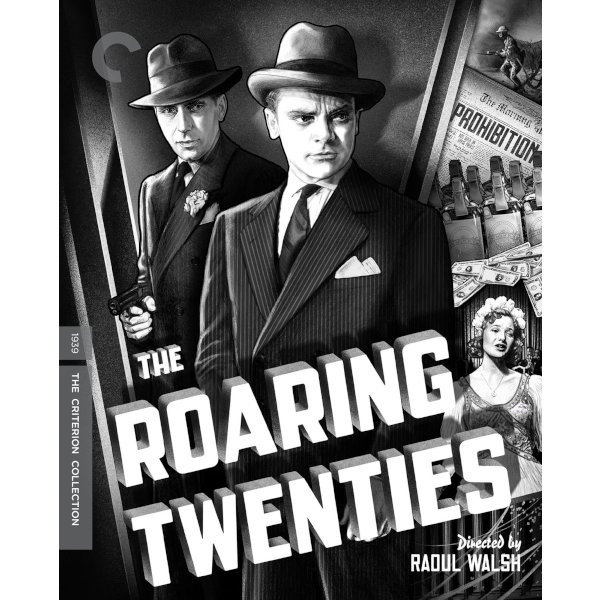

The enforcement of the Production Code tamed Mae West’s comedies and outlawed the glamorization of gangsters that made stars of Edward G. Robinson, Paul Muni and James Cagney. Warners tried movies that extolled the police, but audiences wanted the raw dynamism they loved in James Cagney. He came back as a bona fide hoodlum in Angels with Dirty Faces, but only after Warners laced the script with juvenile delinquent sociology, pious church messages, and sentiment worthy of a silent melodrama. The magical ingredient Cagney made it all work — even the censors liked Cagney’s version of screen sin.
Warners’ followup The Roaring Twenties appears to be the brainchild of ex-columnist Mark Hellinger, who had covered the years of Prohibition and suggested that an adapted newsreel format might lend extra importance to a gangster story. What we now call a semi-documentary did not yet exist in 1939, and most film stories touted as factual were anything but. MGM’s Crime Does Not Pay short subject series (1935-1947) regularly pretended that recognizable character actors were actual public officials.


According to the experts, Mark Hellinger actually coined the phrase ‘The Roaring Twenties.’ His movie is a chronicle of a fictional racketeer through the Prohibition years. It begins with a narrated newsreel-style montage of the state of world affairs in 1939. After flashing images of Hitler and Mussolini, it then drops back to catch the end of WW1, Prohibition, and the Volstead Act. Interrupting the personal story of soldier Eddie Bartlett (Cagney) are swift montages of Doughboys returning home. The montages show the rich getting richer in the rising economy, and the unquenchable thirst for alcohol that creates an underworld of bootleg rackteering. Future director Don Siegel is said to have fashioned these fancy montages, the most famous of which depicts the Wall Street bubble with a giant ticker tape machine, followed by melting skyscrapers to represent the Crash of 1929.
The eye-opening, much-recommended Ken Burns/Lyn Novick documentary Prohibition (2011) emphasizes the social and economic calamity that was America’s addiction to alcohol. It spends less time than one might think on the criminality of the Twenties’ bootlegging boom. The Roaring Twenties assumes that Prohibition was bad, that drinking is an American birthright, and that bootleggers were just giving the public what they want.
‘Big Shot’ Eddie Bartlett is basically a decent guy. The schematic narrative contrasts him with two fellow Doughboys. In civilian life, Sgt. Jones (Joe Sawyer) will become an ordinary working guy. The mild-mannered Lloyd Hart (Jeffrey Lynn) will finish his law studies. The sadistic thug George Hally (Humphrey Bogart) will go back to the rackets.

The only work Eddie can find is driving a cab for his easygoing pal Danny Green (Frank McHugh, hah-hah!). Eddie is suckered into delivering hooch for a fare, not knowing he’ll be arrested and charged with bootlegging. Speakeasy owner Panama Smith (Gladys George) bails him out. They become partners, she as a nightclub operator and he as a hard-charging bootlegger, using a growing taxi company (run by Danny) as a front. Eddie’s enlists his old army pal Lloyd Hart, now an attorney, to manage the taxi company’s legal affairs. The ethical Lloyd is soon dismayed by Eddie’s other criminal enterprise.
To ‘play with the big boys’ Eddie has to get in on the classier trade, with liquor smuggled in from the outside. Turned away by mobster Nick Brown (Paul Kelly), Eddie partners with the untrustworthy George Hally. They use muscle to take over part of the rackets.
Any doubts about story clichés are overridden by sheer entertainment value: James Cagney’s presence is energizing, electric. The weakest part of the film is Eddie’s ill-fated fixation on young Jean Sherman, a chorus girl that he promotes as a nightclub headliner for Panama Smith and others. Sherman is played with bright-faced sincerity by Priscilla Lane, the youngest of the four Lane sisters. They had made a quartet of ‘growing up’ dramas starting with 1938’s Four Daughters, a movie now better known for advancing the career of John Garfield. Ms. Lane is sweet but not much more. She sings several songs — ‘Melancholy Baby twice. We know Jean is good only because the nightclub extras are directed to react with ecstatic applause.

Panama tries but cannot convince Eddie Bartlett that he is a fool in love. The innocent Jean and the decent Lloyd get together, making us worry that the increasingly violent Eddie will kill the young attorney when he finds out what’s going on. Eddie is impulsive, but only once or twice does he lash out with emotional violence. Whenever he kills, it’s always a rat who deserves rubbing out. Bogart’s George Hally executes people in cold blood, out of pure malice. But when Hally gets his, the operative justification is that he double-crossed Eddie.
Audiences of 1939 might recognize Eddie’s promotion of Jean’s singing career to be a gloss on the real-life Martin Snyder and Ruth Etting — 16 years later, Cagney would play opposite Doris Day in a less sentimentalized retelling of the Snyder-Etting story, Love Me or Leave Me. The bootlegging/taxicab side of Eddie is said to be modeled after the gangster Eddie Fay. And Panama Smith is a clear ringer for the famed nightclub entrepreneur Texas Guinan — later played by Phyllis Diller (!) in Elia Kazan’s Splendor in the Grass.
We also note that ‘Hollywood realism’ under the Code preferred to pretend that race and ethnic issues didn’t exist. None of the gangsters have ethnic names unless they’re Irish. George Hally’s sinister henchman is simply called ‘Lefty’ — he’s played by future director Abner Biberman (The Night Runner), at the time best known for playing a Kali cultist in Gunga Din.

Was it a cinematic novelty for The Roaring Twenties to take a nostalgic look at a period of time barely 15 years gone by? Pre-Code Hollywood had spun contemporary stories around prohibition and the unemployment issue. Upton Sinclair’s The Wet Parade is a grim slog about the evils of alcohol, before and after Prohibition. William Wellman’s frightening Heroes for Sale tells the story of a WW1 vet who faces morphine addiction. The country’s situation is depicted as so dire, a Communist revolution seems a real possibility.
Solid entertainment is its own justification, which leaves The Roaring Twenties on a high roost as one of Warners’ winners from the Golden Year of 1939. James Cagney is of course a marvel, and we especially admire Humphrey Bogart’s tenacity. It can’t have been rewarding for Bogart, to have to play yet another creep shot down by Cagney’s hero. Nobody paid his dues as did Bogart. His breakthrough was still seven films away, in High Sierra … directed by Raoul Walsh.
Frank McHugh is his lovable self; his character becomes unfortunate collateral damage when Eddie Bartlett commences a gang war to solidify his bootlegging racket. We still reserve the highest praise for Gladys George, whose Panama Smith is the most sympathetic, authentic personage on screen. Little dialogue ‘explains’ Panama, her complexity is generated 100% by Ms. George’s compelling performance.

Screenwriter Robert Rossen had co-written films with scathing social messages — Marked Woman and They Won’t Forget — and would later run afoul of the HUAC. But The Roaring Twenties has no political viewpoint beyond advising the viewer to not break the law. When Eddie becomes more ruthless, it’s not because he’s a bad man — he just feels cheated in love. At the finale, instead of being humiliated for his crimes, Eddie goes out in a blaze of righteous justice, ‘atoning’ with a noble sacrifice. It’s a fancy grab for audience sympathy and approval . . . and we love every bit of it. Jimmy Cagney can do no wrong.
Critic Gary Giddens makes an excellent point in his video essay. After this movie James Cagney ditched gangster characters for a full ten years. When he returned for WB’s ferocious crime noir White Heat, Cagney’s ‘new’ gangster was a brutal psychotic, a monster whose attachment to his ‘Ma’ is just another part of his sickness. Were Cagney and Raoul Walsh after something more frank, less sentimental? Walsh was known as a pioneer of the genre — his raw, filmed-in-the-slums silent movie Regeneration (1915) is one of the very first gangster sagas.


The freeze is a layer change. It happens to my 4K discs that have a long running time. Polish the disc.
Just re-watched Now, Voyager last week and Don Siegel does get a screen credit for doing the montages in that one.
The real unsung star of this movie for me is the great Ray Heindorf who not only conducted the entire music score, was responsible for the authentic period orchestrations and the choice of songs. He was a musical genius who never gets proper credit. All of Warner’s musicals, especially the Busby Berkeley extravaganzas, were seriously enhanced by his stellar contributions. This film is almost a dry-run for YANKEE DOODLE DANDY where Heindorf really came into his own. Leo Forbstein is credited on-screen but frankly, he couldn’t ‘conduct his way out of a paper bag’ as one old timer from the Warner Orchestra once told me years ago. Bravo Ray!