


In 1972 I attended a fantastic Los Angeles County Museum screening of young Steven Spielberg’s Duel and Jack Arnold’s The Incredible Shrinking Man. Only a few vintage science fiction pictures were getting any respect at that time, and this 1957 Universal-International release was one of the most deserving. The author and screenwriter Richard Matheson talked to us afterward. He told us that he had seen Shrinking Man only once when it was new. He practically apologized for the movie, and hated its altered ending, which he said was not his work. We couldn’t believe he’d think such a thing about what is so obviously a poetic, transcendant experience — that can be honestly described as profound. Much later, we were happy to learn, Richard Matheson saw it again and changed his mind.
The wildcat producer Albert Zugsmith had recently had a prestigious hit with Douglas Sirk’s star-studded Written on the Wind. He obtained Richard Matheson’s creepy novel The Shrinking Man and pitched it as a sure winner, a show with possibilities to excite any studio executive. The project wasl not treated as a down-market item from the sci-fi/horror unit. That unit’s producer William Alland would soon jump ship to Paramount. His Sci-fi specialist Jack Arnold wanted out of the rubber monster game but may have signed on when he read the superior screenplay and learned about the bigger budget allotted the project. Given ample production resources, Zugsmith’s show outdoes all of William Alland’s Sci-Fi efforts.
Kids loved the miniaturization effects, a concept seen mostly in comedy fantasies since the failure of Paramount’s Dr. Cyclops back in 1940. Matheson’s adult, thoughtful script about also resonates with the the anxieties of its time. The Incredible Shrinking Man is Science Fiction poetry for existentialists: what could have become just another monster movie is instead a wondrous delight.
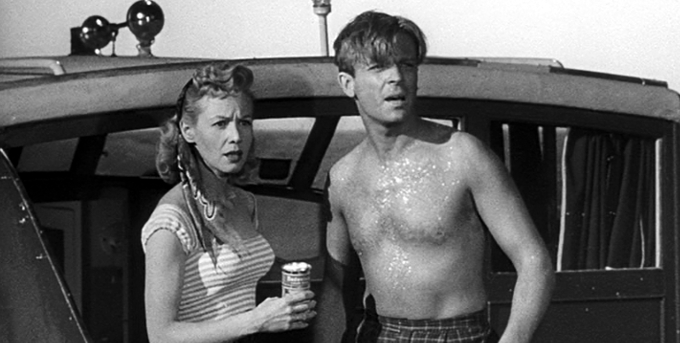
Returning from a boating weekend, Los Angeles ad writer Robert Scott Carey (Grant Williams) notices that he’s gradually losing both height and weight. His malady at first baffles Drs. Bramson and Silver (William Schallert & Raymond Bailey). Like a reverse cancer, Carey’s tissues and organs — everything — are shrinking by a fraction of an inch a day. The specialists soon formulate a theory of what’s going on, and work tirelessly to halt Carey’s shrinking process. As Scott becomes smaller he must retreat from the world and hide like a freak. To earn a living, he sells his story to the press. Eventually shrunken so small that he can live in a doll’s house, the irritable Scott gives his long-suffering wife Louise (Randy Stuart) no rest. He’s still shrinking with no end in sight when the cat, long banished from the house, sneaks back in. . .
The Gothic horror tradition speaks to the human fear of suffering and death, or the loss of one’s soul to bestiality or the Devil. But the insecure postwar years brought an existential crisis into complacent hometown America. The famous ‘intelligent’ ’50s Sci-fi thriller Invasion of the Body Snatchers is about toxic depersonalization. It encouraged audiences to accept the idea that things aren’t what they seem, that the world we see might be some kind of vast political conspiracy.
The Incredible Shrinking Man exploits a complimentary set of modern fears that upend common values, facts and assumptions. Scott Carey is stricken with an unprecedented, deadly malady. But getting smaller robs him of his identity, his sense of belonging. It threatens to render his life meaningless, to make him into a cosmic joke.

There is a classic kind of character that discovers his true nature by losing or casting off material possessions; some philosophies say this is a path to spiritual grace. Carey involuntariy undergoes a similar process as he shrinks bit by bit toward an inevitable zero of personal oblivion. Carey loses everything by which he defines himself. First his clothes don’t fit. Then his wedding ring falls off. The doctors concentrate on Scott’s biological problem but nobody knows how to deal with his mental state. Scott’s wife must mother him like a child. Man becomes toy, husband a helpless baby.
Matheson’s original novella emphasized Carey’s sexual trauma as he realizes that he’s no longer going to be intimate with his wife, and that she may soon need to find someone else, perhaps Carey’s own brother. His resentment grows with the forced isolation. He knows that his personality is changing along with his situation. He can’t help it.
Normally a 1957 movie would have to ignore this sex angle. Scott expresses his frustration through terrible behavior. He shouts angry unreasonable demands at his wife Louise. Nothing she does is good enough. In his jeans and tennis shoes, sitting on a chair with his feet barely reaching the end of the cushion, Scott at first looks like a little kid. Having a sex drive with such a small body must seem like a castration nightmare out of Jim Thompson’s The Nothing Man.
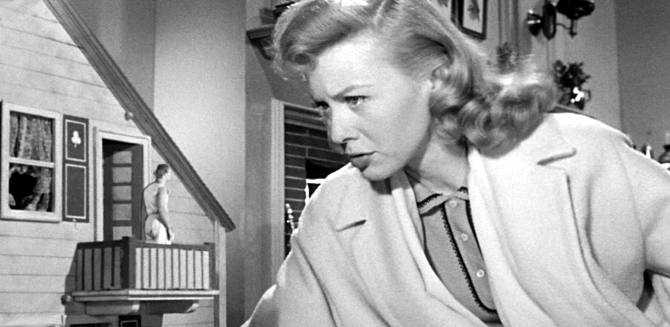
When Carey is three feet tall he wanders out to the carnival. He meets a young midget (April Kent) and begs for her company, desperate to maintain his identity as a man. His shrinking halts, but then re-commences. Carey doesn’t know it yet, but his only certainty is eternal change, and utter isolation in the knowledge that his fate must ultimately be faced alone. Already withdrawn from his normal suburban existence, Scott is drifting into neurosis when events plunge him into a miniature Robinson Crusoe world.
Welcome to Surreal World.
Scott Carey’s ordinary, mundane cellar is now a perilous, hostile prison. Being trapped there expresses a chaos beyond mere disproportion — when one is two inches tall, normal surroundings are grotesque. The Incredible Shrinking Man in this way resembles Alice Through the Looking Glass in its surreal re-ordering of existing reality. His biggest adversary in this cellar is a terrifying spider. Scott rallies his will by flexing an instinct built into the human race, the Territorial Imperative. To battle that spider menace Carey must summon resources he never knew he had.
Richard Matheson wrote both the source novel and the screenplay, but reportedly wasn’t coming up with a satisfactory conclusion. The film’s ethereal, dazzling finale was not written by Matheson and was added against his wishes. It’s something completely unexpected: now just a fraction of an inch tall, Scott looks up at the night sky and experiences a revelation: everything else has changed, but not the stars; they’re just as he remembers them. Scott makes peace with his fate, with his place in the cosmos. His ordeal was part of the process of understanding. . . he had to take The Journey Out and In…

At one point a high angle on Scott Carey abruptly retreats, and he figuratively disappears into the microscopic world. We come to Shrinking Man expecting another matinee diversion only to be transported by this mindbending conclusion. I’ve been at screenings of this film in which one could feel an “ahh” rise from the audience at Carey’s words,
“And I felt my body dwindling, melting, becoming nothing. My fears melted away. And in their place came acceptance. . .”
As Scott continues with his final speech, The Incredible Shrinking Man achieves what might be the most profound ‘Sense of Wonder’ in filmed Science Fiction. Kids that have no idea what transcendence is can feel the pull on some part of their minds. Scott’s revelation can be interpreted as a mystic surrender to fate, or an expression of the death experience. It’s really a triumph over complacent existence. With the simple defiant words, “I Still Exist,” Robert Scott Carey becomes the first folk hero of the Atomic Age.
Director Jack Arnold’s show likely has more individual optical effect shots than anything made in the 1950s. Scott Carey’s battle with the spider is one of the best directed special effects sequences ever. It doesn’t matter that modern fans can pick apart the perspective tricks, split screens and traveling mattes. One wishes all the original optical elements still existed to allow shots to be re-composited more perfectly, with shadows for the tiny Scott, etc. But Matheson’s compelling script makes ‘perfect’ effects unnecessary. Matheson’s screenplay repeatedly hits exactly the right note. The Shrinking Man works because of the little observations, like Scott’s wedding ring dropping from his finger just as he and Louise are trying to reaffirm their marriage.

Most older Hollywood movies believe in tidy resolutions and closure, with all buttons buttoned. No matter what chaos is depicted, they end with equilibrium restored and the world returned to ‘normal.’ The best aspect of Matheson’s story is the way it pulls the rug out from under our expectations. Scott’s misadventure has immutable consequences. Once he falls into the cellar and becomes part of that alternate miniature underworld, he’s never heard from again. Louise never learns the truth. At the ¾ mark the housewife leaves the house in a car and never comes back. Never. Well, sooner or later, everything ends. The Incredible Shrinking Man deals with finality, the obliteration of values thought to be permanent.
Is the movie about scary ‘atomic radiation,’ or is it just basic anxiety poetry? Scott’s malady is initially a mystery and then a theory, but all that finally becomes irrelevant. The film’s first potent image is a man alone facing an approaching ‘mystery cloud,’ which stands in for every ‘unknown’ we face in the uncertain future. The Incredible Shrinking Man is not harmed by the utter absurdity of its science. For Scott to shrink so perfectly his cells would have to shrink proportionately, not just diminish. And how do hard bones get smaller — once formed, they’re largely inert. Scott’s plight is better off left as a philosophical enigma, a poetic fable of modern anxieties.
I still think that another 1957 movie parallels The Incredible Shrinking Man, despite not being related to it in any way. Both touch upon (deep breath) the existential mystery of the human condition. A woman of modest means, not too bright but with a good heart, is cruelly cheated and robbed of her house, her money, everything by which she defines herself. She’s left at the end walking alone, with nothing at all. Yet all it takes to raise her spirit is some laughter and smiles from a few passers-by. She hasn’t changed. Some human essence in her cannot be taken away. In the last shot the woman breaks the barrier between the filmed story and the audience, and looks right at the camera, right into us, and smiles. She might was well be saying, “I still exist.” The movie is Federico Fellini’s best, The Nights of Cabiria.
Here’s Illeana Douglas on the Arnold/Matheson classic:


