

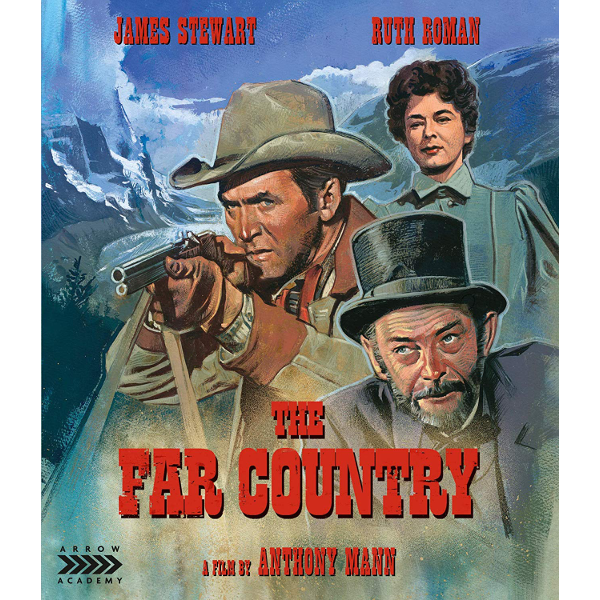

The director-star collaboration of Anthony Mann and James Stewart was one of the coziest and profitable pairings in Hollywood. Mann became an in-demand first rank director and Stewart extended his range as a bankable star, capable of launching projects ranging from goofy comedies to gritty westerns. On their first film Winchester ’73 Stewart also cut himself in on the profits, as stars and agents grew more powerful than studios. The duo jumped between Universal, MGM and Columbia. After Bend of the River they made The Naked Spur at MGM, an excellent revenge story that some feel is the highlight of the series. Back at Universal, their biggest hit came in the non-Western The Glenn Miller Story, a musical biography that gave new life to the genre, as in The Eddy Duchin Story and The Five Pennies.

The scholar Jim Kitses added greatly to western genre criticism when he compared and contrasted the films of Anthony Mann, Budd Boetticher and Sam Peckinpah in his book Horizons West. All three use ‘binary’ characters, with the key hero and villain sharing complementary qualities. Stewart’s first Mann protagonists were driven obsessives, good men under so much stress that they seemed to be suffering from a mental disorder. They resolved their psychological issues by neutralizing the villains, as if exorcising personal flaws. That seems deeply American in spirit: violence is a sure cure for what ails ya.
Writer Borden Chase was the primary man on all three of the Mann/Stewart westerns at Universal. Winchester ’73 is a tightly-written and tough-minded western version of La ronde, substituting a collector’s rifle for sex (and an STD). Their next picture Bend of the River simplifies a pioneers vs. profiteers story into a kindergarten civics lesson, and in The Naked Spur Stewart’s character emerges from a vengeful rage with wisdom and humility.
The Far Country is a little more chaotic in its presentation of a lawless and corrupt west overrun by violent opportunists. It has a wonderfully cynical villain in John McIntire’s corrupt villain, and a jaundiced view of free enterprise that seems too ‘subversive’ for James Stewart’s temperament — he and Anthony Mann had not long before made a film chastising ‘silly’ shrimp fisherman for opposing the first off-shore oil rigs. The Far Country insists that the selfish (and rather ruthless) Stewart character stop minding his own business and turn violent to rid the Yukon of crooked thieves. The show’s production values are rock solid. It delivers the impressive authentic location of Alberta, Canada, with real glaciers on view.

Due to the cutthroat nature of business in the wild west, cattleman Jeff Webster (James Stewart) has a maladusted sense of his place in society. He leaves Seattle for Alaska with a boatload of cattle, but under technical arrest for murder, for killing two quitters on the trail. In Skagway, his herd is confiscated by a Roy Bean-like hanging judge named Gannon (John McIntire), a racketeer who controls the gold rush town with an iron fist. When crooked saloon owner Rhonda Castle (Ruth Roman) hires Jeff and his sidekick Ben Tatum (Walter Brennan) as trail hands to trek to the just-begun mining hamlet of Dawson, Jeff takes the initiative to steal his own cattle back from Gannon at the same time. In Dawson, Jeff and Ben buy a claim and start pulling nuggets out of the river, only to land back in hot water when Gannon and his thugs move in, strong-arming the miners and stealing claims. Good citizens like the Hash House proprietress Hominy (Connie Gilchirst) are helpless. Steve’s other pal Rube Morris (Jay C. Flippen) goes back to drinking. Always keeping things legal, Gannon laughingly says he’ll hang Jeff the moment he steps back into U.S. territory. Jeff and Ben have plans to sneak out of Dawson with their gold, dodging both the needy locals and the corrupt Gannon’s gunmen. Can the terrorized townspeople convince Jeff to put the community’s needs before his own?
The Far Country has a perfectly matched hero and villain. In no way forming a binary character, Jeff Webster and Gannon have almost nothing in common except a desire to succeed. Jeff has already weathered a Red River – like cattle drive from Wyoming, killing a pair of his drovers for attempted mutiny. The proto-gangster Gannon takes advantage of the absence of appointed government to assume the role of crooked law boss. The film takes pains to assure us that he can function in Canadian territory only because distant Ottowa hasn’t had enough time to organize the Northwest Mounted police in the area.

Gannon’s status on U.S. soil seems to be as a renegade judge, exceeding his authority to loot and terrorize the locals. The movie’s message is that the West was (is?) wild from thieving corruption, plain and simple, and that such conditions are the norm! But don’t confuse this for a liberal or subversive statement. For its hero, The Far Country invents an independent businessman, one not limited by the law or unfair ‘regulation.’
Is Jeff Webster meant to represent honest big business having to get tough in the face of economic reality? When the law is corrupt and unfair, he goes around it. This paints a heroic picture of free enterprise doing what it has to do in adverse and unfair conditions. Jeff has already placed his business success over human life, and perhaps rightly so, but the screenplay always keeps his choices very cleanly delineated – if selling his cattle to the corrupt spoilers in Dawson will earn more money than selling to the ‘honest’ folk, then it’s the right thing to do. Webster plays with a set of dirty rules only because the corrupt system forces him to. I’m certain he would be a hero to modern corporate weasels.
Faced with an increasingly hostile and rigged system, Webster becomes cynical, willing to accept corruption if he can outwit it. Stealing his own cattle back is a pragmatic crime, and must have appealed to ’50s viewers resentful of the IRS. The genial and always technically legal Gannon is a wonderful character, probably John McIntire’s best this side of his sheriff in Psycho. Brimming with a pretense of official dignity, the top-hatted Gannon holds all the cards. He parades his corruption out in the open, laughing at the men he fleeces. He aquits Jeff for murder, but then confiscates a fortune in cattle for a piddling misdemeanor. His mocking grin invites his victims to protest so they can be shot down. Gannon’s a transparent, baldfaced crook, and as such he’s perversely likeable.

Ruth Roman’s gambling queen is another cynic with a grudge against people. Both she and Webster make a credo of not trusting anyone, especially where romance is concerned. Their dealings with one another carry a streak of dishonesty — she extorts his help with her grubstake, and he jeopardizes her caravan by bringing along his stolen herd of cattle. What makes her more like Gannon is that she also requires corruption to prosper.
Jeff Webster’s grudging, aggressive isolation from other people is not presented as a neurosis or obsession. There’s no particular treachery or betrayal outlined in his background, beyond the mention of a love affair gone bad. Webster is pigheaded over points of authority, and becomes unnecessarily ruthless in the trek to Dawson. He’s already broken his word to Ronda by dragging his cattle along, and now he allows the caravan to split up — him taking the long way, and Ronda the shortcut under dangerous cliffs. When Ronda overrides his decision, he neglects to tell her his reason for taking the long route, and because of his attitude, she doesn’t ask. He allows Ronda and her men to go in harm’s way simply out of spite: ‘If you don’t bow to my authority, I won’t be responsible for you.’

Webster is strongly attracted to Ronda, yet he’s callously indifferent about her fate after the avalanche. He doesn’t even want to go back to see what’s left of Ronda’s pack train. It’s an interesting moral situation, and a common one. Have you ever allowed a disliked co-worker to walk into trouble, purposely not offering a warning, and secretly hoping something bad happens to them?
The Far Country’s other relationships are much more conventional. Walter Brennan’s ditzy sidekick Ben provides Jeff Webster’s main dose of sentimentality, lighting his pipe, etc.. But Ben has weaknesses that Jeff doesn’t count on. Jay C. Flippen’s character, who goes on and off the bottle, is alogether too obvious and mechanical in conception. But there are other fun bits, like the New York-accented Connie Gilchrist, and the wonderful Kathleen Freeman with her broad smile. Just the same, the ‘good’ citizenry are treated as a lumpen bunch of hicks. Their social solidarity is completely undependable — they’re like the colorful-but-disposable ‘little people’ from Frank Capra’s ’30s pictures, the ones who have big hearts, but will also form a mob for a run on the bank. It’s more than a little insulting that they’re so helpless without the guidance of a charismatic leader Like Jeff.

(spoilers) This is still a ‘fifties movie written by the conservative Borden Chase, so some adjustment may be needed for the state of gender enlightenment on view. Third-billed Corinne Calvet is treated like a foolish child for most of the show — Jeff calls her “Hey, Freckle-Face!” She then becomes the woman Stewart jumps into a clinch with for the fade out, after Ruth Roman’s character suffers an acute attack of Bad Girl Dies To Save The Hero. In classic racist terms this sacrificing western woman is often Mexican; she’s killed off to avoid even hint of race-mixing. Ruth Roman is dark-haired in contrast to Calvet’s blonde locks, so sorry, she’s stamped with an expiration date despite her high billing. Roman played a similar character a year later in Jacques Tourneur’s Great Day in the Morning, and met the exact same fate — the ‘other’ frontier dame Virginia Mayo was a blonde, too.
The supporting villains are drawn from a standard deck of knaves. Among them is the toothily sinister Robert J. Wilke, of Night Passage. He had also just played James Mason’s loyal first officer in 20,000 Leagues Under the Sea. Jack Elam’s lazy eye made him an easily-recognized favorite bad guy; he’s Gannon’s number one deputy/enforcer. As Latigo, stuntman-turned actor Chuck Roberson wears a nasty makeup scar. Like all the actors typecast as villains, Roberson was shot down in feature after feature, most notably by Robert Mitchum in the superlative The Wonderful Country. But some bad guy actors get to switch sides. Gravel-voiced John Doucette plays a friendly miner, and Royal Dano is again under-utilized in a bit as a meek prospector.

Are the more sentimental touches in The Far Country Stewart’s doing, to safeguard his ‘family’ persona? One of the folksier gags is a little bell that hangs from the horn of Jeff Webster’s saddle. It sounds like something invented for a country western ballad. The little bell rings right at the end, for the fade out. One expects Corrine Calvet to twinkle her eyes and chirp,
“Every time a bell rings, somebody Jeff Webster has shot gets his wings.”
As their collaboration matured, Anthony Mann and James Stewart’s aims seemed to diverge. Mann wanted to do more serious pictures like his (unpopular) western greats Devil’s Doorway and The Furies, with its allusions to classical theater. Stewart wanted to soften the output and leaned more toward pro- military (Strategic Air Command) and pro- business (Thunder Bay) themes. Although they continued to work together, Mann and Stewart made their last western in 1955 for Columbia, The Man from Laramie. The CinemaScope reworking of King Lear was done more in Anthony Mann’s style — few endearing family touches, no musical instruments. They parted company while preparing Night Passage, which ended up an agreeably standard western with Stewart calling the shots. The cutesy song Stewart plays on his accordion lauds the railroad, the first corporate entity to become more powerful than the government.
Is The Far Country a great western? It certainly has a lofty pedigree, and James Stewart is always entertaining even in his weaker films. It does seem to gather up its share of clichés — Walter Brennan’s sidekick, the predictable women, etc — but Jeff Webster’s relationship with McIntire’s villain is fresh and amusing. If it misses the brass ring for me it’s because it doesn’t follow through on its somewhat radical notion of a hero who refuses to acknowledge kinship with ‘other people’ — the final confrontation is pure contrivance, with the villains suddenly no longer smart and the previously clueless locals suddenly launching a populist uprising. And Stewart ends up with a girl he’s been treating like a kid for ninety minutes?


