
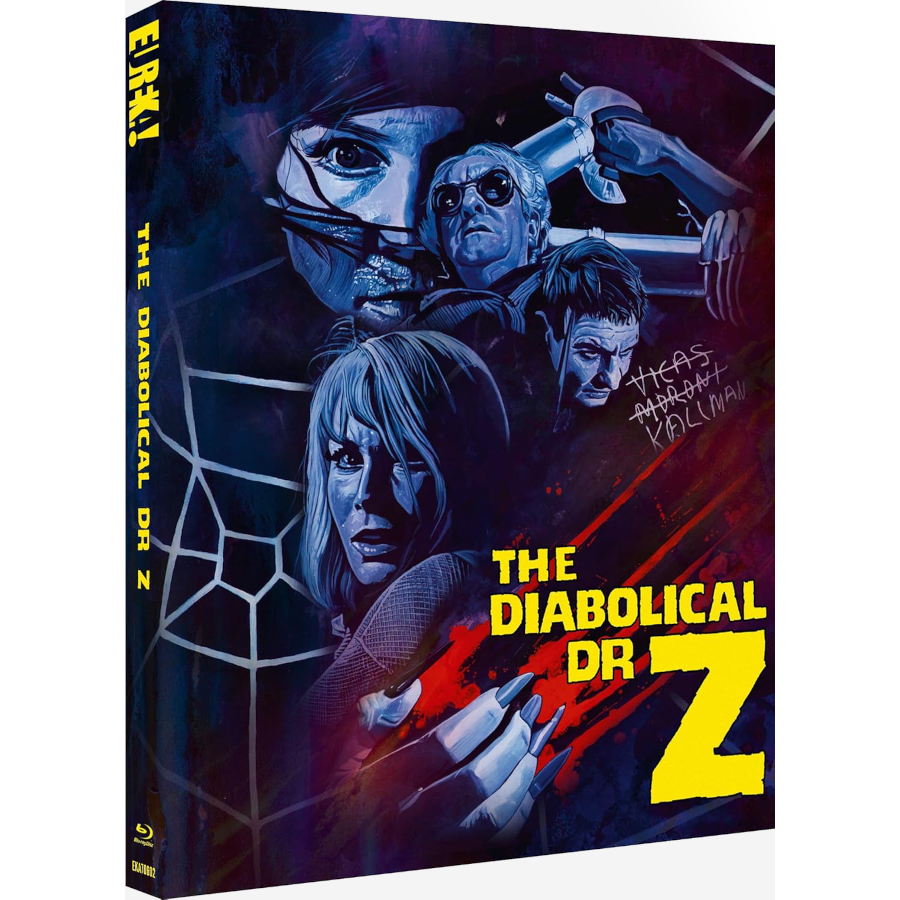

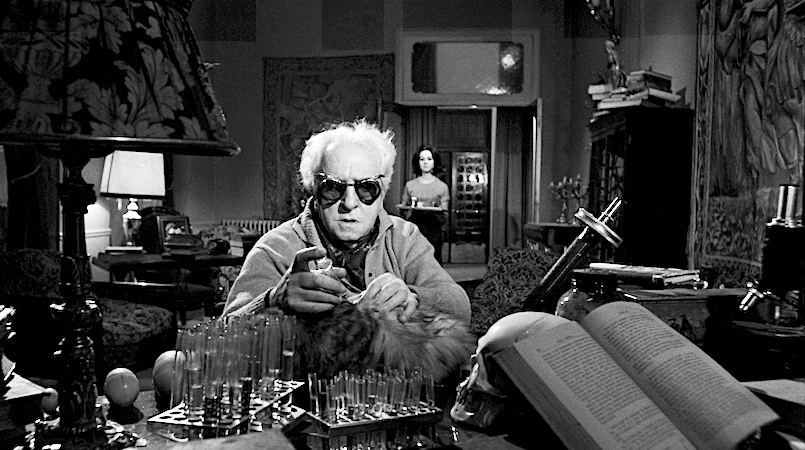
The elderly Dr. Zimmer (Antonio Escribano) has finally perfected a Z-Ray machine which allows him to isolate and control the areas of the brain which govern good and evil impulses. After successfully testing his creation on an escaped convict, Bergen (Guy Mairesse), he presents his findings to a gathering of his peers but his suggestion that experiments be carried out on humans is met by an eruption of aggressive opposition and he suffers a fatal seizure.
His daughter Irma (Mabel Karr) subsequently blames his three most vocal critics for his demise and vows revenge. After faking her own death and relocating to a country mansion, she uses Bergen to capture an attractive performance artist called Nadia (Estella Blain). After a session with the Z-Ray machine Nadia is completely under Irma’s control, joining Bergen as another deadly instrument for use in her plans for vengeance.
There’s a lot going on here in terms of both style and content but — as a whole — this film doesn’t hang together quite as well as Franco’s earlier showstopper, The Awful Dr. Orlof (1962). That exquisite period chiller was able to successfully generate and positively revel in its own skewed sense of the Gothic. By contrast, The Diabolical Dr. Z (which is set in the mid 1960s) fails to find a comparable or consistent tone of its own: it comes on like a cross between an edgy American B Movie from the 1950s and a stylish European Art Film from the 1960s with odd elements from then-contemporary British cult television shows thrown in for good measure.
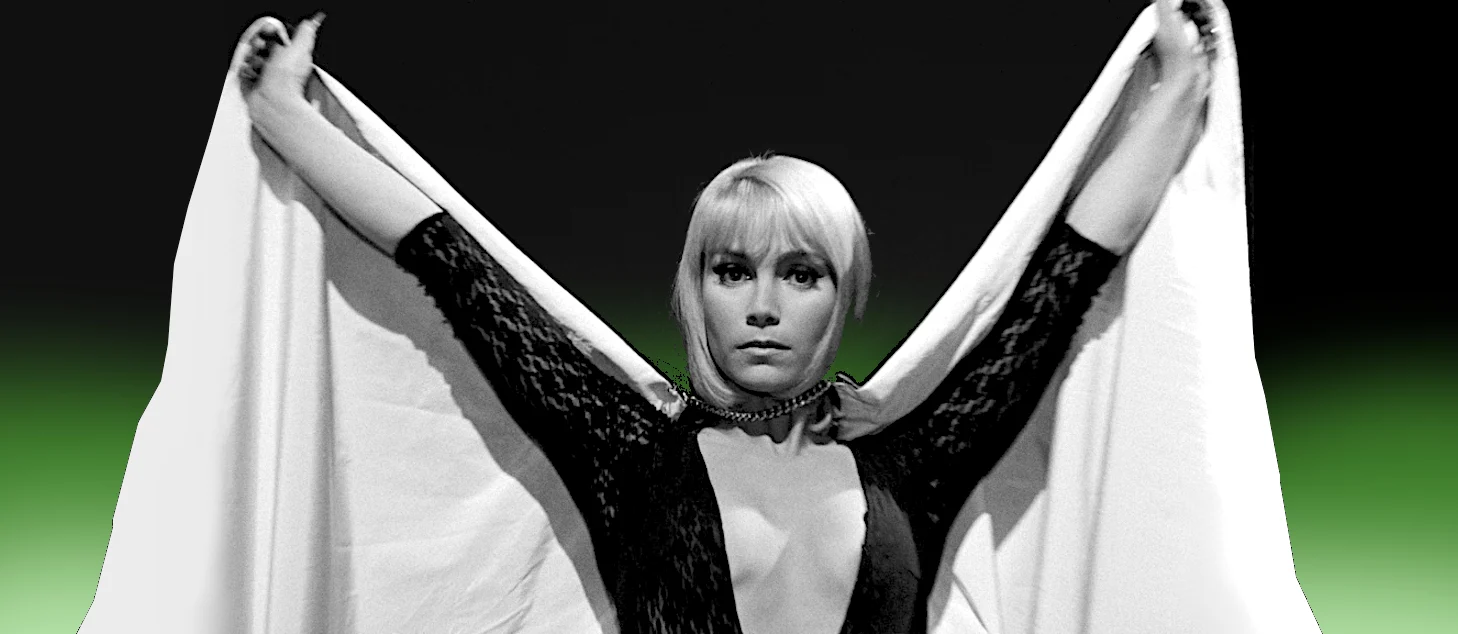
Dr. Z does remain a decent little genre film, though, and parts of it are executed quite brilliantly. A particularly well-lit and atmospheric journey on a late-night train leads Dr Vicas (Howard Vernon) to his doom. A sequence where the automaton-like Nadia slowly stalks a terrified Dr Moroni (Marcelo Arroita) through quiet back streets in the early hours of the morning — panicking him into straying into the wrong side of town — works really well too. Bergen’s jailbreak — while actually resembling something more suited to a World War II film or a spy caper — is also well handled while Nadia’s nightclub performance as Miss Muerte makes for an interesting diversion.

Most of the film’s action set pieces revolve around casual and disturbing but stylishly presented acts of violence that bring to mind contemporaneous British TV shows like The Avengers. In fact, this would have been a perfect case for Steed and Mrs Peel to investigate. Interestingly, some of Irma and company’s wily methods do at times resemble those of the eponymous doctor from Robert Fuest’s The Abominable Dr. Phibes (1971) so maybe Franco and The Avengers/Dr. Phibes designer/director Fuest unconsciously swapped some ideas over the years or shared an earlier pulpy influence?
By contrast, the sequence where Irma fakes her own death is the stuff of edgy and idiosyncratic American B movies: the woodland lake setting, some shocking automobile action and the soundtrack’s switch to strange and distant organ music makes the sequence play like a passing reference to Herk Harvey’s Carnival of Souls (1962). Curiously, the dreaded Z-Ray machine resembles something from the early days of Dr Who: it consists of a rudimentary control panel of flashing lights and an upright glass and steel operating table that has robotic arms which restrain the patient while rather nasty needles or bolts are fired into various parts of their anatomy.

The quality of Alejandro Ulloa’s black and white cinematography is excellent for the most part and the general look of the film is given a real boost by the presence of several architecturally impressive buildings. Franco always knew the value of a good “found location” and he makes really great use of the ones selected for Dr. Z. Added to these exteriors are some equally interesting interiors and Franco and Ulloa present both in stylish and wholly attention-grabbing ways.
The film’s quite excellent soundtrack score, which features all manner of jazzy phrases from the ultra-smooth and cool through to the wild and blowing and almost avant-garde — as well as some atmospheric harpsichord pieces — is also a major plus. A really quite transcendent sense of complete synergy between the visual action and the soundtrack is achieved for a dizzy moment during a sequence wherein Bergen aggressively chases a petrified Nadia around a deserted theatre.
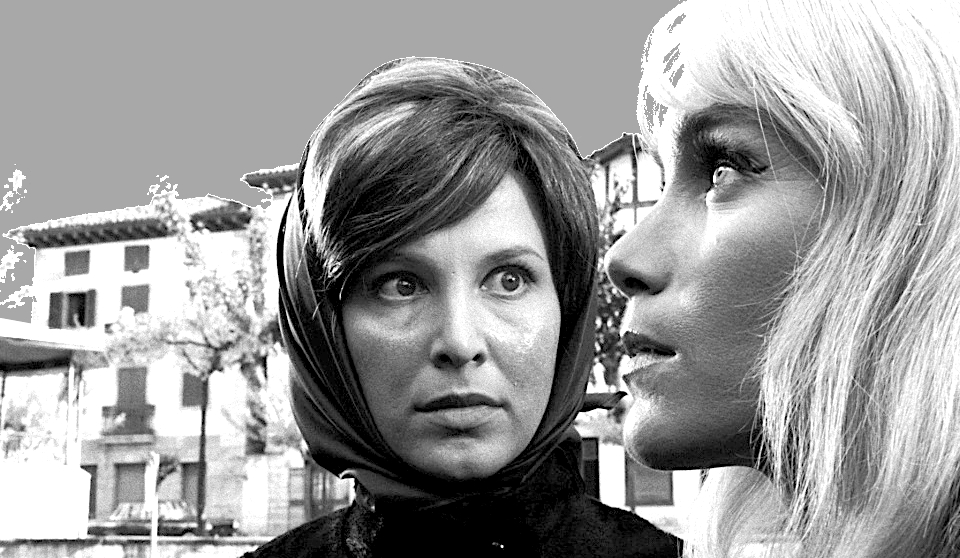
The acting on display here is pretty good for this type of show. Blonde Estella Blain’s icy attractiveness, and her detached yet predatory aura while under Irma’s influence, beg comparison to Marilyn Chambers’ turn as Rose in David Cronenberg’s Rabid (1977). Equally, Mabel Karr telegraphs Irma’s obsessive-if-misguided need for vengeance well enough. A functional hero of sorts is presented in Philippe (Fernando Montes). A former Medical School friend of Irma’s who also happens to be Nadia’s boyfriend, Philippe ably assists the two policemen who are investigating the case.
Franco gets to test his acting chops in this show and he acquits himself very well as Tanner, the local police inspector who is having difficulty fully concentrating on the case due to a lack of sleep that is blamed on his wife having recently given birth to triplets. Tanner has a visiting English counterpart in tow, Inspector Green, who is acting as an observer. The English officer is a fun caricature brought to life by Daniel White who was also responsible for the film’s soundtrack score. All in all, The Diabolical Dr. Z remains a solid little genre film that will interest those with a taste for Franco’s oeuvre and European horror films more generally.
Glenn – your advice “life is too short to watch any more Jess Franco movies” has been life-changing. Every time I’m tempted it always keeps me on the straight and narrow.