


The UCLA Film School of 1970 had this beautiful new screening hall with about 300 seats called Melnitz 1409. Within weeks of starting as a Freshman, I was taking two screening classes and spending too much of my time crashing others, to the see the magic that was being thrown up on the enormous Melnitz screen. One screening class was given by professor Louis Clyde Stoumen and the rest were taken by associate professors David Bradley, who had an enormous film collection, and Robert Epstein, who was in charge of the fledgling UCLA Film Archive and seemed to know more about movies than anybody. Epstein is responsible for the 35mm restoration of It’s a Wonderful Life, a real rescue job. That project kicked off the major rediscovery for what was then a ‘forgotten’ holiday film.
Epstein showed us ‘special’ pictures every semester. One of the best was a surprise, an excellent print of the silent horror film The Cat and the Canary by Paul Leni. There was of course no home video at this time. One would have to be part of a film society or near a museum to see this 1927 picture, then just 44 years old. We lucky UCLA students got the benefit of an excellent presentation accompanied by organist Chauncey Haines on the theater’s powerful keyboard. I suppose that moviegoers at Hollywood’s El Capitan can still get the benefit of a socko organ accompaniment — Chauncey Haines’ music raised the roof.

All that is to say that the special vibe of a proper silent movie screening — big screen, live music and a big audience — is something that needs to be experienced at least once. Perhaps the place to start is a comedy by Buster Keaton or Harold Lloyd, but the entertaining The Cat and the Canary is a great choice too.
Hollywood made a big deal of the boatloads of European talent it imported in the 1920s; and audiences appreciated the stylishness that could be seen when émigrè artisans from UfA slipped ‘German Expressionist’ gimmicks into American movies. The German director Paul Leni was imported by Carl Laemmle on the basis of his remarkable Waxworks, a fantasy that leavened its creepy visuals with a sense of humor. His The Cat and the Canary is an adept, entertaining horror comedy that surely influenced the horror classics of the early ’30s. Its clever, playful direction shows how flexible the silent screen could be, before the talkies gave the upper hand to stage directors and dialogue writers.

Not another story about the Reading of a Will . . .
The source work is a stage play, but the ever-inventive Paul Leni adds scores of visuals that would never work on a stage, along with a weird prologue. Twenty years after the death of old Cyrus West, his relatives gather at his castle-like house for the reading of his will.They are greeted by the stony-faced caretaker Mammy Pleasant (Martha Mattox). Attorney Roger Crosby reads the will: young Annabelle West (Laura La Plante) will inherit West’s entire fortune, including the big house and some priceless diamonds, provided that she is adjudged to be of sound mind. Amid the general jealousy, Crosby disappears and Annabelle finds her way to the missing diamonds. A guard from a nearby asylum searches for an escaped loony. A creepy creature appears to be prowling through secret passages, threatening the heirs one by one. While Annabelle sleeps, a ragged claw reaches right over her head, to snatch the diamonds from her neck!
This semi-comedy creates an uneasy feeling from the beginning. Artful visual effects induce a creepy mood. A hand pushes cobwebs aside to reveal the main titles, and eerie hand-lettered (and sometimes animated) intertitles introduce the mansion of a madman. The castle towers dissolve to reveal a wheelchair-bound Cyrus West surrounded by giant medicine bottles. The bottles are flanked by vicious black cats that represent the greedy relatives, waiting impatiently for Cyrus West to die.

Carl Laemmle’s Universal studios filmed Lon Chaney’s horror classics The Hunchback of Notre Dame and The Phantom of the Opera, but found that adaptations of stage plays were even more profitable. Upscale characters gathered in a weird house on some pretext are beset by supernatural phenomena that might be ghosts or curses, or a monster-maniac on the loose. The source of the anxiety invariably boild down to a scam to inherit money or get someone committed to the nuthouse. The supernatural content is almost always explained away as phony, even if the explanation can’t account for everything we see.
The European influence was heavy in these Hollywood pictures. Danish director Benjamin Christensen had shocked audiences with a weird semi-documentary about witchcraft and psychology; when MGM imported him, he found himself making ‘old dark house’ movies. In Christensen’s evocatively titled Seven Footprints to Satan, a bizarre underworld of mystery and fantastic settings, that turns out to be an elaborate charade to give the jaded hero a ‘new thrill.’ Lon Chaney’s lost London After Midnight was another faux-supernatural horror story, that turns out to be a Sting operation run by con men.

We’d like a few scares, but nothing too horrible, thank you.
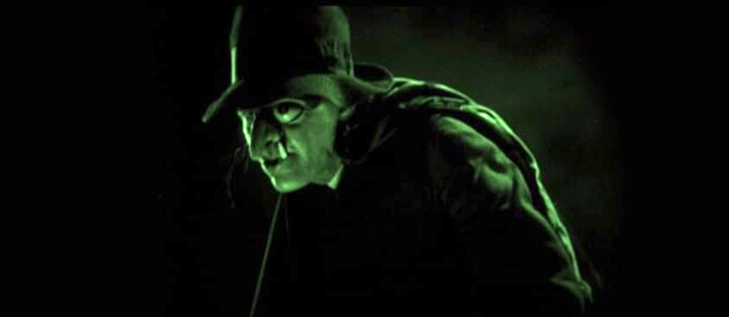
The Cat and the Canary charms us even as we recognize that its thrills are all synthetic — as a horror movie, Cat has its cake and eats it too. A half-dozen nervous heirs fret and worry while people disappear and an asylum guard searches for a dangerous lunatic. As the first thing we see is someone opening the safe and tampering with Cyrus’ Last Will and Testament, we are fully aware that some villain is pulling a hoax. A fanged monster with one bulging eye hides behind hidden panels, reaching with a hairy taloned claw. The players are amusing caricatures. There’s a deserving heroine and some undeserving relatives, but no obvious hero to step forward and be gallant. The male lead Creighton Hale is a stuttering milquetoast, but he finds his courage while defending the girl he admires. The comedy lines are of course restricted to text inter-titles: “Paul! I haven’t seen you since Nurse dropped you on your head as a child!” The silly jokes are more than balanced by an uncanny atmosphere that rivals that of many 1930s classics.

The creative powerhouse Paul Leni began in the German theater and had a long career as an art director. His expressionist storytelling style makes excellent use of the kind of ‘shorthand’ visual gimmicks we associate with silent films by Alfred Hitchcock and Anthony Asquith. When the camera isn’t finding an odd angle, it assumes a subjective role, prowling through sets while representing our point of view. A portrait falling from its place on the wall is filmed in a series of jerking cuts. Leni sees to it that the camera POV of the group watching jerk forward as well.
This visual shorthand is almost as graphic as a comic strip. When Creighton Hale jumps in fright, Leni superimposes a skull over the frame. He does the same with the workings of a clock — ‘visual’ sound effects for a silent movie. Dramatic compositions isolate faces — until the very end, several cast members are active suspects for the murder. Inserts and cutaways concentrate on props and details, especially those secret compartments with sliding doors. Floor-level shots of feet walking remind us of latter-day giallos by stylists like Dario Argento. One sequence in Gertrude Astor’s bedroom is seen from Creighton Hale’s POV, as he hides under a bed watching her undress.
Leni’s direction provides visual jolts for the big scares. WHen the camera leaps sharply at an actressm the cut will be immediately followed by a jolting move on a title card – “HELP!” It’s all very effective. The film’s most iconic shot is a push-in and focus-pull on the grotesque face of the mystery murderer.
Dreamy trucking shots move down a corridor lined with tall gauzy curtains. They billow in slow motion, making the mansion seem like a waiting room for the hereafter. Similarly effective visuals can be seen in everything from Lewis Allen’s The Uninvited to Jean Cocteau’s Beauty and the Beast. Right here in Cat and the Canary is the oneiric source for 1001 corridor-wandering Euro-horrors. Just add a terrorized Barbara Steele or Dahlia Lavi holding a candelabra, and you’re there.

With her stern pulled-back hair, the hatchet-faced housekeeper Mammy Pleasant does her best to make the houseguests nervous. Even the inter-titles get in on the act. Text letters nervously spell out one by one, or drift away in hazy clouds of fog. When an old biddy Flora Finch swears at our clumsy hero, the intertitle is a clot of overlapping symbols: (&,#,%,@) That place-holding usage must have been a substitute for profanity long before 1927 — maybe when typewriters were invented?
Paul Leni’s show has just enough scary stuff to transcend the silly mystery house subgenre. Audiences reportedly jumped at every appearance of a hand creeping around a corner, or nearing the pale neck of our innocent heroine. It is a truly ‘educated’ claw, its fingers flexing with anticipation. We can appreciate the thrills even when they no longer seem shocking. The creativity is nothing to sniff at – a great many cinephiles think this was the greatest era in movie art.
The horror comedy subgenre lasted well into the sound era. The Bat Whispers added a dimension of gangsterism (and 65mm ‘Grandeur’ as well). London After Midnight was remade as Mark of the Vampire, cheating its own premise: we witness all manner of fantastic, impossible horror phenomena, that the film’s make-believe ending fails to explain. The Cat and the Canary was itself remade several times. The Cat Creeps just three years later added sound. A very popular 1939 version with Bob Hope reignited a series of spook-house comedies — starting with a spook thriller for the comedians Abbott and Costello.


I have heard some speculation that because this restoration is from nitrate prints (as opposed to Eureka’s disc, which is sourced from the negative), this is actually a “different” version of the film because of the 1920s practice of putting together prints from alternate, “second best” shots as opposed to the negative which contained the preferred master shots. Any idea if this is correct or not?
I would ask Kino or someone with that knowledge to weigh in — it’s above my knowledge level. Anthony Slide, maybe? Thanks, Scott.
I would be curious to have someone compare this version to Eureka’s, which I have.
Just a brief comment about the joys of silent movies with live accompaniment. I’ve had the thrill of seeing the Phantom of the Opera with a live organ score by the late, great Dave Knutson, at the Fargo Theater many years ago. Nothing compares to that wonderful performance. Yes, everyone must experience this at some point in their life.
Thanks for the nice review of the music, Glenn. Just for info it IS a real theremin, played by the much-missed Celia Sheen, who played theremin on many film and TV soundtracks (Do you get Midsommer Murders over there?) and died much too young. This score is dedicated to her.
So it is a Theremin … thank you Mr. Brand … !