
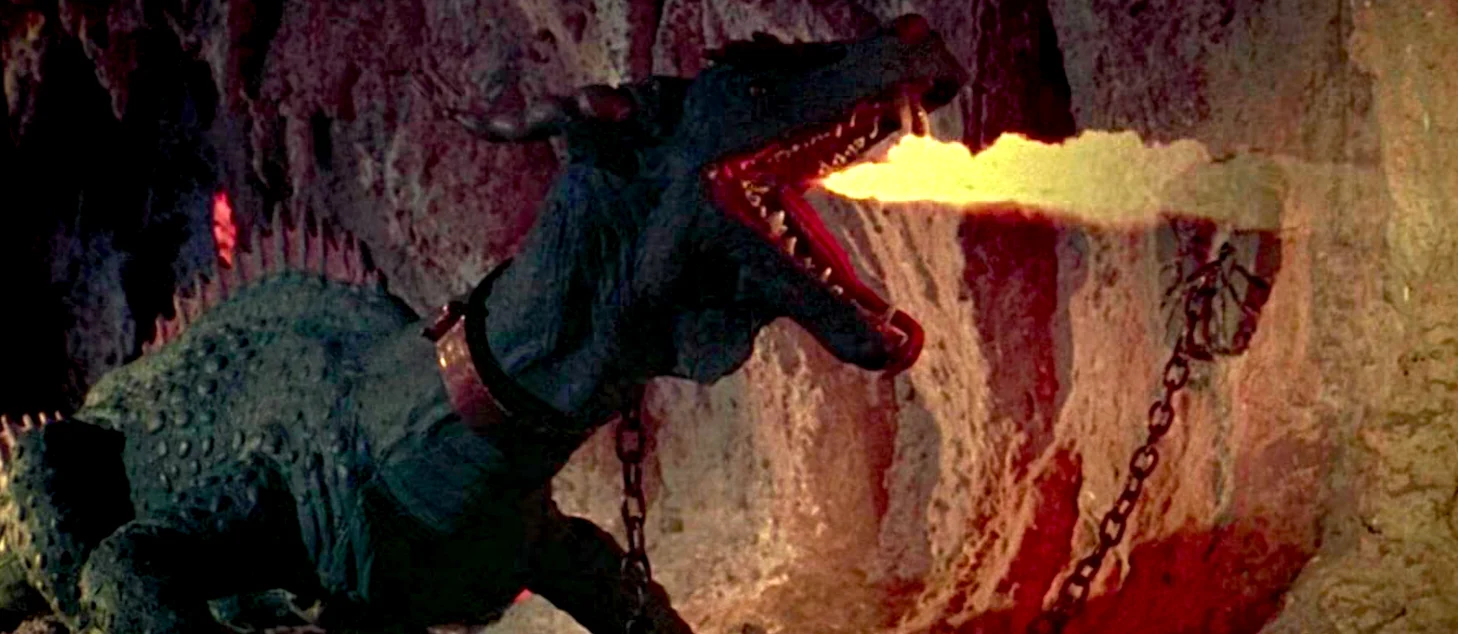


Sony gives us a summer surprise with a 4K of one of the best-known, most admired screen fantasies ever made, The 7th Voyage of Sinbad. No one needs us to go over the film’s legacy in detail; my generation was the one to go gaga over Ray Harryhausen as tots, and we grew up anticipating his every new movie. Ray sat a strange throne, being the top artist in an art form largely unacknowledged. I can imagine him avoiding discussing his work at a dinner table … who knows who would cut him off with a, “How nice, you make puppets” and change the subject.
Ray’s ‘Dynamation’ features were a high point of special effects artcraft, but none were nominated for an Oscar. All turned out fine though, as Ray got to take not one but several career-end ‘victory laps,’ what with special industry honors and tributes. That’s not counting the accolades from his stop-motion disciples, those that followed him into the Lost Art of 3-dimensional animation.
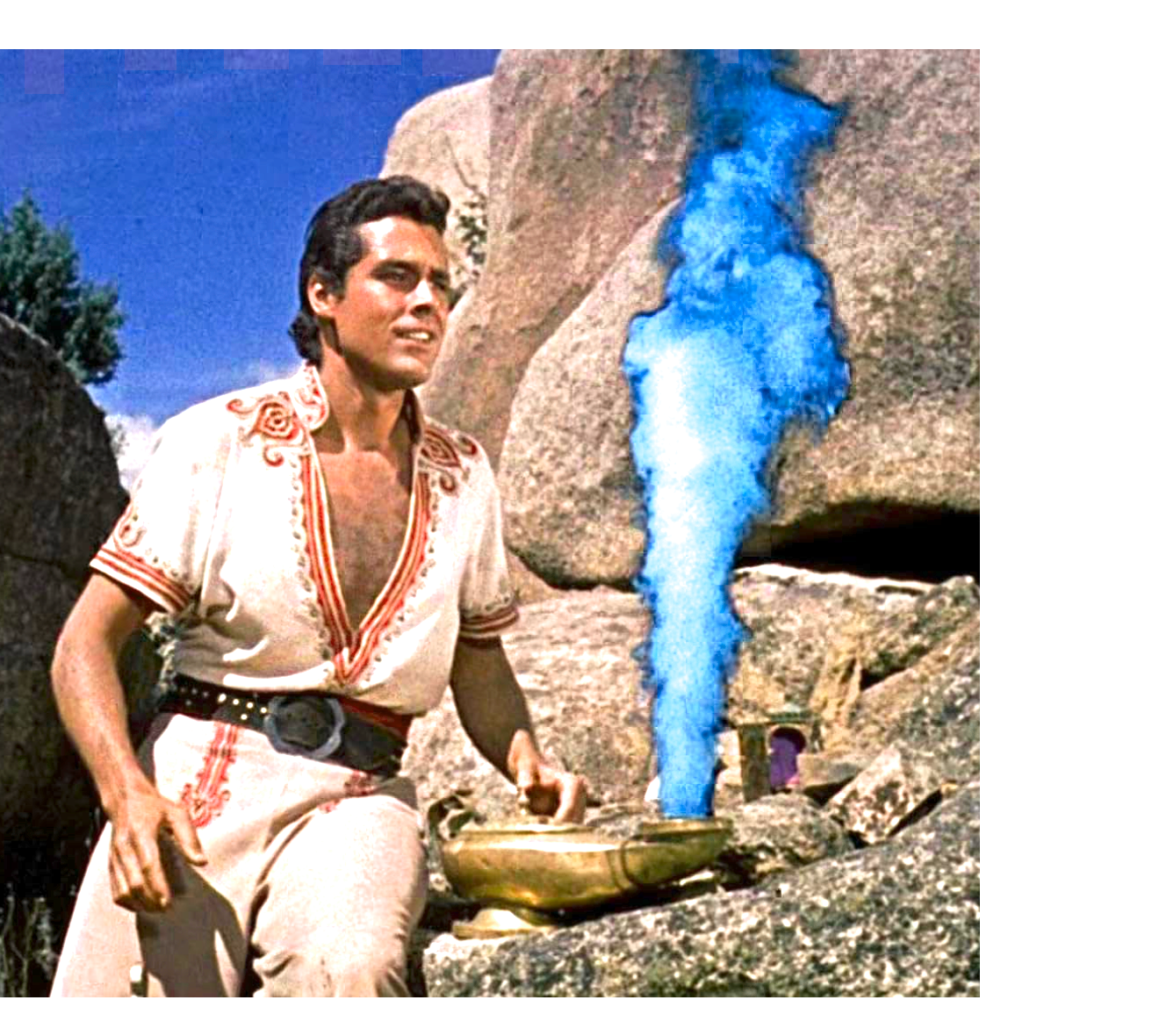
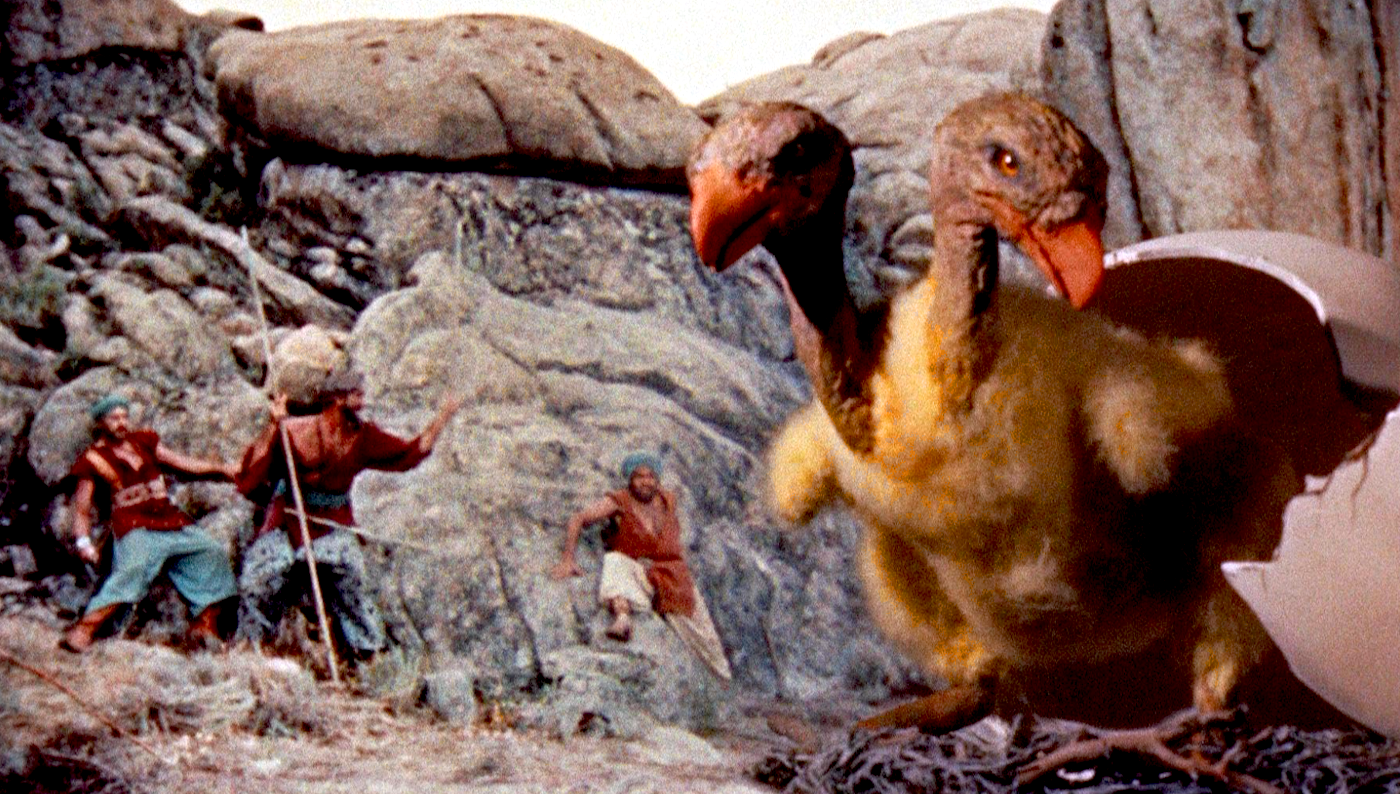
It’s about time that 7th Voyage made the leap to 4K. A number of years back Sony/Columbia doubled down on their effort to improve the film’s video masters, a process made difficult by the lack of surviving printing elements in good shape. They were finally able to restore the color of the Baby Roc on top of Mt. Colossa to the yellowish hue of a newly-hatched chick … but they had to let the sky go a little weird to get it. We spent some time checking out the new transfer, and are very pleased with the results. But see below — the included Blu-ray copy will not please buyers.
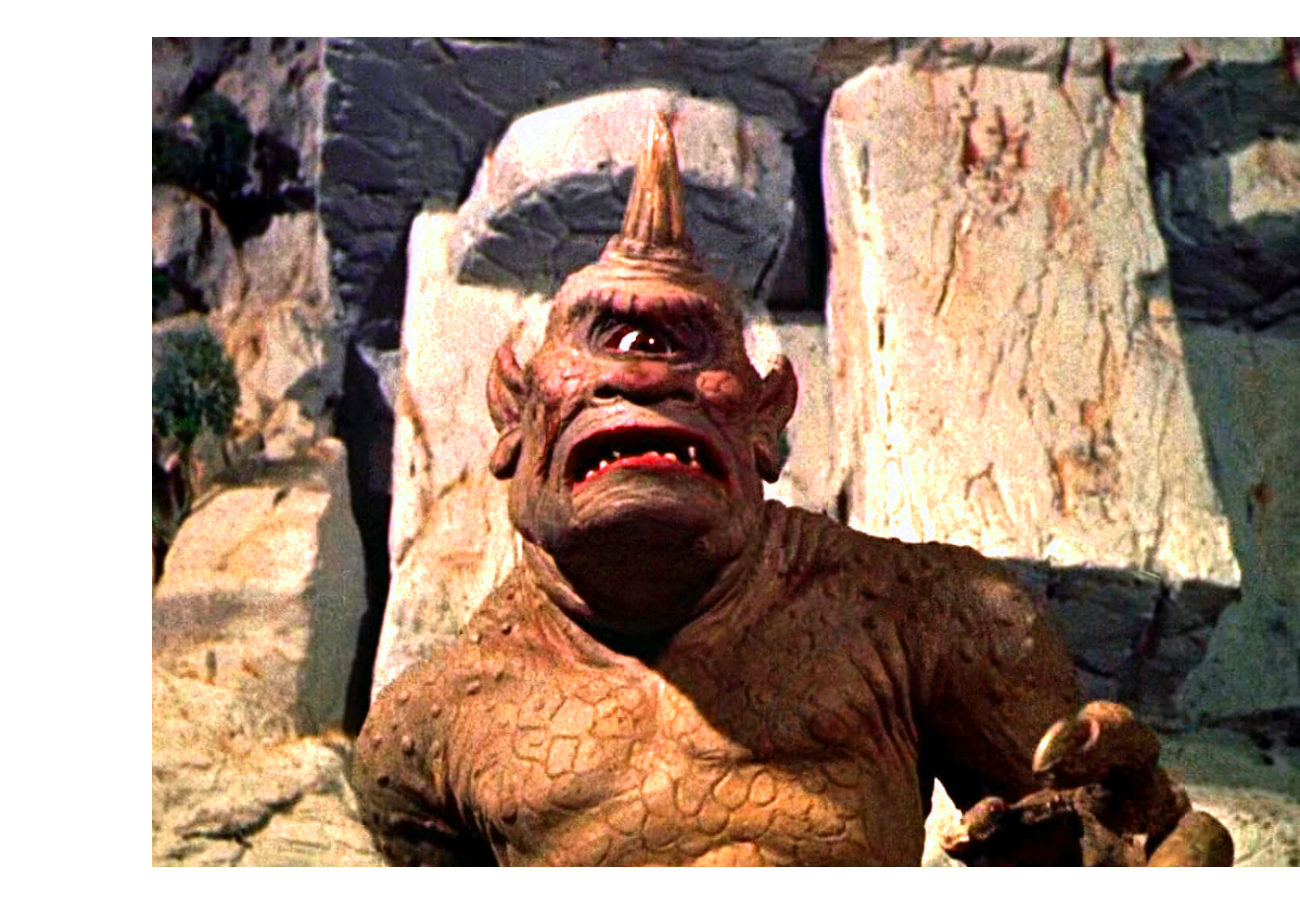
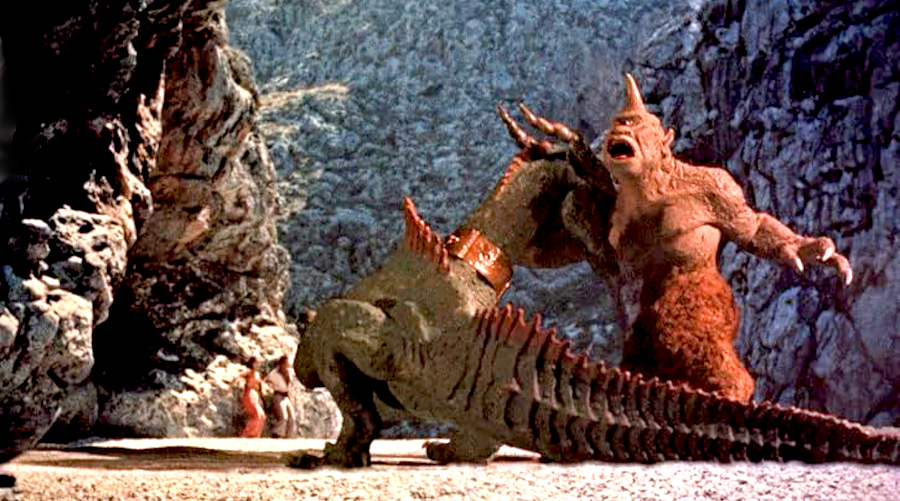
Every fantasy film fan remembers their first encounter with Ray Harryhausen. My first personal exposure to his magic was The Three Worlds of Gulliver. In my town the next year’s Mysterious Island showed on a double bill with a three-year old title unknown to us 9 year-olds. The 7th Voyage of Sinbad took our heads off. It was big, loud and violent. I literally ducked when the big orange Cyclops stomped out of its cave. It was bigger than life, ferocious, and just plain scary. What the heck was it? It for sure wasn’t a man in a suit. Like thousands of other ten-year olds, I immediately rushed home and started drawing pictures of it.
We soon realized that Gulliver, Mysterious Island and 7th Voyage were made by the same man. When a third-grade teacher projected the stop-motion fairy tale Hansel and Gretel in the classroom, we recognized a master at work. Famous Monsters of Filmland magazine then became our conduit to the world of Ray Harryhausen. We learned that he began making his own movies when just a teenager.
Ray’s earlier Science Fiction films were popular, yet limited in terms of box office potential. By the time of his third Columbia effort 20 Million Miles to Earth, Ray had perfected his effects process for B&W. His producing partner Charles H. Schneer knew that the next step had to be to film in color, to break free of the ghetto of Sam Katzman program filler. The 7th Voyage of Sinbad was to be that make-or-break picture.
Schneer’s support made all the difference, especially when one contemplates the career frustrations suffered by Ray’s mentor, Willis O’Brien. Schneer lobbied both for color and for exotic foreign locations. He relocated their company to England partly to escape Hollywood Guilds that disapproved of one film artist serving as his own lighting director and cameraman. The screenplays were not always inspired, but the ‘Morningside’ team enjoyed an intensely productive decades-long relationship.
Harryhausen’s real love was storybook fantasy. 7th Voyage shows his admiration for the earlier Korda production The Thief of Bagdad, still an unsurpassed high point of the Arabian Nights subgenre. 7th Voyage has its own distinct personality, compensating with excitement and intensity for what it lacks in storybook poetry. The island of Colossa teems with bizarre monstrosities that jolt and dazzle the audience; the thrilling capper is an ‘impossible’ fencing match between a man and a living skeleton.
Nathan Juran’s low-budget direction is efficient and energetic. His visual flair was evident even in his ‘Nathan Hertz’ assignment Attack of the 50 Foot Woman. The episodic ‘every-ten-minutes-a-monster’ formula is strengthened by a solid plot hook, Sinbad’s quest to restore the shrunken Princess Parisa to her full height. Bernard Herrmann’s A-Class music score adds the magic of classic fantasy. Some of the composer’s best scoring work is here. An action cue to accompany the Cyclops’ pursuit of Sinbad’s drunken sailors builds with bells and drums to a pounding finish.
We kids weren’t ready for monster effects as vivid as these … at our age, we didn’t yet know exactly what a movie effect was. The constant violence made a big impression as well. Luckless sailors are roasted, impaled, knocked from craggy cliffs and gleefully crushed under tree trunks. The blinding of a Cyclops is particularly traumatic, as is the slaughter of the cute Kingsize-Canary Roc chick. In our theater seats in 1961, we remained in jittery anticipation of more monster mayhem. There was no telling when Sokurah might run into another gruesome Cyclops.

“Attack of the 15-Centimeter Woman?”
Director Nathan Juran exploited attractive Spanish locations to lend 7th Voyage a ‘Big’ look, despite his relatively small budget. We are told that some beach scenes were filmed with just a few crew members, under the gaze of gawking onlookers. Kerwin Matthews carries his role well, showing a real flair for heroic pantomime play opposite non-existent monsters. Nobody made fun of the evil magician Sokurah, with the growling voice. The always-impressive Torin Thatcher anchors the menace on a human level. It’s likely his best-remembered performance. I’m told that he shaved his head a few days into the production, but that his first scenes in Baghdad used a partial skull cap makeup — which we can see.
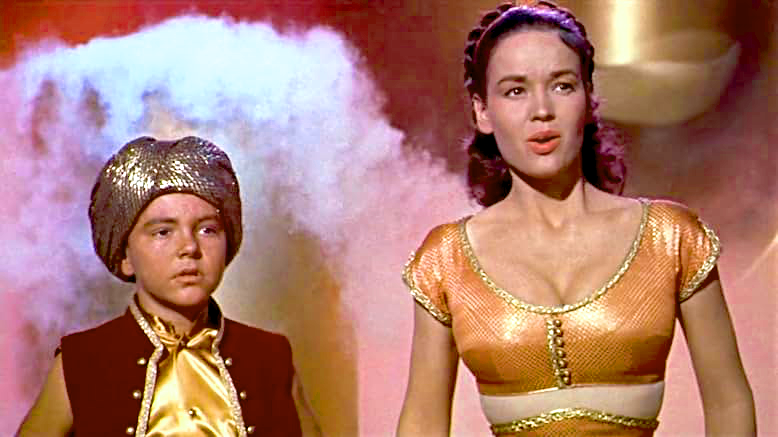
The pregnant Kathryn Grant has considerable appeal as the Princess Parisa, made teeny tiny through black magic. Grant has both charm and spunk, and projects a glamour that makes Matthews seem more handsome and heroic. Richard Eyer is fine as the somewhat dour genie, a difficult role for any child actor. It’s good that a scene was scripted to get Parisa and the Genie together inside the magic lamp. It gives Eyer more to do than obey instructions and spew a lot of green smoke.
It’s not fair to compare this film’s genie with the ‘1001 Knights’ perfection of Rex Ingram in Thief of Bagdad. Richard Eyer’s unhappy boy in a bottle has a nostalgic 1950s vibe. He reminds us a bit of TV’s Beaver Cleaver, when he’s been sent to his room as punishment. Did Eyer’s adolescent genie serve as an identification figure for little kids? I was a little kid, and the only thing on my mind was that scary Cyclops.
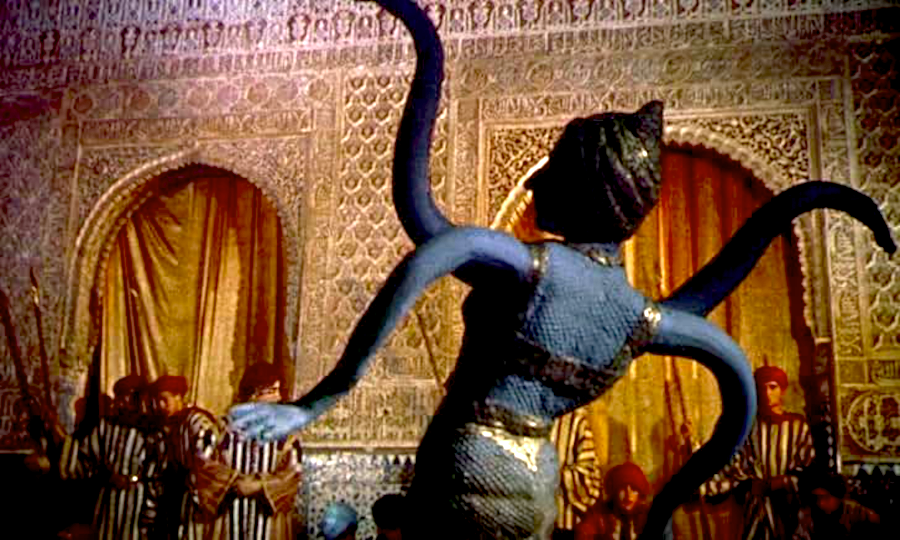
Harryhausen and Schneer couldn’t avoid a certain amount of Sam Katzman corner-cutting. Some viewers blanche at the stock shots used for Sinbad’s ship, which seems to be a different vessel every time we see it. The last shot looks exactly like a garden-variety Spanish galleon. But the picture is full of images that convey more than meets the eye. Enhanced by Bernard Herrmann’s foreboding music, the first view of Colossa’s central valley evokes the idea of a magic place with a monster behind every rock. Randall William Cook has been where most of 7th Voyage was filmed. Big parts of the Baghdad sequence were shot right in the gardens of The Alhambra, a ‘coup-de-access’ for producer Schneer. The amazing carved walls behind Sadi’s ‘snake dance’ are the real deal, a wonder of the world.
Nathan Juran’s assured blocking of scenes holds our attention at all times, and the direct sincerity of the performers overcomes a soundtrack in which a great many dialogue scenes are post-dubbed. The voices have that always on-mike radio show quality. A Spanish teacher I dated in college had her own reason for thinking 7th Voyage special: the dialogue is so clear, it would be an excellent teaching tool for English-language students.
“That’s Right!”
Seeing a movie 50 times of course changes the experience. We now recognize some of the supporting actors in other roles, although Alec Mango and Danny Green are well-known to fans of Brit fare. The guy to look out for is the un-credited Juan Olaguivel, who plays Golar, Sinbad’s most simple-minded crewman. Golar has the script’s most natural dialogue, although he’s probably dubbed by somebody in London. His scruffy face is featured in other movies we’ve seen, most notably a pair of 65mm Road Show epics. He’s highly visible as part of the caravan of followers of gladiator-general Kirk Douglas in Spartacus. If you want more obscure Sinbad trivia, track down Jack Cardiff’s 65mm faux-Cinerama thriller Holiday in Spain. Ol’ Juan gets his own scene, almost. If I made a film in Spain, I’d put Juan in it, just to hear him say “That’s right!”
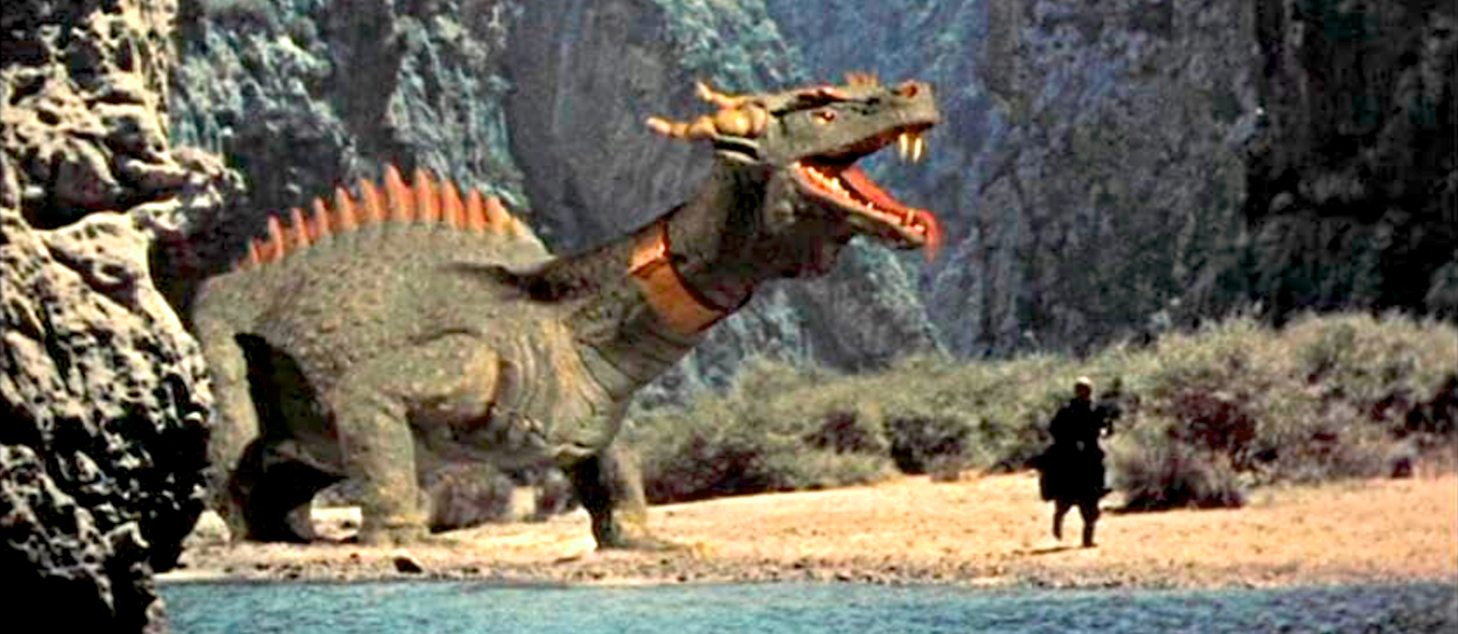
Ray Bradbury wrote a short story or two describing his friend Ray’s artistry, but I never thought his flowery praise connected with the exact appeal of Harryhausen’s craft. Something clicked in his stop-motion animation work that bridges the gap between ‘trick-film’ amusement and a true art form — one that Ray perfected practically on his own. It’s a case of Accept No Substitutes. The Cyclops and dragon simply look colossal, never like puppets that can fit on a bookshelf. Unlike the mechanical plodding of The Beast of Hollow Mountain or the crude monsters in Jack the Giant Killer, Harryhausen’s critters exhibit a sense of heft and balance. Gravity dictates their stance and movement. Harryhausen’s best fairy tale films are already advanced beyond the tabletop clay-animation look that betrays many stop-motion efforts. The pantomime of Mighty Joe Young and The Beast from 20,000 Fathoms is so sophisticated, one must conclude that mentor O’Brien’s lessons went right to student Harryhausen’s heart and soul.
It’s always a toss-up as to which Harryhausen film is his best … the consensus usually splits the prize between Sinbad and Jason and the Argonauts. Until Columbia/Sony remasters that show, this fantasy from the Land Beyond Beyond is going to be his best-looking home video experience.
Here’s Brian Trenchard-Smith on the Harryhausen classic:
Outlier I may be, but First Men in the Moon is my personal favourite Harryhausen flick; lovely cast, a fine script and oodles of charm. Plus it genuinely disturbed me as a kud. I’d love to see that wonderful film in 4K someday…
It’s beautiful, and for me a most-repeated Harryhausen… even with the non-Herrmann music. smart script twist! thanks Ian.
A personal reminiscence: Kathryn and her associate, the great Tom Madden, former executive at both NBC and ABC television, were in Toronto on business. My wife and I joined them for lunch on Sunday afternoon in the early eighties, and something got stuck in my throat. Kathryn, a former nurse, saved my life—a wonderful woman.
Wow, that’s impressive … thank you.
If I purchased the 4k, I wouldn’t be the least bit interested in the blu ray copy of the film.
Some buyers want the 4K for the future but want the better transfer now … so we lookout for them as best we can.