


MGM / United Artists began doing some good things around 1994. They helped reboot of the 007 franchise with Pierce Brosnan, and they distributed a number of smart movie projects that either paid off well or earned industry respect: Get Shorty, Richard III, Leaving Las Vegas, Rob Roy, The Birdcage. But other ambitious movie deals didn’t have happy endings.
From 1995, Rachel Talalay’s Tank Girl is one of those projects that sounded good in a pitch meeting. It’s from a British comic book inflected with a punk sensibility, a graphic commitment to irreverence, crude sex, and violence. Tank Girl is Rebecca Buck, a survivor of an apocalypse who roams the wasteland in a tank, ‘doing her thing.’ She’s a renegade agent dispatched on missions by a vague authority that also considers her an outlaw. Her main boyfriend is Booga, a mutant kangaroo; her allies have names like Sub Girl and Jet Girl. The comic stresses graphic excess, not structured narratives.

The ambitious director Rachel Talalay interested Pen Densham of Trilogy Entertainment Group in the project, which they eventually co-produced with United Artists. Perhaps Talalay convinced her backers that Tank Girl would open up a new vein of success, tapping the Riot grrrl art/music/lifestyle movement.
Tank Girl trumpets female empowerment, yet was created by two male comic artists. That doesn’t sound compatible with the aggressive feminist drive of Riot grrrl. Nor does a multi-million dollar movie that investors surely hope will become the next Star Wars. You know, like The Ice Pirates and Solarbabies.

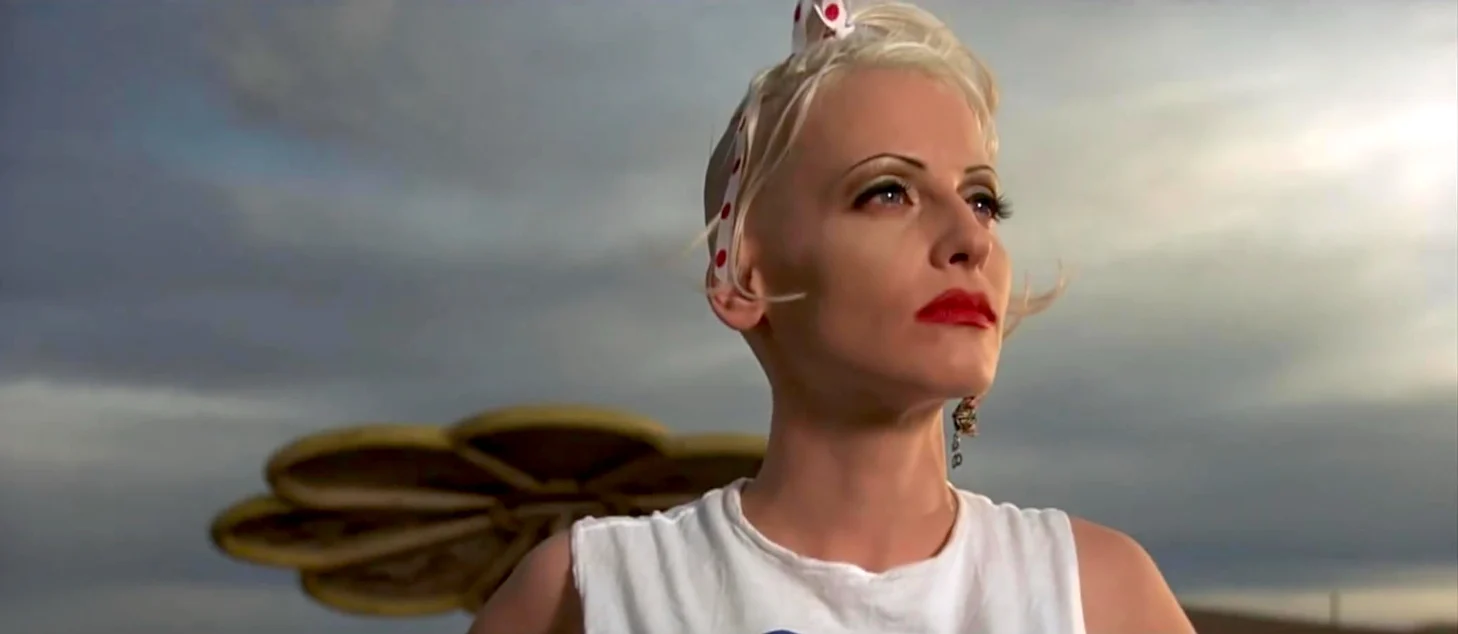
Actress Lori Petty (A League of their Own) must have seen Tank Girl as a breakout opportunity. She’s got energy to spare and the sassy attitude that defines the character. The end product is a bit like Robert Altman’s Popeye … the key characterization hits the right note of vulgar irreverence. But why put Tank Girl in such a conventional, by-the-numbers Sci-fi action fantasy?
Talalay’s movie retains the original’s graphic-novel anarchy and hip-cynical dialogues. But it drops her into a standard resist-the-evil-empire storyline. The year is 2033. A comet has destroyed civilization, and the few nomadic survivors are dominated by The Water & Power Company, run by an evil mastermind, Kesslee (Malcolm McDowell).

Kesslee’s W&P troops are fighting a losing battle against ‘Rippers,’ savage bandit monsters that keep destroying the company’s outposts. Captured by Kesslee’s men and put to hard labor, Tank Girl conspires to escape with Jet Girl (Naomi Watts), a mousey mechanic who also wants her freedom. But Kesslee instead dispatches Tank Girl to infiltrate the secretive Rippers, so he can destroy them from within. To their surprise, Rebecca and Jet Girl discover that the Rippers are mutated kangaroos with their own rebel spirit and counterculture attitude. They’re murderous phantoms — but also quite congenial.
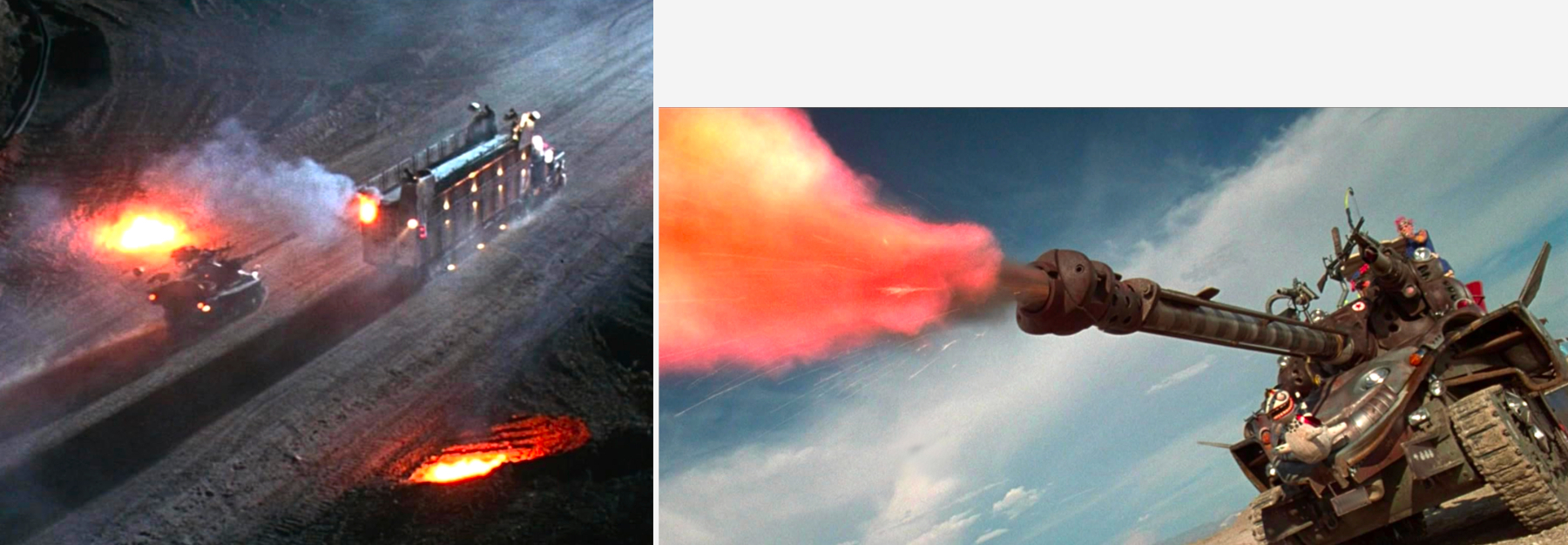
The movie version of Tank Girl is lumbered with woefully unoriginal story elements. Rebecca’s introduction is swiped from the opening of Butch Cassidy, the Sundance Kid gag of a rape scene that’s really consensual foreplay, only this time it’s the hunky boyfriend who must strip. The Evil Empire conflict is a non-starter. McDowell’s villain Kesslee demonstrates his ruthlessness by executing his own generals, like a bush-league Darth Vader. The post-apocalyptic setup makes us think a bit of the Mad Max franchise. What with several road chases with trucks, the kangaroo mutants, and the occasional UK accent, we expect to find out that the show was made in Australia. But the desert scenes were all filmed in Arizona and New Mexico.
Rebecca Buck effects a fashion statement that might be called Melrose Avenue Punk Chic. Her costume changes in most every scene, the same as her crazy hairdos. She of course sports oversized boots, that were big with teens in the ’90s. Her makeup is just as meticulous. When in motion she’s often accompanied by punk & rap tracks, from Ice-T, Björk, Veruca Salt, Bush, Portishead, etc. Everything’s there but the core of a real characterization.
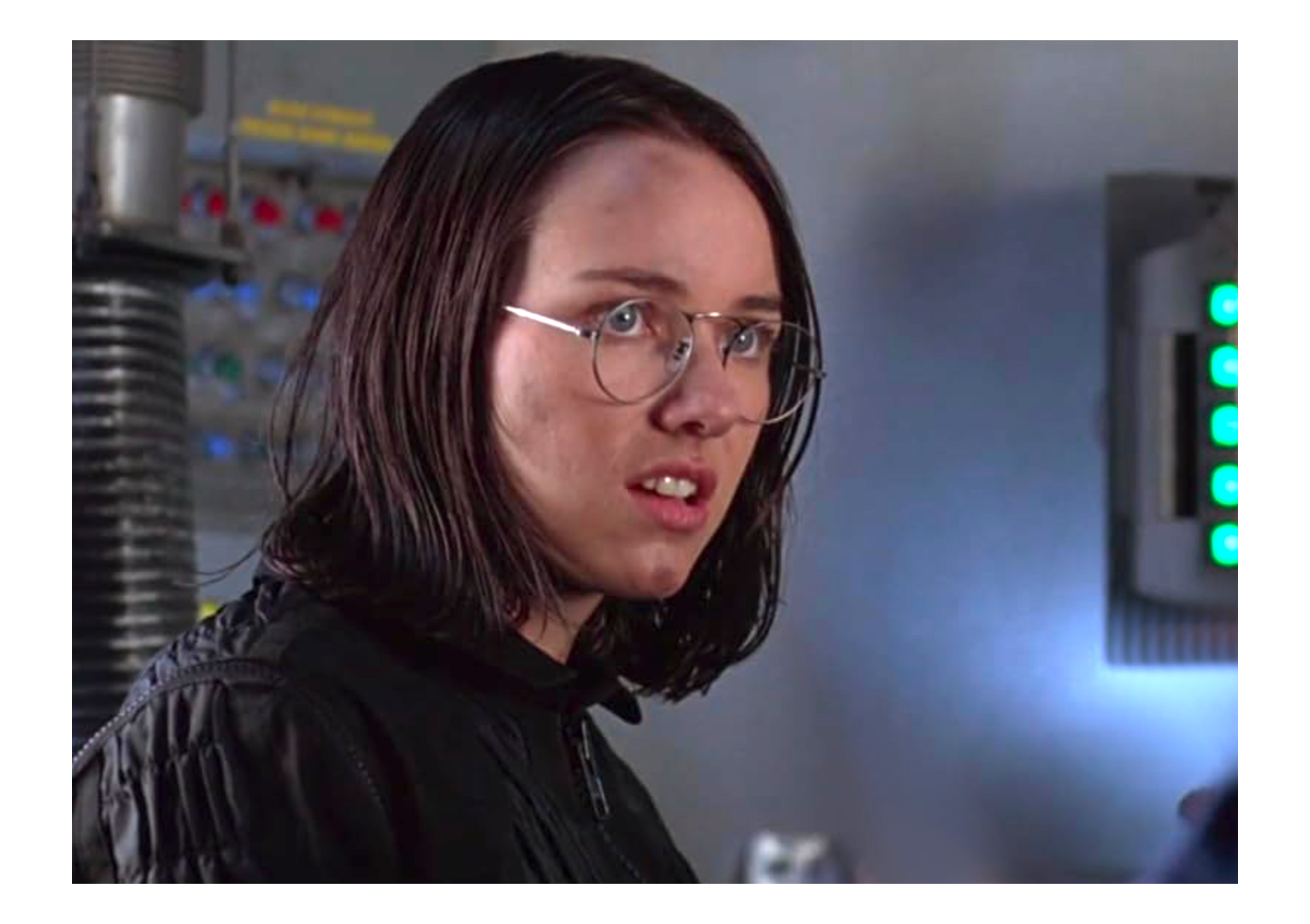
To create a contrast, Naomi Watts’ Jet Girl is an introvert who needs Rebecca’s example to break out. On this dry planet people bathe with sand; Rebecca and Jet Girl share a shower scene that teases girl-girl eroticism. But Jet Girl ends up a career misstep for the mighty Ms. Watts, the future star of Mulholland Drive, King Kong and The Impossible.
The Hollywood law of ‘movie by committee’ also enforces some lazy sentimentality. Tank Girl has a heart as well … a big motivation at the finale is to save a pre-teen sidekick named Sam, who looks like the little girl from Aliens.
Tank Girl strives to be different. It leads with its graphic-comic look, which is erratic but arresting. The millions to make the show are on screen, with numerous elaborate sets. Every room is cluttered with trendy décor, ephemera collected from the lost 1990s. Rebecca makes jokes about things like the Broadway show Cats. Her main tank does cruise at 30mph, as she hangs onto the barrel. It’s remote controlled and programmed to perform rescues, like a ‘wonder horse’ or Lassie.
Jet Girl’s hover-jet also looks like a fugitive from Aliens. That points us to the credit for the Skotak brothers, masters of practical-magic visual effects. The jet scenes are all good; the miniature sets and models look great.
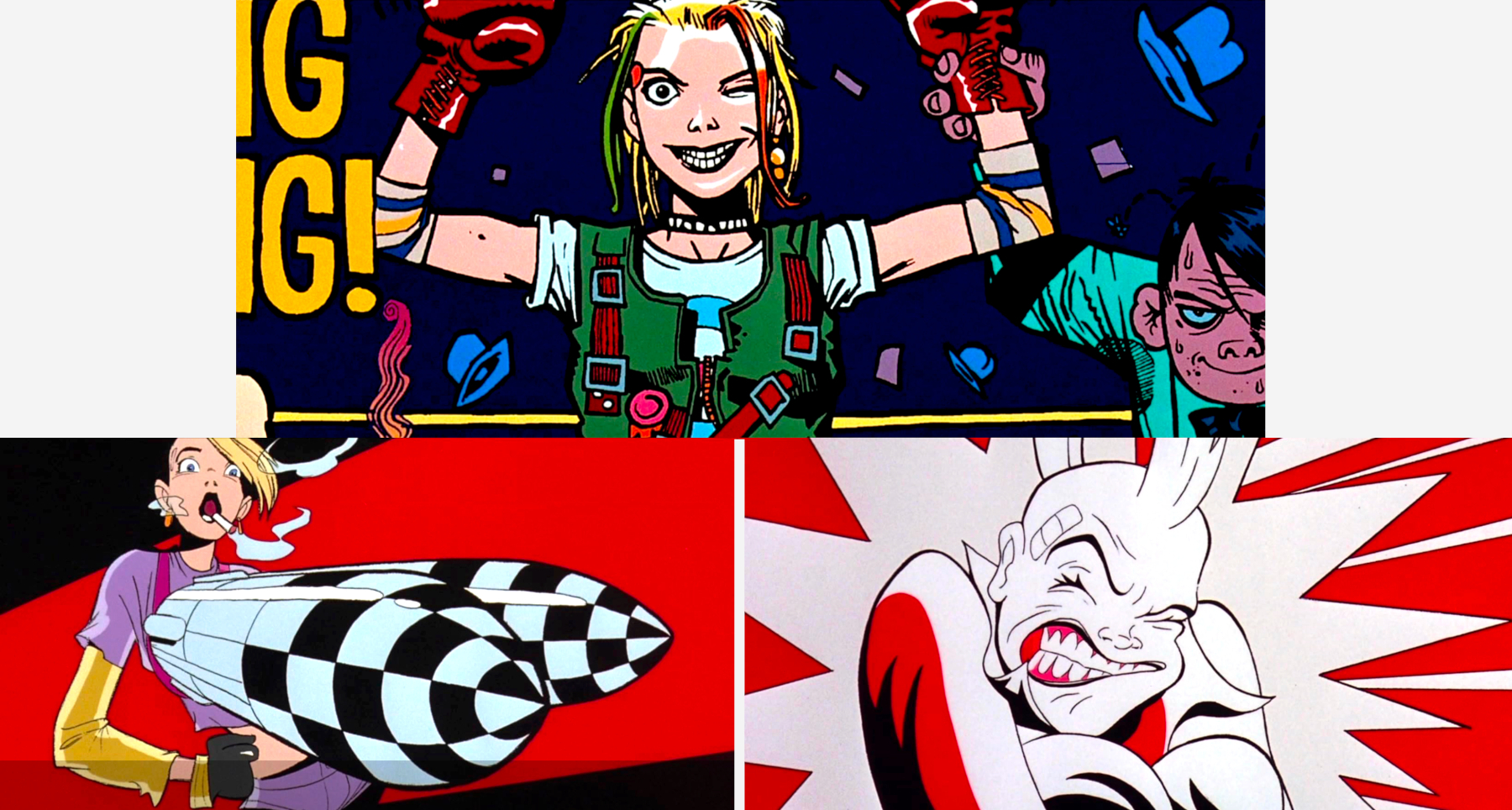
Tank Girl’s effort to front an appropriately chaotic style is hampered by the dull storyline. Scenes are punctuated with quick-cut montages that show off details in the art direction. Elaborate animated segues bridge scenes and express Rebecca’s strongest emotions. The animated segments are dynamic, but they still feel like an interruption. All we think is, ‘oh, is that what the comic looked like?’
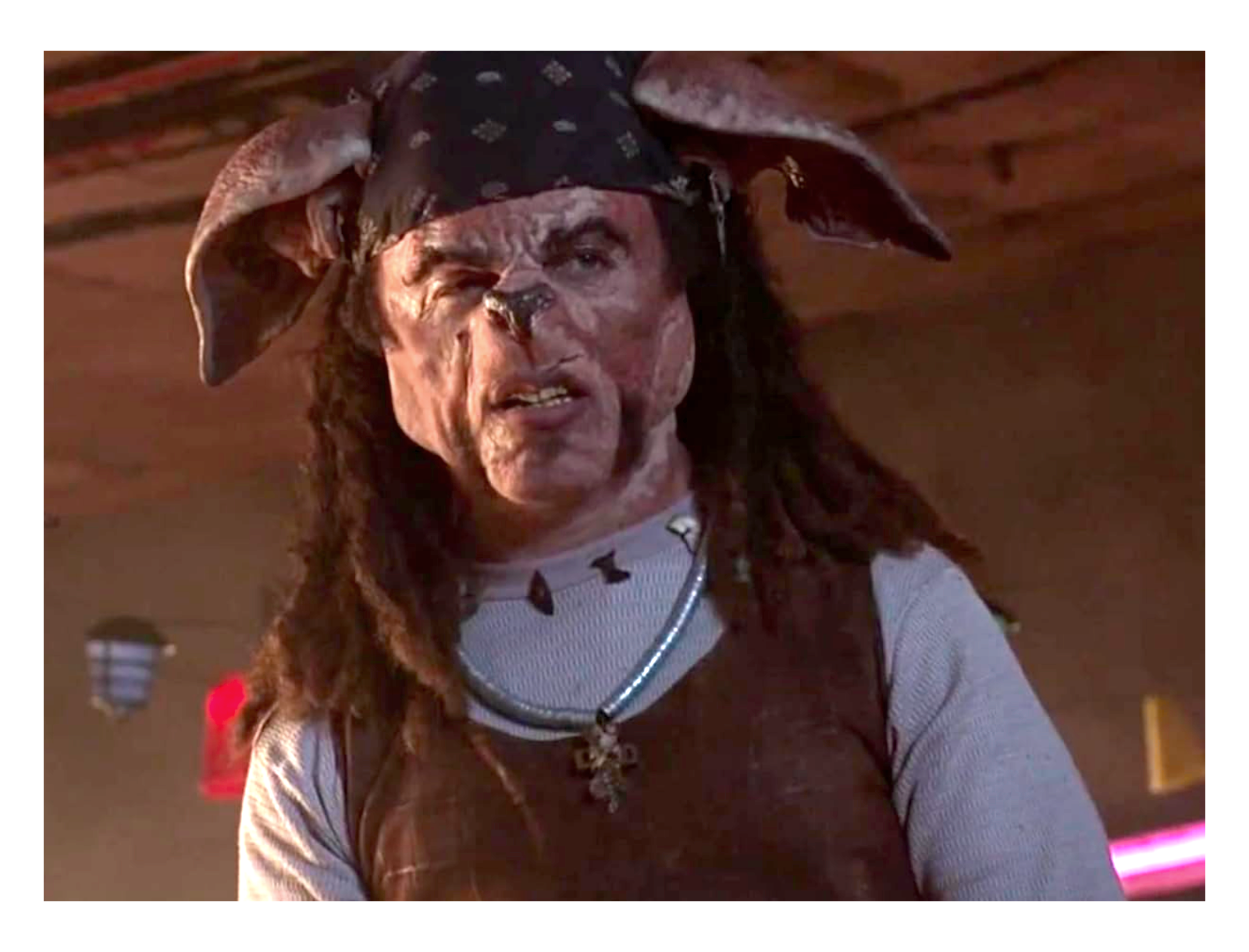
Then there’s the Ripper clan, an impressive makeup / fx achievement that is also the film’s breakdown point. The elaborate Stan Winston kangaroo-mutants look great and let the actors offer distinguished performances — Ice-T, Jeff Kober, Reg E. Cathey. But the Rippers don’t add up — they’re both merciless killers, and cute personalities that would fit in well with a Scooby-Doo vibe. For all their animatronic polish, they aren’t a welcome development … no Ewoks, please.

The conversion of the comic book’s Rippers to cute playmates points up the fact that Tank Girl was at some point taken away from its director. From remarks made by Rachel Talalay, we recognize a familiar pattern in studio development: the money folk greenlight a project that’s supposed to be edgy, irreverent and controversial … and then force it back within ‘safe’ limits. Tank girl talks nasty ‘n’ rasty (but no expletives), making coarse sex jokes and even one zinger about ‘funny’ incest. Other than the odd severed arm here and there, we see little blood. Kesslee’s favorite killing method is a plastic bottle device that drains every drop of fluid from a victim, making them shrivel up (an excellent effect).
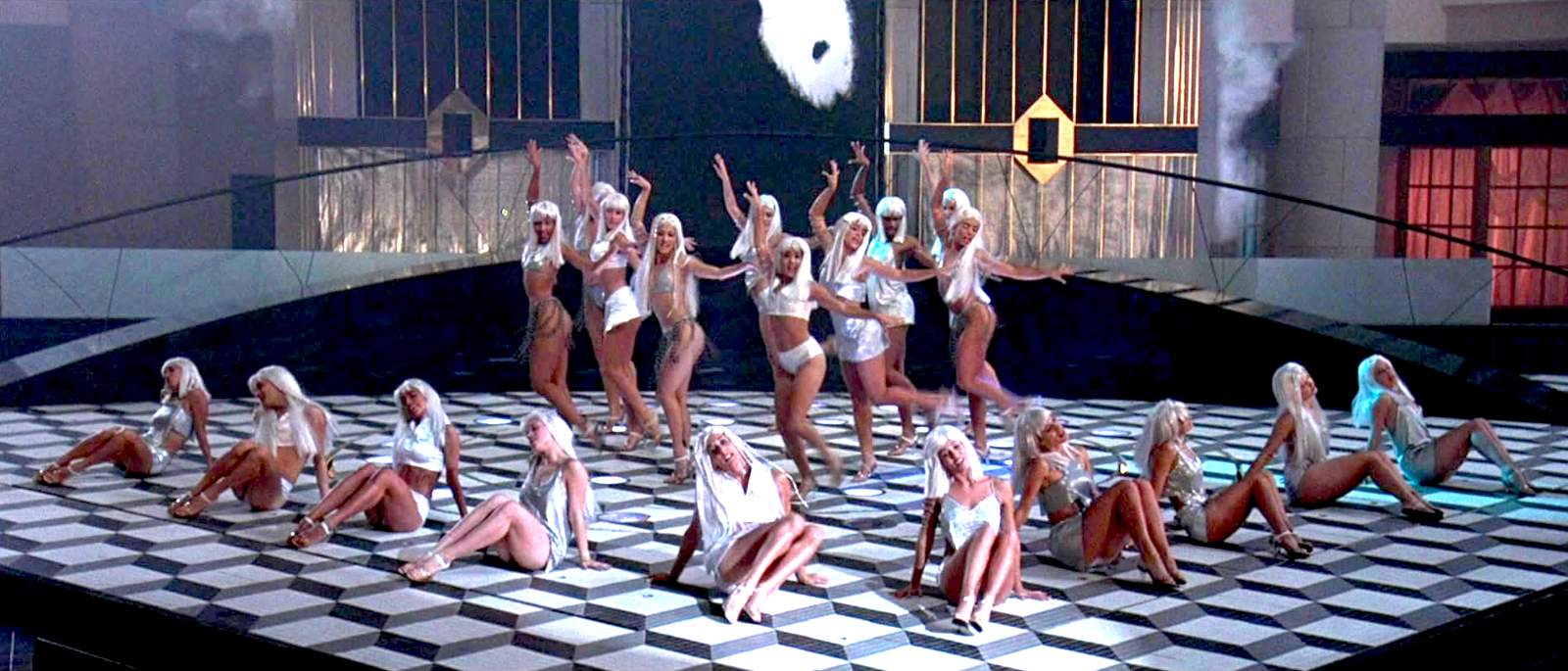
‘Dangerous’ content is teased but withheld. An un-billed Ann Magnusen is ‘The Madam’ of an oasis-brothel called Liquid Silver, where little Sam is threatened by a pervert pedophile (guest star Iggy Pop). An elaborate choreographed floor show stands in for any overt sex content, with just glimpses of semi-nude performers. The movie’s most ill-judged scene is an impromptu performance of Cole Porter’s Let’s Do It. It’s incongruous, but not in a good way. ‘This movie dares to be awful!’
American fans were wanting Spiderman, and probably knew of Silver Surfer, but Tank Girl was an exotic fringe item. Movie adaptations of the well-known European comics Barbarella and Modesty Blaise had failed to take America by storm. In the case of the Italian Diabolik, the studio’s advertising tried to hide its source as a comic book series. Word of Mouth for Tank Girl could not have been encouraging. The advertising suggested some kind of kooky culture mix-up comedy, with Lori Petty playing a feminist version of Pee Wee Herman. But I cannot see U.S. audiences in 1995 embracing this big, noisy, well-produced but unappealing show. I think Lori Petty’s characterization is spot on … and that it ended up a career setback, the kind of frustrating debacle that would make the industry even more shy of big films fronting women stars.
My first wife loved this movie. Boy, am I glad she’s dead.
I found this visually stunning, and Lori Petty a hoot, but felt left out of the fun.
I could never get thru this whole movie…
i always appreciate Glen’s insight & knowledge. Especially grateful that he highlights genre, international and independent films. Though the comment here about Riot Grrrl being a market that film companies wanting to tap is alittle off. You know film history but let others comment on music. I’m knee deep in the California punk scene and when Riot Grrrl arrived here it was heavily maligned and misrepresented by the likes of the SF Chronicle and NY Times. To the point Bikini Kill–the loudest proponents of the movement stopped talking to mainstream press. In 1993-95 the big money flowing around was with Grunge, Maybe elements of the Riot Grrrl movement could be found there—but the Hollywood image at the time was hyper-focused on long hair men in flannel playing a mutant form of heavy metal. Grunge was sold to us devoid of any real resistance to oppression. The counter culture was(is) quite a different thing than the media representation —as Tank Girl demonstrates.
Riot Grrrl seemed more mainstream 20 years later…..when punk feminism slowly became the easy cash grab that the studios like to practice. Better use of your mind/time would be; Tjenare Kungen (God Save the King) from 2005, and We Are the Best (2013). Both from Sweden. Both have great productions and messages. Sadly both are set in the 1980’s and therefore make it seem that the punk scene was only valid then
Hi Robert, thanks. It’s opinion overreach on my part, and an incomplete thought. Riot Grrrl was its own thing and not yet the kind of trend that Hollywood would aspire to co-opt…. Is that the drift? There’s just something to the rebellious, female empowered energy the film wanted, but didn’t channel particularly well. Thanks again.
I thought it was a neat movie.