

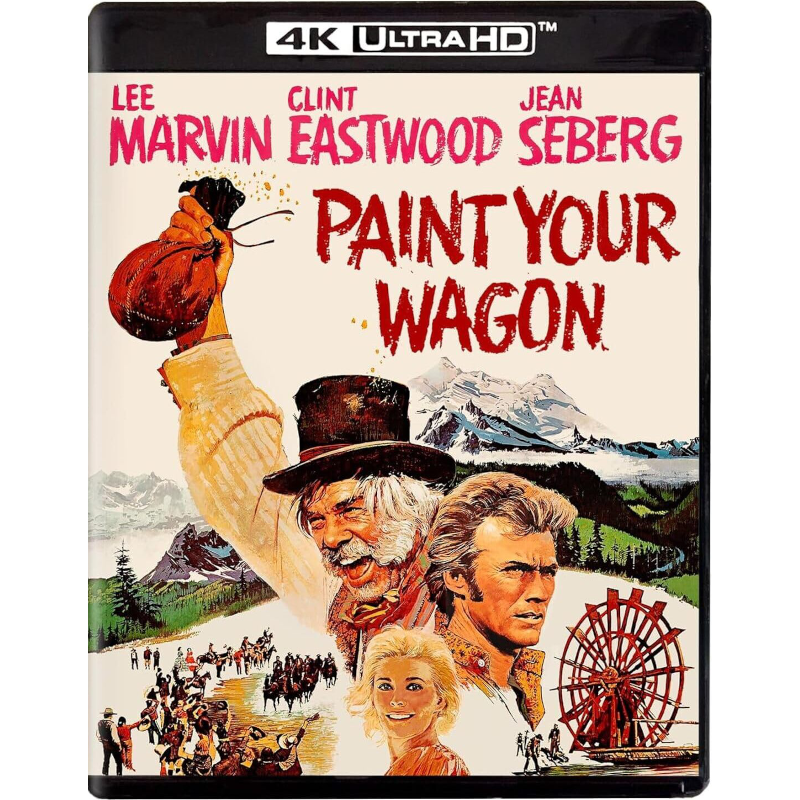

A musical western? We think Doris Day in Calamity Jane is just fine, and we have a soft spot for the not-quite-fine Red Garters because Rosemary Clooney is a favorite. Oklahoma! is technically a western … it just doesn’t feel like one. The Broadway team of Lerner & Loewe did a major western musical that wasn’t a big performer like their other stage hits, that became the films Brigadoon, My Fair Lady and Camelot. Almost 20 years passed before a film version of Lerner & Loewe’s Paint Your Wagon was adapted for the screen. The huge production came along at the end of the Road Show era, just as big musicals suddenly became box office poison: Star, Sweet Charity.

Having signed Lee Marvin and Clint Eastwood at the height of their careers, Paramount must have thought Paint Your Wagon was the casting coup of the decade. Each had made movies with music, but not a musical per se.. A particularly good gag from a 1998 episode of The Simpsons nails the issue of audience expectations for a movie starring America’s top macho male leads.
When the Movie Rating system arrived, that part of middle America that frequented the movies discovered that almost everything on the screen was becoming more adult. Westerns were likely violent and unsuited for small children, but big musicals were considered ‘family safe.’ The ads for Paint Your Wagon suggested a Family attraction, but the movie originally carried the ‘M-Mature’ rating, later re-named ‘PG-Parental Guidance.’ Some families that attended the rowdy musical must have decided that all of Hollywood had gone to The Devil.
In the wild and wooly California Gold Rush days, miner Ben Rumson (Lee Marvin) digs a grave for an accident victim and accidentally discovers a promising gold claim. That leads to the instantaneous founding of a new miner’s camp, ‘No Name City.’ Rumson also tends to the victim’s surviving brother, who he nicknames Pardner (Clint Eastwood). The two become the best of friends … and then the beautiful Elizabeth Woodling (Jean Seberg) comes along. Elizabeth is an unhappy 2nd bride in a polygamous Mormon marriage. She has already lost a baby. When the husband Jacob Woodling (John Mitchum) agrees to sell her, Ben bids high and wins a bride. Elizabeth is adventurous and willing, but demands that Ben build her a real cabin in this tent city.
As No Name City grows, the scattered storyline collects anecdotes of wild times: Rumson’s bouts of jealousy, the stealing of a wagonload of French prostitutes for the camp, and the communal corruption of young Horton Fenty (Tom Ligon), the son of some pious pioneers. No Name City eventually succumbs to a spectacular destruction.

It’s Sodom and Gomorrah in the Sierra Nevada …
The Paramount project was initiated by singer Eddie Fisher, who for more than a year was slated to produce and star in the film, perhaps with James Cagney coming out of retirement to play Ben Rumson. During the adaptation process, almost half of the play’s book was jettisoned, replaced by new subplots. Fisher’s proposed part was the play’s romantic lead, Julio Valveras, who falls in love with Rumson’s young daughter, Jennifer. Their absence necessitated that the romantic songs be given to others, including Ben Rumson and Pardner. When new songs were needed, André Previn stepped in as additional composer. Fisher was listed as still associated with the project, right until filming began.
The changes greatly alter Alan Jay Lerner’s original storyline. He signed the final screenplay, but much of it is original material by the celebrated Paddy Chayefsky, who is credited only as ‘adapter.’ The AFI Catalog describes a ‘pastoral reverie’ replaced with a ‘sexy morality tale.’ The depiction of the amiably decadent community is a little edgy, and occasionally tasteless. The tone becomes strange around the Mormon polygamy business, yet the auctioning of Elizabeth was part of the original play. In the film, Ray Walston’s dame-hungry Mad Jack Duncan only complains of the unfairness that Fenty should be hoggin’ an ‘extra’ wife. In the play the miners have no women save for the virginal Jennifer, and demand that the Mormon sell.

…. or maybe The Summer of Love circa 1848?
Lee Marvin offers plenty of energy, but what gives the movie some occasional freshness is the spirited performance of Jean Seberg. To get free of servitude under Fenty, Elizabeth welcomes the auction, and declares out loud that she will take her chances with whoever ends up ‘owning’ her. But she has more grit than any of these foolish men, and she won’t let herself be abused. There is a wedding, but she puts Ben Rumson on notice. She’ll stay, but only after Ben agrees to build her a real cabin. In this case, scarcity breeds emancipation — she is the one who blows out the candle to signal bedtime.
The bargain bears comparison with that in John Ford’s The Quiet Man, where Maureen O’Hara’s new bride Mary Kate Danaher holds out for her dowry possessions before she’ll submit to her new husband. The subject on everybody’s mind is SEX … racy filmmaker, that John Ford.
The film’s most promising scenes are a few bright minutes in the Rumson cabin. With the three occupants in such close confines, Pardner realizes that he should leave. Ben intuits that something’s going on between Pardner and Elizabeth, and gallantly offers to be the one to move on. Elizabeth has already seen her share of non-standard marriage and sex relationships. She proclaims that she loves them both, and suggests a dual marriage. If one man can have two wives, why can’t one woman have two husbands? Can such a thing really work?
Thus the film adaptation is a ‘sexual revolution’ update for a frontier that accepted most any kind of relationship that didn’t end in bloodshed. The serious shortage of woman on the frontier may have been best dramatized in the fine show Westward the Women.
Not that Paint Your Wagon has a great deal to say about Free Love, open marriage or the ‘one woman-two men’ arrangement. Instead, affection and favors shift as Elizabeth is slowly persuaded to migrate from one beau to the other.

Lerner and Chayefsky’s film adaptation does much more than just open up the stage play. Synopses tell us that the stage version didn’t have a ‘Pardner’ character. Other miners vie for Elizabeth’s attention, with a focus on the Jennifer – Julio romance delayed by the impermanence of the mining camp. The song “Wand’rin Star” is Julio’s lament when he must leave to search out a new gold strike. The development of No Name City into a wide-open booze ‘n’ girls party wasn’t so bawdy on stage. Neither was a pious young boy converted into a dissolute whoremonger. Fifth-billed Ray Walston’s Mad Jack Duncan is one of many sex-obsessed characters. The expanded storyline fixates on the plight of horny miners, who are seen as harmless clowns. The word ‘horny’ is actually used a couple of times, as is fornication.
The play dealt with the frontier realities of gold towns; the finished Paint Your Wagon spins the miners-without-women crisis into a bawdy party joke. The film’s biggest action scene is the hijacking of another town’s floozies-for-pay for the camp’s pleasure, a rowdy version of the polite sleigh ride kidnap in the earlier musical Seven Brides for Seven Brothers. To confect a spectacular climax, another fanciful subplot has the miners digging underneath the town for rumored gold deposits. Expensive slapstick special effects show the collapse of No Name City, as all those excavations cave in. Undermined by greedy tunnel diggers, the Sodom-like town is literally swallowed up by the earth. Going to Hell, get it?

Aren’t we supposed to be pleased when actors do their own singing?
Thus Lee Marvin and Clint Eastwood, specialists in violent action genres, hired on to sing in a half-western, half-musical comedy. Most of the comments about Paint Your Wagon are aimed at these unlikely-voiced leads crooning ballads suitable for the likes of Burl Ives or Robert Goulet. The fact that they sing for themselves is something we normally would praise. Hollywood musicals had a nasty history of redubbing perfectly good singers (Lena Horne, Russ Tamblyn) for the craziest reasons. The 1960s were the Marni Nixon years. Even the delightful My Fair Lady has a curious hollow at its center, when Audrey Hepburn’s singing voice turns out to be an overdub job.

At least the singing isn’t phony. Eastwood’s voice is thin to the point of being a dry whisper. Lee Marvin growl-talks his way through one tune after another. But did Rex Harrison really sing as Henry Higgins, or did he just talk? Lee Marvin had already seen his bankable range extended in Cat Ballou, with an Oscar as a reward. We loved it — you’d think no actor had ever played against type before. We’re reminded that both men spent years as low-salaried players. What actor would turn down such a Big Payday, with a huge salary and participation points? The worst that could happen is that somebody would be hired to sing for them … as was done for Jean Seberg. Anita Gordon dubbed her singing voice.
Not long back from making his name in Italy in the grossly underpaid Leone films, Clint Eastwood spent 1968-71 raking in big bucks as a top star, and figuring out how to expand his performances beyond a few facial scowls. He quickly found his footing. Paint Your Wagon may not be a great role, but gives it an honest effort. Neither Eastwood nor Marvin has especially strong romantic chemistry with Jean Seberg … I think the hormonal connection is between Seberg and us.

Lee Marvin is gruffly winning and Clint Eastwood has a fair measure of charisma, but Jean Seberg is the film’s best-cast player, the one who really shines. Although the play with sex relationships remains mostly a tease, Seberg brings a wandering eye and a knowing smirk to Elizabeth. Rumson’s drunk assault on their wedding night probably emptied theaters of churchgoers from here to Sioux City, Iowa. Seberg’s provocative pride makes for about twenty seconds of real movie. Marooned among the lonesome miners, Elizabeth is a thinking adult, a proto-Earth Mother and an independent, welcoming vision of feminine strength.
Associated with experimental European filmmakers and leftist causes, Seberg may have been somebody’s attempt to tap into a hip demographic. The star of Jean-Luc Godard’s Breathless and Robert Rosson’s Lilith was angling for the Hollywood mainstream Hollywood, with parts in Pendulum and Airport. She then was not heard much from again until her 1979 death, accompanied by tabloid stories about her involvement with Black Panthers. Imagined as a tragic figure akin to Frances Farmer, rumors once circulated about Seberg being murdered by the FBI or the CIA.

For years Paint Your Wagon was remembered as a monstrously over-budget, over-schedule picture. This writer talked with several of William Fraker’s camera crew people, who had spent months on the Oregon location. They recalled that it was a giant sinkhole for Paramount’s dollars, and a big money $$ opportunity — a location shoot so big and unwieldy invariably led to massive overtime charges for Guild personnel. * Bad weather, set construction and special effects issues caused delays, with a large company on the clock and drawing special Per Diem bonuses.
The picture motivated some key personnel to make career changes. Clint Eastwood was professional, responsible and thrifty. He had been astonished by the sometimes haphazard filming habits of the Italians, but the inefficiency and waste of this show had a hand in his decision to become a director. Joshua Logan never directed another feature; Paramount probably credited Director of Photography William Fraker for getting the film finished. Fraker also turned director for a spell after Paint Your Wagon, with Monte Walsh and A Reflection of Fear.
Overall, Paint Your Wagon has a higher reputation now than it did when new. People still love the classic song “They Call the Wind Maria.” Many viewers like the insistent slapstick with the sex-starved miners …. the bawdy comedy is sometimes actually funny, unlike most of John Sturges’ thirsty miner epic The Hallelujah Trail. For us it still seems to go on forever, with too many scenes a group effort with 90 people on screen. Just the same, director Joshua Logan delivers his best-directed picture since Sayonara.
We once wrote that the level of wit didn’t rise above that of TV’s F Troop … but as film comedies become dumber and uglier, F-Troop improves in the memory. What we mainly see in Paint Your Wagon is an hour of screen business we don’t care about — Harve Presnell has a great voice, but he’s surrounded by those horny miners and Ray Walston’s’ exaggerated Scottish accent. We’ll revisit the show for its beautiful greeting card scenery and a few interesting, provocative romantic scenes with the incandescent Jean Seberg.

Clint and Lee were great at packin pistols…but they were terrible at singing! No matter how good the money was, they should’ve thought twice about this one…
PAINT YOU WAGON seems to have had 70mm roadshow engagements in the U.S.:
https://www.in70mm.com/presents/1963_blow_up/titel/p/paint_your_wagon/index.htm
The chapter about the PYW production in Logan’s book MOVIE STARS, REAL PEOPLE AND ME is really painful to read, and what Logan wrote about it is in line with the stories the camera crew people told you.
I saw it in Denver at the Cooper Cinerama. ‘Hard Ticket’ – reserved seating. Played for nearly a year there (folks came from 11 states to shop and catch live theater and films in Denver while Stapleton International Airport was still in operation)…
“Aren’t we supposed to be pleased when actors do their own singing?”
Not if they can’t sing.
I suffered through this one a few decades ago. You’d have to pay me triple Golden OT to do it again. And maybe not even then…
Saw it in limited release. It had reserved seats.
Thanks Gary!
I’ve only seen the segment watched on The Simpsons. Looked like the hokeyest movie ever.