


This new Blu-ray special edition of a very special gothic Eurhorror classic is one of those releases where I say ‘this is exactly what we wanted.’ Back in 2004 I was delighted to see Mondo Macabro’s premiere DVD, which had a reasonable picture plus three audio tracks, two in English and one in French. The Deutsche Subkultur Blu-ray set from 2016 was a jump upward in quality. It was Region-free and had several separate versions, unfortunately not subtitled in English. Now Arrow Video comes forward with the answer: four discrete versions on two discs. I headed straight for the Italo original with English subs. It’s the longest version (although another has a unique scene or two) and the one to see — at least for Eurohorror ‘elitists’ like myself that soak up foreign language atmosphere.
Better yet, the transfer looks incredibly good. No more bleeding color on the text in the title sequences. I’ll extol the disc’s visual and audio graces in the quality section below, after I run through my man-splaining thoughts on the film’s content.
1960 was a boom year for horror internationally. After the example of Hammer Films’ brightly colored classics, everything was finding an audience. Horror films could be pre-sold. America brought Roger Corman’s House of Usher and Hitchcock’s Psycho to the party; on the continent came Mario Bava’s directing debut Black Sunday and Roger Vadim’s Carmilla story …Et Mourir de Plaisir (Blood and Roses) in Technirama. Michael Powell’s notorious Peeping Tom appeared at almost the same time as Hitchcock’s classic, with an oddly parallel agenda. Also arriving in the next couple of years was a brace of less distinguished ‘medical horror’ pictures: Atom Age Vampire, The Awful Doctor Orloff. It’s hard to believe that they weren’t all inspired by Georges Franju’s Eyes Without a Face, but contemporary reviewers more often pointed to Henry Cass’s imitation Hammer film Blood of the Vampire.

One of the first and most impressive of 1960s horror thrillers is Giorgio Ferroni’s Mill of the Stone Women. The exotic, eclectic shocker was given a relatively lavish production, with a capable name cast, artfully lit Eastmancolor images, and locations in Northern Europe. A period picture (1912 or 1915), it’s a quality gothic, mixing medical horror with macabre romance, mad artistry, desecration of the dead and the notion of a lover from beyond the grave. The show reportedly did well in Europe but didn’t show up in the United States for three years, where it was promoted as down-market exploitation fare.
Outside Amsterdam in a town called Veeze, Hans von Arnam (Pierre Brice) arrives by canal to work for Art Professor Gregorius Wahl (Herbert Böhme) documenting the old windmill that serves as a famous wax museum. Hans re-encounters his old sweetheart Lisolette Carnin (Dany Carrel), one of Wahl’s students, but is captivated by Wahl’s mysterious daughter, Elfi (Scilla Gabel). Told to stay away from the young lady, Hans is drawn to her boudoir and into the horrible secret shared by her father and his ‘guest,’ Doctor Loren Bolem (Wolfgang Preiss). Elfi may indeed be dangerous but her twin father figures are far more malevolent.
Mill of the Stone Women is an artfully contrived horror concoction boasting brilliant color, beautiful sets and elaborate art direction. The filmmakers must have been inspired to stress cinematic beauty, beginning with imagery straight from Theodor Dryer’s Vampyr: on a foggy canal, a lonely bell summons a hand-pushed ferry boat. The fairytale-like setting then segues into The Mystery of the Wax Museum territory, mixing art-craft and madness. The rooms of Dr. Wahl’s creepy windmill-house are strewn with art bric-a-brac and morbid statuary. Rigged to the windmill’s clockwork is a mechanical display of female mannequins that parade on a track to organ music, for the amusement of visitors. They represent ill-fated women from history: Joan of Arc, Cleopatra, etc. One is a graphic hanging victim and another lies ready at the head-chopping block.

The story components emphasize the plight of women, who are either powerless servants or the objects of male pride and lust. In this decidedly adult fairy tale the weirdest woman in the mill is both a victim and a ghoulish predator. Elfie Wahl first appears holding a dog on a leash, just as did Barbara Steele in Black Sunday. Beautiful but strange, Elfi is that woman whose attractiveness hides secrets we’d rather not know about, the one who appears in stories from the Bible forward to inspire men to foolish decisions. At times she also seems to represent the curse of venereal disease (nice call, Tim Lucas).
Hans is honest but vulnerable, and he confuses sympathy for the ‘ill’ Elfi with erotic attraction: he gives in to her enticements. After succumbing to The Way of All Flesh, Hans doesn’t know how to proceed. Despite his best intentions he has nevertheless betrayed both his employer and his official sweetheart Liselotte. To his credit, Hans doesn’t try to weasel out of his predicament by pleading,
“I slept with her but it’s okay because in the process I discovered I love you. So you’ll forgive me, right?”
For poor Hans it’s a case of Betty & Veronica dating horror. When Elfi overhears Hans declaring himself to Liselotte, under the old mill gear works, we know there will be hell to pay. Hans has been told that Elfi’s health is precarious and determines to meet with her to honorably break off the affair. . . at which point Elfi suffers a seizure and appears to die on the spot. But that’s only the beginning of Elfie’s story . . .
The supernatural fairy tale weirdness soon becomes a more conventionally sinister medical horror story. Elements that seemed sleazy in older, trashier horror fare (She Demons, El monstruo resucitado) are rejuvenated.

Professor Wahl and Doctor Bolem’s morbid secret requires the blood of young women, but every scene brings on a new macabre spectacle: a corpse being fashioned into a statue, a dummy buried in place of a body. Most alarming is a fantastic hallucination sequence in which Hans is confronted by a spooky vision stemming directly from his guilty conscience. Hans’ nightmare involves a missing pendant, a bloody knife, and a living-dead Elfi reaching for him in a cobweb-filled room.
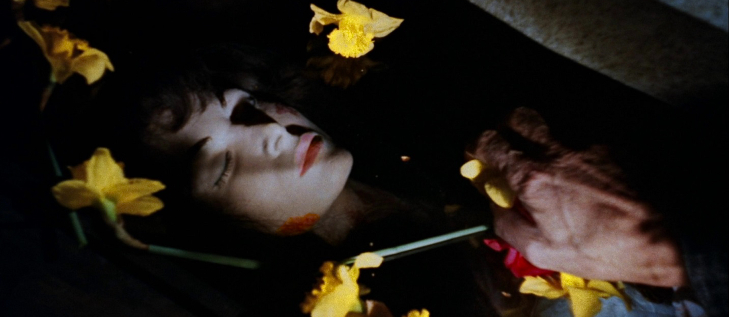
First-generation Euro-horror stressed the potential beauty of gothic cinema, bridging the gap between trashy pulp and surreal art. The accomplished Mill of the Stone Women extends the erotic/horrific use of Victorian settings and sensual color beyond the example set by Hammer’s Technicolor Jack Asher classics. The bright cinematography abounds with expressionist effects. Professor Wahl makes an entrance through a narrow aisle of carved emblems and religious sculptures, with a blast of unmotivated blood-red light on the floor. Elfi stands holding a crimson rose (much like Annette Stroyberg in Blood and Roses) or lies draped across her bed awaiting the arrival of Hans, bathed in chroma contrasts that heighten her sensuality. In a two-shot embrace she moves from rim-lit backlight into a careful composition with a Joan Crawford-like eye light across her otherwise dark face.
This is more than ‘pretty pictures,’ it’s the kind of careful lighting abandoned by most genre efforts of the 1950s. The ‘aesthetic delirium’ has an impact similar to that of Vertigo. In horror, only Freda’s The Horrible Dr. Hichcock and Bava’s Black Sabbath front a comparable color atmosphere.

If Walt Disney had a fetish for grisly, sexy adult horror
movies — in good taste — he might have made something like this.
Mill of the Stone Women has an excellent sense of period decor; the beer hall scenes are more impressive than Hammer’s typical pubs and country inns. Co-star Liana Orfei’s singing scene is quite good, as are the impressive gowns and dresses worn by the three leading ladies. The musical score veers from a creepy carousel tune, to a lush romantic theme for Elfi’s seductions. Her appearances are heralded by a melancholy violin motif. The one production disappointment is an unconvincing miniature of the mill used for night exteriors — it weakens the film’s ending.
The medical horror content gives us two fiends with easily relatable motivations: blind hubris, megalomania, bitter resentment, frustrated lust. They’re gentlemen scholars yet function as kidnappers, murderers and mutilators of young women. Herbert Böhme’s Professor Wahl is kind, thoughtful to his art students and a princely aristocrat sculptor, proud to preserve the hundred-year-old Carousel of Women in operation for a new generation. The process by which he ‘petrifies’ beautiful women for his carousel has a creepy, necrophiliac logic. A hypodermic syringe in one hand, he calmly manipulates lovely female corpses.
That Professor Wahl is stark raving mad is a matter of unbridled hubris, the same as the malevolent Docteur Genessier. Wahl’s agenda prioritizes art, his daughter Elfie and his selfish will ahead of the lives of the young women he exanguinates, petrifies, and puts on display. Sinister Wolfgang Preiss (The 1,000 Eyes of Dr. Mabuse) mixes his surgical villainy with an understandable lust for the heroine. He’s convinced that keeping her alive gives him the right to possess her body. A clue in one of Elfi’s lines of dialogue suggests past sexual abuse by one or both of her male ‘protectors,’ another A+ revelation gleaned from Tim Lucas’s commentary.

Scilla Gabel is the focus of all this mayhem. I believe her name is pronounced “Shee-la.” The ravishing Italian actress served as Sophia Loren’s stand-in before using plastic surgery to find her own look (more thoughts of Les Yeux sans Visage). Gabel’s full body contrasts with a face that’s all bone structure, and skin stretched more taut than that of Barbara Steele. Elfi is a lean vixen with hungry, haunted eyes. Between Gabel, Steele and Daliah Lavi (The Whip and the Body) the ‘sixties gave us a full spectrum of romantic heroines — that double as erotic traps for unwary males.
Perhaps Gabel was not an important actress, but she had a run of excellent genre appearances. She’s dynamite in her scenes in Tarzan’s Greatest Adventure and the epic Sodom and Gomorrah, and in her star cameo in Joseph Losey’s Modesty Blaise. A cursory web search shows that Ms. Gabel was a popular sexy pin-up attraction as well.
Handsome Pierre Brice is better known for playing Winnetou the Indian in a series of German Westerns, and a good enough actor to lend Hans some needed complexity. Hans can’t resist Elfi’s invitation and feels that he has betrayed both women. He looks suitably frazzled from the effects of Dr. Bolen’s hallucination-inducing tranquilizer. ‘Drug trip horror’ would become a staple of Roger Corman’s Edgar Allan Poe pictures, with their color-tinted dream imagery.
Although her billing does not reflect it, at the time the biggest name in the picture was Dany Carrel, a sexy contender for stardom with an interesting face. She’s mostly decoration as Liselotte, providing the slight bit of nudity that was censored from many prints. Marco Gugliemi serves as Liselotte’s gee-whiz best friend. Liana Orfei is the beautiful victim to fulfill the formula quoted by Raymond Durgnat for Eyes Without a Face: one girl is sacrificed, and another saved in the nick of time.
Rule Number One when dealing with a mad surgeon:
Allow the genius sawbones to revive your daughter before you stab him to death.
Foolish Professor Wahl!
Although the mad doctor machinations provide a fiery ending, what we remember most from Mill is our hero’s affair with a poisoned / poisonous seducer. The doom represented by Elfi is difficult to separate from society’s double standard, the rule that encourages young men to prove their manhood by taking whatever favors they can. Elfi is the highly prejudiced ‘mysterious female’ representing the notion that Sex is by definition Evil. She’s a Lorelei, a Siren, the woman with the skull face that represents lust and vanity in old engravings. She’s also the skeletal seducer that symbolizes War in archaic political cartoons. Mill of the Stone Women is an excellent example of an undefined misogynistic myth. Once again, fire cleanses ‘evil,’ and our hero is able to go forward in life with an ‘acceptable’ female partner: virtuous, inexperienced, ‘innocent.’ At least until Liselotte demands a full explanation of Hans’s ‘adventures’ in the Mill of the Stone Women.


Has anyone turned up a copy of “Flemish Tales,” yet? LOL!