


We were intrigued by the opening pilot episode of Irwin Allen’s Lost in Space. Not having a color TV, we didn’t realize that the first season wasn’t in color. It looked halfway interesting, and semi-serious. When I saw another episode a year later at a friend’s house the show was in color, but by then it had morphed into a semi-comic vehicle for Jonathan Harris’s Doctor Smith character, and was even dumber than Allen’s TV version of Voyage to the Bottom of the Sea. At 14 years, I’d aged out of the whole concept.
We’re told that the prolific writer-director Ib Melchior had actually written up the idea of ‘Swiss Family Robinson in Space’ for Irwin Allen. He wasn’t credited on the original show, but received a courtesy credit on this reboot, which seems fair to us.

New Line Cinema didn’t go cheap on 1998’s Lost in Space, which clearly paid a lot to assemble its stellar cast. Gary Oldman, Mimi Rogers, Heather Graham and Matt LeBlanc were clearly in it for the payday, as succeeding in ‘something the kids like’ was a good path toward career stability. William Hurt had been very picky with his projects. He had chalked up some good films yet his last major success had been a full ten years back, in The Accidental Tourist. When filming Wim Wenders’ Sci-fi masterpiece Until the End of the World the actor had railed against what he thought was a stupid story, with a stupid character. (or he may have just been irked by an extended schedule that messed up his work calendar.) But Hurt clearly applied himself to the ‘Ward Cleaver in Orbit’ requirements of Lost in Space. He and Mimi Rogers show full commitment, selling the film’s just-plain-awful dialogue without reservation.

Nobody’s slumming in Stephen Hopkins’ picture, least of all top star Gary Oldman. The accomplished actor had recently finished serving villain duty in both Air Force One and Luc Besson’s The Fifth Element, another space adventure with elaborate visual effects. Director Hopkins does well handling a gigantic production with an enormous number of complex effects. It’s a special talent, directing all that traffic. Hopkins certainly has career survival skills — we at MGM/UA were appalled by his lazy action thriller for two generations of the Bridges family, Blown Away, but his earlier The Ghost and the Darkness has sustained an okay reputation.
Lost in Space is jammed with plot complications,
all simmering in a sauce of ‘family issues.’
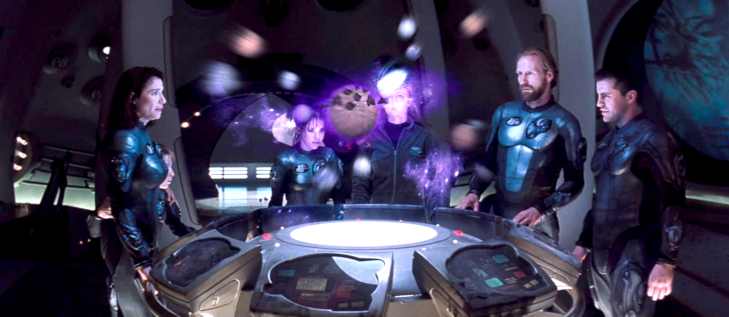
In 2058 a united Earth wants to relocate somewhere that hasn’t been ecologically ruined. The Robinson Family is picked to fly the Jupiter 2 spaceship across the galaxy to homestead the distant planet Alpha Prime. There they will assemble a ‘Hypergate’ portal to allow Earth pioneers to relocate to Alpha Prime in one instantaneous move. Paterfamilias John Robinson (William Hurt) concentrates on his research, and his wife Maureen (Mimi Rogers) thinks he neglects the kids. Grown-up Judy (Heather Graham) is a qualified space scientist and teenage Penny (Lacey Chabert) an impish rule-breaker. Spunky genius Will Robinson (Jack Johnson) pranks his teachers but also probes scientific ideas that would impress his father, if John Robinson ever paid attention.

Nasty terrorists are trying to stop the mission. Space fighter pilot Don West (Matt Le Blanc of TV’s Friends) saves the Earth Orbit’s Hypergate from a terror attack. He then learns that he will be the piloting the Jupiter 2, as terrorists have assassinated the chosen pilot. The launch goes without a hitch, but when the Robinsons go into hypersleep, an on-board defensive robot self-activates and attempts to destroy the ship. It has been reprogrammed by the mercenary saboteur Dr. Smith (Gary Oldman). But the wily Smith has also been double-crossed by his terrorist employer (Edward Fox). Waking up as an involuntary stowaway, Smith must help the Robinsons save the Jupiter 2, just to save his own skin. He becomes an untrustworthy, potentially treacherous fellow traveler.
As in other fantasy space missions, amazing technology finds a solution for every problem. The Jupiter 2 is falling into the sun, and the only way out is to put the ship into Hyper Mode. That lets it pass through the sun but deposits the Robinsons way out in the cosmos, who-knows-where. A combined effort keeps the damaged ship ‘afloat,’ but the nefarious Smith keeps trying to take control. The ship seems to have slipped somewhat into the future, as they encounter a derelict ship that has been trying to rescue them for years. They must deal deal with a monstrous alien infestation, a species of spider than can live in the vacuum of space.
The Family also adopts a ‘cute’ space creature called a Blarp or Blawp, a hairless monkey with the enormous eyes of a Merrie Melodies cartoon character. The Blarp is along for the ride — it doesn’t figure in the storyline or really do anything. The CGI animation is not bad for 1998, though.

The Robinsons eventually crash on an icy planet, where they investigate a force-field dome. Inside is a ‘power core’ that can re-energize the stricken Jupiter 2. Young Will’s ideas about time travel are proven, for they encounter ‘future’ versions of both Will and Dr. Smith. The adult Will (Jared Harris) wants to use the core to time/space travel back to Earth. Dr. Smith has become an alien monster, as he has melded with that nefarious species of space spider.
More detailed complications could continue for four pages, but we’re being merciful here.
Retained from the TV show is the ship’s massive robot, its booming voice provided by the original talent Dick Tufeld: “Danger Will Robinson”. Young Will can participate in various monster battles via ‘hologram control’ of the robot. As if operating a drone, he shoots the nasty spider monsters by remote control. Will also ‘tinkers together’ needed inventions, while fixing stuff for his older sister Penny. But his father (sigh) just doesn’t take him seriously. ‘Gee, if dad only listened to my time travel theories, everything would be peachy.’
The Robinsons work out their family conflicts in the gaps between constant catastrophes: wife vs husband and father vs kids. John and Don squabble over who is in command. The trickster Dr. Smith plots against all of them.
There’s of course a budding romance ‘twixt Judy and Don, which has appeal because Graham and LeBlanc do their best to make it cute and frisky. It might go somewhere if not for the awful dialogue, which makes LeBlanc’s Don behave as a persistent horn dog. Every line is a lame smart remark, laced with a hollow cliché or a bad sex pun: “Why don’t you just hang on to your joystick?”

Lost in Space is first and foremost a mass bombardment of CGI eye candy. It begins with an elaborate space battle and never lets up. The noise, threats, agitation, explosions and mishegoss occurs over and over again, repeatedly, without end. You know, it’s that word … redundant! This must have cost a pretty penny indeed, as so much of the show is augmented by CGI or entirely animated with computer graphics.
There is a genuine information overload in the onslaught of new designs and fancy animated technology. A kid of 12 will let this sort of thing wash over him, soak it up and take it for granted, as if drama is best served as an unending video game. It’s difficult to appreciate any spectacle, when a new MAJOR ATTENTION ISSUE arrives every ten seconds. Viewers seeking a story and characters to appreciate won’t find much … but we reluctantly agree that not everything has to have ‘something to say.’ Lost in Space certainly delivers the aforementioned eye candy.

But that screenplay … yikes. The soundtrack layers on tons of ‘radio exposition’ dialogue: everybody dumps out information to people who already know said information, because it’s really being said for the benefit of the audience. It’s practically a radio show — narrating itself to keep distracted viewers on the same page. We’ll bet that Lost in Space would be much more engaging without the constant, idiotic info-jabber. A lot of exciting things are happening. If the radio talk were cut down, we’d pay more attention to the visuals and participate more closely in the thrills. End of unwelcome opinionizing.
Lost in Space has plenty of good acting, with Hurt, Rogers and Oldman straining mightily to keep the show on its feet. They earned every dime they were paid. We can see where New Line’s money went — into sophisticated design work and hundreds of complicated, fully CGI animated shots. There are so many ‘miracle’ visuals that we soon stop seeing them as special. The finale sets up an immediate sequel — another Hypergate jump may take them closer to Alpha Prime. Two more movies were planned but never filmed, perhaps to form an extended ‘Robinson Crusoe Odyssey.’


They dubbed Jared Harris’s voice in post-production for the original release, much to his displeasure. Not sure if that’s retained in this version. Harris is certainly much better known now.
I recall watching this on Cable – but don’t remember anything else about it.
I saw it on a 5-inch screen on an airplane. Didn’t remember it much either.
I thought it was okay, and have the DVD in my collection, just because I also have the whole original series on DVD. Maybe I’ll watch it again, but I doubt my thoughts will change. It always seemed to be a mess of a movie, especially spider Smith. Yuck. And why did their version of Penny have to be such a teenage cliché b***h?
This is one of the worst major studio movies I have ever seen. When I bought my first DVD player, it was one of ten free movies that came with it. Free, and I still wanted my money back.
Ha! I remember that policy … was it that alternative format that gummed up the DVD rollout for several years? They were giving away movies they couldn’t get rid of !