


Ever since we were kids reading Famous Monsters and watching TV shows about space travel, we thought George Pal’s Destination Moon was the first coherent movie about the nuts and bolts of space travel. There was nothing before that besides Fritz Lang’s 1929 Frau im Mond, which introduced the count-down but had its moon rocket blast off from a pan of water, and depicted a moon with a breathable atmosphere. In between there nothing beyond Buck Rogers fantasy … until an entry in the 1984 Hardy Film Encyclopedia of Science Fiction dropped mention of a 1936 Russian film that sounded amazing. Kosmicheskiy reys: Fantasticheskaya novella was clearly something we’d never see — until effects specialist and Sci-fi historian Robert Skotak helped assemble a traveling exhibition of Soviet-bloc fantasy. Included were marvels by Karel Zeman, Jindrich Polák and Jan Schmidt … and this elusive Soviet silent. Kosmicheskiy reys has its share of scientific eccentricities, but it’s produced far more elaborately than either Lang or Pal’s picture.
To my knowledge, this show is almost totally unknown outside Sci-fi collector circles. A weak DVD came out in 2010 or so; it looked okay. Then no action until a couple of months ago, when correspondent Matt Martell tipped me off to the existence of a new Blu-ray from the German Ostalgica company. It is a massive improvement.
Imagine a Soviet space film about a journey to the moon, filmed during the Stalin era, that is almost as scientifically accurate as Destination Moon made twenty years later. The movie was released for only a short time in 1936 and since then has been virtually unknown. Now it can be seen.

Only after the Second World War, when the Germans’ deadly V-2 weapons had proven what rockets could do, was space travel considered a real possibility. We had thought that Soviet space movies began in the late 1950s, reflecting pride in their Sputnik satellite and manned space program. A few Eastern-bloc movies depicted the brave scientists from harmonious socialist nations on lavish space flights: Nebo zoyvot (The Heavens Call), Mechte navtrechu (Toward Meeting a Dream), Planeta bur (Storm Planet), Der schweigende stern (The Silent Star) and Ikarie XB 1 (Voyage to the End of the Universe). Original versions of these films did not become widely available in the West until the collapse of the Soviet Union.
The title Kosmicheskiy reys: Fantasticheskaya novella translates literally as “Space Flight: A Fantastic Story.”
The film harnesses impressive special effects to tell a simple story set in the ‘future’ year of 1946. The white-bearded visionary academic Pavel Ivanovich Sedikh (Sergei Komarov) has overseen the construction of a Cosmodrome called the “USSR Tsiolkovsky Institute of Interplanetary Communication” (TIIC). Two enormous spaceships lie horizontally on their cradles, ready for launch: the Joseph Stalin and the General Voroshilov. General Kliment Voroshilov’s name on the rocket carries a definite chill factor: the general would soon become a major player in Stalin’s deadly purges, personally denouncing army officers and offering his name as a signatory to at least death warrants.

Young flight officer Viktor Orlov (Nikolai Feoktistov) agrees with administrator Professor Karin (Vasili Kovrigin) that the elderly Pavel should not go on the moon flight. A rabbit shot into space has returned dead of a heart attack, giving weight to Karin’s objections. Karin insists on shooting another probe to the Moon’s surface, carrying a live cat.
Old Pavel is way ahead of his comrades. Before he can be officially pushed aside, he impulsively launches the Stalin on his own authority. He asks his associate (and Viktor’s sweetheart) Professor Marina (K. Moskalenko) to accompany him, and receives an enthusiastic “Yes!” Pavel’s dotty wife insists that he take along a pair of warm boots; she’s been told that the moon is very cold. Pavel invites Victor’s kid brother Andryusha (Vassili Gaponenko) to bring members of his Youth League to witness the launch. The impetuous Andryusha stows away on the Stalin at the last moment.
Once free of the Earth’s gravity, the trio enjoys the weightlessness of the space voyage. The moon landing is successful but a ruptured pipe allows the ship’s oxygen supply to escape, jeopardizing the return trip. The radio doesn’t work and they are also unable to locate the probe missile containing the cat-cosmonaut. Undeterred, the voyagers leap about the moon’s surface, and spell out the letters “CCCP” in lights that can be read from Earth. When no radio contact can be made, Professor Karin assumes that the Stalin is disabled. He orders the second rocket General Voroshilov prepared as a rescue craft. Meanwhile, Pavel has fallen into a deep moon crevasse and cannot signal his comrades. The impromptu moon flight may end in disaster.

The plotline of Kosmicheskiy reys may be juvenile but its science is not. Theoretically speaking, Russia was way ahead of the world regarding practical space travel. Russia’s Konstantin Eduardovich Tsiolkovsky (1857-1935) was writing about space travel in the 1880s. His 1903 scientific study of the subject addressed most of the basic concepts, such as calculations for escape velocity. The brilliant Tsiolkovsky is also credited with inventing the space elevator, a concept popularized in Arthur C. Clarke’s 1979 science fiction novel The Fountains of Paradise. Kosmicheskiy reys is adapted from one of Tsiolkovsky’s books and the science in the film is based on his teachings.
The movie Kosmicheskiy Reys was commissioned by the Communist Youth League Komsomol to promote science among Soviet children. But as happened with many state-controlled films during the Stalin years, it was withdrawn soon after its premiere, possibly for its failure to follow the approved Social Realist style. The Cosmonauts’ playful adventures on the moon did not sit well with censor requirements that every Soviet film promote a narrowly defined collectivist ideology.
But the Stalin’s mode of launch suggests that Kosmicheskiy Reys did see screenings abroad. The ship shoots skyward up a mile-long inclined ramp, (Top image ↑ ) a fanciful idea that was re-used just the next year in the impressive German short subject Weltraum Schiff 1 startet…. The ramp idea definitely saw practical real-life service with the Nazis’ dreaded V-1 cruise missiles. George Pal adapted the ramp idea as a dramatic mode of launch for the Space Ark in his 1951 epic When Worlds Collide. A hangar-ramp construction identical to this movie appears in the English film Satellite in the Sky (1956).
A major Stop-Motion Achievement.
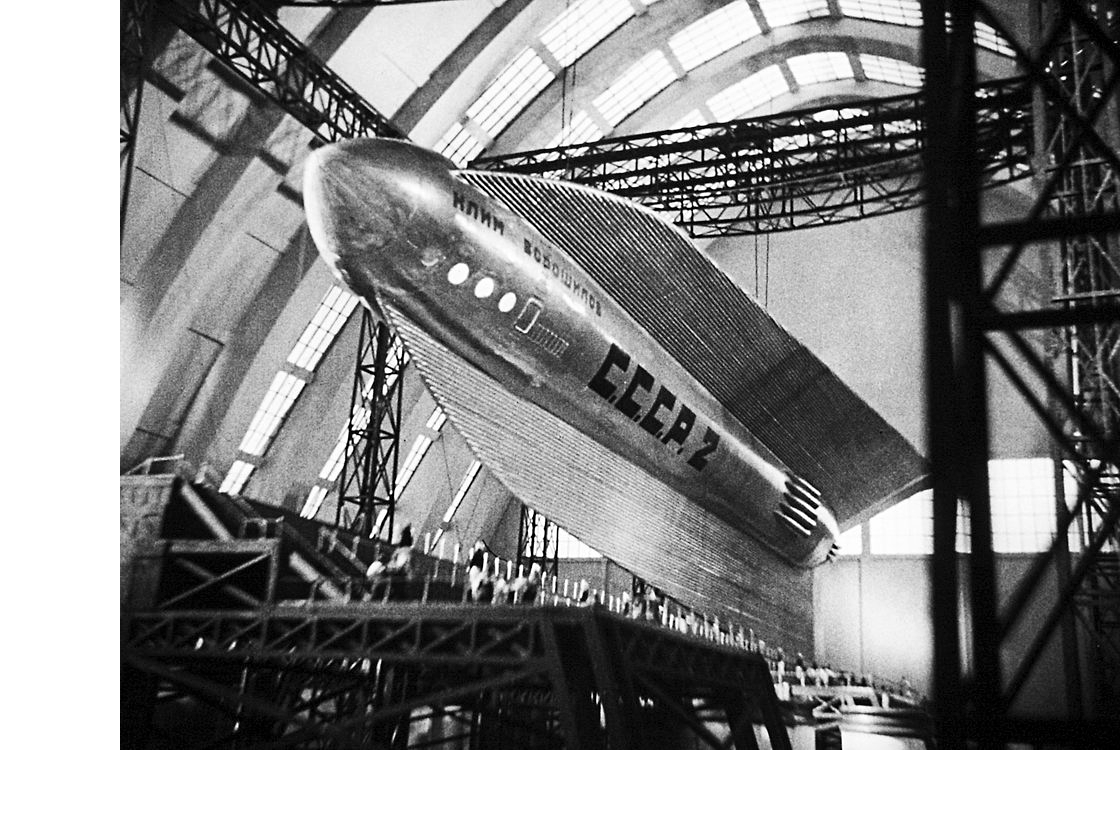
Kosmicheskiy Reys’ space ships, their gigantic hangar and the surface of the moon are miniatures more elaborate than in any science fiction film until Stanley Kubrick’s 2001: A Space Odyssey. Special effects designer and animator Fodor Krasne introduces the twin rockets in a seemingly endless stop-motion animated trucking shot down the full length of the ships lying in their launch cradles — two minutes and five seconds without a cut. The intricate scene includes scores of moving cranes, vehicles, and workers. Still images from the film give the wrong impression about the shape of the twin rockets — they’re actually very long, like torpedoes.
Several exterior sections of the rocket and its gantry were constructed full scale, and the entrance to the Tsiolkovsky Institute resembles a spacious white hotel lobby. The rocket interior is a sturdy construction of steel that appears capable of carrying a dozen Cosmonauts. One very interesting detail is a line of glass water booths along one bulkhead. The space travelers launch and land while submerged in water, to protect them from the physical shock. The sight of the three voyagers sitting as the booths fill with water around them reminds us of the ‘disintegration tubes’ in the later This Island Earth and similar apparatus in Forbidden Planet that enable humans to travel at near- light speed.

A few of the moon scenes merely double-expose the actors in front of obvious painted artwork. But sophisticated stop-motion animation techniques are used to show the spacemen leaping about the rugged lunar terrain, just as in H.G. Wells’ book First Men in the Moon. The realistic puppets are smoothly animated, as is the camera that follows them across the lunar landscape. Fine wires support the spaceman puppets when they jump, and even do back-flips. It’s Harryhausen ‘aerial brace’ work, albeit with rather visible wires.
The art directors give the Cosmodrome a Things to Come look; the Institute is topped by a statue atop a tower that reminds us of the Mosfilm logo. The launch ramp looks like a giant suspension bridge. The hangar interior may be the biggest and most elaborate stop-motion miniature setting ever built. The surface of the moon is an endless field of jagged rocks with dangerous deep fissures. Leaping like frogs is the only safe way for the Cosmonauts to get around.
Kosmicheskiy reys repeats Fritz Lang and Thea von Harbou’s notion of a technical mishap that threatens the moon mission. Also repeated is the idea of a youthful space stowaway, to provide an identification figure for younger audience members. Old Pavel Sedikh parrots Soviet homilies and repeatedly dedicates his flight to the Youth of Tomorrow. The Youth League scout Andryusha cries only once, when he discovers that his comrades have chosen not to tell him about the oxygen crisis. As a good Soviet youth, danger is a trifle next to his desire to be accepted as a full member of the mission. Andryusha’s ‘useless’ homemade peashooter ends up saving the day: it allows the trapped Pavel to signal for help.

The beautiful Marina mostly provides encouragement through her bright, sincere smiles. She had previously shoved her fiancé for daring to suggest that the elderly Pavel not go to the moon. Pavel Sedikh’s personal pride and individualist ambition apparently rubbed Soviet censors the wrong way. Stalin’s ideologues preferred self-effacing heroes that credit all personal accomplishments to the collective body.
The direction is only so-so, although the movie is always attractive. Continuity can be rough in dialogue scenes. ‘Crossing the 180 degree line’ is an overrated problem but director Zhuravlyov is a real offender — we keep wanting to flop shots to correct issues of screen direction.
Soviet movies and their directors tended to suffer career disruptions, Changes of political tide made some films undesirable. Under Stalin, even a top director might find themselves unable to work for long periods of time. Kosmicheskiy reys: Fantasticheskaya novella was the second film of Vasili Zhuravlyov, a director not well documented in the West. But his screenwriter Aleksander Filmonov also wrote 1953’s Serebristaya Pyl (Silver Dust) a controversial comedy-drama set in the United States. At a time when Soviet and American film representatives competed in publicity-driven ‘culture wars’ at international film festivals, our state department condemned Silver Dust as anti-American propaganda.


This sounds really interesting. Would LOVE a nice blu of Planeta Burg (or Bur, or Bura), too. One of my favorites! “…clearly something we’d never see…” makes me think of, as a kid, seeing pics of Kuroneko in Famous Monsters magazine and thinking pretty much the same thing. Now, however, I own the beautiful Criterion blu-ray and can watch it at my leisure. What a time to be alive!