
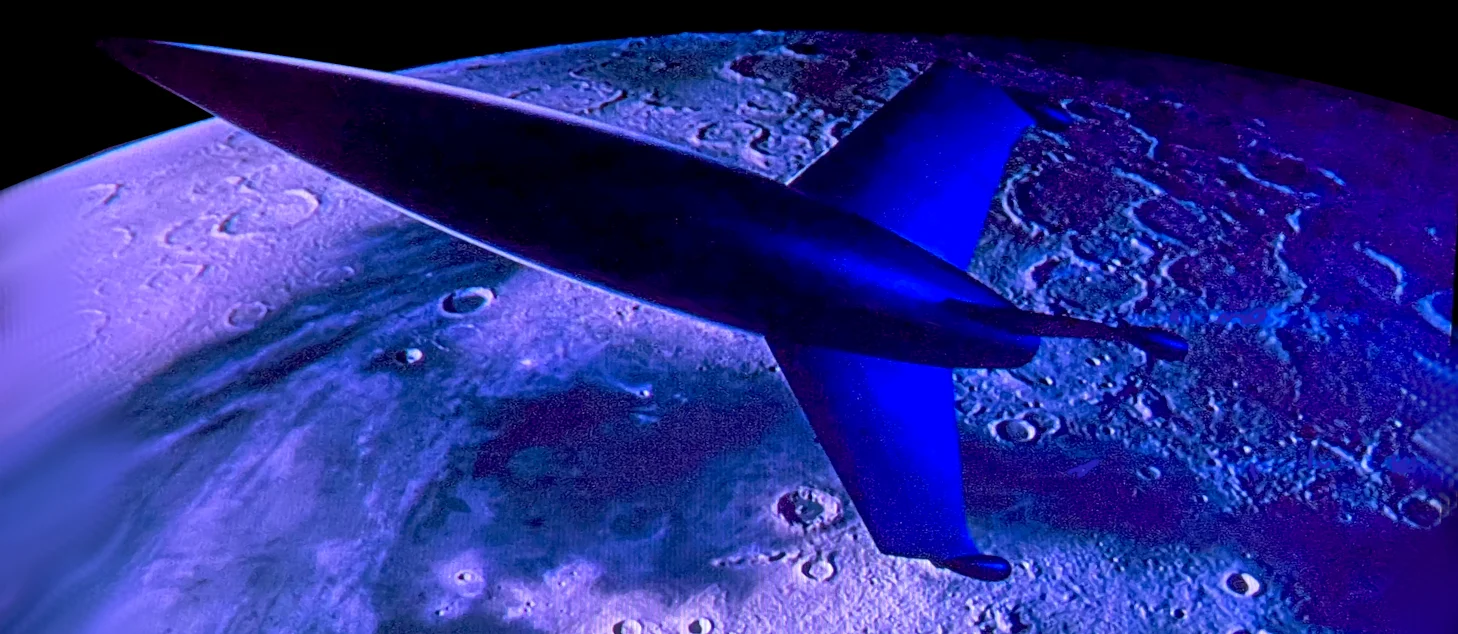


Film Masters can be congratulated on this release: we finally have the science fiction classic Destination Moon in an acceptable Blu-ray encoding … actually, it’s better than acceptable. The only other legit release of George Pal’s movie is a weak DVD from 2000. That old encoding had all the flaws of a Technicolor print transferred on a conventional transfer machine of the time. It wasn’t even intact — the print was marred by jumps where the film had broken.
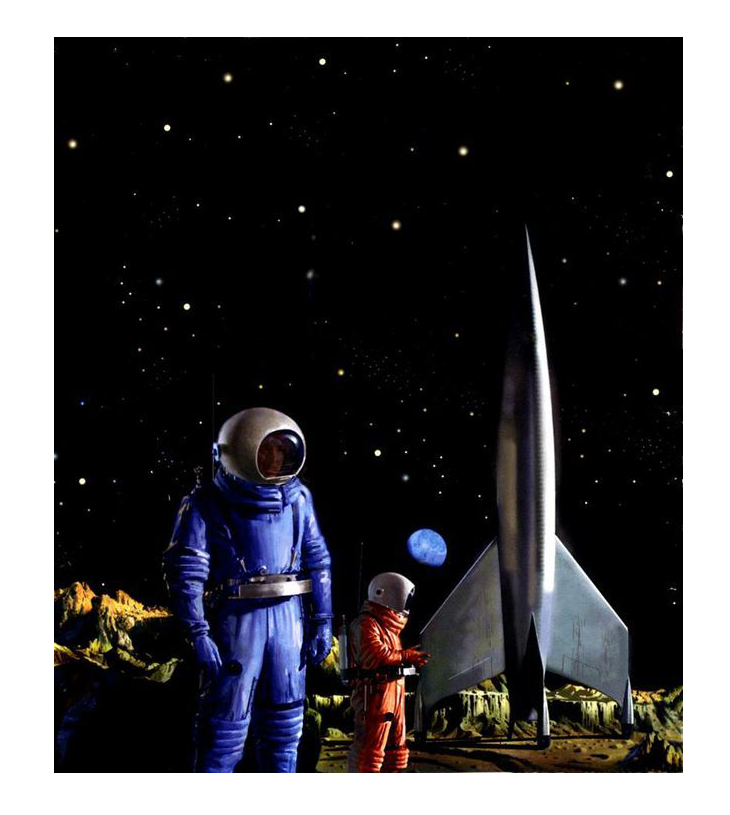
This new disc has the advantage of better technology and extra care. Today’s scanners can pull very good exposures from high-contrast Technicolor, without burning out the whites or clogging up the blacks. The silver rocket Luna and Chesley Bonestell’s paintings of the moon once again jump off the screen as they did 76 years ago. A movie that looks this good plays better as well. This time through, we found Dick Wesson’s dopey comic wisecracks to be an asset. The movie needs somebody with a sense of humor, even if he’s not funny.
When Apollo 11 landed on the moon NBC news showed clips from this movie and Fritz Lang’s Woman in the Moon as the only previous moon-shot space epics based on scientific principles. We’ve now seen a remarkable Soviet production] that has as much technical detail as either of those picture. We’re not sure that the 1936 film played anywhere that George Pal could have seen it before he left for America.
The original story for Destination Moon came from the ace science fiction author Robert A. Heinlein. Before he wrote the seminal books The Puppet Masters and Starship Troopers, one of Heinlein’s earlier specialties was Juvenile Fiction. Screenwriter Alford ‘Rip’ Van Ronkel collaborated with Heinlein on a screenplay of Heinlein’s book Rocketship Galileo. The adaptation dropped the book’s entire third act, in which our teenaged astronauts discover a Nazi rocket base on the Moon. Van Ronkel retained Heinlein’s notion that ‘enemy agents in Washington and paid propaganda’ are sabotaging America’s space effort.
Ex- Puppetoon Oscar winner George Pal was fresh from a lacklustre first feature about a magical squirrel when he got this space project greenlit at the tiny studio Eagle-Lion. The big studios had turned Pal down, but the legendary executive Arthur Krim allowed Pal to assemble a team of independent Hollywood creatives, and proceed with what was then called Journey to the Moon or Operation Moon.
Destination Moon would become the very first film of the 1950’s science fiction craze. The field had previously been dominated by the adventures of Flash Gordon and Buck Rogers. The few speculative ‘serious’ epics were remembered as box office flops, notably the German silent Metropolis and H.G. Wells’ far-fetched Things to Come. Literary Sci Fi was for goggle-eyed boys, and the flying saucer cult was still in its infancy. Just the same, by 1949 creative producers were cooking up Sci-fi concepts — Howard Hawks, Julian Blaustein.
George Pal’s promotional skills yielded a lot of pre-release press coverage, aided by the film’s elaborate moonscape landing site set at General Services Studio. KTLA TV broadcast a show directly from the film set. The socko outer space art of painter Chesley Bonestell had already been featured in national magazines. The hot new movie genre initiated by Pal got traction even before Destination Moon reached movie screens: Robert L. Lippert’s copycat production Rocketship X-M was rushed into production, making it into theaters a full a month before Pal’s color extravaganza.
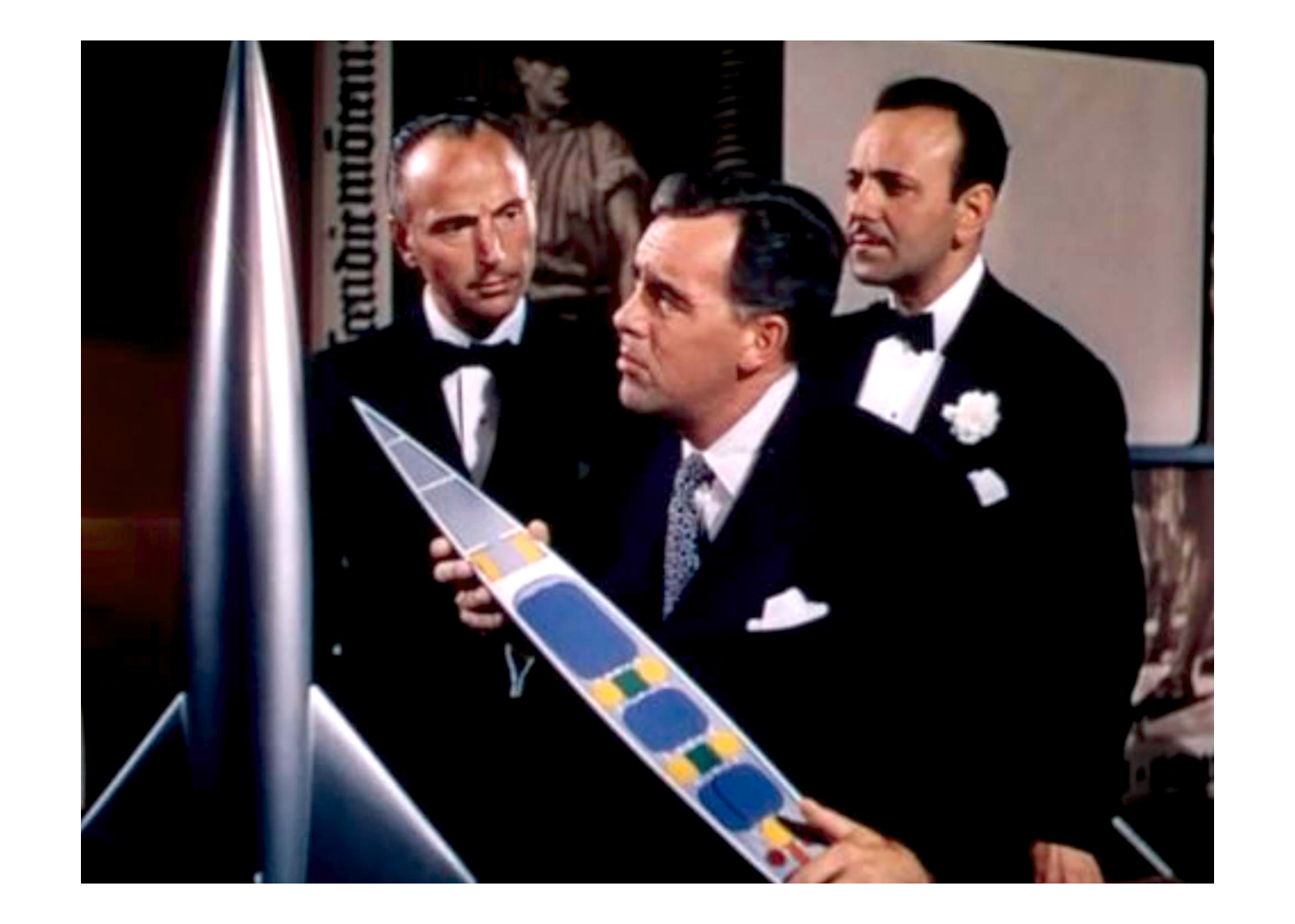
Rocket scientist Dr. Charles Cargraves (Warner Anderson) and space enthusiast General Thayer (Tom Powers) have funded a rocket test of Cargraves’ new atomic rocket engine. When their rocket explodes and government funding collapses, the charismatic General solicits the collaboration of the wealthy aircraft magnate Jim Barnes (John Archer). With millions raised from a group of adventurous and patriotic industrialists, the three build a ship at a desert base.
They’re nearing a launch date when the project is threatened by a public uproar over radiation safety. Barnes proclaims that the ‘danger’ is a lie planted by communist subversives. The three idealists circumvent an injunction to halt their project by launching ahead of schedule. The rush forces them to use an untrained substitute radio operator, Joe Sweeney (Dick Wesson).
In space, they must perform a spacewalk to free a frozen radio antenna, and almost lose a crewman. Barnes’s moon landing uses up too much fuel. They don’t get to do very much exploring before it becomes clear that the ship must be lightened if their remaining fuel is to get them home. That ‘cold equation’ cannot be solved by trying harder or hoping for the best. No matter how much equipment they throw overboard, one astronaut will have to stay behind …
If the show now seems too primitive, viewers need to squeeze themselves into the mindset of 1950, when Destination Moon was the imaginative wonder of the screen. Science was largely taken for granted, or blamed for the world’s ills. Few people then had a clear notion of what space really was. This was the film that first introduced the world to the concept that space travel was a real, practical possibility.
The arrival of the atom bomb was the big wake-up call. Big Science was now the province of national security. The Pentagon and Wall Street were on a high-technology roll. Big new companies were already building giant computing machines …
Welcome to Space School.
George Pal added a Disney-like ‘infotainment’ section to his movie, in the form of a Woody Woodpecker cartoon spelling out the basics of space travel in a way any yahoo could understand: action and reaction, the vacuum of space, the notion of zero gravity. Five years later, Walt Disney created an expanded version of this animated ‘Space Primer’ with a TV show designed to sell the public on the need to allocate Big Buck$ to what would soon become NASA. The eventual three TV shows Man into Space, Man on the Moon and Mars and Beyond were consolidated on a marvelous Disney disc. It is long OOP, but might be available on the Disney streaming channel.
Destination Moon is a basically a docu-drama that stays focused on the nuts and bolts of the space voyage. Our moon voyagers are dedicated idealists. There is no romance angle. Dr. Cargraves’ wife bids him farewell at the launch site, and is barely mentioned again. Dick Wesson’s last-minute crewmember Joe is a good-natured Brooklynite disinterested in space because it has ‘no baseball, no beer and no babes.’ His character is a holdover from WW2 movies, a Sad Sack who knows nothing. He therefore asks lots of questions that solicit an unbroken stream of technical exposition. Joe was always the film’s most criticized aspect. As an audience surrogate, he learns about things like weightlessness first-hand. His co-astronauts are patiently condescending. Joe is a good and noble mascot. When it’s time to execute the ‘cold equation,’ he volunteers to be the spaceman left behind.
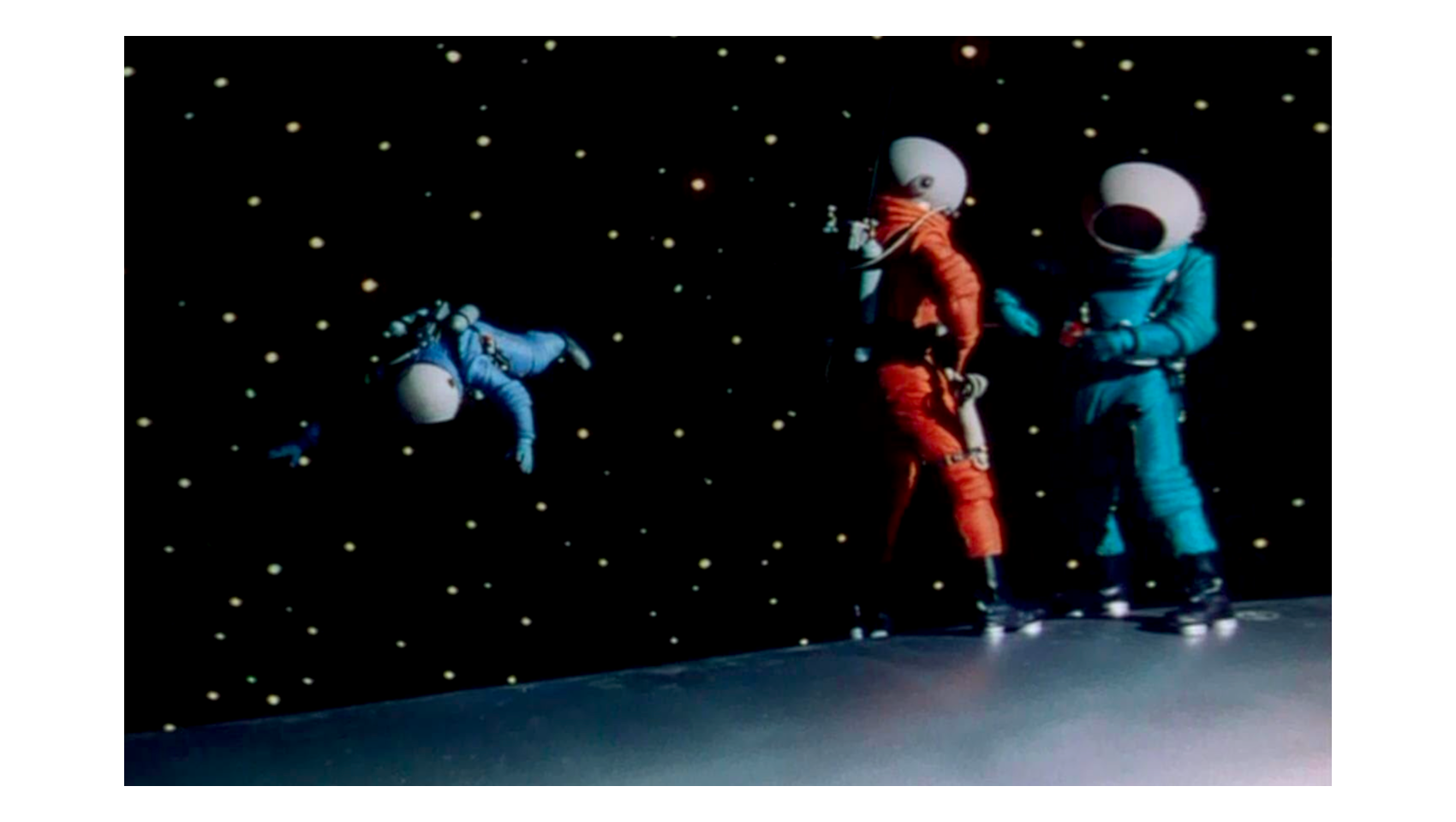
What makes Destination Moon such pure hardcore Science Fiction? Drop the ‘atomic rocket’ business, and there’s nothing fanciful about the science. Even 2001, with its aliens and mystical hoo-haw, is more of a fantasy. Fritz Lang/Thea von Harbou’s Woman in the Moon (1929) may have introduced the Countdown but their rocket looked like an ugly cannon shell. Destination Moon’s dazzling Luna set the style for spaceships in the Sci-fi boom. Featureless, dart-shaped chromium rockets would dominate the screen for years, until authentic space hardware became commonplace.
When the real-life Apollo moon landing came in 1969 the parallels to Destination Moon were noted by many. The basic flight mechanics are similar. The spacemens’ untethered space walk is technically accurate to later EVAs by Mercury astronauts.
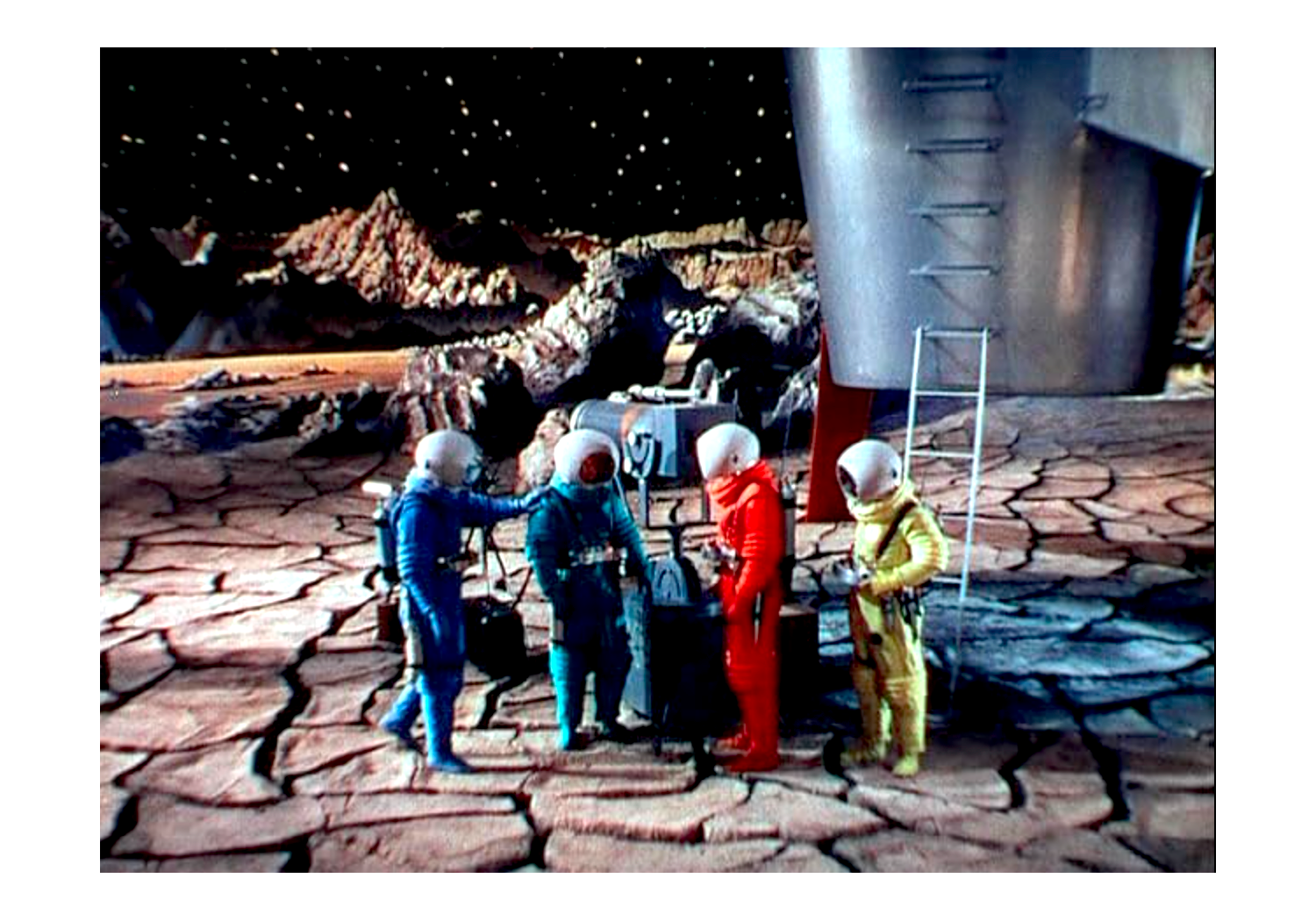
The Luna has no separate landing capsule. The whole rocket can land on the moon’s surface, the better to look GREAT in Chesley Bonestell’s dramatic paintings. Just as in the movie, Neil Armstrong’s descent to the lunar surface in the Eagle required a last-second sideways maneuver to find an appropriate landing site. Luna’s landing maneuver expends too much of the atomic engine’s ‘reaction mass.’ The writers apparently thought the word fuel sounded too conventional.
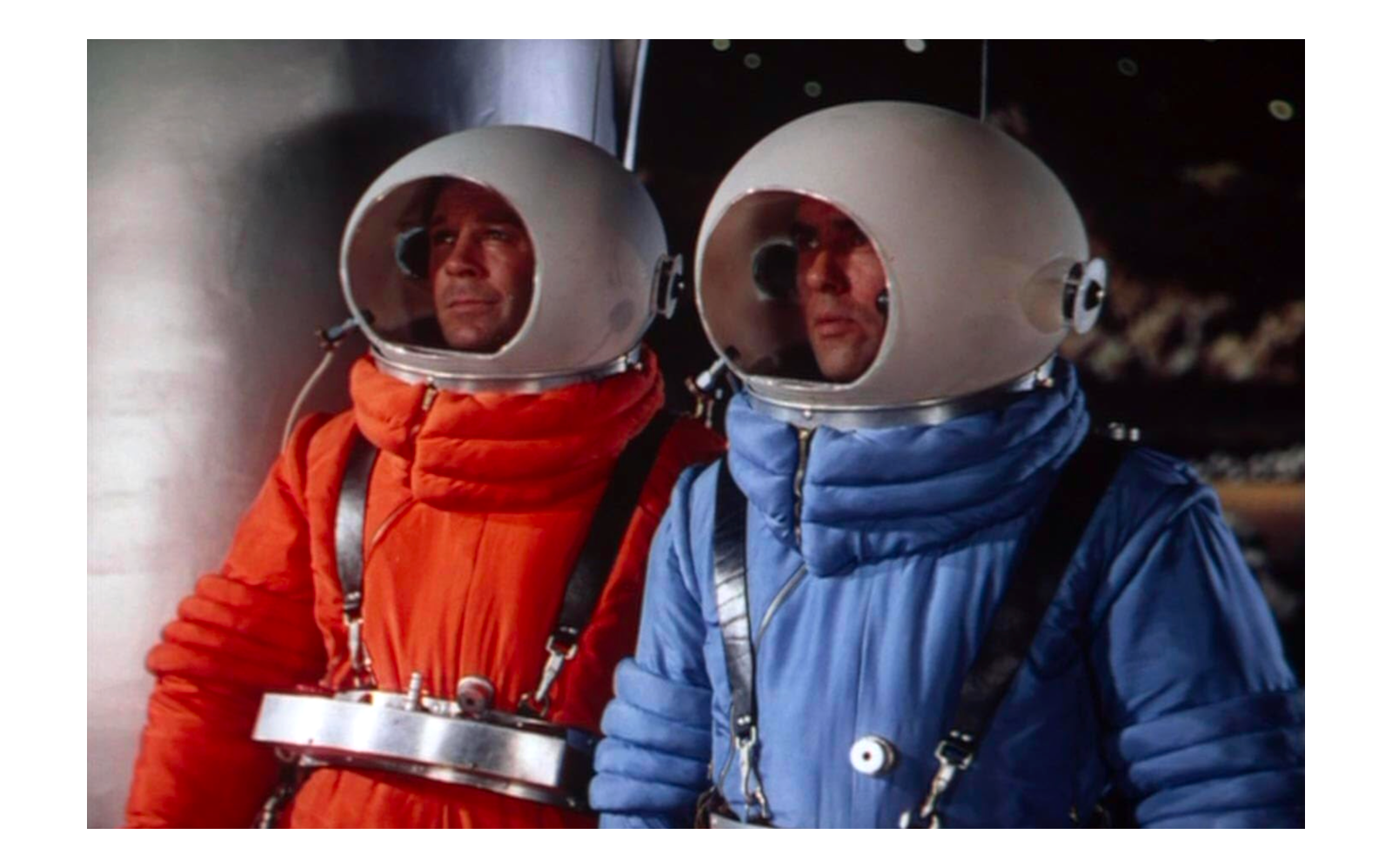
When Luna voyagers formally claim the moon, Dr Cargraves speaks the formalities:
“By the grace of God, and the name of the United States of America, I take possession of this planet on behalf of, and for the benefit of, all mankind.”
We’re not 100% sure about that wording. ‘Taking possession on behalf of all mankind’ makes us wonder if the U.S. will be the legal owner and gatekeeper. By contrast, Neil Armstrong’s words (and the plaque left on the moon ) make it sound as if we Americans are passing up formal ownership:
“That’s one small step for [a] man, one giant leap for mankind.”, and, “Here men from the planet Earth first set foot upon the moon. July 1969 A.D. We came in peace for all mankind.”
I wish that spirit were still alive. We weren’t like Spaniards claiming everything in sight for Queen Isabella. Had the Soviets landed first, would they have been as magnanimous, or would they claim the moon only for the collectivist workers’ bloc?
Millionaire aircraft playboy Jim Barnes is clearly modeled on Howard Hughes; the idea that powerful businessmen would outpace and outperform the government in space adventurism has been borne out with this century’s billionaire oligarchs, the movers and shakers that are trying to reshape society along less democratic corporate lines.
One of the moneybags bankrolling the moon shot is a drawling Texan who jokes that they’ll have to build the rocket in the Lone Star State becasue it’s the only one big enough to hold it. Soon after the space program got rolling, Lyndon Johnson moved NASA’s headquarters to his home state of Texas.
Most of the active community of Science Fiction authors and cognoscenti welcomed the technical fidelity of the voyage of the Luna, only to feel betrayed by the ensuing wave of Sci-fi thrillers. Ten or so ‘A’ productions would follow, but none continued the semi-documentary approach. Destination Moon had broken the Science Barrier, but for the majority of what followed, science became an excuse to get to the good stuff — invading aliens, ray guns, mayhem and disaster. Writing in a 1952 article in the Journal of the British Interplanetary Society, none other than Arthur C. Clarke ridiculed lack of basic scientific values in George Pal’s own follow-up production When Worlds Collide. Five years later, when Pal again attempted a pure docu-drama approach, bad-faith studio politics lumbered his Conquest of Space with buffoonish comic relief and ridiculous melodrama.
And then there’s the Cold War aspect to deal with.
Destination Moon’s screenplay was not written by pacifists. The Space Race was a noble quest ‘for the benefit of mankind’ yet also a drive to claim the orbital high ground before the Soviets. Government promotions mainly allowed messages saying that space avionics would have a positive effect on the national defense. We don’t think that Washington forced militarist messages on the early Sci-fi pictures, yet the classics put across some truly threatening Cold War sentiments.
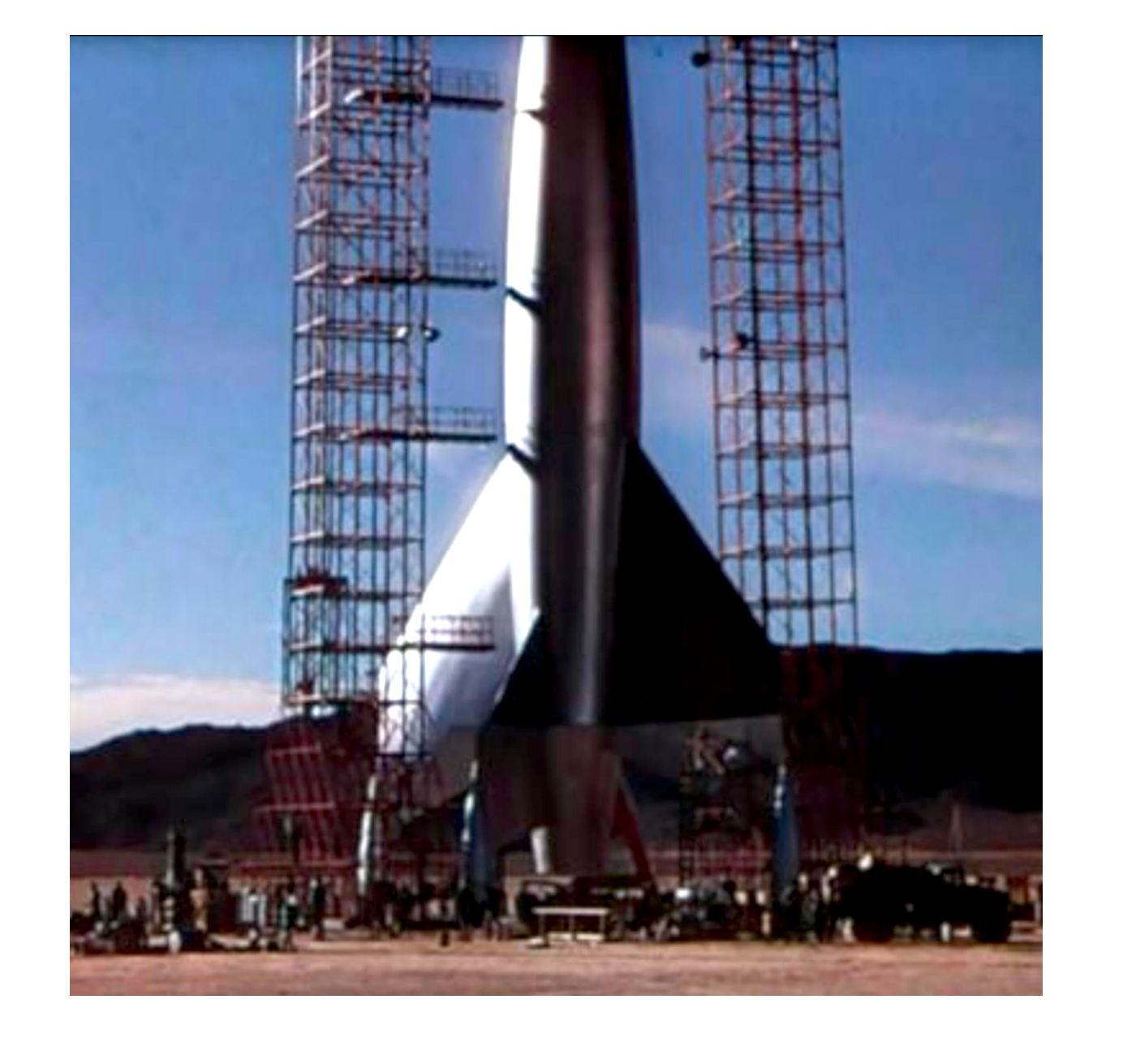
The aggressive attitude is front and center in Destination Moon. Jim Barnes’ pricey moon project is a no-go until its promoters play the ‘Red Card’ — sermonizing that whoever reaches the moon first will militarily control the Earth. Only then do the industrial millionaires fall obediently in line, doing “what the government can’t do” – i.e., fund necessary military-space projects.
What a fantasy, flattering the military-industrial complex as paying for our defense, rather than profiting from it.
The exact same argument is behind the top-secret rocket project in Invaders from Mars. Its aim is to put nuclear weapons in orbit, where ‘any enemy that dares attack us can be wiped out with the push of a button.”
Jim Barnes and General Thayer blame communists for undermining the rocket’s support, and for direct sabotage. Howard Hawks’ The Thing from Another World indicts the very notion of scientific values not directly linked to national defense. Its professor Dr. Carrington is depicted as an egghead misanthrope, who ‘doesn’t think like us.’ He also wears a Russian-style fur hat. Don’t trust scientists like Oppenheimer, is the message. The absurdly exaggerated Carrington places knowledge above human lives. His zeal is rejected as both inhumane and defeatist … we don’t want to understand invading aliens and communists, we want to destroy them.
The giant ants of Them! are apolitical, but a pure menace that must be ruthlessly eradicated. Yet the paranoid context and forceful visuals suggest an anti-Red message. We’re entering a post-Atomic conflict in which we must set aside humanitarian considerations and steel ourselves to wipe out obvious Enemies of Freedom.
Robert Heinlein’s scripted message is direct: disloyal elements in Washington are crippling America’s defense … at a time when Military expenditures were actually growing exponentially every year. ‘Paid propaganda’ headlines spur Jim Barnes to become ultra-secretive, lie to the authorities and break the law. We wonder why Barnes is so certain that his rocket is safe — it hasn’t been fully tested. Our first American moon heroes thumb their nose at a court order to delay their launch, just because they might poison the Earth with a reactor-load of plutonium. American know-how doesn’t make mistakes like that! Let’s hope that Joe Sweeney didn’t grease the reactor’s cooling valves, the way he did the ship’s radio antenna.
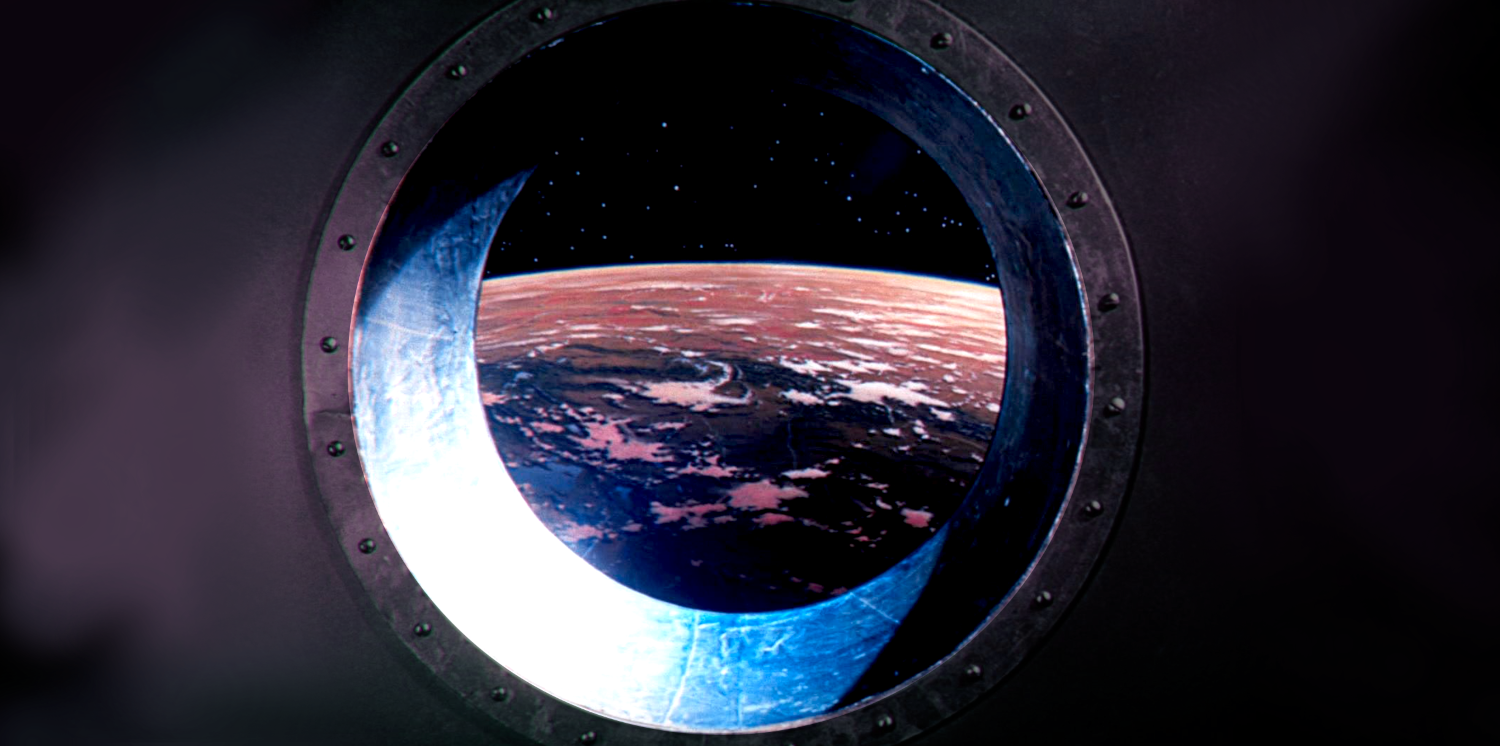
The happy verdict for Film Masters’ Blu-ray of Destination Moon is that we like it. The image beats the old DVD in every respect. This encoding looks as good on a 65″ screen as it does on Film Masters’ website clips. We are now accustomed to The Warner Archive’s lavish Technicolor remasters that source original 3-strip elements and digitally recomposite them. The source for this remaster appears to be a Technicolor print. Film Masters says that their remaster began with a 4K scan.
This looks much better than a ‘digital restoration’ performed on somebody’s laptop. All of the movie is reasonably sharp and almost all of it exhibits an attractive Technicolor look. The stars as seen in outer space were more than just one color; we can see the hues but I remember them being a little more colorful. It looks very handsome on my 65″ LG display. We wonder if the transfer was taken from the same Wade Williams collector’s print that was sourced in 2000.
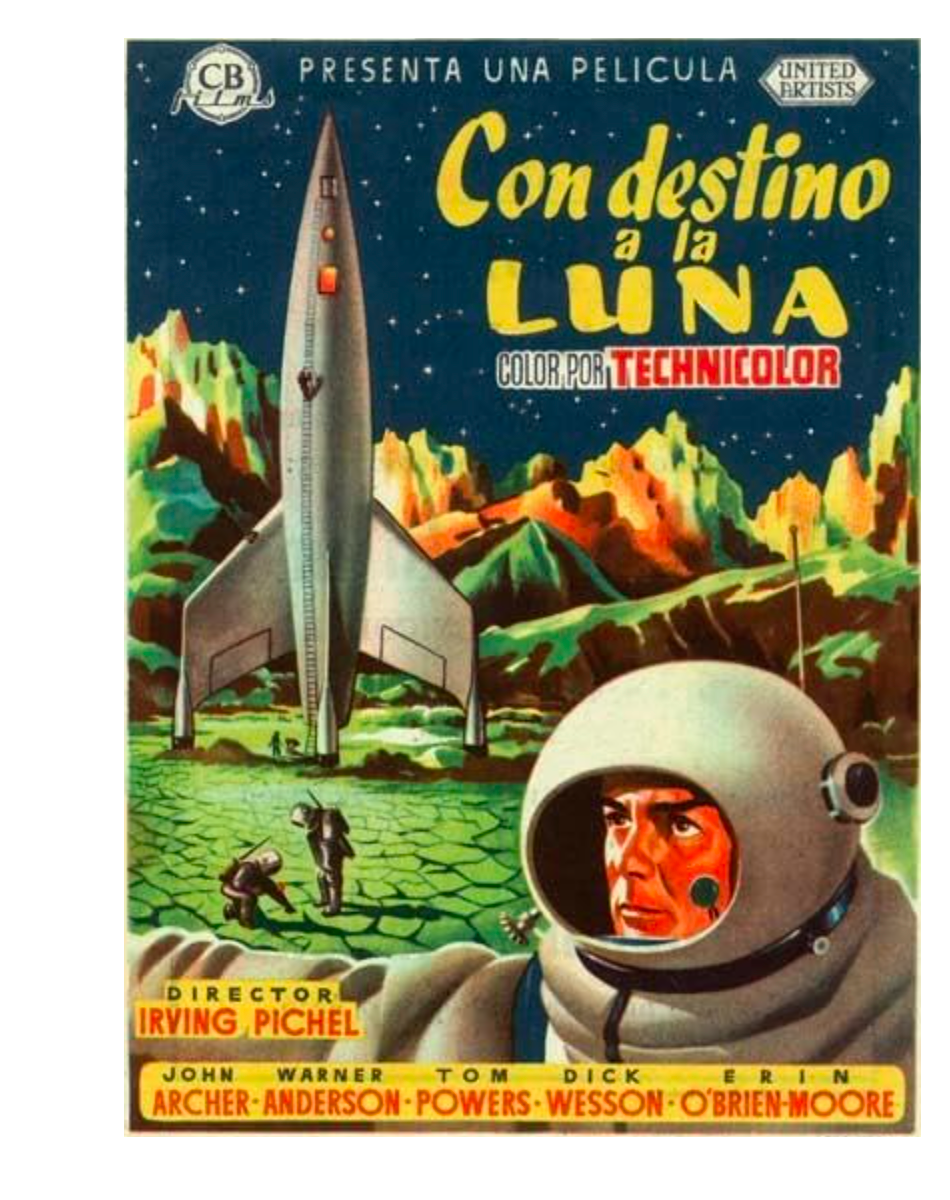
The flaws we see are minor. On our one viewing we noticed a number of tiny jump cuts, which we think is where frames were removed. The new digital technology makes the ‘splices’ look invisible, without marks on the picture or an image shift going through a film gate. There are not many of these 1-frame jumps. Either they ceased, or I stopped noticing them.
The jump cuts may indicate that only one Technicolor print was available. The restorers of Detour used other sources to replace missing shots and frames, as do studio remastering managers that must work with damaged original negatives.
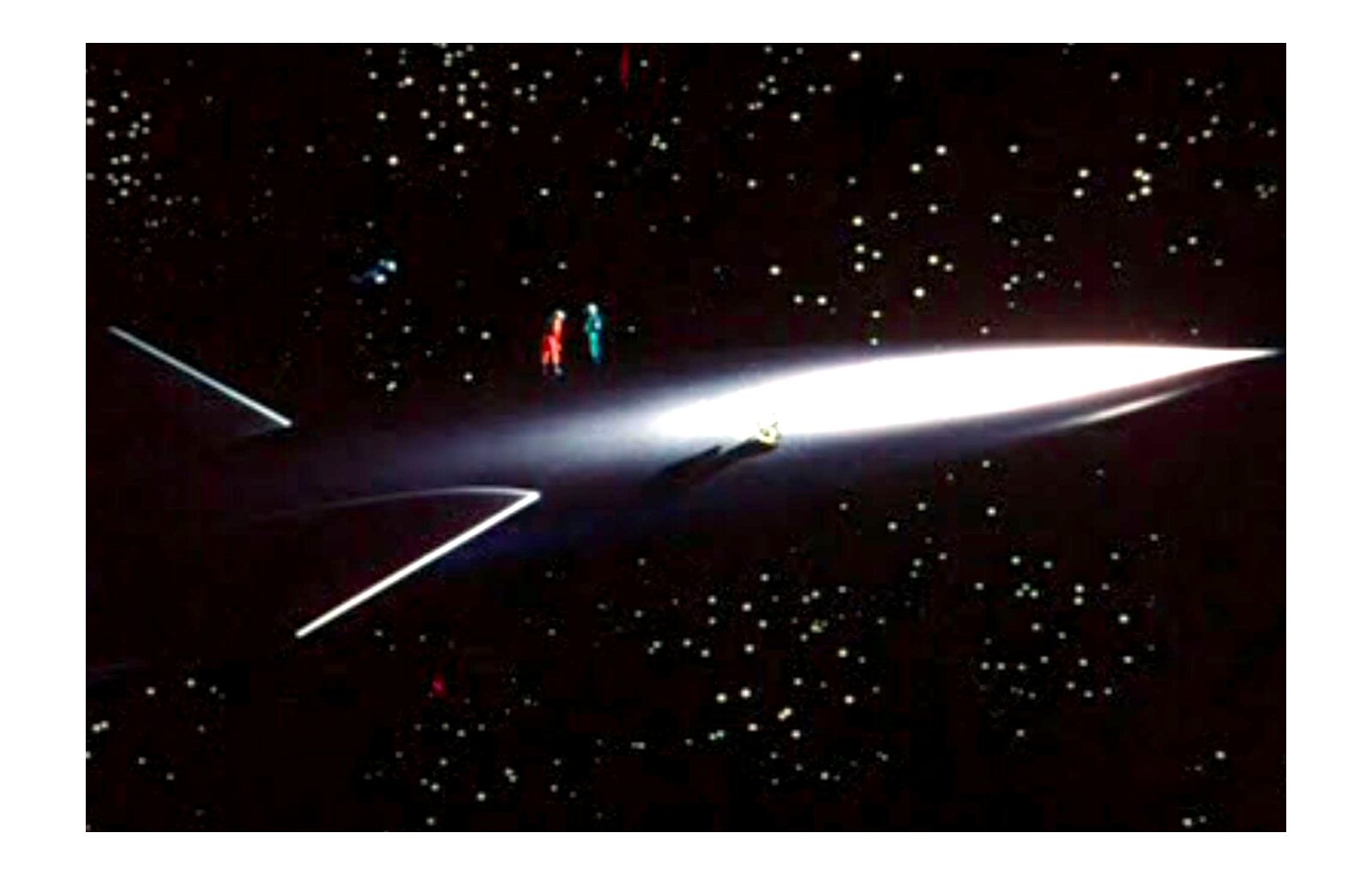
We really appreciate the improvement in the special effects scenes. The matte paintings are excellent in design and execution. Many shots use stop-motion animation, when human figures walk on the outside of the ship, or climb down to the moon’s surface. Robert Heinlein described the miniatures as being something a watchmaker might construct, and the added sharpness lets us see the detail. Yes, in our favorite space view, we can now see that the Luna is suspended by very thin wires. Only spoilsports will issue demerits.
Film Masters’ extras begin with a separate disc encoding of the full Walter Mirisch feature Flight to Mars, Monogram’s budget answer to Destination Moon. The good news is that it appears to be the same or very close to Film Detective’s excellent restored Cinecolor disc release from 2021. The chapter stops are in different places but the image looks the same. The extras mostly line up as well — the commentary by Justin Humphreys is here, plus the featurette on Mirisch and an extended version of Film Detective’s Interstellar Travelogues featurette.
Destination Moon carries a 23-minute Ballyhoo making-of documentary, plus its own Justin Humphreys commentary. A nice plus is that the commentaries have their own subtitle tracks. A 14-page insert pamphlet has a general essay by Sloan de Forest.
Was this remaster of Destination Moon sourced from a Wade Williams’ 35mm film print? We have some comments to make about film collectors and movies we sometimes can’t see on video disc.

The situation involving Kronos is seems quite complicated. Apparently Williams obtained some, but not all, rights to the picture from the former National Telefilm Associates, who had previously licensed the picture to the old Nostalgia Merchant label for VHS release. Both NTA and Williams filed for copyright renewal in the Spring of 1985. If NTA won (and it seems like they did) the title would now be held by Republic Pictures, who now control the Lippert/Regal productions that NTA held.
I still hope to see a clean Blu-ray of this title before I cash out, but I’m despairing. Fortunately, there is an available bootleg DVD apparently taken from a licensed Italian release that, while not the cleanest transfer, is aspect-ratio correct and miles better than the Williams/Image letterboxed disc from years ago. I hope Film Masters can straighten it all out.
Thank you Mark, I am of the exact same sentiment…
As usual, great in-depth review!
George Pal was only able to obtain financing for DESTINATION MOON by agreeing to a two-picture deal with Eagle-Lion. The assumed profit from THE GREAT RUPERT would reduce the financial risk of making DM. DM was delayed by months while most of the production crew were pressed into the shooting of THE GREAT RUPERT. Irving Pichel would end up directing both movies as well as narrating the Woody Woodpecker piece.
When “Rupert” failed at the box-office, not only the studio but Pal himself faced financial ruin if DM faltered too. Robert Heinlein gave great credit to both Pal and Pichel for ignoring the relentless pressure exerted from the panicked studio to ‘jazz up’ their ‘moon picture’.
The above is all related in much greater detail in William Patterson’s two-volume biography of Robert A Heinlein. Mr. Patterson also contributed extensive notes to Volume 44 of The Virginia Edition of the Works Of Robert A Heinlein which is devoted to RAH and Destination Moon– PLUS (ahem) 1953’s PROJECT MOON BASE.
On a whim I bought the “Mythical Popcorn” DVD release from Amazon, and was depressed to see the notation on the back cover that it was “4:3”!
However, it is in fact in the Regalscope format and looks pretty good, much better than the windowboxed Wade Williams version.
Say no more … can’t resist checking this out.
Film Masters TV is premiering Kronos on YouTube July 3.
https://www.youtube.com/watch?v=07U4pcrZS7k
Wonderful … but not for us crazed disc collectors. Just to note — I haven’t yet found a listing for the ‘Mythical Popcorn’ disc.
Finished watching the YouTube stream from Film Masters in 1080p. Probably the same source as described by Mr Dante for the ‘Mystical Popcorn’ DVD, just upscaled to HD— and in black and white CinemaScope.
Incidentally, one of the Tintin books got called Destination Moon in English.