

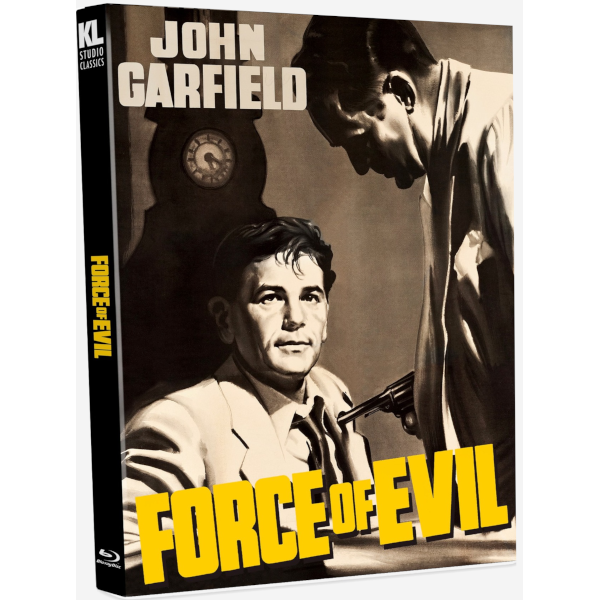

When John Garfield got clear of his Warner Bros. contract in 1946, he co-founded the film company Enterprise Productions, which made a number of interesting films, like Max Ophuls’ Caught, Andre De Toth’s Ramrod and the excellent Four Faces West, a Joel McCrea western in which nobody fires a gun. Enterprise mostly released through United Artists, until Lewis Milestone’s costly failure Arch of Triumph with Ingrid Bergman sank the company’s finances. Its final films were distributed by MGM.
Today Enterprise is mostly known for two features starring John Garfield. The first was the company’s one runaway success, Robert Rosson’s classic boxing story Body and Soul with Garfield opposite Lilli Palmer and Hazel Brooks. Its writer Abraham Polonsky was a former attorney who had served in the O.S.S. during the war. Polonsky’s focus was political. Other exposés about corruption in boxing put the blame on character flaws (Champion) and simple greed (The Harder they Fall), but Polonsky’s script indicts the capitalist system itself — success is impossible without ‘selling one’s self ‘body and soul’ to the temple of profit. An emotional sledgehammer, Body and Soul shows big money destroying what it cannot exploit. Garfield’s feisty boxer Charley Davis eventually decides that resistance to corruption is the only way he can retain his dignity. When mobsters say they’ll kill him, his answer is flippant defiance: “Everybody dies.”

Body and Soul did so well that Polonsky was able to move up to writing and directing for his even more personal follow-up, 1948’s Force of Evil. It is his best film and possibly John Garfield’s best as well. Its 79 perfectly-directed minutes revise older myths about up-from-the-streets ambition in New York City. The gangsters don’t hide down on the waterfront, but flaunt their success in swank offices on Wall Street. The ‘subversive’ inference is that Big Money is the same as Big Crime: a ‘fix’ is no different than Insider Trading, and the real profits are to be found on the edge of legality. Our hero is Joe Morse, a slum kid who got a law-school education, but has used it to become an irreplaceable associate for an old-time racketeer.
Force of Evil did not do well on its release, for a number of reasons. Its distributor MGM had little incentive to promote the work of an outside company — the original trailer (included on Kino’s disc) is not very good. The increasing political pressure on slandered ‘Hollywood Reds’ may have had an effect as well — John Garfield was tainted by association. But the biggest factor may have been the thriller’s complicated explanations of the financial crimes being committed. The fast dialogue assumes a thoughtful audience that’s willing to pay close attention. The numbers racket, aka ‘policy,’ is an illegal game that flourished before the advent of legalized gambling — which is of course itself merely a legalized racket. A great many Americans knew of the numbers racket, but few had understood how it functioned.
The riveting film noir thriller Force of Evil is today recognized as a masterpiece, one of the most intelligent and persuasive of films about corruption in the American success story. Unlike some political films noir, its issues are still very topical.

“Temporarily, the enterprise was slightly illegal.”
Attorney Joe Morse (John Garfield) represents the interests of a New York gambling syndicate, lobbying to transition the illegal numbers racket into a legitimate lottery. But he has stepped over an ethical line by becoming a de factor partner of the syndicate head Ben Tucker (Roy Roberts). Tucker plans to gain control of hundreds of neighborhood ‘policy stores’ by rigging the game. It’s traditional on the 4th of July that everyone bets on the number 776, for good luck. When Tucker’s experts make that number come up, all the independent stores will go broke. Tucker will bail out only a few operators willing to join the new combine on Tucker’s terms. Joe Morse has cleared the way for Tucker’s scheme — his own law partner, a ‘Harvard Man’ who lost his fortune in 1929, looks the other way because he’s benefiting from Ben Tucker’s money as well.
Joe sidesteps potential romantic trouble with Tucker’s seductive wife Edna (Marie Windsor), but an even more personal problem remains. His older brother Leo Morse (Thomas Gomez) sacrificed his own education to put Joe through college. Leo is now a small-time numbers operator, with ulcers and a weak heart. Joe offers to pay Leo back with a cushy job in Tucker’s combine, but Leo knows and fears Tucker from ‘the old days’ of racketeering and wholesale murder. He turns Joe down cold.
Joe keeps saying that his job is to change public opinion and make the numbers racket legal, but Tucker’s combine still operates the old way, with threats and coercion. Leo’s clerks are frightened, especially his nervous office accountant Freddie Bauer (Howland Chamberlain). Concerned about Joe’s loyalty, Tucker considers allying with his old gangland associate Bill Ficco (Paul Fix), who is already conniving to force his way in. Ficco’s hoodlum Wally (Stanley Prager) is putting pressure on the weakling Freddie Bauer.

In the middle of all this, Joe falls in love with Leo’s secretary Doris Lowry (Beatrice Pearson), an innocent whose sweetness nags on the lawyer’s conscience. Doris is charmed by Joe’s slick approach, even as she knows she’s playing with fire. Joe flirtatiously pretends to be ‘corrupting’ Doris, but his teases only make him more aware of his unsavory career choice. Tucker’s organization may already be under investigation, and Joe worries that he could be disbarred. The really scary news comes from Edna Tucker — who reveals that Joe’s phone has been wiretapped.
A decade earlier, Hollywood’s Production Code had suppressed the gangster film genre, restricting crime stories to simplistic tales of cops and robbers. Force of Evil is one of the first Hollywood films to detail how organized crime really operates. Its accusatory tone begins with the first dynamic notes of David Raksin’s title theme. Writer-director Abraham Polonsky’s thesis is that crime is not a mysterious underworld, but an active enterprise that permeates normal urban life. Everyone is tainted by the illegal numbers game, which compromises the moral fabric of the community.
The film’s portrait of urban corruption includes a lot of ‘ordinary people.’ The struggling businessman Leo Morse is not a criminal fat cat, and the clerks sorting nickels and dimes at his counting house are just eking out a living. Lobbyist Joe Morse has overstepped his legal protection and become a criminal himself, working in concert with Tucker and his underworld cronies. In the eyes of the law — a new special prosecutor — Joe is now just another of Tucker’s people, profiting from the numbers racket.

“All that Cain did to Abel was murder him.”
Force of Evil shapes up as a thematic inversion of Frank Capra’s It’s a Wonderful Life, with the desperate small ‘businessman’ Leo Morse corresponding to James Stewart’s George Bailey. Having friends, remaining virtuous (in Leo’s case, staying loyal to his neighborhood people) and staying independent from corrupting power systems (Potter’s banks, Tucker’s racketeers) have completely different consequences in the two movies. George Bailey is a hero, whereas Leo becomes a victim and a martyr.
When lawyers get involved, a criminal enterprise can pass itself off as a legitimate business. Force of Evil isn’t about evil men or greedy thieves. Polonsky implies that free market capitalism is inherently predatory, that only honest law enforcement and government regulation can keep it in check. Leo claims that his earlier businesses failed because success was impossible without cheating. He describes basic business practice as Everybody cheating Everybody.
With his first words Joe Morse boasts of his plan to make his first million in just a couple of days. An educated wise guy, his modus operandi is to go for the cash and work out the details later. He thinks he can mend fences with his brother with money and favors, but the effort only puts his lack of ethics in relief, especially with his guileless new girlfriend Doris. Joe knows he’s doing wrong but still wants be the good guy, a rich good guy.

” I didn’t have enough strength to resist corruption, but I was strong enough to fight for a piece of it.”
Some audiences get lost in Force of Evil’s brisk explanation of the numbers racket, with its vast system of ‘banks’ collecting millions in dimes and nickels. Even more viewers are confused when Tucker, Morse and other racketeers listen to the math prodigy ‘Two and Two Taylor’ (Sid Tomack) explain how he will place targeted racetrack bets to ‘fix’ the numbers that will be the winners in the day’s numbers racket. * But the film communicates its personal conflicts with total clarity. The chemistry between the brothers Morse is compelling, and so is the romantic tension between Joe and Doris. The steadily-rising feeling of menace overtakes the hopes and schemes of the entire cast. It is as if the characters are caught in a wave of ambition, hope and corruption.
What distinguishes Polonsky’s movie from other socially-focused film noirs of its time are the rich speeches given its characters. It’s not the hardboiled patter we expect from hepcat private eyes, where everything sounds like a cynical punchline. Some of Polonsky’s stylized dialogues stress repetition, with an eccentric emphasis. communicating confusion and anxiety. Yet it still sounds natural — David Mamet pales by comparison. Leo Morse’s bombastic answer to Joe is the most quoted example:
“I am sensible. I am calm. I’ll give you my answer calmly and sensibly, my final answer. My final answer is finally no. The answer is no! Absolutely and finally no! Finally and positively no! No! No! No! N – O!”
Joe Morse’s love talk isn’t flowery, yet some of it feels like poetry. His verbal jousting with Doris is seductive, more romantic than we expect. He ought not to talk that way yet we enjoy the pleasure his words give Doris. Joe insists that Doris wants to be seduced, and teases her with the notion of moral temptation. Do we really expect anybody to refuse the things money can buy? Frustrated by Doris’s ethical objections, Joe hefts her up onto a high mantel in an empty room, and leaves here there. His message is clear: “Do you want to get into the swim of life with me, or stay up on the shelf?”

Force of Evil’s most noted scene takes place in a taxi with Joe and Doris. It is frequently compared with On the Waterfront’s more famous Brando-Steiger taxicab scene. Joe is slightly tipsy, and frustrated by his failure to do right by his brother Leo. As if debating himself, he loses the seduction angle. He questions why Leo refuses his help, refuses the financial ease and security that the combine offers. To Joe, not taking the money is perverse, sinful.
Joe normally has an answer for everything, but with his guard down he expresses his deeper disturbance. The scene concludes with with Joe saying something about guilt. An unexpected fade-out underscores his inability to find Peace of Mind. Unlike Garfield’s boxer in Body and Soul, Joe Morse is not a hero fighting The System. He’s a confused transgressor looking for redemption in Doris Lowry’s eyes.
The movie is much more than just poetic speeches. Either Abraham Polonsky is also a directing genius, or he worked closely with his creative associates to put together dynamic, emotionally jarring scenes. The cornering of Leo in a step-down restaurant seems a direct influence on Martin Scorsese. An unnervingly somber classical music cue plays counterpoint to some extremely shocking violence. The scene has what might be noir’s most traumatic use of a gun to date — a subjective, point-blank close-up of the gun barrel firing, as in an Eisenstein film.
Instead of the usual gangster thugs, both the slayer and the victim are miserable underworld pawns, nobodies. A weasely mob underling is played by Stanley Prager, an actor that Billy Wilder fans may remember as a comical soldier in the same year’s A Foreign Affair. As always, it is the meek and the innocent that suffer.

The Birth of Paranoid Noir is Right Here.
The thrillers of Fritz Lang introduced scores of cinematic motifs associated with espionage and criminal conspiracy, but Force of Evil may be the first noir to communicate the distress of discovering that strangers are listening to one’s phone calls. An unscheduled late night visit from Edna Tucker isn’t another seduction bid, but a tip-off: Joe Morse’s ‘secret’ phone line to Tucker has been tapped. A tight series of choker close-up inserts shows Joe putting the receiver to his ear, and listening to hear the “–click–” of the wiretapper picking up, just as Edna described. It may be all over for Joe — the special investigators may already be able to disbar him, as a co-conspirator abusing the rules of attorney immunity:
“A man could spend the rest of his life trying to remember what he shouldn’t have said.”
The grim finish insists that an empowering truth has been discovered. As Joe descends countless steps to the river Hudson (Styx), poetic symbolism takes wing, both verbal and visual. The endless stone steps take Joe down to the dirty water of the river, where a body has been thrown away ‘like garbage.’ Joe’s narration repeats the word down for poetic emphasis, with the promise that he’ll rise again to ‘do something’ about the corruption. The ‘cinematic architecture’ stresses that chaos doesn’t rule; the bridge’s enormous foundation is anchored in solid rock.
David Raksin’s music score has been adding a sly, sometimes mysterious tone to the film’s dialogue scenes, and here it becomes a little musical suite. Halfway down the steps, a patch of beautiful melody slips through, as if forgiving Joe Morse, and wishing him strength as he reclaims his soul. Doris is still with him, so there is still hope.
Force of Evil is an artistic high point for many of its creative contributors, starting with John Garfield and Thomas Gomez. Stage actress Beatrice Pearson made only two movies, this and the even more socially daring Lost Boundaries. Pearson’s Doris Lowry is delightfully vulnerable and conflicted – she keeps Joe Morse at bay with talk of morality yet obviously hopes that he’ll sweep her off her feet.
The casting throughout is spot on. Marie Windsor (The Killing, The Narrow Margin) bats her enormous eyes to seduce the hero, to no avail. Her small son is said to be played by Beau Bridges, but I think he must have been cut out of the film. The same goes for actor Arthur O’Connell. The IMDB lists him uncredited as the special prosecutor, who I don’t remember appearing in the movie either. Roy Roberts is very convincing as the new kind of dull racketeer. Howland Chamberlain, Barry Kelley and Stanley Prager hover around the periphery as weak or venal pawns in the film’s tawdry underside.


Love this film but still don’t understand the numbers racket
I was privileged to know Abe Polonsky well. He was the most unwaveringly honest (110%)
man that I ever met. I’m convinced that no individual that honest and that ethical can
possibly survive in the movie business. He spoke of Julie (John) Garfield in the most
unwaveringly loving tones.