


This show was highly anticpated in 1981, by a legion of fantasy film fans eager to see Star Wars inaugurate a wave of lavish sci-fi fantasy spectacles enhanced with the ‘new’ generation of special effects. And the films did follow — Disney’s The Black Hole, Fox’s Alien, Paramount’s Star Trek: The Motion Picture. Even James Bond went ‘Star Wars’ in Moonraker.
USC writing grads Hal Barwood and Matthew Robbins wrote the story for Steven Spielberg’s first theatrical feature and continued to contribute to his movies; Robbins would eventually collaborate with Guillermo Del Toro as well. In 1980 Barwood & Robbins teamed with industry veteran Howard W. Koch on Dragonslayer, a first-class epic backed by two studios and filmed in England. The cinematographer was Derek Vanlint of Alien. The music score was composed by the respected Alex North, of A Streetcar Named Desire, The Wonderful Country and Spartacus.
The pre-release effects buzz was that the little group of stop-motion animators that created the Hologram chess board in Star Wars would help bring Dragonslayer’s title monster to life. As Dennis Muren, Phil Tippett and Peter Kuran were already ‘names’ we anticipated a dragon like none before.
The final product is a big, serious ‘ancient legends’ adventure, a fairy tale with rather brutal trimmings.
In the world of 500 AD magic and magicians are very much real, but in decline. The kingdom of Urland is plagued by a horrible fire-breathing flying dragon known as Vermithrax Pejorative. Urland’s King Casiodorus Rex (Peter Eyre), has made a terrible bargain with Vermithrax to keep its killings to a minimum: twice a year, it is appeased with a sacrificial virgin selected by a cruel lottery system. Apprentice sorcerer Galen (Peter MacNicol) possesses a magic amulet but hasn’t much control over its use. Encouraged to oppose the monster by his new friend, a boy named Valerian (Caitlan Clarke), Galen tries to enlist the aid of his master, the eccentric wizard Ulrich of Cragganmore (Ralph Richardson).
Galen discovers that Valerian is actually a young woman passing as male to avoid the lottery. Galen tries to bury the dragon by sealiing the only entrance to the its steaming cavern lair. King Casiodorus is displeased, and imprisons Galen. But the princess Elspeth (Chloe Salaman) discovers that her father has cheated to keep her and other wealthy Urlanders out of the lottery. She rigs the upcoming drawing to guarantee that she will be picked. Casiodorus frees Galen to save his daughter, armed with the amulet, a newly-forged anti-dragon weapon, and a heat shield made from shed Vermithrax scales. But can he defeat the ferocious monster single-handed?
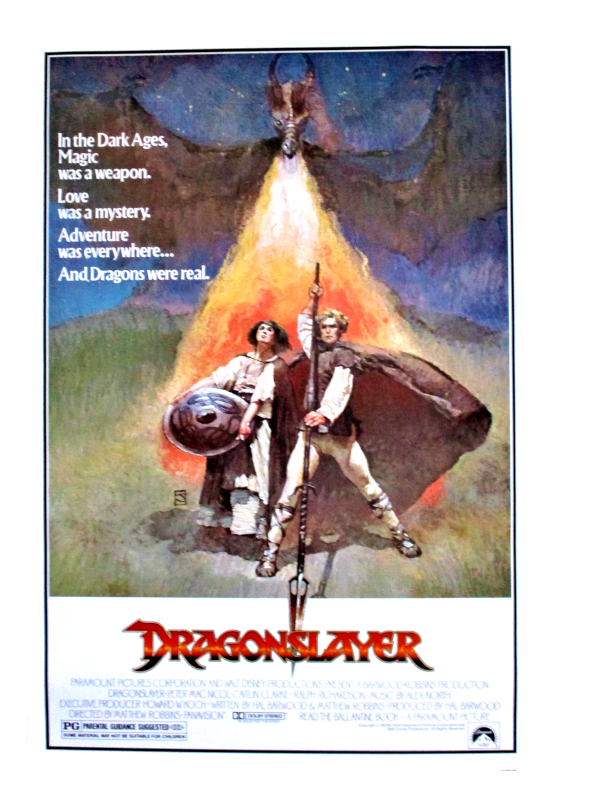
↖ Starting with its advertising campaign, Dragonslayer seems pitched to reach the huge audience of Star Wars. The original poster is practically a clone of the artwork for George Lucas’s first space adventure. With a major nod to The Sorcerer’s Apprentice, the story also bites off a huge chunk of Tolkien’s popular The Lord of the Rings. Ralph Richardson’s elderly wizard is more like Gandalf than Merlin — standing on high peaks, causing giant whirlwinds to rush around him.

Instead of a squeaky-clean Lucas realm, Urland is a pre- Middle Ages mud & rags kingdom, in transition from the old magical world of sorcerers and demons to religion. Did Barwood & Robbins make a basic commercial miscalculation? The genre wants fun, excitement and uplift, and Dragonslayer instead leans toward horror. Teenaged girls are sacrificed without mercy, followed by a graphic scene in which the dragon’s goblin-like offspring devour a virtuous, brave princess. Nothing in the show prepares us for that level of gore.
Just the same Dragonslayer is to be commended for trying something different. It is consistent in its approach, a melding of fantasy and grit.
The Merlin / Obi-Wan / Gandalf character Ulrich is bookended at either extreme of the script. Ralph Richardson is delightful in the limited role; everything he says carries a slightly daft, eccentric charge. Magically resurrected from the dead, Ulrich transports himself to dry land by walking on water. His first words are an amusing throwaway: “Did you bring anything to eat?” The film could use more humor elsewhere, if only because so much of what occurs is downbeat. The story is worthwhile, it’s just that audiences weren’t often expected to take such fanciful subject matter so seriously.

No Bone Spurs for fair Elspeth.
Casiodorous seeks to hold Evil at arm’s length by sacrificing the daughters of his kingdom one at a time, a ‘few to save many’ arrangement that Ulrich condemns as a compromise with Evil. The sober process sees various virgins delivered to Vermithrax, trussed up between two poles as was Fay Wray way back on Skull Island. Barwood and Robbins gave the lottery a contemporary spin, evoking our 1971, ’72 and ’73 Vietnam draft lotteries. I can attest that young men of my age certainly made that connection. (I pulled number 304 in the ’71 drawing, so no Vermithrax Pejorative for me!)
The two women with speaking parts are potential love interests for young Galen, and they’re both proud, virtuous and outspoken. Caitlan Clarke’s warm-hearted Valerian has common sense, while Chloe Salaman’s noble Elspeth plays out her father’s hypocrisy to its logical, appalling end. Elspeth could serve as a lesson to little girls immersed in the ‘Disney Princess’ cult. All those pampered cuties enjoyed their unearned privileges, but noblesse oblige also requires them to accept a downside: arranged marriage, a possible divorce at the chopping block . . .

Lean, mean and fueled by hellfire.
Dragonslayer’s terrific Vermithrax Pejorative is a flying, fire-breathing cross between the dragon in Disney’s Sleeping Beauty and various dinosaur creations of Jim Danforth. Vermithrax soars like a dive-bomber and crawls like a bat on its folded wings. Seen only in bits before his confrontation with the far-outclassed Galen, the monster shoots torrents of blast-furnace flame.
Many Vermithrax visuals use full-sized manipulated figures, and smaller puppets. The ‘baby’ Pejoratives look a little puppet-ish, it must be said. Much of the key action with Vermithrax is full on stop-motion animation, embellished with optical work by Industrial Light and Magic, relocated from Van Nuys and fully established in Northern California’s Marin County.
Stop-motion has always been criticized for its ‘jerky’ nature, a natural result of shooting action one still frame at a time. Back in 1970’s When Dinosaurs Ruled the Earth, Jim Danforth moved the wings of his Pterodactyls during exposure, to add an appropriate blur effect. The key animators brought North to ILM, including Phil Tippett, animated the Taun-Taun beast in The Empire Strikes Back with a method they called ‘Go Motion,’ a computer-assisted refinement of Danforth’s motion-blurring technique.
We’re not sure how much if any Harryhausen-style rear-projection was used by the stop-motion camera team.The backgrounds behind Vermithrax are dank cave interiors and dramatic cloudy skies, with subtle textures that would be difficult to make match using Harryhausen’s rear-projection technique. ILM appears to have composited everything with sophisticated optical printers. ILM had invested in old VistaVision cameras, that used flat lenses and yielded a large-format film image. When reduction-printed down to anamorphic 2:35 and intercut with standard Panavision live-action footage, ILM composites in films like Raiders of the Lost Ark looked immaculate. Of course, computer graphics and compositing has obliterated a number of traditional photochemical special effects arts.

The animators manage some great shots with moving cameras, as when the creature crawls out of the hazy darkness of the cave. One spectacular shot shows the reptile rearing up and vomiting yellow flame at the cavern ceiling. Vermithrax is given just enough personality to be loathsome. It is also given a bit of motherly sympathy when it discovers that Galen has chopped its babies into ugly dragon-bits. We’re disturbed by the dead girls and the dead monsters.
Later major movie dragons have surely eclipsed Dragonslayer in impact. Today’s fans have been wowed by the talking dragon Smaug in the Hobbit trilogy, and by the fantastic dragon monsters featured in Game of Thrones. But in 1981 this was the pinnacle of visual effects artistry.
At the conclusion, early Christian peasants led by an oddly-cast Albert Salmi (Wild River) claim the dragon’s death as a victory for their Lord. Then the scurvy King Casiodorus officially dubs himself the Dragon Slayer of record. With his amulet lost forever, Valerian and Galen exit to new adventures. But not all the magic seems to have departed ..
I don’t remember big cheers at the finale; the end of Vermithrax plays as downbeat, not a glorious victory. Barwood and Robbins have Richardson’s Ulrich employ the ‘Father Karras’ method of defeating the monster, a gag that I’ve always argued is itself stolen from a near-legendary finale of, of all things, Abbott and Costello Meet Frankenstein. The Wolf Man, Father Karras and Ulrich all make suicidal gestures to destroy a conventionally un-killable evil — Dracula, the spirit of Pazuzu, and the hell-dragon Vermithrax. From another viewpoint, another friend said the demise of the monster is simply copied from Jaws — something Vermithrax grabs to eat, blows up in his face.
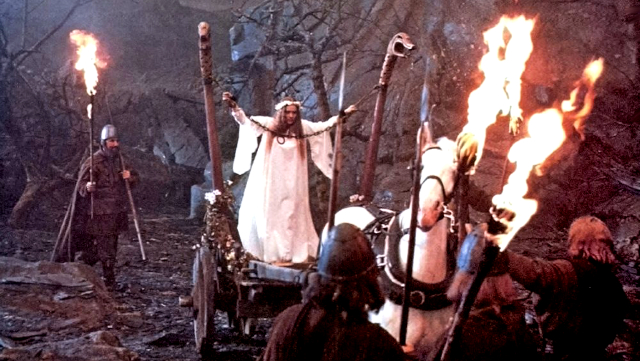
Both young leads in the show were making their feature debuts. Peter MacNichol (Ghostbusters II, Ally McBeal) is more than capable but isn’t as appealing as Mark Hamill. Likewise Caitlin Clarke serves her character well, but we can’t say we itched for a continuation of the Galen and Valerian saga. Being 78 years old, Ralph Richardson is not asked to exert himself too much. He lends a proper sense of oddball authority to the old wizard, a quality distinct from his stern Supreme Being in the more whimsical, contemplative Time Bandits.
The critics mostly admired Dragonslayer. It didn’t earn back its $18 million budget, but it holds up as quality filmmaking that needs no excuses. That’s more than can be said for Peter Yates’ Krull, a big-budget 1983 fantasy that places medieval-type knights with ray guns on a distant planet.
As a last note we’d like to point out Ulrich’s broken-down assistant Hodge, a familiar character actor with an amusingly weary brow. He’s Sydney Bromley, a fave presence in UK pictures: Night Creatures, Roman Polanski’s The Fearless Vampire Killers and Macbeth, The NeverEnding Story.

