



Actually, 1958’s Curse of the Faceless Man is too endearingly simpleminded not to find a warm place in the hearts of monster movie lovers. Pretty much near the bottom of the spectrum of studio-funded Hollywood filmmaking, it is barely feature-length, uses almost no sets and for thrills relies almost completely on a reasonably good monster costume.

Producer-writer Robert E. Kent must have contracted with UA to turn out cheap westerns, teen pix, monster movies and crime sagas by the yard. Other fantastic titles in his low-budget filmography are the minimalist space zombie movie Invisible Invaders and The Four Skulls of Jonathan Drake, which at least score points for grisly originality. Curse was originally released on a double-bill with United Artists’ It! The Terror from Beyond Space, which was also directed by Edward L. Cahn, a fearless veteran of countless “B” pictures. The credited screenwriter is the accomplished science fiction author Jerome Bixby, who also wrote It! as well as episodes of TV’s Star Trek. Bixby’s highly exploitable story idea imagines a romantic but murderous Golem from ancient Pompeii, but the cheap and artless production guarantees that almost all of the idea’s potential comes to naught. Its best audience is going to be smaller kids, and adults who remember being frightened by it as children.
Writer Bixby claimed that director Cahn rewrote his more elaborate original script to bring the price tag below $100,000 dollars. The finished film takes place on a few nondescript sets, a beach, and the exterior of the Griffith Observatory, which not very convincingly stands in for an Italian research museum. A ponderous narration informs us about Quintillus, an Etruscan gladiator killed in the Biblical-era eruption of Mt. Vesuvius (Bob Bryant). His petrified corpse is unearthed in an archeological dig. Brought to the museum, it proceeds to come to life and murder various individuals, beginning with an unlucky truck driver. It is determined that Quintillus has been reanimated by the radioactive dirt in which he was entombed. While researcher Dr. Paul Mallon (Richard Anderson) debates the mystery, Mallon’s artist girlfriend Tina Enright (Elaine Edwards) falls under the influence of the stone figure’s magic spell. As it turns out, Tina is the reincarnation of Quintillus’ great love from long ago. The stone monster eventually seizes Tina and carries her off. Dr. Mallon realizes that Quintillus thinks the eruption is still happening, and is trying to take Tina to the safety of the ocean.

Before dismissing this narrative as a crazy hodgepodge, we need to admit that it has all the necessary ingredients to motivate an interesting monster movie. Quintillus is a pasty white, face-challenged artifact with a one-track mind, controlled by the magic of an ancient amulet and a surviving spark of romance. The reincarnated love angle is borrowed from various Mummy stories and the superb original Karloff version, but it does lend the monster a better-than-usual reason for carting the heroine around. I hope Bob Bryant had a strong back, for publicity stills, the trailer, and UA’s crude 2-color poster all emphasize the same carry-the-girl graphic. The film’s ending communicates a fairly original macabre irony; I remember fellow horror enthusiast Susan Turner once explaining to me that Curse was especially popular with female monster fans (Actually, she said, ‘the girls’). Although it’s not a big secret, I won’t detail the ending for purposes of spoilers. It’s actually the one clever thing in the whole movie.
Farfetched fantasies need careful handling to succeed: an eloquent script, appropriate actors, expressive lighting. Sightings of the stone monster should be carefully rationed, as his every appearance needs to be a new scare.
Don’t look for any of that stuff in this movie.. The mostly flat-lit sets are cheap, the dialogue is padded with irrelevant chatter and the unfortunate actors do a lot of standing rooted in place to read their lines. A droning narrator is heard at frequent intervals, re-capping the story and telling us what we’re seeing, as if nobody’s expecting us to pay attention. Edward Cahn’s direction creates little in the way of mystique around the flaky white stone monster, which is on view from the very first shot. As it has all the mystery of a mannequin covered with plaster, nobody seems to be particularly frightened by it. Deprived of a scare factor, our minds wander to thoughts of how the costume bends and wrinkles when Quintillus walks… he’s the first-ever rubberized plaster man.
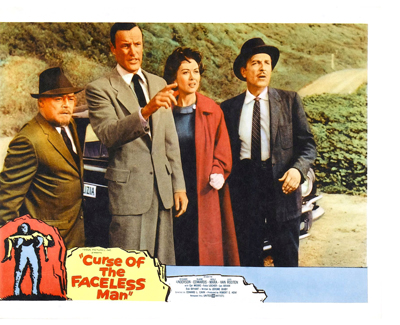
Richard Anderson looks unengaged in the drama before him, and in more than one shot seems outright embarrassed. As the lady with the psychic connection to Quintillus, Elaine Edwards does the best that she can. When hanging limp in the statue’s arms, she appears to be holding her head up, perhaps to avoid receiving a concussion when the obviously vision-impaired actor in the Quintillus suit (Bob Bryant) walks through doorways.
Attractive Adele Mara (The Sands of Iwo Jima) plays the secondary female lead, a former girlfriend of Paul. Her accent sounds pasted-on, and definitely not Italian. Almost everybody else just stands still when they talk in director Cahn’s cost-saving static master shooting style.
Charles Gemora’s blank-faced monster costume has a face that looks like the dark side of the moon. More creative lighting could easily have made it much more scary. Inside the monster suit, Bob Bryant does his best to move in a rigid fashion, even when his plaster-like skin wrinkles and stretches.
Despite the weak execution, Curse of the Faceless Man’s basic idea is a good one. Many of the great science fiction movies of the 1950s have been remade, some of them twice. Curse belongs in that category of pictures that ought to be remade, because the potential for scares and bizarre imagery wasn’t exploited the first time around. The idea of a lovesick Etruscan walking among us in search of his dream girl seems right in step with today’s romantic teen vampires. Quintilllus may not be the most attractive boyfriend from beyond the grave, but one must admit that he’s a loyal cuss, and persistent, too. And don’t forget durable.

To cover all bases for the matinee crowd, Curse embellishes its supernatural content with a sci-fi element, the radioactivity. As pointed out by Bill Warren, anybody who read The National Geographic’s reports from Pompeii knows that Quintillus makes no archeological sense. In 79 A.D., the victims of the eruption were caught and killed almost instantaneously by a rolling cloud of superheated gas and sticky, molten ash. They were covered by the clinging ash and eventually buried by it. 2,000 years later, the excavators found odd cavities in the earth covering the floors of buildings. When filled with plaster, the empty spaces became perfect molds, yielding amazingly life-like tableaus of fallen bodies. I remember the most dramatic was of a man propped up on one elbow, as if frozen in place and struggling to breathe.
Of course, since the scientists found no body of any kind, just the negative mold cavity, coming up with a resurrected citizen of Pompeii for a modern science fiction film is a tall order. I suppose a proper remake would want be more of a straight horror show, with another Pompeii-like ruin excavated. An ancient curse or other hoodoo voodoo would be needed to explain how the ‘statues’ of long-ago citizens come to be reanimated. Perhaps the eruption caught them engaged in compromising crimes or scandalous behavior — and like in a fairy tale, when given ‘bodies’ again, they pick up where they left off — a Danza macabra down Vesuvius way.
Well, the idea is just as rational as a zombie or a vampire…
The best filmic appearance of the macabre statues yielded by the Pompeii excavations is in Roberto Rossellini’s deeply affecting humanistic drama Journey to Italy. An unhappy married couple (Ingrid Bergman and George Sanders) is entreated to visit the ancient ruins because a mold is to be opened that day. The plaster figures underneath are revealed to be holding hands, signifying that they were true to each other even unto death. The wife immediately recognizes this as a direct rebuke to her lack of marital commitment. It sounds pretentious, but it plays as genuinely profound.
Curse of the Faceless Man may not be profound, but there’s at least some romance in its personality-challenged bogeyman. The show gets little respect from today’s impatient monster fans, but I have to say that it was good enough to pass muster in 1958, when the end for micro-budget monster fare distributed by major labels was only a year or two away. Ed Cahn’s Pompeii quickie was just good enough to make the bottom half of a double bill.
Research: Bill Warren, Keep Watching the Skies!
21st Century Edition, McFarland 2010

This is a perfect review. Heart, irony, humor, accuracy—delight! LUV this movie so. Saw it over 60 years ago 🤗😱💖.