

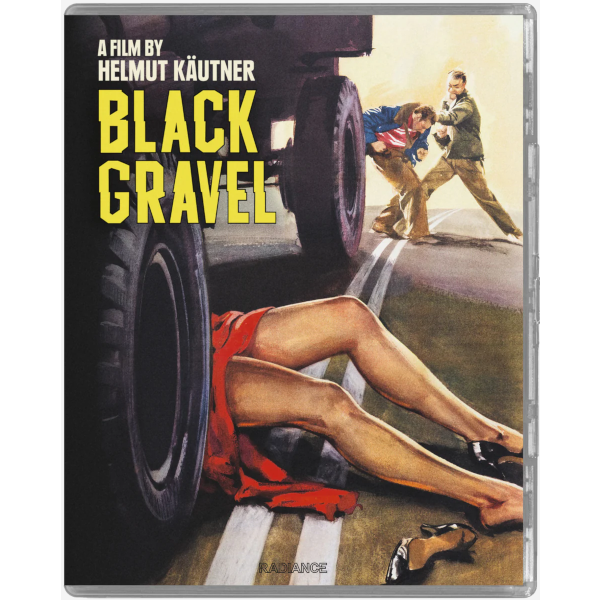

When they dig it up, what will they find? Collectors interested in movies that dared expose unpopular truths will want to see this verdammt Deutsch-noir masterpiece. Helmut Käutner’s down & dirty drama Black Gravel is unique in its outrage, reminding us of home-grown socially critical noirs like Ace in the Hole and Try and Get Me! This English Region B disc follows an earlier Kino release, but has an excellent exclusive extra. It comes in a Radiance three-title World Noir Vol. 2 disc set, ↙ with Jacques Deray’s Symphony for a Massacre and Takumi Furukawa’s Cruel Gun Story.

Quick, name a film about American servicemen stationed in Germany after the war and after the Berlin Airlift, when the cooperative West Germans allowed NATO to load the country with weapons pointing East to the Soviet Bloc. There’s the Elvis Presley movie G.I. Blues which leverages superstar Elvis Presley to generate positive PR for arming Germany to the teeth. The only drama that comes to mind is Gottfried Reinhardt’s 1961 Town Without Pity with Kirk Douglas and Christine Kaufmann. Bored, surly American GI’s rape a local fraülein, a crime that turns into an even worse tragedy. A real downer of a picture, it spreads the blame to the victim’s parents and the morally rigid locals. Helmut Kautner’s (very unwelcome) exposé sees nothing but degradation in the NATO occupation.
Popular German films produced in the postwar Bundesrepublik Deutschland normally avoided controversy. Bernhard Wicki’s 1959 war story The Bridge (Die Brücke) is a tragedy of German child-soldier defenders that’s careful to offend nobody. In Billy Wilder’s earlier American comedy A Foreign Affair, some defeated Germans put puritan morals aside so they can subsist, not just survive. Were audiences offended by Wilder’s indulgent winks at mild corruption? Few movies criticized or even acknowledged the peacetime conversion of West Germany into a NATO warfront.
The German film industry didn’t like Helmut Käutner’s Black Gravel one bit: it did not present the U.S. forces in West Germany in a flattering light. Its initial release was scuttled by an unfounded charge of antisemitism. The Wilhelm Murnau Foundation (Stiftung) has restored two versions of the picture, an uncut premiere original and the slightly shorter release version that censors content deemed offensive. The darker-than-dark original ending is as downbeat as the most nihilistic of American films noir.

Black Gravel’s brief release was in the Spring of 1961, months before the East Germans sealed off the border and constructed the Berlin Wall. It presents an unflattering picture of the American military presence, yet is not as stridently anti-Yankee as some Japanese films made around the same time. Shohei Imamura’s Pigs and Battleships (1961) depicts American military bases as open sores of vice and corruption. Black Gravel is closer in tone to Cy Endfield’s 1957 Hell Drivers, but without Endfield’s anti-capitalist venom. Both films center on working people trying to survive in a hostile environment. Fifteen years after the defeat, our German hero and heroine know they are morally compromised. But the options left open to them left little room for conventional morality.
Deemed unnecessarily sordid, Black Gravel begins with a scene guaranteed to offend many viewers — the unnecessary killing of a dog. It becomes a perverse ‘meet cute’ for former lovers, separated by economic hardship.
Right outside the gates of a NATO airbase in West Germany, the tiny hamlet of Sohnen has been transformed into a sleazy vice district. The ‘hostesses’ at the makeshift Atlantic Club cater to the lonely airmen. Fifteen years after the defeat, ex-German soldier Robert Neidhardt (Helmut Wildt) is still trying to find his economic footing. At present he living above the Atlantic Club and working as a truck driver, hauling gravel to extend the runways on a new U.S. Air Base. Robert is one of a number of drivers working a racket with local fixer Otto Krahne (Wolfgang Büttner), faking gravel loads to multiply their take. One of Robert’s fellow on-the-take truck drivers kills a dog, and when Robert finds its owner he gets a surprise: she’s Inge (Ingmar Zeisberg), a former prostitute with whom he had a romance several years before. She’s now married to Major Gaines (Hans Cossy), a U.S. officer expediting the airfield construction. Although Robert already has a steady bedmate in the unstable Elli (Anita Höfer), he makes a serious play to reclaim Inge. But trouble and tragedy close in from all sides.

Robert and Inge might have criminal records but they’re basically decent people. At one point Robert recites various unsavory things he’s done, starting from when he was a prisoner of war. Inge married the stiff-but-decent Major Gaines in the hope of starting a new life in America, away from her past. But Gaines’ language skills keep him stationed locally. ‘Military adjacent’ burgs tolerate vice districts to keep restless servicemen away from the locals’ daughters. Sohnen is much like Alabama’s Phenix City, except with petty scams instead of organized crime.
Of course the local German girls date Americans. Robert’s airman buddy Bill Rodgers (Peter Nestler) is a straight arrow who steers clear of the gravel scam. He prefers romancing Anni, the sweet niece of a shopkeeper. Robert envies their innocence. Also hanging around the Atlantic Club is C.I.A. agent Eric Moeller (Heinrich Trimbur), investigating the local procurement profiteering. Inge hates the Club, where she might run into old clients. Her defection to Robert comes about when she realizes thatshe’s little more than an accessory to help with her husband’s all-important Air Force career. She manages to tip Robert to a sting by the Military Police, a bit of luck that makes him one of the few gravel drivers to escape capture.
When a terrible accident occurs Robert must cover it up to hide his relationship with Inge. This leads to a pair of corpses being buried under tons of gravel to be covered by a concrete foundation. Bill then learns that Major Gaines is overseeing a series of sensitive sonic tests on the gravel beds. If the acoustics reveal ‘soft pockets’ the engineers may dig up the gravel to check.
The ugly secrets in the gravel seem a metaphor for the German-American ‘co-prosperity alliance’: is the foundation of the Wirtschaftswunder too corrupt to remain amicable? Black Gravel became a political target just for posing the question. Its raw honesty can’t have pleased politicians. It was bad enough fending off the accusations leveled against the West by East German propaganda pictures.

Crime is crime: the crooked truck drivers aren’t the victims of labor exploitation, as in Hell Drivers or Jules Dassin’s equally political Thieves’ Highway (1949). Robert and Inge are too hardened to be shocked by ordinary vices. He spends his time among the hookers at the Atlantic Club, where even the proprietor is concerned about Elli’s vulgar displays. Inge dresses elegantly to impress her husband’s friends, Americans that would never understand the life she’s led. The Major seems to need her mostly for social functions. She feels more kinship for Robert’s raw pragmatism — they understand each other’s hardship and humiliation. Inge doesn’t care that he flaunts his relationship with Elli. In these circumstances a dicey sex life is the least of one’s worries.
Black Gravel is set specifically in late 1960, when the military buildup was in full swing. When an airman and a local girl disappear, they are suspected of having defected to the East. The air base is off limits to the locals, who sometimes call it ‘the estate,’ in the feudal sense. They are not pleased by rumors that nuclear missiles will be positioned on German soil. Nobody wants to live on the front line of an atomic war.
Director Käutner’s movie had to compete in an exhibition market that preferred escapist entertainment. West German moviegoers flocked to westerns and comedies with big stars. ‘Krimi’ crime thrillers were becoming a popular fad. Still being made were the nice-nice Heimat films lauding country values and traditional wisdom, starring smiling, fresh-faced young women like Liselotte Pulver and Romy Schneider. In other words, Germans didn’t flock to realistic pessimism any more than Americans did.

Black Gravel is dark, but not openly sleazy, as was some of West German pop culture in 1961. The word ‘black’ in a title connotated stories of vice and sordid crimes: Schwarze Nylons–Heisse Nachte (‘Black Nylons–Hot Nights’, 1958) and Gefaehrdete Mädchen (‘Endangered Girls’, 1957). Just the same, Helmut Käutner doesn’t avoid vulgarities. Robert isn’t afraid to say exactly what he thinks of some of his corrupt associates. A dead dog keeps coming back into the storyline, buried, unburied, mangled in close-up. Some nudity slips into the bar scenes. Elli vomits on-camera, the earliest instance I know of such a scene.
The screenwriters make other, more subtle anti-Heimat comments. Next to his little homestead outside town, Robert has built two picturesque hobby projects, small-scale reproductions of traditional German buildings. Asked about his twenty-foot church model, he indicates that no religious fervor was involved: he copied a picture from a calendar. That moment is mirrored on the Air Base, where we see a pre-fab, non-denominational chapel that features an altar that rotates to serve both Protestant and Catholic ceremonies. Robert pauses to play ball with some American kids in front of their new military housing. His desire to share the Yankees’ secure, straight life is overpowering.
The excellent cast will be unknown to American viewers. Helmut Wildt’s Robert is roughly handsome — Jeff Chandler crossed with Wolfgang Preiss. Wildt has the hardness of a man who must lie convincingly day in and day out, yet he maintains a personal integrity. Ingmar Zeisberg’s Inge escaped ‘the life’ years ago but feels more hemmed in than ever — and attracted to her old flame. Anita Höfer’s Elli ↙ lives up to her terrible reputation yet is so desperate to flee that when Robert turns her down, she falls in with the unreliable crook Otto Krahne. ↘ The German actors convince as Americans, switching between languages at will. Hans Cossy’s Major Gaines is more than credible as a U.S. officer who must keep up appearances with his peers. Future director Peter Nestler looks exactly like a fresh-faced American serviceman, the kind that would find a nice foreign girl and fall head over heels for her.

The unfair charge of antisemitism.
Postwar Germany had strong laws punishing antisemitic crimes. Commercially speaking, Black Gravel’s doom was sealed when it was publicly sued by a member of a Jewish anti-defamation league. The suit was thrown out of court but the negative publicity persisted. The German distributor UfA panicked, cutting scenes and re-dubbing dialogue to remove ‘offensive’ material — tacitly agreeing that writer-director Helmut Käutner was guilty as charged.
The recut obliterates important scenes that show prejudice for what it is. Loeb (Max Buchsbaum) is the Jewish proprietor of the Atlantic Club. His awareness of bigotry is shown when he observes a group of white airmen choosing against the club because they see some black airmen inside. The realistic dialogue has Loeb jokingly refer to a customer as ‘an American Yid.’ At another point, Otto Krahne whines that the Army cops wouldn’t be on his case if he were Jewish. The movie uses this speech to show Krahne excusing his criminality with an ethnic slur.
But Black Gravel goes farther with the issue. Some airmen in the Atlantic Club want to play American pop on the juke box. The elderly German, Rössler (Karl Luley) is drunk, and insists on playing an old marching tune associated with the war. The club was formerly Rössler’s barn, which he sold to Loeb with the proviso that he could drink all he wants. Loeb tries to silence the offensive Nazi song, only for the abusive Rössler to shout, ‘Filthy Jew’ for all to hear. When Loeb re-starts the juke box we see the concentration camp number tattooed on his forearm. Loeb isn’t looking for social justice; he’s trying to make a living in a postwar Germany where antisemitism obviously still exists.
But the whole subject was ‘uncomfortable:’ the suggestion that a Jew might run a sordid establishment was considered grounds for defamation. The accusation tainted the film and spoiled its release. A conspiracy-minded person might wonder if the lawsuit was a surreptitious way to curtail the distribution of a film critical of the American military presence.
The daring, adult Black Gravel is as good as the best of European production in 1061. It ended up on ‘worst movie’ lists and was buried, forgotten. Few critics were even aware of it until the Murnau Stiftung’s recent restoration. This link to a 2017 Lincoln Center film series shows Black Gravel first on a list of movies from what are called ‘The Lost Years of German Cinema 1949 – 1963,’ with Robert Siodmak’s The Devil Strikes at Night. With its strong characters, sophisticated storyline and sensitive direction, Helmut Käutner’s ‘lost’ thriller compares well against American noirs reflecting political realities.


Käutner was one of the best German filmmakers of the forties and fifties. I vividly remember my surprise and joy when I discovered his work (especially UNTER DEN BRÜCKEN and DES TEUFELS GENERAL) & the films of Wolfgang Staudte (DIE MÖRDER SIND UNTER UNS and ROTATION) and Konrad Wolf (STERNE) in the early nineties. While I was well aware of the classics of the Weimar era, these movies were little known at the time, and the consensus seemed to be that only with the New German Cinema noteworthy films had been made in Germany again – many of which I found very overrated. As with the great BBC productions in England to me much of the most interesting work in the seventies stemmed from television, like the films of Eberhard Fechner (TADELLÖSER & WOLFF), Wolfgang Menge (DAS MILLIONENSPIEL) and Wolfgang Petersen (DIE KONSEQUENZ). Only in recent years have these films been really rediscovered & I am very happy that they finally find the appreciation they deserve. So thank you for shining a spotlight on another rare gem that I did not even know about until I saw it last year!