


This featherweight foreign Sci-fi comedy was likely deemed unfit for a U.S. release when new. Forty years later, it comes off as affectionate commentary on dreamers that obsess on space aliens and fantasy fiction.
In the last twenty years the obscure world of classic European Sci-fi has really opened up, thanks to the efforts of curators like Robert Skotak and the importation of wonder pictures from Czechoslovakia and East Germany. Until the era of videodisc, those last examples were only known here in bowdlerized, retitled versions. The pioneering Hardy Encyclopedia of Science Fiction teased us with exotic foreign productions we thought we’d never see here. But a few snuck through, sometimes on discs from other regions — a Marxist space opera, a Nazi- era techno-thriller.
As we moved into the Star Wars era, the two political worlds began to blend. Tarkovsky’s Solaris and Stalker expanded our horizons, and the rest of the world embraced the very different Star Wars and Close Encounters of the Third Kind. In 1981, a celebrated Croatian filmmaker who got his start in world-class animation made the Sci-fi comedy Visitors from the Arkana Galaxy. It was shown in only in a few Western film festivals, under the more generic title Visitors from the Galaxy. The trade paper Variety reviewed it at the Croatian Pula film festival in July of 1981, and said rather oddly that it would be a good candidate for children’s shows. Then it was never heard from again, as far as the U.S. is concerned.

Visitors from the Arkana Galaxy is modest fun with ideas familiar from Close Encounters, a fun take on the Sci-fi craze from a different social-political viewpoint. Its humor is quirky and affectionate but not the sentimental exercise of the next year’s E.T. the Extraterrestrial, which might as well have been subtitled, “Lassie from Space.” The pleasant hero Robert (Zarko Potocnjak) is a somewhat Spielbergian Average Joe, a hotel receptionist with an ambition to write Sci-fi adventures. His girlfriend Biba (Lucie Zulová) chides him for dictating into his tape recorder while wearing a space helmet, to ‘get into the mood.’
Wonder of wonders, the alien visitors Robert invents become real: a blue-orb spaceship lands on a resort island just offshore. He borrows the boat of his friend Toni (Yugoslav star Ljubisa Samardzic), another frustrated artist. In the island’s rocky caves Robert meets the golden alien beauty Andra (Ksenia Prohaska) and her child-like companions, Ulu and Targa. Andra is described as a robot; judging by her appearance, Robert has derived her directly from Fritz Lang’s feminine ‘machine man’. She has a stomach that sometimes has a see-through panel. All three aliens do fantastic things common to Sci-fi pulp literature, like shoot energy rays.
Amusing but unsentimental, Visitors offers an absurd Pirandellian sit-com situation. The aliens are manifestations of Robert’s imagination, something Philip K. Dick might motivate with a malevolent drug. Visitors explains little but its quirky events are not wholly arbitrary. The little blonde-haired Targa causes trouble because Robert considered eliminating him from the story. Andra’s actions are inconsistent — she shoots rays at Robert, and then becomes protective of him.

The standard Sci-fi questions — will the aliens terrorize humanity? — will the authorities endanger the aliens? — are downplayed in quirky, almost dismissive story developments. Ulu, Targa and Andra repulse an assault by frogmen armed with spear guns. Instead of a military response, the vacationers at the resort all jump in boats to greet the aliens with a gesture of peace. In a wholly bizarre development, the most vocal woman among them suggests they greet the ETS with a non-threatening welcome — by all stripping naked. The scene is in impeccable taste, but it’s yet another reason to wonder why Variety’s reviewer thought Visitors suitable for children. Did Zagreb/Jadran perhaps screen a slightly edited print at the film festivals, or did the reviewer just fall asleep? The partying UFO fans makes us think of the utterly unsuccessful doomsday satire of 1967’s The Day the Fish Came Out.
Robert cannot reconcile his new ‘maybe’ sweetheart from the stars with his everyday routine. He’s soon fired from his job. He frustrates his pal Toni, the photographer, who repeatedly fails to capture the world-changing aliens on film. Bibi has a meltdown over the fear that Robert prefers his new galactic babe over her. She has reason to worry, as Andra is Robert’s ideal, having been conjured from his futuristic daydreams. Again teasing adult content, the hysterical Bibi confronts the two of them and strips down to ask if the metallic Andra can match what she can offer.

Robert eventually finds Andra busying herself in his apartment, cleaning up with an arm mutated into a vacuum. Truth be told, his notion of a ‘perfect female’ is disappointingly un-progressive. But their one-on-one meeting leads to an interesting ‘interspecies sex scene.’ Andra directs Robert to touch her on the hand and arm, and with every ‘zing’ contact the image transforms into a moment of sensory Nirvana. The background becomes a swirling field of plasma energy. ↑ The ‘zings’ are orgasmic shocks, of the Devoutly To Be Wish’d variety.
None of these descriptions quite capture the droll tone of what we see. Some of the show seems pitched like a sitcom, but like a lot of European humor, other jokes are indirect, conceptional. A point of comparison is Polanski’s Dance of the Vampires, a comedy with a giddy horror vibe that some find fatally unfunny. Director Vukotić also taps into the anything-goes absurdity of his older animated films. The cartoon logic is similar to what former Looney Tunes director Frank Tashlin brought to his live-action features: living things behave like inanimate objects, and vice-versa.

Each scene offers goofy Vukotić/Tashlin phenomena, from simple gags to elaborate transformations. Andra’s fingers shoot death rays, but they also dispense coffee and cream. In one of the more alarming developments, Targa transforms Bibi into a small metal cube. ↑ It is accidentally lost in the bay, the same way an alien finger gets dropped into a meat grinder.
Some of the human reactions are equally cartoon-stylized. We’d expect Bibi to lose her sanity upon being recombobulated into her human form, but her main reaction is perplexed irritation. Other witnesses don’t freak out for better reasons, such as the blind man who keeps playing his accordion as the scene around him turns into utter chaos. The humor is ‘Absurdist Sitcom Weird’: the people are cute and likable, and the emphasis remains on gentle Sci-fi satire.
Robert continues to materialize things from his imagination, but involuntarily. A softbound copy of his unwritten book appears, with no text inside because it’s still just a pipe dream. That would seem a pretty accurate observation about Sci-fi fantasists. The film’s most bizarre development is a flashback to Robert as a baby. Having lost his mother, the hungry infant Robert wills his father to grow breasts. The crazy event is presented matter-of-factly. An oddly un-skeptical psychiatrist cheerfully tells Robert that his super-talent is a prime case of something he calls ‘Tellurgy’ — apparently a perfectly cromulent word.

The movie treats Robert’s Tellurgic power almost as a throwaway: ‘oh, we get it, Robert has had this odd super-power since he was a baby, how cute.’ Disc commentator Samm Deighan points out that co-writer Milos Macourek was a principal contributor to Who Wants to Kill Jessie? (Kdo chce zabit Jessii?) — a Czech comedy classic about a machine that also brings a male sex fantasy to life, namely a Wonder Woman-like superheroine. Sci-fi films about similar mental abilities usually skew more toward paranoid horror, as with the telepathic combatants of George Pal’s The Power and David Cronenberg’s Scanners.

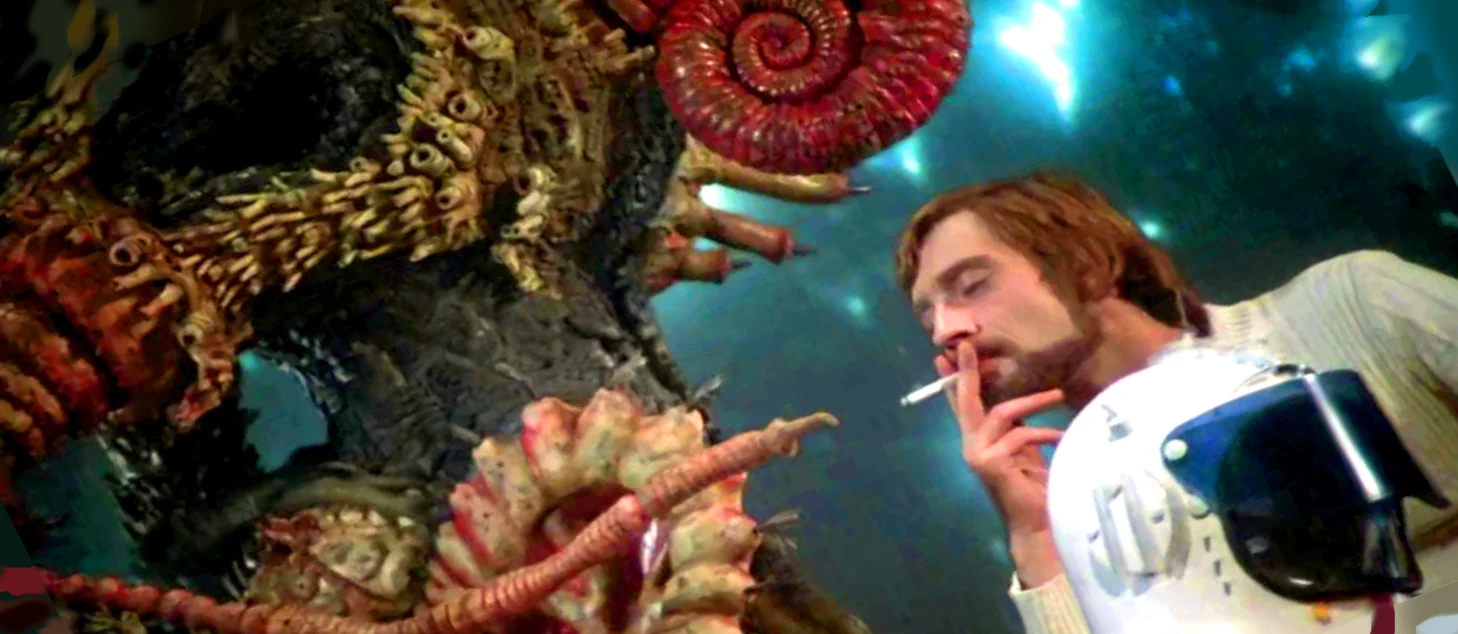
The final demonstration of Robert’s fantasy projection disrupts a marriage celebration. A friend insists that every Sci-fi story needs a monster, so the little creep Targa produces an alien toy called a Mumu, which grows to monstrous proportions and invades the wedding dinner. We note that it only wants to caress flowers with its tentacle-tongue. When attacked with a knife and shotgun, it proceeds to wipe out the party, biting off arms and legs and ripping off heads Ixode– style. The bizarre mayhem is handled like a Monty Python skit, grotesque but not gross. One victim’s head is squashed flat, a goofy distortion like something from Beetlejuice.
The slaughter set piece is loud and messy, yet maintains the tone of a carefree sitcom. Czech filmmaker Jan Svankmajer is given special credit for the Mumu monster, an elaborate man-in suit creation. Is Mumu a goofball response to Ridley Scott’s Alien? Eyes sprout from its legs, and a pair of giant ear-tentacles un-curl with stop-motion animation.

Visitors from the Arkana Galaxy’s Sci-fi fun subverts its own premise — Biba’s love means little to a man enslaved by a futuristic sex fantasy. The show may not be heartwarming but it does have a positive attitude — Andra ‘fixes’ various screw-ups with a time-machine in her tummy, in the same way that Christopher Reeve revived his girlfriend.
Filmmaker Vukotić in no way insists on making a heavy statement . . . in fact, the show is so lightweight, its satire of fantasy fandom may be lost on many viewers. *


I saw “Lassie from Space” and it ruled!