


In 1953 Darryl F. Zanuck wagered the entire future of 20th Fox on the widescreen gamble that was CinemaScope, spending millions of dollars of hype on The Robe and How to Marry a Millionaire to convince America’s theaters to change over to the new format. It wasn’t a sure bet, as many editorials in trade magazines forecast 3-D as the wave of the future. Zanuck immediately lined up a roster of pictures to take ‘Scope to exotic places, giving the first 18 months of pictures locales in Florida bayous, downtown Tokyo, volcanic Mexico, a recovered Berlin and a picturesque Rome.
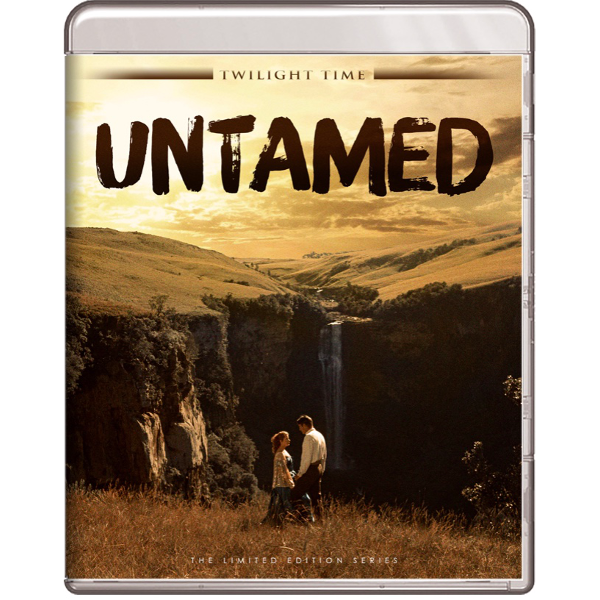
The travelogue, romance and adventure formula continued into 1955, when Henry King’s Untamed took the anamorphic lenses to South Africa for a story combining epic conquest and bodice-ripping romance, starring Tyrone Power and Susan Hayward. It was Power’s final film under contract to the studio where he’d been a star for almost twenty years. Still a major star, Hayward was weathering a string of genre movies requiring her to play variations on the same lusty, aggressive feminine lead: Demetrius and the Gladiators, Soldier of Fortune, The Conqueror. Prolific author Helga Moray was born in South Africa and was the wife of director Tay Garnett; as adapted for the screen, her story has a lot in common with previous tales about bold women pursuing romance in a momentous historical setting.’ From Cimarron comes a building-a-nation theme, while the idea of an ambitious female breaking the social rules seems very close to Fox’s earlier epic romance Forever Amber. Push come to shove, Untamed is yet another showcase for the redheaded Susan Hayward, who is in fine form.

With the potato famine spreading calamity in 1840s Ireland, Squire O’Neill (Henry O’Neill) is happy to sell horses to Paul Van Riebeck (Tyrone Power), a transplant to South Africa dedicated to forming a Dutch free state there. O’Neill’s daughter Katie (Susan Hayward) falls fast in love with Paul, but he thinks the hard, war-torn country is no place for a wife. When he leaves without a proposal of marriage; Katie is furious. She marries her neighbor Shawn Kildare (John Justin of The Thief of Bagdad) and convinces him to pull up roots and move to South Africa as well. Along with them comes Katie’s companion Aggie (Agnes Moorehead); Shawn’s baby is born on the way. In Cape Town they join a massive wagon train heading for the Hoffen Valley, a thousand miles distant. Katie befriends Maria DeGroot (Hope Emerson) and catches the eye of the capable but rough Kurt Hout (Richard Egan). Foreign transplant Julia (Rita Moreno) is Kurt’s casual girl, and she’s not happy about his new interest in another man’s wife. The wagon train runs into a battle with Zulus, and Katie becomes a widow. Paul and his commandos return to protect the settlers, and Kurt is frustrated when Katie gravitates once again to the dashing Paul. The romantic upheavals continue. Katie allows Kurt to help her farm her new land knowing he expects some kind of quid pro quo.
There’s no lack of dramatic developments, with a massive storm, an amputated leg, and fabulous diamond that allows Katie to buy Paul’s ancestral Capetown mansion ‘Abend Bloem.’ Another baby arrives, with more romantic misunderstandings. Losing her fortune, Katie, leaves with Maria and the children to search for gold in a place called Kolesburg, only find that the one-legged Kurt has become the leader of a band of brigands, and expects to finally claim Katie as his own.

Untamed is one of those movies that falls on the wrong side of history, as even in 1955 it should have seemed a bad idea to make a show extolling the glory of hardy colonial pioneers taking the lands of indigenous Africans. The South African government would much later institutionalize apartheid, a policy that in 1955 wasn’t getting much editorial space in our news. It now seems very wrong to background an escapist romance in the formative days of While Colonialism, ignoring the voice of political reason. The independent filmmaker Lionel Rogosin was trying to launch his more relevant view of South African crimes, Come Back, Africa. An African warrior takes place of pride on the Untamed poster, but the film itself treats the Zulus the same as Red Injuns in unenlightened westerns, as troublesome wildlife that should step aside to allow decent and civilized white folk to take what’s rightfully theirs … to be precise, everything.
Thanks to the solid direction of Henry King, Untamed shapes up as good entertainment of its kind. It’s a real kitchen-sink epic. A Fox hunt in Ireland makes way for a wagon train trek, a giant wagons-circled battle, a whopping storm, a fancy ball, a ‘duel’ with bullwhips, and the usual fiery embraces and fuss-fighting between lovers with different agendas. Tyrone Power does his standard stoic hero thing, looking good when laying down the law in his bush hat and rudimentary uniform. I’m not sure exactly what his commandos do in the new Dutch land — but it’s likely they spend most of their time battling the natives. Untamed is a lot like Edna Ferber’s Cimarron in that an inspired woman spends a great deal of her time wondering why the man of her life is off ‘adventuring’ while she’s trying to build a fortune and a family. Why Katie O’Neill Kildare is not a problem for the censors is unclear — marriage in this new land seems rather optional for some.

Susan Hayward should have received an award just for giving the incredibly predatory ‘assertive’ Katie a semblance of respect. The Irishwoman knows how to look out for number one, that’s for sure. Otto Preminger’s Restoration-era Forever Amber repeatedly humbled and vilified Linda Darnell’s adventuress for letting her morals slip while pursuing the love of her life, Cornel Wilde. But Katie is celebrated for using other men like stepstones to attain the man of her dreams. The young Miss O’Neill throws herself at the Dutchman back in Ireland. She apparently weds poor Shawn and gets him to move to the wilds of Africa just so she’ll be within range of Paul, the real object of her affections. Katie doesn’t encourage the bold (and rather deserving) Kurt, but she doesn’t discourage him either, and makes a very unfair, opportunist bargain with him. After shacking up with Paul for a few months, she ‘allows’ Kurt to do the heavy lifting on her new farm, knowing full well that he intends to become her husband.
A key thematic scene combines the ‘tree’ image from Gone with the Wind with any number of devastating storms in lusty romance novels. Kurt tries to chop down the tree that symbolizes Paul’s claim on Katie, and the damn thing falls over on his leg, performing a pointedly symbolic castration. Poor Kurt! If only he paid more attention to his lower rank in the picture’s cast list. Richard Egan was at this time paying dues in a number of Fox pictures, while trying to achieve big-star status in independent dice-rolls like the science fiction picture Gog. He’d stay more or less at the same level as guys like John Hodiak, and a little earlier, John Lund, while contributing excellent performances to some of our favorite thrillers.

Given even less respect is Rita Moreno, who at this time was on-call whenever an ‘exotic native,’ an Indian or a sultry ‘dark’ female was needed to spice up an adventure. She’s always lose the hero to the lighter-skinned leading lady. In her next film she’d play an Indian maiden who kills herself over her Conquistador boyfriend Richard Egan. Here Rita is Julia, a fiery, dusky dame who is apparently Kurt’s main squeeze. She loves him unconditionally; he uses and abuses her as he sees fit. We’re not made fully aware of Julia’s background — is it presumptuous to assume that she’s a mix of races, and therefore is allowed no claim to anything in life? That’s all there is to the loyal Julia — although everybody else gets along with the (incredibly selfish) Katie, the two women are like oil and water.
Henry King’s direction can’t be faulted. The secondary characters are given just enough of a presence not to seem superfluous. Agnes Moorehead seemed to play this same kind of role in every other film she made, holding the big star’s baby while facing up to hardship. Hope Emerson had previously had a much better outing playing the same basic character in William Wellman’s Westward the Women. Brad Dexter pops up a couple of times as a hard-riding militiaman. Future top child star Kevin Corcoran is one of Katie’s children, while poor John Justin is practically ignored to death as Katie’s unfortunate first husband. He’s literally this story’s ‘Frank Kennedy:’ Scarlett O’Hara’s disposable first husband.

Untamed is quite an impressive production. Much of the shooting was done in South Africa, and the characters are integrated into the backgrounds so well that we’re surprised to learn that Susan Hayward didn’t go on location — a divorce proceeding required that she stay in Los Angeles. Fox’s matte and optical department fashions several impressive illusions that drop Hayward and Power into Africa-shot backgrounds, such as a windy beach. Most of the action is matched to Hayward’s scenes filmed at Fox’s Malibu Ranch. Traveling mattes place Hayward in street scenes in an African set representing Cape Town in 1849. I would imagine that the lessons learned here encouraged Hollywood to do even more ‘faking’ with expensive talent — using lookalike stand-ins on location, and restricting the stars to blue-screen stages back in Hollywood. The same year’s The Rains of Ranchipur pulls the same kind of tricks.
The hot-blooded but cold-hearted Katie never gives up. We’re supposed to admire her moxie for stealing trading with naïve natives to acquire a priceless stone. A single diamond finances Katie’s exit from the muddy country, back into a dazzling ball gown for a few minutes of screen time. The pretzel of a plot confects a violent finale that puts poor Kurt and Julia in their place, and promises a bright future for the Dutch hero and his Irish firebrand.
