


The 1980s was a decade in search of a style, and its most trend-setting TV cop show was Miami Vice, a slick tale of crimebusters that dressed hip, frequented fancy hotel bars and took to sleek boats to chase drug traffickers. It looked great on the tube: decent color TV had finally arrived, even if it was still NTSC. The show also co-opted the music video vibe, with current pop music hits integrated into the editiorial style.
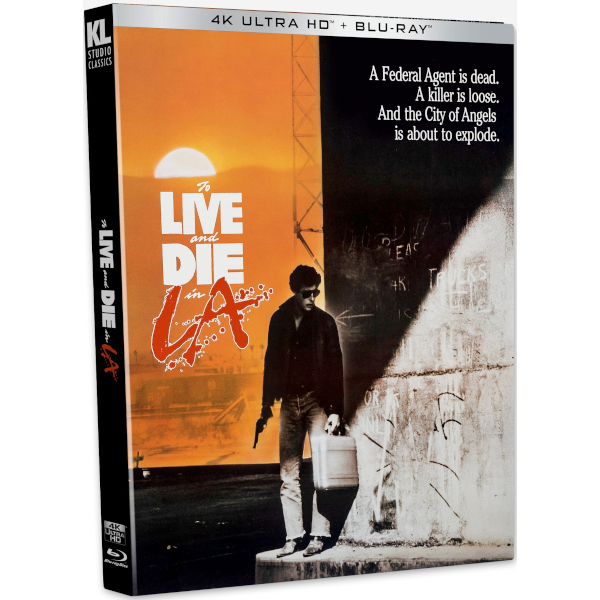
Director William Friedkin had pioneered the gritty ’70s street policier and made history with a supernatural horror sensation. He then took some bold turns that didn’t continue his winning streak at the box office — Sorcerer, Cruising. Neither the historic heist The Brink’s Job nor the sarcastic satire Deal of the Century reached his earlier level of accomplishment. A boost back into form came with To Live and Die in L.A., an action picture that allowed Friedkin to once again run wild with edgy crime material.
Friedkin is the star of TLADILA — the show’s top roles aren’t established names. The film’s advertising led with slick poster art, and the print publicity stressed Friedkin’s screenwriting collaboration with novelist Gerald Petievich, a former Secret Service Agent. As in The French Connection Friedkin, a vibe of authenticity set this project apart from the crime/action thrillers of Sylvester Stallone and Arnold Schwarzenegger.

In 1985, Secret Service agents were part of the Treasury department — they protected the President but also cracked down on counterfeiters. Counterfeiting was once a lot easier; nowadays the specs for U.S. currency are so involved that we’d expect each $1 bill to cost $2 to print. Back in the heyday of film noir, anti-counterfeiting movies played like high-end police fantasies, with clever secret agents taking big risks in undercover work. The classic show in this vein is Anthony Mann’s T-Men, with exotic variations on the theme — guns, fast women and ruthless conspirators — carried through in the slightly more fanciful Trapped! and SOuthside 1-1000.
To Live and Die in L.A. brings this all up to date in the Reagan years. Secret Service agent Richard Chance (William Petersen) lives on the edge, with no personal life outside of work. His credo is decidedly unchivalric: a scummy terror bomber isn’t given the benefit of the doubt for a second. Addicted to danger, Chance veers from one violent situation to another. He celebrates by bungee jumping from a bridge at the harbor.

Counterfeiter Eric Masters (Willem Dafoe) prints up $20 bills in a slick lab stocked with sophisticated, expensive equipment; we’re surprised he can’t be traced through his purchases. Old-school counterfeiting engravers were depicted as little old men, who behaved like eccentric watchmakers. Masters is a combo technician, scientist and fine art genius. He’s also a mad killer and conspirator, a New Age version of several Batman villains rolled together.
The film is distinguished by the extreme behavior of its main character. When his loyal partner (Michael Greene) is murdered, Richard Chance (Petersen) sets out on a no-holds-barred pursuit, aided by his new partner John Vukovich (John Pankow). At first wary of Richard’s willingness to take risks and skirt procedure, John is soon trying to emulate his style. Chance and Vukovich trace their prey through a series of contacts: cash courier Carl Cody (John Turturro), attorney Bob Grimes (Dean Stockwell) and criminal cohort Max Waxman (Christopher Allport).

Friedkin and Petievich lead us into a tangle of ruthless crooks and their unfortunate minions. Some that associate with Richard Chance are just as badly abused and betrayed. Chance bends more roles to spring Cody from prison, to help him locate Masters — who promptly hires dealer Jeff Rice (Steve James) to eliminate Cody. Richard cruelly manipulates his informant-turned-girlfriend Ruth Lanier (Darlanne Fleugel) to game his investigation. She can’t get free from Richard’s control — his demands come with the implicit threat that he can put her in prison. Eric Masters uses his own girlfriend equally callously to settle his own scores. Dancer Bianca Torres (Debra Feuer) follows Masters’ instructions without question.
Chance finally spins off the deep end, planning a crime to trap his prey. Unable to secure department money to make a counterfeit purchase, Chance opts to hold up some diamond smugglers ‘off the books’ and steal their cash. Chance’s insane heist leads to more killing and an believably hairy car chase. It tears through a rail yard and ends up going the wrong way on a crowded Los Angeles freeway.

TLADILA doesn’t try to revive the semi-docu tradition of French Connection — these visuals are highly stylized. Friedkin challenged his experts to surpass earlier action scenes of the same kind. The scenes didn’t come cheaply, with a section of a freeway shut down and filled with stunt drivers. The Big Action is too refined for comparison with exploitation thrillers — It’s of course all pre-CGI, which increases the feeling of authenticity.
The real tension in the movie is provided by William Petersen’s Secret Service agent, a rogue who looks like a straight arrow in all respects. Chance convinces because we believe he’s crazy enough to pull off these criminal acts; he’s lost his moral compass altogether. His misalignment peaks in his sadistic relationship with Ruth Lanier — he enjoys his perverse control over her.

We’re impressed by Chance’s superhuman attempts to win, but we’re not at all on his side. The last 40 minutes see him committing ever-bigger crimes and making terrible mistakes. We have to pay close attention to understand these chess moves that doom villains and innocents. By the time we discover that Chance’s games have cost the life of an FBI agent, the audience can only pay witness to events. We’re neither surprised nor dismayed by the film’s conclusion. The lesson is apparently that major law enforcement is a total madhouse.
TLADILA is one of those movies that critics and film students explain by saying ‘the cop and the crook are twins,’ opposite sides of the same coin, amoral soul brothers, etc.. To buy the thesis we must set aside all notions of law and order, civil responsibility and moral ethics; like a few other Friedkin movies the final lesson is that things are so horrible that trying to do good is pointless. This movie at least does a brilliant ‘compare and contrast’ job, pitching artist-crook against overachieving daredevil-cop. The cop/crook equivalence notion always seemed a weak way to give crime movies ‘importance.’ We love Michael Mann’s 1995 thriller Heat, but have no tolerance for its ‘meaningful’ conclusion on the airport median greenway, where Pacino and De Niro hold hands like comrades in arms.
Friedkin’s manic burst of creativity in To Live and Die in L.A. paid off — his movie is cold and off-putting but also intelligent and convincing. The performances are consistently excellent. Perhaps contributing the most creatively is cinematographer Robby Muller, who adjusts his artful, colorful style for Wim Wenders to something faster paced, and not quite as decorative. Those Los Angeles sunsets look great, but Chance and Vukovich pursue their quarry in some of the ugliest corners of the city.


The 4K looks sharp. Of course the movie rocks!
“The tragedy is that MGM located the original 35mm negative for the BTS footage only after we’d finished the online sessions for the documentary. ”
Oh, no! Is the stuff still around? How much footage existed?
Stunt specialst Buddy Joe Hooker played Wally’s friend Chester Anderson in the original Leave It to Beaver!